
New Cormac McCarthy movies
Posted: August 4, 2010 Filed under: articles, books, fiction, people, writing Leave a comment
first edition cover
Good news. Two more Cormac McCarthy novels, Cities of the Plains and Blood Meridian, are scheduled to be filmed in 2012 and 2011, respectively.
This bodes well for his Border trilogy being filmed complete. There hasn’t been a novelist who has had such a string of successful films from his novels in my memory. We can hope these two movies are done as well as All the Pretty Horses, No Country for Old Men and The Road. See the McCarthy website here.
McCarthy wisely decamped from Knoxville in mid-life and hid away in El Paso where he found a city, a landscape and a people, past and present, that were equal to his majestically precise prose.
happy birthday, Hunter Thompson
Posted: July 18, 2010 Filed under: articles, books, people, writing Leave a comment Born on July 18, 1937; five years dead and still living in the printed word, and in movies, as never before. If you haven’t read HST’s letters, do so, particularly Vol. I which takes him through the beginning of his career to the completion of Hell’s Angels and prior to The Rolling Stone days . I hope the Johnny Depp movie based on The Rum Diary adds a human side to the Gonzo image. Letters Vol. 1 is free of Gonzo babble, and you get a solid picture of Thompson’s energy, anxieties, pleasures and his dream of writing fiction. How that desire to create stories––compelling worlds––and his work in journalism eventually influenced one another is still a story whose pieces are being put together.
 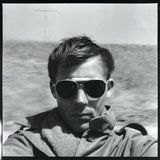 Check out the Hunter S. Thompson Books website for a complete bibliography of the newspaper and magazine stories, information on various editions of his books, links on the Beats, and a very good listing of related sites. Also see the Owl Farm blog by his wife, Anita.
Enjoy the opportunity to say good night
Posted: July 17, 2010 Filed under: articles, books, people, states of mind Leave a comment
wittgenstein
I don’t much like writing the name Ludwig Wittgenstein because he’s so often trotted out for a quote by people who have little feeling for what was behind his philosophy. That’s not true of a core of people who clearly understand what he was up to. See Stanley Cavell and Norman Malcolm, particularly Malcolm’s Wittgenstein: A Religious View. His life hangs over his work accounting for his legend, but what’s really at stake here is his immense sensitivity to the process of life and thinking and how it fueled his work. A deep longing to break through… He had problems expressing feelings. Was he happy––there are few signs. But his sensitivity, or is it sentimentality––tenderness, sadness––comes through occasionally, particularly in writing about or to his former student and sympathetic friend Drury. Here’s some revealing quotes:
“‘I am not a religious man, but I cannot help seeing every problem from a religious point of view,’ Drury rightly observes.”
“Of one thing I am certain––we are not here in order to have a good time.”
“Enjoy more the opportunity you have to say ‘good night’ to so many people. This alone is a gift from heaven which many people would envy you.”
In 1941, Drury, a doctor, was posted to the Middle East. Wittgenstein came to Liverpool to say goodbye to him, and presented him with a silver drinking cup.
Wittgenstein: “Water tastes so much nicer out of silver. There is only one condition attached to this gift: you are not to worry if it gets lost.”
Earlier, in a 1938 notebook, he wrote: “Whoever is unwilling to descend into himself, because it is too painful, will of course remain superficial in his writing.”
And the following year: “The truth can be spoken only by one who rests in it; not by one who still rests in falsehood, and who reaches out from falsehood to truth just once.”
asian moments
Posted: July 11, 2010 Filed under: books, buddhism, people, writing Leave a commentA letter from Red Pine recalling the entrance way into the house of writer John Blofeld in Bangkok:
“I have a black and white photograph of John Blofeld’s yin-yang designed doorway, leading into his garden, at his old home in Bangkok.
Over the doorway was written the first part of the last line of a four-line Li Pai poem: There’s another world.
The rest of the line would have added: Beyond the world of man.”
Zen Baggage by bill porter (red pine)
Posted: July 2, 2010 Filed under: books, buddhism, people, reviews 4 Comments
This review is scheduled to appear in The Kyoto Journal.
Zen Baggage: A Pilgrimage to China by Bill Porter. Berkeley: Counterpoint Press, 359 pp., $16.95 (paper).
You wonder how a book like Zen Baggage could be written. First, who would have guessed that China’s legendary Zen temples would rise from the ashes of the Cultural Revolution and prosper in the new century? And second, what Western writer could pull off a history of Zen in China and then go on to paint a vivid picture of contemporary life in China’s most legendary Zen temples and monasteries?

bill porter in Port Townsend, Washington (2010). photograph by Julie Anand
The only writer I know who could do that justice is Bill Porter, also known as Red Pine, the éminence grise of translators and commentators on Zen and Taoist poetry and texts. In this latest, most personal, travel book, Porter is back on the fertile ground he covered so well in Road to Heaven: Encounters with Chinese Hermits.
Thanks to that book, we know that Taoist hermits continued to practice and live in their remote huts in the Chungnan Mountains throughout the era of China’s Red Guards. The book was a revelation to Westerners and it seems to have fascinated many Chinese as well: the Chinese translation is now in its sixth printing under the title Hidden Orchids of Deserted Valleys.
Porter makes it clear that the average Chinese doesn’t quite know what to make of the legendary Zen temples and monasteries that have become heavily visited pit stops on a sort of Zen Tourist Highway running from Beijing to Hong Kong. Most of the temples are thriving: attracting more monks, building academies, expanding zendos, and refurbishing, enlarging, and promoting themselves in close—maybe too close—cooperation with the Chinese authorities, all under the auspices of a program that seems more intent upon raking in tourists’ money than in preserving the cultural legacy of Zen. The current government’s new relationship with Zen temples seems to be motivated in part by a desire to be more respectful and tolerant than the Communist regimes of the past, and its view that Zen is a non-threatening, home-grown, institution that promotes responsibility and discipline.
Zen being Zen, the abbots of these ancient temples are only too happy to accept whatever benefits accrue from the government’s new view of things. They remember all too well the days when monks were rounded up and abused, and temples were gutted or shut. Now abbots can easily meet the government’s modest expectations while also scooping up hoards of badly needed yuan from the bus loads of Chinese tourists who flock to the temples’ trinket shops to buy T-shirts, tea sets and kitschy souvenirs. The money is wisely used to build sub-temples in remote locations where monks can practice without being put on public view.
Porter’s personality comes through vividly in Zen Baggage, and it contains sketches of his earlier life in Taiwan, his frequent travels to China, and, most revealingly, his on-the-road personae as he makes his six-week, 2,500-mile, temple-hopping pilgrimage, which was largely a catch-up journey to supplement his many previous visits. He is on intimate terms with many of the temple abbots and others that he meets on his trip. In contrast, in Road to Heaven, during his forays into the rugged Chungnan Mountains (home of the hermits), he was on new ground ferreting out the names of hermits and the mountains where they were living, and then he tracked them down. What was most surprising about his first encounters with these Taoist solitaries, both men and women, is how seldom they showed surprise at the appearance of this bearded foreigner–if, indeed, they perceived him as a foreigner. He seemed to have been expected.
Zen Baggage is soaked in wisdom so subtle it is almost invisible. I was three-quarters of the way into it, for example, when I realized I’d easily absorbed a chronology of the major Chinese Zen patriarchs along with the distinctive swerves and turns that collectively make up Zen’s birth, its crucial philosophical debates, its divisions, its flowering in the sixth century, its slow decline, and its diffusion in the world.
Porter’s personal Taoist/Zen style of travel gives his journey an interesting edge. Whether he’s interviewing the abbot of a legendary temple or eating sweet cakes at a truck stop, he lashes it all together in a bundle of concrete details that help illuminate the tales, metaphysics, koans, and esoterica of early Zen. He has read so deeply in Zen, Taoism and Buddhism that he could be the abbot of any of these legendary temples––to the benefit of the temples and monks––but it’s clear that most, if not all, of the abbots and monks he talked with would laugh at such a suggestion. Throughout Asia, Zen too often remains the “property” of individual countries, whereas in the West it’s readily perceived as open to all equally. In all his encounters, you get the feeling that in only a few cases was there a true meeting of minds. Many Chinese sized Porter up as just another Westerner who spoke good Chinese, and had no knowledge of his translation work or of his life (not that he cared), and most probably weren’t interested anyway. The prevailing orthodoxy seemed to be: “We’re the only ones who can translate the texts, who understand Zen––Westerners can’t get it.” But as history reminds us, Buddhism is international: the Chinese texts the abbots depend upon were carried back to China from India by Chinese pilgrims and translated from Sanskrit and other languages. In Porter’s many trips to China over the past two decades, we have an apposite addition to the history of Buddhism: a Western pilgrim who traveled to the East to get Chinese texts to translate into English.
On this latest trip, he bounced down China’s buzzing highways in buses to report to the world (or the English-speaking West), on what grew from those early Chinese translations into Zen. This recounting of how Zen was born and thrived in China (for a while), then died out, and is now being reborn closes China’s Buddhist/Zen circle, for the time being at least.
Along with his translations (11 so far), Porter’s two travel books are singular achievements that break new ground in our understanding of Zen and Taoism in contemporary China. My guess is that we can expect more travel books from him that will flesh out the on-the-ground story of Zen and Taoism, and that they will showcase his two greatest assets as a writer: his independence as a scholar and his practical knowledge of whatever he calls his personal blending of Taoism and Zen.
The travel books most closely resemble the work of his mentor John Blofeld (1913-1987), the British writer and translator of Buddhist texts, who gave Porter the encouragement that led to his first translation in 1983, Cold Mountain Poems. Like Blofeld, Porter uses his unique skills as a translator and his talents as a travel writer to bring to life Buddhism’s past and present.
favorite novels list
Posted: June 14, 2010 Filed under: books, fiction, writing Leave a commentHere’s a favorite novels list from a close friend. I post it because I have read only three of the novels, and it opens up new possibilities for me.
Camus, The Stranger
McCarthy, Blood Meridian
Faulkner, Absalom, Absalom!
DeLillo, Libra
Dickens, Dombey and Son
Johnson, Tree of Smoke
Banks, Affliction
––By Jim Giles, who taught English at what’s now The University of North Texas when I was student there.
Khao San Road
Posted: June 11, 2010 Filed under: books, places, writing 2 CommentsAn earlier version of this article originally appeared in The National Post in Canada.
By Roy Hamric
The most famous road on the Asian backpacker’s tour is only a few blocks long, and it’s in the center of Bangkok. It’s called, Khao San Road, and it’s been a required backpackers stop for nearly thirty years. The road’s image was jolted into destination status by the movie “The Beach,” starring Leonardo DiCaprio and directed by Denny Boyle of “Trainspotting” fame. Based on a 1996 first novel by Alex Garland, it’s a quirky, improbable story of a 20-something, idealistic American named Richard, who checks into a guesthouse on Khao San Road, where he meets an older, mentally rattled character called “Daffy Duck,” who babbles on mysteriously about a secret island. The next morning, there’s a map to the island pinned on Richard’s door. He goes to the stranger’s room only to find him dead––his wrist slit. Too make a long, and not too interesting story, short, Richard is lured to the mysterious island—where he’s caught up in an idyllic milieu of an exotic international crowd of dreamers, misfits, run-aways and crazies. Over zealous critics compared the book to the works of Golding and Joseph Conrad, with touches (to set the record straight) of Looney Tunes, “Apocalypse Now” and Nintendo psychology thrown in for the ride.
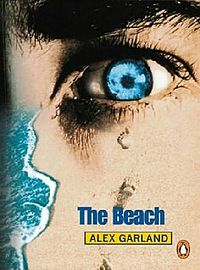
a Penguin paperback cover
As the book begins, Richard steps out of a taxi on Khao San Road. Garland wrote: “When you hit Bangkok, the Khao San Road is the first place you come. It’s a decompression chamber between East and West.”
When I stepped out of a taxi on Khao San Road on a sweltering mid-afternoon, there was a sense of arrival––books and movies do that to you––and a sense of departure as well, to be fully accurate, for everyone, the foreigners at least, was in arriving or departing mode, just passing through. If this place were on the old Silk Road, it would be at an oasis, a spot where everyone on the road that day stopped at night to exchange the word of the day. It felt like that type of place, a place that existed for its convenience, to share warnings, to offer advice, to meet friendly traveling companions.
For me, Khao San Road stands for a single, throw-away line in Garland’s novel, when Richard, trying to explain what he’s looking for, says only two words, “something different.” For more and more people something different is exactly what they’re looking for, but they don’t know where or what it is. Only a few months earlier, I had pulled up my roots to build a new life in Thailand. I had read about Khao San Road. I was curious, but I expected it to be just more media hype.
The first day, it was sensory overload. A few feet away from the taxi, the sounds of Hank Williams’ “Hey, good lookin’, what’ cha got cookin” blared from a boom box. Across the street a boom box was blasting Bob Marley’s “I Shot the Sheriff.” Music as the home you left behind… The shops along the road wedged old and new Bangkok side by side: trinket shops housed in one-story, weathered teak buildings with coruscated aluminum roofs jammed next to modern, air-conditioned Internet cafes, ATM machines, silver and gold exchanges, 7-Eleven stores, travel agencies, walk-up or walk-down back alley guest houses, tailor shops, pirated cassettes and CDs spread out on tables, street-bistro cafes, and a swirl of dozens of languages gave it all a world bazaar atmosphere, not to mention the smells wafting from restaurants with dishes from Thailand, America, China, Israel, Italy, India and Nepal.
Fresh-faced, Midwestern American farm girls were having their hair done in African braids by Thai women to the beat of pop songs coming from 5-foot TV screens. Fresh tattoos were being etched into the arms, ankles and shoulders of first-time teenage travelers. The in-tattoo for young women was a black, “linked chain” design around an ankle, and for young men, a large Thai warrior “spirit” figure, with bulging eyes, a grimacing expression and a ready sword in hand.
At nightfall, the frenetic pace eases, and the police close off the street. Shop owners move tables outside to catch a whiff of cool breeze. In the twilight, neon lights wrap a soft glow around the faces of people who you watched arrive during the day, and they’re now studying the new people struggling to pull their backpacks out of taxis, in search of a cheap room and some nightlife. The Thais have a word for what’s going on here, “saduak,” convenient, easy––make it easy, take it easy. Come to Bangkok, come to Khao San Road, it’s easy, it’s convenient, and it’s where you can learn the latest news.
My room for the night was 10X10-feet, just about large enough for a good size bed, but clean and quiet, and early the next morning I was back on the road––who were all these people streaming in and out, and what’s going on in their heads? I dropped into Buddies Beer Garden, which is really a restaurant & swimming pool, a blend of Southern California and Dali Lama decor, one of the hotter hangouts complete with lithe, young Thai women splashing in the swimming pool in back. I spotted a group of people sitting at a nearby table, backpacks leaning against their chairs. Were they Americans? You couldn’t be sure. Everybody dresses alike here––cheap Thai, Indonesian or Nepal baggy pants and T-shirts with catchy phrases (I’m a Yao), and lots of silver, stones and beads around ankles, wrists, and necks, plus various ornaments in ears, noses, lips and navels. With practice, you can gauge how long a traveler has been on the road in Asia by their tan: a two-week soft tan, a two-month soft brown, a six-month dark brown and a six-month-plus weathered leather look.
“Did you say you’ve been to Cambodia?” I asked a very attractive girl who had a dark brown tan. “We just came from Cambodia,” she said in an American accent. Her name was Hillary Glenn, and this was her fourth time passing through Khao San Road. She was surprised she’d seen so few Americans here. “We normally try to meet up with British or Dutch travelers,” she said. This reminded me of a Dutch man on holiday I had met earlier in Vientiane. “The Dutch are the Chinese of Europe,” he said. “You will find us everywhere.”
Hillary was traveling with two Americans that she’d just met in Cambodia and they planned to leave the next day for Koi (island) Phi Phi near Krabi, where a lot of the filming was done for “The Beach.” It was a little known island on the western side of Thailand’s lower peninsula, but it has turned into an eco- controversy ever since the movie production crew uprooted trees and replanted various areas with more film-worthy foliage. The publicity was a magnet that has drawn backpackers to the semi-isolated islands that dot Thailand’s gulf. After that, Hillary said the place to be was Koi Pha Ngan, an island famous for its monthly “Full Moon Party” (disco in the sand). Some people believe Garland’s novel was modeled on the Koi Pha-Ngan scene, with its Dionysian nights of dancing ravers, moonlight swimming and howling at the moon. At another table were three Swedish college girls on a two-week holiday. Carola Bragen, 29, a social work major, said her group came to the road not knowing what to expect. Garland’s novel had recently made the Swedish best-seller list. “You see it in a lot of peoples’ backpacks now,” she said. “We just knew this was a backpackers’ place.”
The road’s cultural mish-mash has a legitimate buzz on arrival, but to some long-timers here, the road’s best days are already long gone, and the novel and movie was the coup de grace.
“Khao San Road has changed,” said a man named Steve, who said he now lives near the road. He comes for coffee and to check out the scene, but he spent the past six years moving between Cambodia and Thailand. A wizened, bone thin expat, he dressed in the cool-is-uncool style. He wore checkered Bermuda shorts, high top black tennis shoes, and a T-shirt that said, “I’m Pol Pot.” He lived in a nearby $60-a-month room where he made miniature metal sculptures that sold in some of the local shops. Sipping a cup of adrenalin-charged Thai coffee, he scanned the street. “Before, this place was a lot quieter with mainly a few backers, trekkers passing through, and junkies,” he said. “The place had a seedy, low-end appeal. Very, very cheap. People came, stayed a few days and left. It’s a completely different crowd now. Lots of partying, people on the make. You see a lot of beautiful foreign women. It’s right at the point of turning yuppie. The more neon, the more yuppies. You don’t see that many Americans. It’s mainly Germans, British, Japanese, the Scandinavian countries.
“The newest bar up the street is straight out of America. In some ways, Khao San Road is one of the worst places in Thailand now. There are so many stupid, rude foreigners concentrated here. In the places I go to regularly, I see how the Thai staff really feels about most foreigners who come here. The good side is that the guest houses are still cheap. Rooms for $5 or $10. The money is good for the Thais, of course, and the money is spreading. The next ‘in’ place is Phra Athit Road, where Khao San Road curves and changes its name.”
Anyone doubting that Khao San Road has changed need look no further than the 50-some e-mail shops that have mushroomed in the past few years. Internet N/B, one of the larger shops, was filled with people doing the Internet, or eating or heading upstairs for a quick three-dollar massage (Thai or Swedish).
The owner, Napporn Bhuttan, said business was always good and was clearing several thousand dollars a month, and the road is the most computer-concentrated area of Bangkok. “The market has been slowing for the past year, but now it’s getting better again,” he said. Down the street at Gulliver’s Traveler’s Tavern, a Thai lady, Thanyatorn Srisit, who had the very casual glowing look of someone who knows she’s beautiful, was holding court with two young, tattoo-covered Americans. In a well-tailored dark blue blouse and a black ankle-length skirt with a slit discreetly rising up to mid-thigh, she fingered the cellular phone resting beside her glass of white wine. The owner of a antique fashion store on Rambutri Road, she said the road is what it is. It’s more for tourists than Thais, “but Thais are starting to come here now, to party with the foreigners and to practice their English.”
“Europeans come here to buy cheap clothes,” she said. “They ship them back and sell them to shops and make a good profit.” She said Khao San Road doesn’t have the wild night life one finds on the infamous Pat Pong Road. “Khao San isn’t for the ‘working woman,’” she said, using the polite term for ladies of the night. “There’s not too many working women here––a little bit.” She’s was right. I’d seen none of the hard-core hookers of Bangkok’s sex industry, but you did notice another type of attractive Thai woman on the road when party-time started around 10 p.m.: they were more casually dressed, and, maybe, just liberated Thai women who had day jobs, but who also liked to have fun with fralongs (foreigners).
The road’s reputation as a heavy drug scene was myth, Srisit said. “Drugs are not openly used or available,” she said. “But you see some people who have done drugs.” Earlier, on a restaurant bulletin board, I had seen a notice appealing for donations for foreigners in Bangkok prisons––mostly for drug offenses. There even a mini-tour offer for backpackers to visit prisoners with gifts of food or books, in exchange for a chance to hear hair-raising tales of misadventure.
One of the young Americans sharing Srisit’s table, his forearm covered with Thai spirit tattoos, was sorry his vacation was ending when he’d just discovered the road. “We can’t stay longer,” he said. “Yes, but you’ll be back,” said Thanyatorn.
As my time on the road was winding down, I guessed that most of the passers-through here, asked where they went in Asia, would mention Khao San Road. It had claimed their imaginations and was now a social calling card: “I spent three days on Khao San, were you there?”
Kipling’s overused line about “East is East and West is West” catches the “something different” search that’s going on with people around the world. But when he said “and never the twain shall meet,” he was wide of the mark, and he certainly knew better. It was a poem written for the popular magazines, for the armchair travelers back home. The East and West have been meeting, and blending, since history began. The fusion between East and West really has no beginning or end, but has been ever present and on- going. What’s happening on Khao San Road is a mini-version of the world to come, everyone bumping against everyone else, exactly like some bustling oasis city on the Silk Road 3,000 years ago, when a Greek, Chinese or Iranian traveler stopped over at a village bar and said, “East is East and West is West, here’s to us all…” or some such sentiment.
Garland’s young seeker had the right instinct. There is something different to be experienced by being at-large in the world, something not to be missed, and it’s taking place in cities everywhere. I could only bathe in the mysterious mix of signs and cultures that swirled around Khao San Road. It was a good place to visit.
When I left Khao San Road it quickly became a few memories of a few blocks on a longer road signifying something much larger. Probably Garland’s young man was really just trying to say he was searching for a place where he could see himself clearly without all the cultural baggage that we carry along in our lives. Everyone’s coming together on Khao San Road is just one more step in searching for that place.
Lines of thought
Posted: June 7, 2010 Filed under: books, people, states of mind, writing Leave a commentGleanings from reading Pater, Kerouac and Emerson:
“We have an interval, and then our place knows us no more. Some spend this interval in listlessness, some in high passions, the wisest, at least among ‘the children of this world,’ in art and song. For our one chance lies in expanding that interval, in getting as many pulsations as possible into the given time.
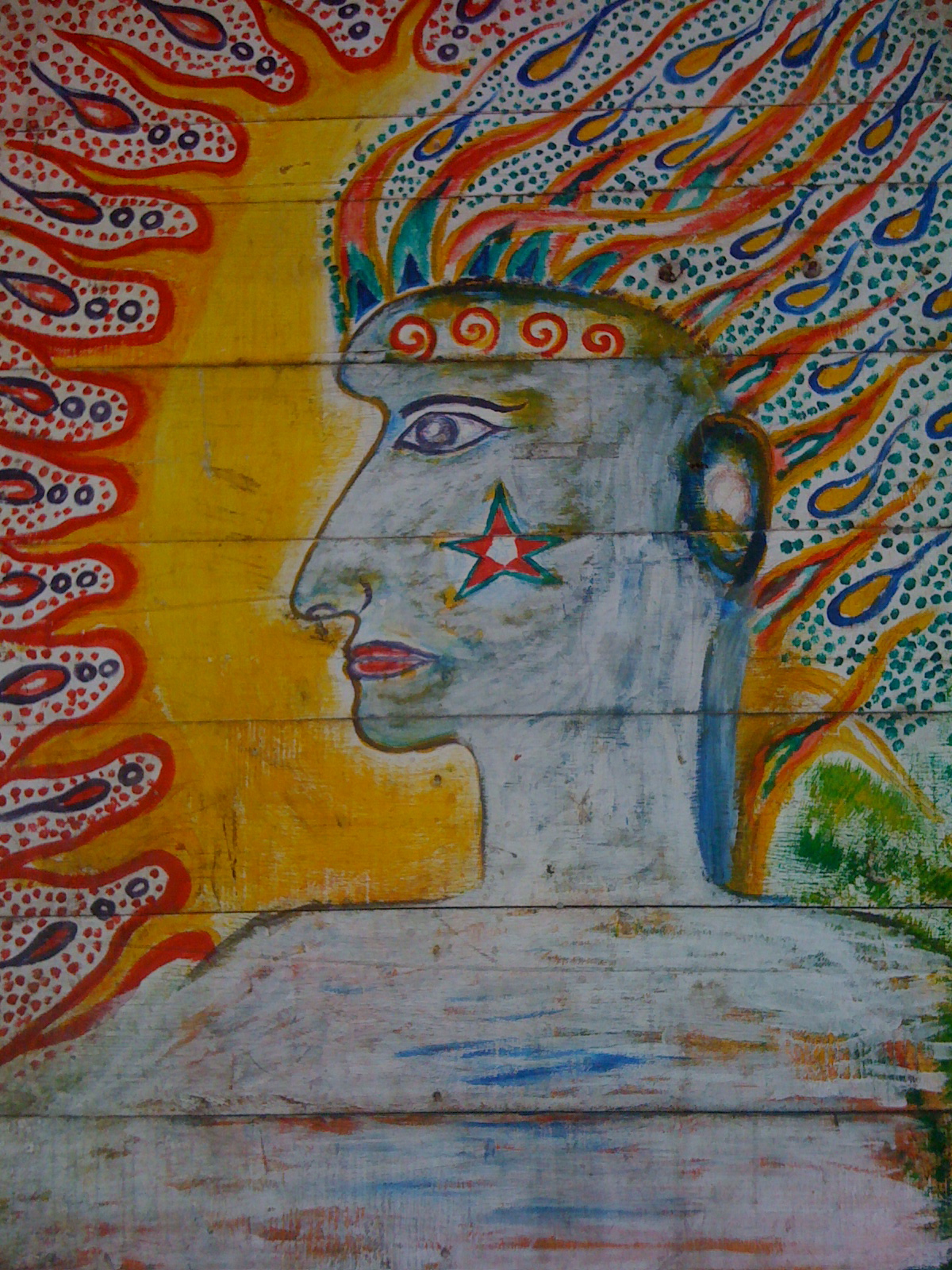
burning man, painting in Cafe del Sol, Chiang Mai
“….Great passions may give us this quickened sense of life, ecstasy and sorrow of love, the various forms of enthusiastic activity, disinterested or otherwise, which come naturally to many of us. Only be sure it is passion––that it yields you this fruit of a quickened, multiplied consciousness. Of this wisdom, the poetic passion, the desire for beauty, the love of art for art’s sake, has most; for art comes to you professing frankly to give nothing but the highest quality to your moments as they pass, and simply for those moments’ sake.”––Walter Pater, The Renaissance
“Believe in the holy contour of life.”––Belief & Technique of Modern Prose, Jack Kerouac
Emerson, in his Journal: “The days come and go like muffled and gray figures sent from a distant party, but they say nothing and if we do not use the gifts they bring, they carry them silently away.”
why Stanley Cavell?
Posted: June 5, 2010 Filed under: articles, books, people, states of mind 1 CommentI was first attracted to Stanley Cavell’s study of Thoreau, The Senses of Walden, and his deep probing of Emerson’s ideas in essays throughout his many books. All his books circle around American thought, American originality, while pulling in Wittgenstein, Kirkegarde, J.L. Austin, Heidegger, and others, with a commitment to use ordinary language and works of literature as a common ground of thought through which we all can assess and explore life, not something separate from philosophy but a living part of a philosophy that identifies itself with a deeper sense of experience. I think the passage below from the preface to Must We Mean What We Say?, as well as any, summarizes his intent and purpose:
“I suppose that the idea of the philosopher as guide was formed in me in resistance to the still current idea of the philosopher as guard. So I should perhaps add that at no period in my life has it occurred to me that philosophical problems are unreal, that is, that they could be cured and philosophy thus ended, as if left behind. The problems I was concerned with are better expressed as about the all but unappeasable craving for unreality. Kant’s diagnosis of such perplexities was as “transcendental illusions.
“I had in Must We Mean What We Say? already suggested understanding the philosophical appeal to the ordinary in relation to Kant’s transcendental logic, namely, as the sense of uncovering the necessary conditions of the shared world, but not until the second essay in the book, The Availability of Wittgenstein’s Later Philosophy, was I able to give a certain textuality to this relation to Kant, at the point at which Wittgenstein in Investigations announces that “Our investigation….is directed not toward phenomena, but, as one might say, toward the ‘possibilities’ of phenomena.” And it would not be until the Claim of Reason that I would feel I had secured some significant progress in assessing the difference it makes that Wittgenstein sees illusions of meaning as something to which the finite creature is subject chronically, diurnally, as if in every word beyond the reach of the philosophical system. The idea that there is no absolute escape from (the threat of) illusions and the desires constructed from them says there is no therapy for this, in the sense of a cure for it…[that] was evidently something that captured my fascination halfway through Must We Mean What We Say? with Samuel Beckett’s Engame––in effect a study of the circumstances that say, “You’re on Earth, there is no cure for that.”
bedside books
Posted: June 3, 2010 Filed under: books, reviews, writing Leave a commentNovels and Novelist by Harold Bloom; his essay connecting Hemingway to Emerson, Whitman and Stevens, and to Pater’s theme that we have an interval and then our place knows us no more, sums up why Hemingway’s stories and several novels are quintessentially American. Bloom writes judicial estimations of virtually all of the Western canon in this and another complementary volume.
Must We Mean What We Say by Stanley Cavell; his first book, written in a burst of manic philosophical creativity shortly after his doctoral dissertation and before his The Claim of Reason; his essay on Lear’s avoidance of love makes a nice bookend to Empson’s essay on Lear seen as renunciation of responsibility (see below). I like one review that said this work “reintroduced the book [literature] to philosophy.”
The Renaissance by Walter Pather; beautiful, well-carved prose in the service of the fully tasted, lived life through the prism of Europe’s intellectual and artistic flowering.
From the Land of Shadows by Clive James; I’m fascinated by his prosecutorial technique of finding a moral or intellectual opening and building the opposite case. The very high end of personal journalism/essays.
How the Swans Came to the Lake by Rick Fields; a history of Buddhism in America; affirms an Asiatic bedrock in American culture, especially as literary influence.
Pieces of My Mind by Frank Kermode; finely seasoned and reasoned literary essays.
Pleasing Myself by Frank Kermode; refreshing for nuanced judgment and lack of critical malice.
Emerson’s Fall by B. L. Packer; a dissection of the arc of Emerson’s heroic intellectual packaging of an American mind.
Back to the Sources edited by Harry W. Holtz; a thorough guide into the Kaballah, Talmud, Midrash, Hasidic masters, Biblical narrative and poetry, and more.
The Books in My Life by Henry Miller; personal, unbounded prose energy focused on a search for kindred spirits in print.
The Gary Snyder Reader by Gary Snyder; a sure-footed, pure American spirit in service to literature and community.
A Moveable Feast by Ernest Hemingway; pent-up revenge, traces of fear, defensiveness and edenic loss; a sad song to consciousness in the spirit of the Romantic poets by a writer who places emotion beneath the surface of his prose.
The Structure of Complex Words by William Empson; a down-to-earth linguistic, literary criticism, bracing for the attention it demands; I’ve already downloaded free copies of Seven Types of Ambiguity and Some Versions of Pastoral; such an original sensibility.
 the roy hamric journal