
red pine
Posted: April 13, 2010 Filed under: buddhism, people, poetry Leave a commentRed Pine’s “Dancing with the Dead” on translation
My “Dancing with Words” profile of Red Pine/Bill Porter in The Kyoto Journal
Here’s a clip below from Bill Porter, who uses the name Red Pine for his clear-headed translations of Buddhist poetry and philosophy:
Dancing with the Dead: The Art of Translation
Every time I translate a book of poems, I learn a new way of dancing. The people with whom I dance, though, are the dead, not the recently departed, but people who have been dead a long time. A thousand years or so seems about right. And the music has to be Chinese. It’s the only music I’ve learned to dance to. I’m not sure what led me to this conclusion, that translation is like dancing. Buddhist meditation. Language theory. Cognitive psychology. Drugs. Sex. Rock and Roll. My ruminations on the subject go back more than twenty-five years to when I was first living in Taiwan. One day I was browsing through the pirated editions at Caves Bookstore in Taipei, and I picked up a copy of Alan Ginsberg’s Howl. It was like trying to make sense of hieroglyphics. I put it back down and looked for something else. Then a friend loaned me a video of Ginsberg reading Howl. What a difference. In Ginsberg’s voice, I heard the energy and rhythm, the sound and the silence, the vision, the poetry. The same thing happened when I read some of Gary Snyder’s poems then heard him read. The words on a page, I concluded, are not the poem. They are the recipe, not the meal, steps drawn on a dance floor, not the dance.
This ties in nicely with the post below of D.T. Suzuki’s note fragment on poetry and religion. We’ve stepped into the infinite here, a place beyond our battered world. See the underlined link above for Red Pine’s full article in Cipher Journal.
d. t. suzuki on poetry
Posted: April 12, 2010 Filed under: buddhism, people, poetry, states of mind Leave a commentReading last night, I found this scribbled note fragment by D. T. Suzuki reprinted in The Eastern Buddhist, Vol. 33, No 2, 2001. I don’t think it’s found in any of his many books:
Poetry is more real than what is generally regarded as reality.
Religion is poetry.
The Infinite is absolutely real.
What is called reality is finite and not at all real. Impermanent, transient, subject to mutability.
I want to parse this a bit: it seems to fly in the face of Zen’s granting “suchness” or “isness” the dominant role in understanding “reality.” Also, the not relying on “words and letters.” In other words, the perception of the object rather than the perception of the subjective. That’s pretty standard Zen metaphysics.
This is the sort of thing that used to play with my mind, but now I couldn’t agree with Emerson more: “Consistency is for people with small minds,” a rough paraphrase. The fragment passes my feeling test.
jim harrison interview
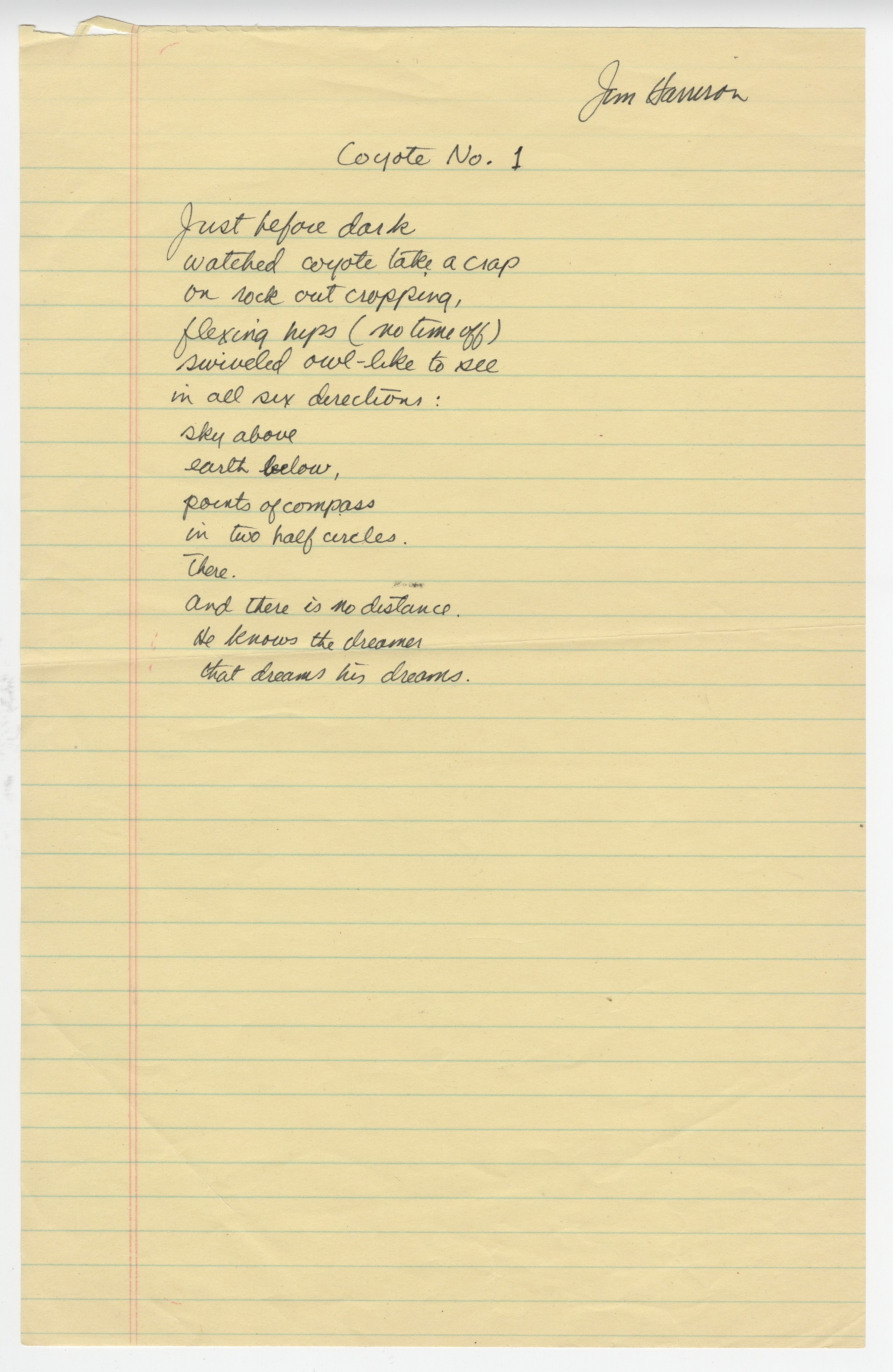
Posted: April 9, 2010 Filed under: interviews, people, poetry, writing | Tags: interviews, poetry, writing Leave a commentI’ve read novelist and poet Jim Harrison’s work since he first started publishing. Jim is simply indispensible to a certain kind of male reader. Women look at him with interest and amusement, I think, something that he’s not entirely against. Recently, I did an interview with him on the Asian connection to his poetry. The interview was published in The Kyoto Journal. The interview isn’t online, but you can click on a pdf version in On the Record (to the right of this post). Also, here’s a manuscript page he sent, but the image wasn’t used so I’m posting it also. Click on the page to enlarge it.
 the roy hamric journal