
Kerouac wrote Dharma Bums in this house
Posted: May 14, 2011 Filed under: books, people, places Leave a comment
Jack Kerouac lived in this house with his mother in Orlando, Florida, for a little more than one year. While there, in a burst of memory-writing he wrote Dharma Bums. The house is now a writer’s retreat and is maintained by a nonprofit group that needs funds. For a nice story on the house and group by Carolyn Kellogg , click here. To hear Kerouac sing Ain’t We Got Fun, click here. Thanks, Carolyn Kellogg.
Thomas Merton’s photograph of God
Posted: May 13, 2011 Filed under: buddhism, people, photography Leave a comment
Thomas Merton named this photograph “The Sky Hook,” but he wrote, “It is the only known picture of God.” See my essay Thomas Merton: Looking Through the Window in the On the Record listing.
getting to know you, getting to know all about you
Posted: May 11, 2011 Filed under: articles, people, states of mind Leave a comment Getting to know, or thinking that you know, anyone is not easy, particularly so in a different culture where it can be a mysterious and often frustrating experience. A philosopher of language, Ludwig Wittgenstein knew it was normal for most people to go around believing that they understood what other people were saying simply because of the words they used, but he also knew that really understanding what anyone says is a difficult task that requires work and thought. Especially so in dealing with people whose background or culture is vastly different, truly foreign. At one place he says:
One human being can be a complete enigma to another. We learn this when we come into a strange country with entirely strange traditions; and, what is more, even given a mastery of the country’s language. We do not understand the people. (And not because of not knowing what they are saying themselves.) We can not find our feet with them.
The word in German that was translated as “feet” actually employs an idiom that literally says: We can not find ourselves in them. Of course, we can’t find ourselves in anyone period, but his point underscored the dangers of assuming you understand correctly or were understood correctly, or that everyone is feeling, seeing, agreeing or disagreeing based on the same perceptions or assumptions and even if they were, words and language have to be used with as much simplicity, precision, patience and humility as we can muster.
Yippe Yee Yai Hyo
Posted: May 8, 2011 Filed under: photography Leave a comment
photograph copyright Robert Hart
This picture by my good friend photographer Robert Hart of Forth Worth, Texas, is a classic Western image. His Website shows all his skills, click here. Take some time to browse. The portraits are masterful in every detail. He has the eye and a steady soul. See his blog entries.
bedside books
Posted: May 7, 2011 Filed under: books Leave a comment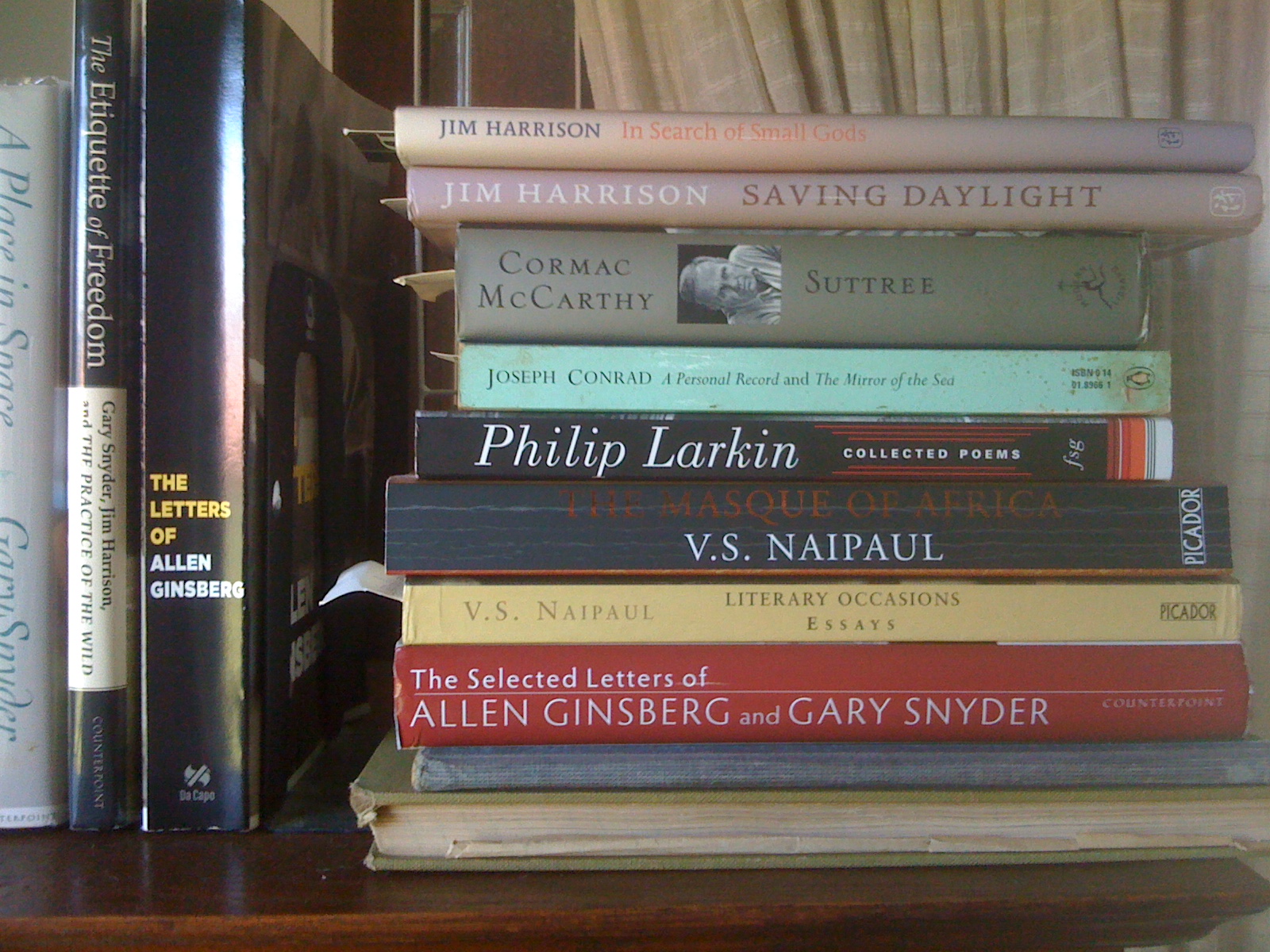
Cormac McCarthy’s Suttree is his most fulsome, flowery language, so different from his Bible-influenced rhythms in Blood Meridian, yet full of the darkness, the basso seriousness––his homage to Joyce and Shakespeare in counterpoint to his Meridian homage to Job and the Manicheans.
Jim Harrison’s poetry voice has taken up permanent residence in my head, and I keep wanting to hear more of his inspired conversation with himself. I’m rereading, probably forever, his last two: Saving Daylight and In Search of Small Gods. His genius is knowing what’s right there in his mind is his art. But sensing what’s right there is the art of consciousness and craft.
The Selected Letters of Allen Ginsberg and Gary Snyder are a testament to friendship and literature, spanning their whole lives; there’s no similar relationship in American letters. So filled with respect and helpfulness; an example of two bodhisatvas at work. Ginsberg’s restraint and intellectual rigor is on show, a really deeply compassionate man. Snyder’s exemplary life is a serious marker of sensible living when the world is falling apart around you.
Naipaul’s The Mask of Africa, a travelogue on African religion, is a shallow, egotistical failure; his first. The quirky aspects of his life and voice took over; it’s too indulgent; the writing begs for an editor. Where was Robert Silver when he needed him?
Philip Larkin’s Collected Poems are like funny, sad, beautiful fish shining in clear water.
Conrad’s voice in A Personal Record sounds like a polished recording. You wonder at the raw, vast distance between that voice and the sea and sun, the palm tress, the tropical nights of his youth. It’s the parlor room version of some great stories. He should have inhabited the Whitmanesque “I,” but it was foreign to his nature. The ladies were always in the room.
clive james’ flowering
Posted: May 6, 2011 Filed under: books, poetry, writing 1 Comment The Australian native Clive James, one of the writers who has dominated British journalism and criticism in the past decades, is undergoing a late blooming in his poetry, unfortunately the offshoot of some serious illnesses. He’s one of those essential British writers, like Martin Amis and Christopher Hitchens, who is hard to keep up with because of their prolific outpouring. His blog, click here, is one of the best on poetry and art. For a good close reading of his poetry, see this article in The Australian. For essential, confirmational reading, see his “Five Favorite Poets” essay on his blog. His prose glows when he writes about poetry. Here’s a poem from his Website:
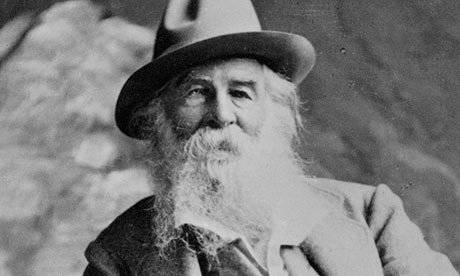
 Whitman and the Moth
Van Wyck Brooks tells us Whitman in old age
Sat by a pond in nothing but his hat,
Crowding his final notebooks page by page
With names of trees, birds, bugs and things like that.
The war could never break him, though he’d seen
Horrors in hospitals to chill the soul.
But now, preserved, the Union had turned mean:
Evangelizing greed was in control.
Good reason to despair, yet grief was purged
By tracing how creation reigned supreme.
A pupa cracked, a butterfly emerged:
America, still unfolding from its dream.
Sometimes he rose and waded in the pond,
Soothing his aching feet in the sweet mud.
A moth he knew, of which he had grown fond,
Perched on his hand as if to draw his blood.
But they were joined by what each couldn’t do,
The meeting point where great art comes to pass –
Whitman, who danced and sang but never flew,
The moth, which had not written Leaves of Grass,
Composed a picture of the interchange
Between the mind and all that it transcends
Yet must stay near. No, there was nothing strange
In how he put his hand out to make friends
With such a fragile creature, soft as dust.
Feeling the pond cool as the light grew dim,
He blessed new life, though it had only just
Arrived in time to see the end of him.
––The New Yorker
to the future?
Posted: May 5, 2011 Filed under: articles, states of mind, time, space Leave a comment An institute affiliated with Oxford University is studying the future with the goal of making some fairly rational predictions of where humans might be in hundreds of thousands, millions and billions of years from now––not an easy task to be sure with no real guarantee that humans, at least as we know them, will continue to exist. An interesting article which sketches some possibilities can be found here, but first read the quotation below:
Only 0.01 percent of all species that have ever existed continue to do so. We happen to be one of them, for now. When Rees looked at the myriad ways in which the present is more perilous than the past in his 2003 book “Our Final Hour,” he set the odds of human extinction in the next century at 50 percent.
Bostrom, the Oxford philosopher, puts the odds at about 25 percent, and says that many of the greatest risks for human survival are ones that could play themselves out within the scope of current human lifetimes. “The next hundred years or so might be critical for humanity,” Bostrom says, listing as possible threats the usual apocalyptic litany of nuclear annihilation, man-made or natural viruses and bacteria, or other technological threats, such as microscopic machines, or nanobots, that run amok and kill us all.
Ian McEwan on Updike
Posted: May 4, 2011 Filed under: books, fiction, interviews, people Leave a commentMcEwan was interviewed on some of his favorite books, and he launched into an appreciation of John Updike. He’s called him ‘the greatest novelist writing in English at the time of his death’.
Interviewer: What is it about Updike that deserves that praise?
Rabbit At Rest
McEwan: Great sentence-maker; extraordinary noticer; wonderful eye for detail; great fondler of details, to use Nabokov’s phrase. Huge comic gift, finding its supreme expression in the Bech trilogy. A great chronicler, in the Rabbit tetralogy, of American social change in the 40 years spanned by those books. Ruthless about women, ruthless about men. (Feminists are wrong to complain. There’s a hilarious streak of misanthropy in Updike). He reminds us that all good writing, good observation contains a seed of comedy. A wonderful maker of similes. His gift was to render for us the fine print, the minute detail of consciousness, of what it’s like in a certain moment to be another person, to inhabit another mind. In that respect, Angstrom will be his monument.
And it goes on…click here to read the full interview.
Thoreau’s koan
Posted: April 25, 2011 Filed under: buddhism, people, states of mind Leave a comment
“I long ago lost a hound, a bay horse and a turtle dove, and am still on their trail. Many are the travelers I have spoken to concerning them, describing their tracks and what calls they answered to. I have met one or two who have heard the hound and the tramp of the horse and even seen the dove disappear behind a cloud, and they seemed as anxious to recover them as if they had lost them themselves.”
lunch with Harold Bloom
Posted: April 22, 2011 Filed under: articles, books, interviews, people Leave a comment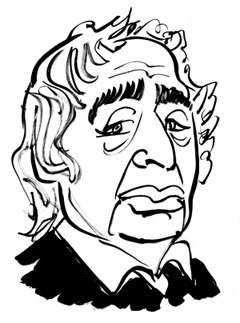
At 80, critic Harold Bloom says he should have departed this world seven times by now, but thank goodness he hasn’t. His 39th book, The Anatomy of Influence: Literature as a Way of Life (published this month by Yale), is due out now. For a dash of Bloomian spirit, see this lunchtime interview in Vanity Fair, click here. Along with Stanley Cavell, Bloom is the best guide to Emerson that we have, and he calls Emerson, in this interview, the “best mind ever to come out of America.”
 the roy hamric journal