
William Empson, Philip Larkin
Posted: June 25, 2011 Filed under: books, people, poetry 1 Comment This evening I heard Philip Larkin in William Empson’s voice (Larkin followed Empson, of course):
Empson: The heart of standing is you cannot fly.
Harold Bloom talks about this back and forth influence that writer’s share. This is from Empson’s Let It Go:
It is this deep blankness is the real thing strange.
The more things happen to you the more you can’t
Tell or remember even what they were.
Jan Reid’s Comanche Sundown
Posted: June 21, 2011 Filed under: books, fiction, people, reviews 5 CommentsComanche Sundown, Jan Reid’s new historical novel, is, as some reviewers have written, a masterpiece of imagination and prose, capturing a time in the nation when Quanah Parker, a half-breed, and his unexpected friend, a black cowboy named Bose Ikard, himself a son of a slave owner, lived life on the Texas plains fighting the Union Army and watching the old ways disappear. Quanah’s epitaph on his grave at the Parker family plot at the Fort Sill Cemetery in Lawton, Oklahoma:
:
Resting Here Until Day Breaks
And Shadows Fall and Darkness Disappears is
Quanah Parker Last Chief of the Comanches
Born 1852
Died Feb. 23, 1911

CPA: photographs from Asia
Posted: June 14, 2011 Filed under: buddhism, photography Leave a comment
move over stevie ray vaughn
CPA is a photographic and editorial Web site that specializes in historical and contemporary photographs from Asia, the Mid East and other areas. It is run by a gang of Asian specialist, all wise and gifted people. To see a treasure house of images from Asia, check out CPA here. The site can be searched for various cities, ethnic groups, themes, people and other topics. Much historical work and loving attention to details can be seen on the site, which is the most thorough you’ll find outside a major museum. A great resource for people who enjoy travel, whether on the road or in an armchair.
Bedside books
Posted: June 9, 2011 Filed under: books, fiction, people, poetry, writing 2 Comments
 Jan Reid’s Comanche Sundown is a beautifully imagined novel with two real-life quintessential Americans at its core, the Comanche half-blood chief Quanah Parker and a half-blood black named Bose Ikard, the son of his slave-owning father. This book should be a contender for the National Book Award and the Pulitzer Prize. It’s in the ranks of Cormac McCarthy’s All the Pretty Horses, Thomas Berger’s Little Big Man, E.L. Doctorow’s Welcome to Hard Times and Larry McMurtry’s Lonesome Dove. Quanah and Bose are blood brothers engaged in living their lives as men at a pivotal moment in history when Whites are turning the Comanche ranging ground into cattle country. The story is also an intoxicating tale of the Indian women who shared their lives. The novel puts flesh on two real-life figures and their time, not so long ago. Reid’s re-imagining of the Comanche way of life and Quanah’s shamanistic aura and fearlessness is a masterful feat of story-telling. His recent biography of Doug Sahm, the Texas Tex-Mex rocker, is also a good one for the road. His The Bullet Meant for Me defies easy description. It’s an autobiography of a writer who took a pistol shot in the stomach that passed on to lodge against his spine––paralyzing him for months until he regained the partial use of his legs: bracingly tough-minded, inspiring, beautifully written, a portrait of an artist in mid-flight who refused to go down for the count. In Comanche Sundown, he’s written a masterpiece on the richness and tragedy of frontier life.
Clive James’s Cultural Amnesia is encyclopedic in scope, his summing up of a lifetime of reviewing, 851 pages that cover a daunting range of literature with a particular nod to European writers, historical and modern. The more I read James the more I’m reminded of his rare qualities, the mind of a poet blended naturally with the hard-earned wisdom of someone at home on the streets, who can’t and doesn’t want to put literature behind academic walls but keeps it rooted at the forefront of lived life, as it was when it was created by writers struggling with the temper of their time. He writes with the assurance of someone who knows that literature, poetry and the lives of writers can teach truths far beyond the esthetic sublime.
Harold Bloom’s The Anatomy of Influence just came in the mail. What can I say. I love what his critics find irritating about his prose, the quick-wrapped lightning illuminations that fearlessly strike at the quick of a writer’s essence. If they would only accept that Bloom is a Jewish mystic writing not so much from a historical view but from a point of revelation, they wouldn’t be so vexed by his approach. He’s the most inspired, broadly visionary critic in American history, and his books will rest on a shelf reserved for uniquely American writers, close beside the three mentors who gave him the courage to be himself––Emerson, Thoreau and Whitman.
Larry McMurtry’s Hollywood and Literary Life. I always fall for McMurtry’s quirky nonfiction voice. What I like about these two memoirs, the first was Books, is their lack of personal or literary pretension, his tendency to dodge any serious discussion in mid-course and go off to eat a burger and fries or some such ordinary undertaking. I know underneath it all is a reader and storyteller of the first magnitude, but taking himself too seriously in these memoirs isn’t in his nature. At any rate, the memoirs feel honest. They have a diary feel by a diarist who knows pretension is the kiss of death.
Theroux-Naipaul shake hands
Posted: June 3, 2011 Filed under: books, fiction, people Leave a comment
paul theroux
Talk about social media, the ubiquitousness of cameras and instant communication: Paul Theroux and V.S. Naipaul unexpectedly encountered each other at a literary festival in England, which led to a long handshake and a smiling exchange. Here’s a post of the video. I’ve always admired Theroux’s “Sir Vidia’s Shadow” for its evocation of their early encounter in Malawi and the unknowable, dramatic course friendships can take. Here’s part of the post on The Book Bench:
“Talk about being in the right place at the right time: Reza Aslan was at the Hay Festival last weekend, where he gave a talk about his latest project—the gorgeous, comprehensive “Tablet and Pen: Literary Landscapes from the Modern Middle East,” a collection of Middle Eastern essays, fiction, and poetry from the past hundred years in English translation—and was in the green room when Paul Theroux and V. S. Naipaul had their encounter. Aslan happened to be taking a video with his phone, when, to his surprise, Theroux approached Naipaul and offered his hand. Aslan put it on his Twitter feed (@rezaaslan): “Holy Cow! I caught first face-to-face reconciliation of Paul Theroux & VS Naipaul. Magical moment.”
The Mekong: A long, soft river
Posted: May 31, 2011 Filed under: articles, places, writing Leave a commentA version of this article originally appeared in East Magazine.
By Roy Hamric
“The Mekong, it’s just a long, soft river.”––Jack Kerouac, in After Me, the Deluge
Part I
The bus pulled into Chiang Khan on the Mekong River as the sun fell behind the mountains lined up like sharks’ teeth to the north in Laos. Moments before, I had traced the Mekong’s blue line on a map. It marked the Mekong River journey I would take riding in cheap buses down a 650-kilometer course along the Laotian-Thai border. The bus pulled onto Chiang Khan’s main road lined with rustic, wood buildings and teak wood guesthouses. At the Suk Som Baan Hotel, the ping of raindrops sounded on the tin roof. The small white room with its simple metal bed frame and white sheets and teak wood flooring were straight out of a Joseph Conrad story. Beyond the three open windows, two-deck Chinese junks loaded with felled trees were docked on the riverbank. The window view framed a misty picture of the pearl-gray Mekong and the blue-green shoreline of Laos on the far side. I dozed off that night to the high-pitched squeaks of jing-jok lizards scampering across the walls. It was a perfect start to a Mekong River journey through sleepy Laotian river towns. My plan was to start on the Thai side of the Mekong, to cross to the Laotian side at Non Khai for a visit to Vientiane, the capital, and then to take ordinary buses along the Mekong River south until it disappeared into Cambodia.
After breakfast, I hired a longboat pilot to give me my first taste of one of the longest most mystery-filled rivers in the world. The difference between the river’s two sides was clear the night before. Only two or three lights could be seen on the Laotian side. The boatman shoved off to parse his course through the swiftly flowing river, around large tree limbs and uprooted trees being swept downstream. On the Laotian side, dozens of bamboo fish traps rested on the bank. Old men and children splashed in the water to chase in fish. Families bathed. Two naked kids wearing Santa Claus hats stopped splashing water on each other to wave hello.
About 5 miles down the river the boatman gunned his 20-horsepower engine through the Kang Kood Koo rapids before turning to circle back to Chiang Khan. He pointed to a grassy water line 25 higher, where the river had crested only one month ago. In Chiang Khan, the rooftops of the buildings were dotted with red satellite dishes mounted on the shop houses sitting next to the river on slender wood beams like very still dark spiders.
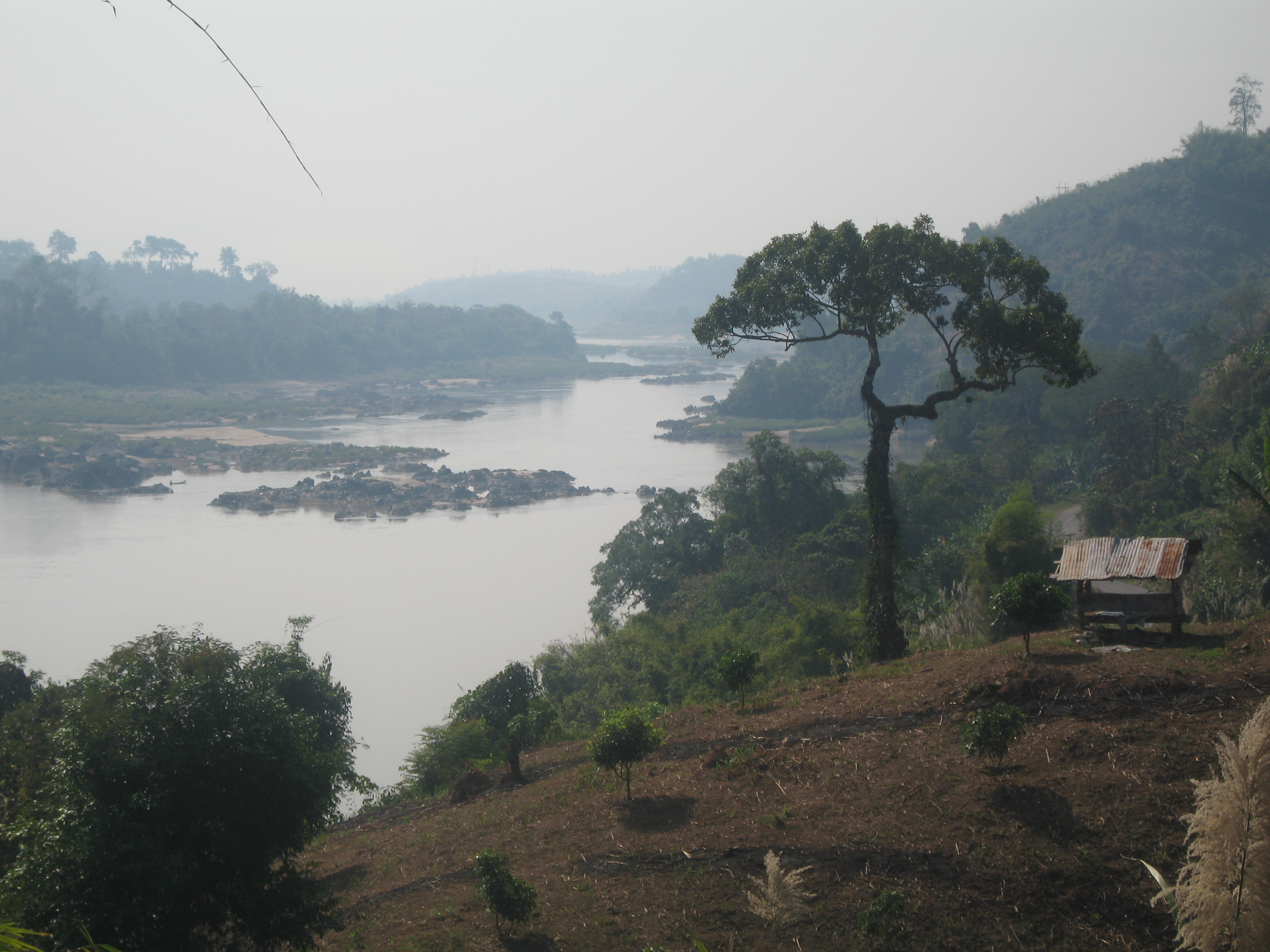
The Mekong River in Thailand
My first boat ride on the Mekong River fulfilled a long-held dream. I had pictured its tiny rivulets beginning high in the eastern mountains of Tibet before heading southward, passing through six countries before finally fanning out into Vietnam’s southern delta in hundreds of web-like streams. For much of its 2,800-mile course, the Mekong River was still a natural, free river. Three bridges span the river in Southeast Asia, one at Vientiane, built in 1990; one in Pakse, Laos, opened in 2000, and one recently completed in Vietnam.
China has built seven dams on the Mekong, in Yunnan Province, but so far the river is undammed in Southeast Asia, where it remains a main artery of travel and sustenance. But, the river’s wildest days are clearly over. China plans to build six more dams along its course. It’s estimated the river’s full hydroelectric potential is equal to the annual petroleum production of Indonesia. China now controls its flow through Southeast Asia. Laos and Thailand have built dams on Mekong tributaries. Laos is counting on exporting hydroelectric energy as a capital resource to energy-starved countries. Proposals to put more dams on the Mekong in Laos, Thailand, Cambodia and Vietnam haven’t yet borne fruit, but its only a matter of time.
“Without doubt, no other river, over such a length, has a more singular or remarkable character.”––Francis Garnier, co-leader, French Commission Expedition to the Mekong River, 1866.
The next morning I boarded a bus to Nong Khai. An ancient, battered TV and CD player was wired above the driver’s seat. A Thai teenager scanned a magazine with nude centerfolds, and two foreigners were speaking Dutch. The Mekong flowed by only a few hundred feet away for most of the ride. Willem Leutner, in his fifties, a red-cheeked high school psychology teacher, was on holiday. He was being befriended by a barefooted, drunken Thai man, who was shouting louder and louder as if that could make Leutner understand Thai. The driver and passengers all ignored the drunk, his slurred speech and his embarrassing encounter with the foreigner.
“In Thailand,” Leutner said, “most rural people believe in spirits. That means this man is not himself now. He’s under the control of an evil spirit, and if they do something to embarrass him they make him lose face, plus they would also lose face too because they would have to show their emotions. Thais always try not to show their emotions in public. They feel sorry for someone who does. So they just ignore him.”
It was his third trip to Thailand. “The Dutch are the Chinese of Europe,” he said. “You will see us everywhere.” He described his recent vacation to Malawi, where he said the women taught him to dance from the hips down. But, Thailand, he said, it has something even more special. He lived with a Thai woman for six months. “The place has woken me up to something inside me that I never thought I had,” he said. “I have a different energy inside me now. I am growing inside. I will return to teach in a few months, but I will come back to live here later. I’ve discussed it with friends in Holland. They don’t understand.” Scenes of modern Thailand flashed by. A barefooted rice farmer knee-deep in water talking on his cellphone. Small engine-powered plows, replacing the water buffalo, furrowed straight rows in flooded rice paddies. The road entered Nong Khai lined by verdant ponds filled with two-foot lily pads and pink flowers. The drunk Thai was sleeping peacefully.

River bank farming in Thailand
A Way Station at Nong Khai
That evening, I dropped into The Meeting Place, a legendary expat bar to visit with the owner, Alan Patterson, an Australian, who was something of a Mr. Fix-It for expats. From his bar-restaurant-guesthouse, he provided immigration forms to cross the border, or he might try to sell you a house, a banana plantation, a fish farm–or just introduce you to aging Vietnam veterans who lived in the area in small houses or rooms with a Thai wife or girlfriend. They congregated to The Meeting Place both day and night to while away the time.
“This is command central,” said Patterson, who had lived in Nong Khai for nine years. He sat behind his horseshoe shaped desk surrounded by a computer, a TV tuned to CNN, a fax, several mobile phones, three clocks showing time for Bangkok, Perth and Honolulu, and assorted sales brochures and maps.
Expats and Thais kept kept drifting in as we talked. “About 80 expats live in the area, and maybe 20 in town,” he said. “They come in and out and they don’t get on each others’ nerves too much. A lot of them are sick with this or that, living on their government checks. They’re good for the economy.” Then his voiced trailed off. “There aren’t many Americans in the area––easily four times more Germans, Dutch and Finnish.”
From his desk, Patterson managed his Web site which promoted the Mekong River area and his business schemes. “We had beautiful houses built here in the boom era that still haven’t been sold,” he said. “Prices started around 1 million baht (US $30,000). You get great value for your money. I want to build a retirement community here for vets––and make sure they don’t get jerked around by the Thai mafia.”
Leaving, I noticed a bar tab list nailed to the wall alongside large magazine centerfolds of Asian women. “VICTIMS,” it read, followed by 10 scribbled names, ending with the name, “God.”
“An Englishman wrote that. He makes us laugh a lot,” said a red-haired man sitting at the bar, one forearm tattooed with “Airborne” and the other “Singha,” a Thai beer.
Looking at a row of weathered foreigners sitting on the bar stools in mid-day took me back to a feeling of Vietnam. Lke clockwork, paranoia surfaced in the room. A white-haired, haggard man with a pockmarked, swollen face, his nose a dull purple, slurred, “You look like you’re from Langley. CIA, right? I can always tell. You’re from Langley, right?” Everyone’s head turned to look. We were on Vietnam and Laos time, a long time ago, and it was time to leave.
The riverfront of Nong Khai was lined with restaurants––all with a verandah view of the Mekong flowing past. At sunset, the sky and river took turns mirroring red, orange, pink, gold, deep blue-gray and black. Then the lights of Friendship Bridge flashed on linking Thailand to Laos in a tiny chain of gold. Vientaine awaited across the river. (Part II to come)
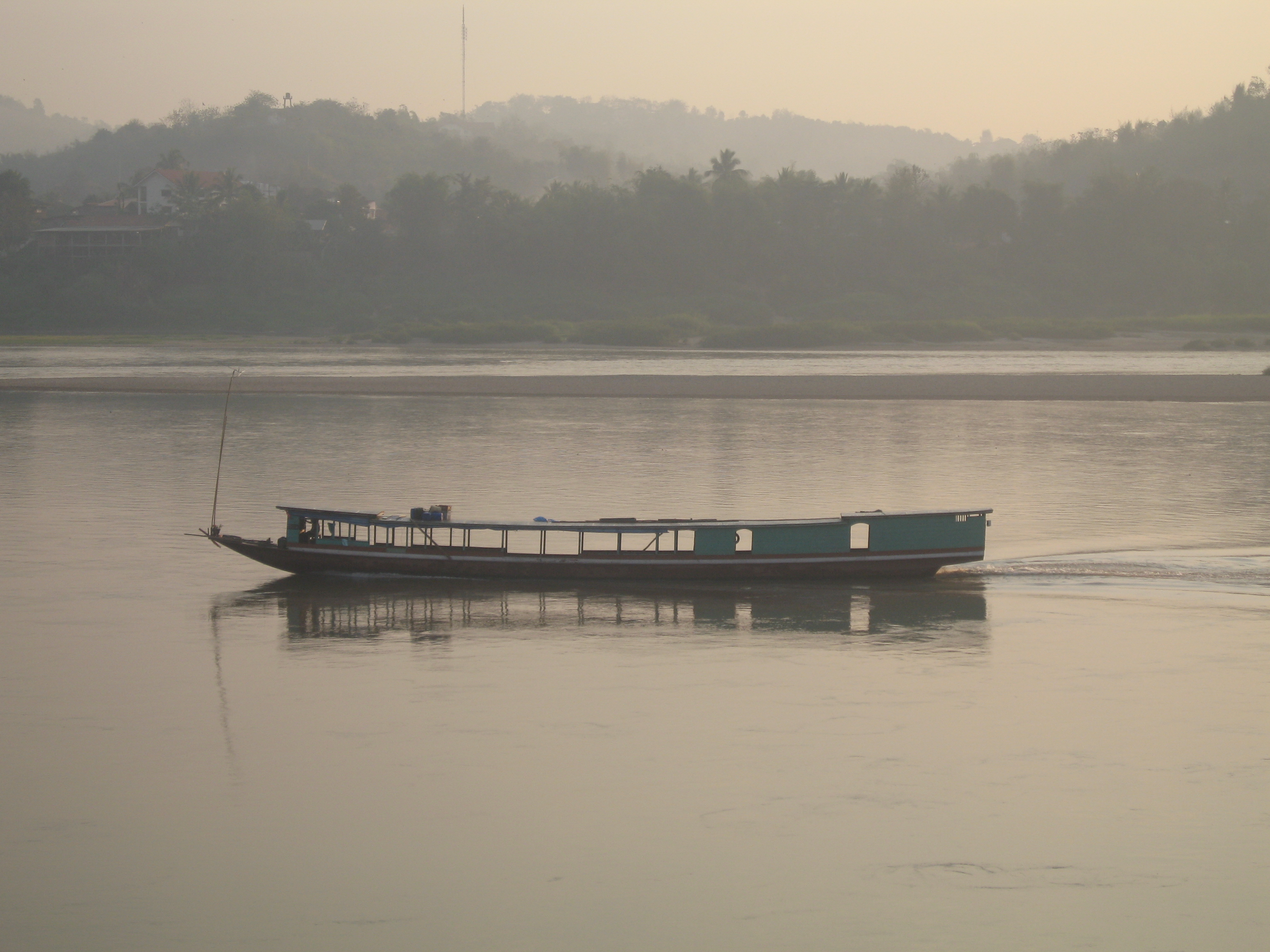
An empty passenger boat on the Mekong River
Harold Bloom: the uncommon reader
Posted: May 20, 2011 Filed under: books, people Leave a comment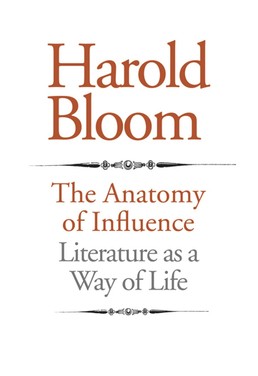 For a beautiful appreciation and clear dissection of Harold Bloom’s career as America’s most gifted literary critic and poet of the sublime influence of like-minded writers, click here. By Sam Tanenhaus, editor of The New York Times Book Review. Bloom’s new book, The Anatomy of Influence, is a summation of his early and latter work, focusing on the esthetic links, sometimes not readily apparent, that bind the pantheon of Western writers together, with the centerpiece his great hero Shakespeare. Bloom has two more books in the works, one a look at the Bible as literature, narrative storehouse and infuence called “The Shadow of a Great Rock: A Literary Appreciation of the King James Bible” due in September. He also has begun work on his next, “Evening of the Imagined Land: Achievements in American Literature.”
To see a video of an extraordinarily vibrant Bloom, now 80, talking to Tanenhaus and reciting poetry, click here.
For a beautiful appreciation and clear dissection of Harold Bloom’s career as America’s most gifted literary critic and poet of the sublime influence of like-minded writers, click here. By Sam Tanenhaus, editor of The New York Times Book Review. Bloom’s new book, The Anatomy of Influence, is a summation of his early and latter work, focusing on the esthetic links, sometimes not readily apparent, that bind the pantheon of Western writers together, with the centerpiece his great hero Shakespeare. Bloom has two more books in the works, one a look at the Bible as literature, narrative storehouse and infuence called “The Shadow of a Great Rock: A Literary Appreciation of the King James Bible” due in September. He also has begun work on his next, “Evening of the Imagined Land: Achievements in American Literature.”
To see a video of an extraordinarily vibrant Bloom, now 80, talking to Tanenhaus and reciting poetry, click here.
Lincoln portrait by Matthew Brady
Posted: May 16, 2011 Filed under: people, photography Leave a comment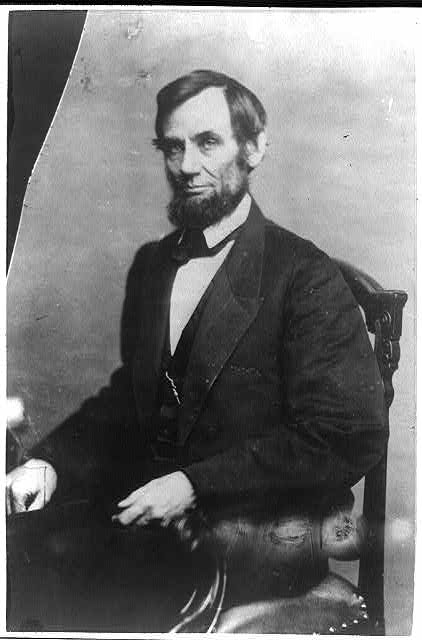
Portrait taken by an assistant to Matthew Brady
Walt Whitman in Specimen Days: “Probably the reader has seen physiognomies (often old farmers or sea captains) that, behind their homeliness, or even ugliness, held superior points so subtle, yet so palpable, making the real life of their faces almost as impossible to depict as a wild perfume or fruit taste, or a passionate tone of the living voice — and such was Lincoln’s face, the peculiar color, the lines, the eyes, the mouth. Of technical beauty it had nothing — but to the eye of a great artist it was a rare study, a feast and fascination.”
Kerouac wrote Dharma Bums in this house
Posted: May 14, 2011 Filed under: books, people, places Leave a comment
Jack Kerouac lived in this house with his mother in Orlando, Florida, for a little more than one year. While there, in a burst of memory-writing he wrote Dharma Bums. The house is now a writer’s retreat and is maintained by a nonprofit group that needs funds. For a nice story on the house and group by Carolyn Kellogg , click here. To hear Kerouac sing Ain’t We Got Fun, click here. Thanks, Carolyn Kellogg.
Thomas Merton’s photograph of God
Posted: May 13, 2011 Filed under: buddhism, people, photography Leave a comment
Thomas Merton named this photograph “The Sky Hook,” but he wrote, “It is the only known picture of God.” See my essay Thomas Merton: Looking Through the Window in the On the Record listing.
 the roy hamric journal