
Hunter Thompson’s two weeks in Vientiane
Posted: July 15, 2011 Filed under: articles, people, places 2 CommentsBy Roy Hamric
Part II
Laos is as different from Vietnam as Big Sur is from Long Island––Hunter S. Thompson
The next morning, two Russian hookers waited in front of the visa gate on Friendship Bridge. They talked in agitated bursts with a small Russian man who had the body of an acrobat and a face like a famous French pantomimist. One of the ladies was very young and beautiful. The other was worn away inside and out. They were mother and daughter. The bra strap on the daughter’s right shoulder read, “Midnight Angel.” Soon I was bouncing down the road in a taxi, a 1978 Toyoto Corina with the original black crusty leather upholstery, for the 23-mile ride to Vientiane. The door panels were stripped out exposing the bracing and gears for the roll-up windows. You could see the ground below through rusted holes in the floorboards. A half dozen Buddha amulets dangled from the arm of the rearview mirror which had no mirror. A miniature bamboo fish trap dangled between the Buddhas amulets. It was a good luck charm to help catch money. “You like to fish?” asked the driver. “Good fishing. Every night. Lake here.”
We passed a shop with dozens of modern rods and reels displayed on the ground alongside the road. It made a strange impression. Then another fishing shop passed, very new. Then two or three more. In the fields between the houses and shops, grey-white cattle displayed the perfect outlines of their skeleton covered by sagging skin like a thin, frayed blanket. Old women sold bright red chillies from bamboo mats next to the roadside. A solitary, barefooted old man in his underware squatted next to the road, a long cherrot dangling from his lip. Many cinder-block buildings were new and quickly put up with the cement oozed out from between the blocks. We passed the new spic and span Australian Embassy, very white in the afternoon sun. Then the Lao-German School of Technology.
The usual Internet shops began to appear and more outdoor restaurants. Foreigners on motorbikes. Newly built guesthouses. As we entered Vientiane, scattered old French villas in faded white-beige colors stood silently with long, wooden shutters tightly closed. A sign that Laos was a country still strictly controlled could be seen in the motorbike riders, who all wore helmets. Laos wasn’t Thailand. In Thailand, the law required it but only a few safety-minded bikeriders wore helmets. You could see Thailand’s lack of discipline too in its soldiers and policemen. In their off-hours they wore their uniform pants and shoes but stripped off their tops down to a white T-shirt, and they sat casually sipping a beer or eating in a restaurant. In Laos, soldiers and police always wore a full uniform so weighed down with epaulets and finery that privates looked like generals.  Emerging from 33 years of Communist rule, Vientiane, the once delicate Laotian capital numbering about 500,000 people, has the frayed look of an Eastern European city, signalled by the dominance of official governmental buildings. The highest buildings are hotels. There are no skyscraper office buildings. The center of the city’s night life has always been on Fa Nyum Road, named for Laos’ first king, now a strip of restaurants and guesthouses facing the Mekong River.
The city was overflowing with backpackers and hardy tourist types. Laotian women, with their elegant long skirts and coal-black hair, made up for the city’s controlled feel. Following the Communist Pathet Lao takeover in 1975, Laos was a closed society until 1989, when it slowly began to allow Westerners back into the country. The Communist regime officially proclaimed 1997 the “Year of the Visitor.” Years later the country still scrambles to accomodate itself to the growing number of tourists. There’s a handful of ATM machines. The local media is still heavily censored. Personal mail is routinely inspected. The sewer system has been under construction for decades. But at night, the riverside area fills up with Laotian couples and tourists, all eating, drinking and people-watching along the boulevard with its floating bamboo restaurants and food stalls, all lit up like a carnival with the Mekong flowing and Thailand on the other side of the river.
The driver let me out at the Lan Xang Hotel, once the finest in the capital, and I confirmed my reservation for Room 224. For two weeks during the 1970s, the room had been the home of the writer Hunter Thompson, who checked into the Lan Xang, which means Place of a Million Elephants, late one night after spending a few pressure-filled weeks reporting on the final days before the fall of Saigon for Rolling Stone magazine. Thompson left a curious account of his stay at the Lan Xang in an short piece called “Checking into the Lang Xang,” published in Generation of Swine, Gonzo Papers II.
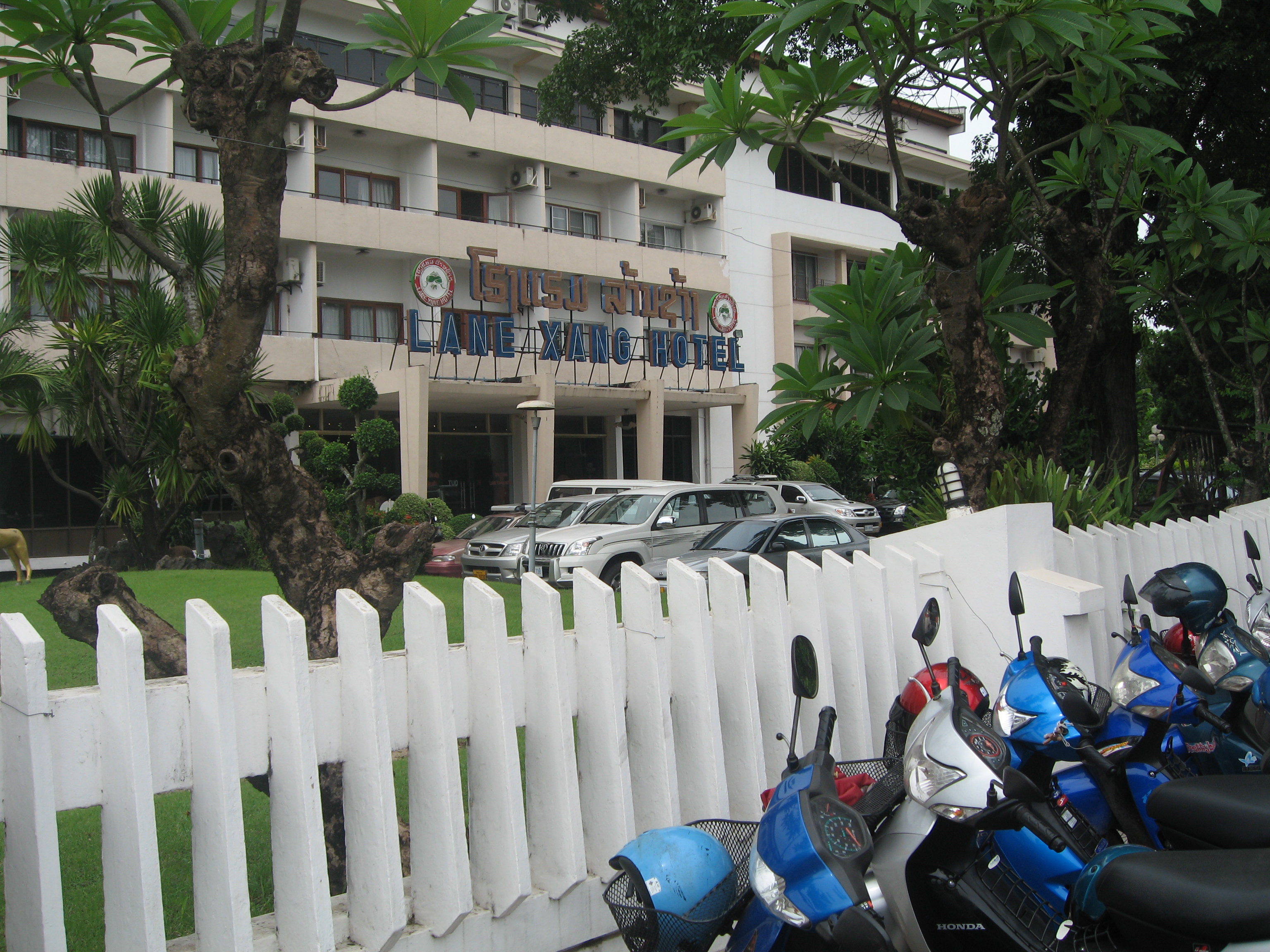
the lan xang hotel
He arrived in late April 1975 around 2 a.m. during a drenching monsoon rain. He told the desk clerk he wanted a king-sized bed, quick access to the swimming pool and a view of the Mekong River that flowed past only a few hundred feet in front of the hotel. The hotel is a long, two-story building with a massive lobby, cavernous dinning room, a special English-style Billiards Room, and an exotic disco with soft-eyed hostesses. The hotel is still noted for its Massage and Sauna Center beside the pool, and the masseuses who provid expert room service. Room 224 was almost exactly as Thompson described it, but with no view of the Mekong River: “A rambling suite of rooms half hidden under the top flight of a wide white-tiled stair ramp that rose out of the middle of the Lan Xang lobby. When I first went into 224, it took me about two minutes to find the bed; it was around the corner and down a fifteen-foot hallway from the refrigerator and the black-leather topped bar and the ten-foot catfish-skin couch and five matching easy chairs and the hardwood writing desk and the sliding glass doors on the pool-facing balcony outside the living room. At the other end of the hallway, half hidden by the foundation of the central stairway, was another big room with a king-size bed, another screened balcony, another telephone and another air-conditioner, along with a pink-tiled bathroom with two sinks, a toilet and a bidet and deep pink bathtub about nine-feet long.” The Lan Xang was perfect for Thompson. Built by the Russians, it still had Soviet air conditioners and signs in Cyrillic here and there. The disco then and now offers a classic Asian band with rotating singers and lovely hostesses in spiky high heels who lay a hand on your leg very quickly and rest their head on your shoulder. There’s no written account of how Thompson filled his two weeks in Vientiane. The best guess is that it

a cobra and other snakes in moonshine whisky
involved burst of manic writing, wiring dispatches to California, lots of Laotian marijuana, long stretches of sitting at an outdoor restaurant next to the Mekong River, probably some of the local rice whisky, probably some opium, probably long stretches of meditation on the star-filled sky over the river. I’m certain some nights were spent in the dark recesses of The White Rose, checking out the night life in one of the most legendary bars in Asia renowned for its spunky floor shows and hostesses. Down the road was Lulu’s where nightly pipes of opium could be found. At any rate, Thompson had successfully decamped from the manic desperation of crumbling Saigon to seemingly tranquil Vientiane. But with his acute sense of the possible and probable, he knew Laos’ days were numbered. Shortly after arriving, he scheduled a meeting with The New York Times correspondent, David Alderman, and they spent some time traveling around Vientiane together. “He looked me up as soon as he pitched up in Laos. I had been filing quite relentlessly from there for some weeks). I had, of course, heard of him, though I was not aware that he’d been in Vietnam before he arrived in Laos. As I recall, he said that he was finishing up a major Vietnam piece and then intended to turn his attention to Laos. But I’m not sure how intense that attention was. Most of the time, as I recall, he spent trying to score the ‘finest weed ever produced on the planet.’ And he seemed to be quite successful. “At the time, Vientiane was very much an open city. The bar girls still plied their trade nightly at the White Rose which Peter Kann and I closed up some weeks later, with the girls going across the river to Thailand the next morning, really marking the end of the Royalist regime in Laos and the arrival in power of the Pathet Lao. For a price, and Hunter did seem quite flush at the time, there was very little that was not obtainable. “Hunter vanished as suddenly and mysteriously as he arrived. I don’t remember seeing any piece that materialized out of his visit to Vientiane. I was aware of his gonzo reputation, so his search for the perfect weed more amused than surprised me. He seemed so intense about it––more so than any other goal in fact––even though he was soaking in all sorts of details, scenario, dialogue, that could have produced a vivid piece if he ever got to the point of writing it, which seemed only a part of his ‘mission’ to Laos. I also recall that at times his circuits seemed pretty fried.” In May, 1975, a few weeks after Thompson’s visit, the Vientiane government fell to the Pathet Lao. The Communist isolated the country from the West and sent tens of thousands of Laotians and ethnic group members to prisons and reeducation camps. Indeed, Thompson had a long strange trip through life. His writing captured his times and the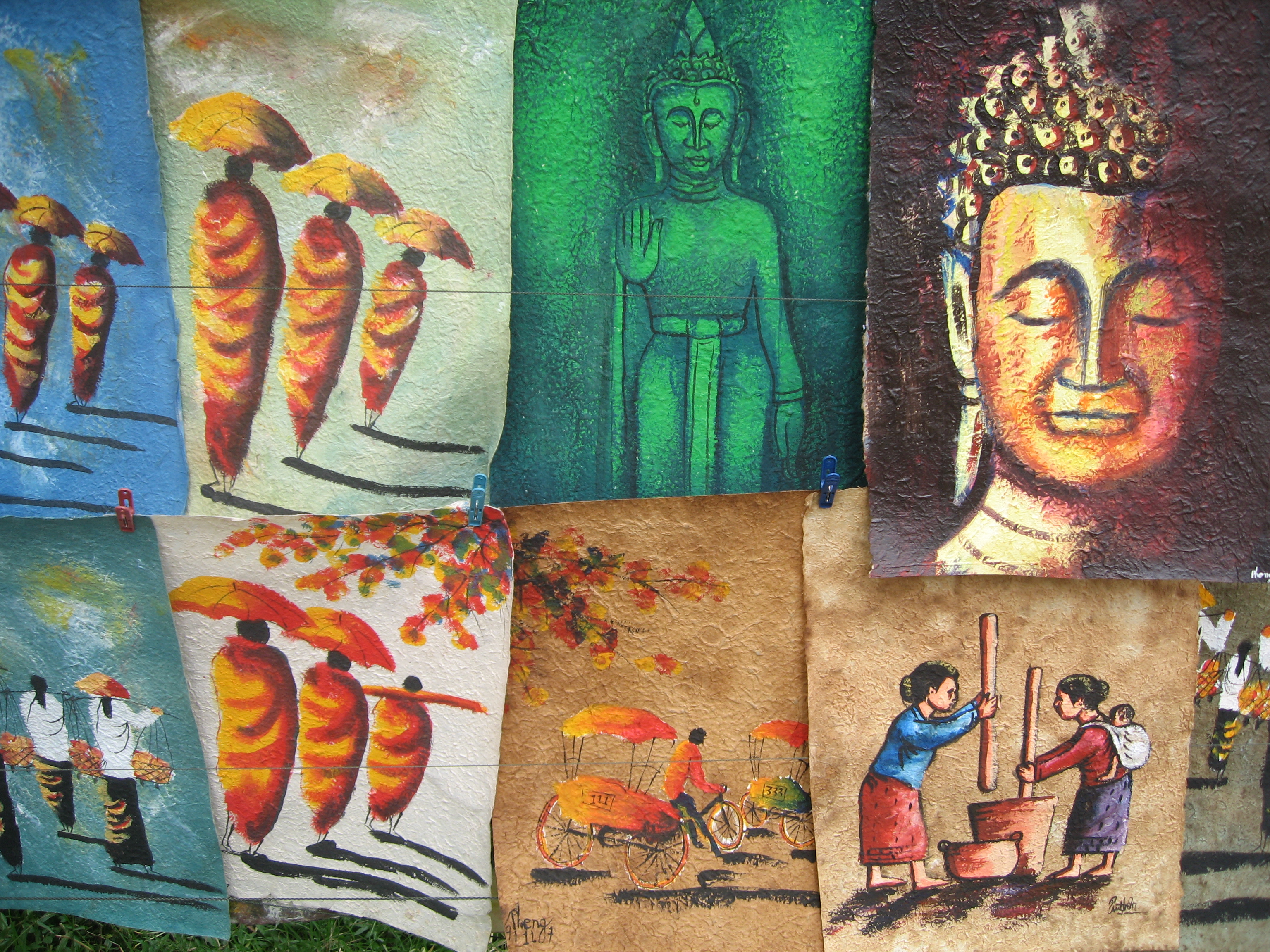 imagination of millions of readers. Thirty years later, on Feb. 20, 2005, Thompson, like Hemingway, shot himself in the head at his “fortified compound,” Owl Farm, in Aspen, Colorado. What reads like a short, personal note written to himself a few days before his death, titled “Football Season is Over,” is now called the “suicide note”: “No More Games. No More Bombs. No More Walking. No More Fun. No More Swimming. 67. That is 17 years past 50. 17 more than I needed or wanted. Boring. I am always bitchy. No Fun — for anybody. 67. You are getting Greedy. Act your old age. Relax—This won’t hurt.” Of all American writers, Thompson, in his prime, somehow seemed to be at home in Vietnam and Laos with their benighted strangeness and beauty. The country seemed to have found him. The country’s deep strangeness could swallow up most writers, and no doubt gave even him pause. He glimpsed the final days of Vientaine before the weird storybook kingdom was smothered in a long, totalitarian vengence. At the moment of its descent into Communism, the country had so little, yet it lost the open days of its future. Thompson innately understood, despised and raged against repressive forces wherever he found them but in Laos he sensed something walking the land far different than the politics of America and the resurgence of Richard Nixon. Laos had defied generations of writers who tried to decode the internecine feuding between its former kings and princes. All were swept away conclusively by the Communists. A lock was snapped shut on the future. Things quickly turned very dark in Laos, there were lost decades, but slowly the country began to emerge and it still is and you saw that some things never went away or were coming back. The next morning as I ventured out of the Lan Xang, I learned that drugs were everywhere in Vientiane, in spite of the Communist government or probably because of it.
The taxi driver turned, grinning. “You want gangha?”“No ganja,” I said. “Too dizzy.” He nodded, appearing to understand. “Opium?” he asked. There was something about him. His body was too sure of itself. He was not a taxi driver. The body had a military bearing, the authority of a policeman. Yes, this was Laos and it was as different as Big Sur is from Long Island, in a world where all is strange if we can only see.
Part III to follow
The Mekong: A long, soft river
Posted: May 31, 2011 Filed under: articles, places, writing Leave a commentA version of this article originally appeared in East Magazine.
By Roy Hamric
“The Mekong, it’s just a long, soft river.”––Jack Kerouac, in After Me, the Deluge
Part I
The bus pulled into Chiang Khan on the Mekong River as the sun fell behind the mountains lined up like sharks’ teeth to the north in Laos. Moments before, I had traced the Mekong’s blue line on a map. It marked the Mekong River journey I would take riding in cheap buses down a 650-kilometer course along the Laotian-Thai border. The bus pulled onto Chiang Khan’s main road lined with rustic, wood buildings and teak wood guesthouses. At the Suk Som Baan Hotel, the ping of raindrops sounded on the tin roof. The small white room with its simple metal bed frame and white sheets and teak wood flooring were straight out of a Joseph Conrad story. Beyond the three open windows, two-deck Chinese junks loaded with felled trees were docked on the riverbank. The window view framed a misty picture of the pearl-gray Mekong and the blue-green shoreline of Laos on the far side. I dozed off that night to the high-pitched squeaks of jing-jok lizards scampering across the walls. It was a perfect start to a Mekong River journey through sleepy Laotian river towns. My plan was to start on the Thai side of the Mekong, to cross to the Laotian side at Non Khai for a visit to Vientiane, the capital, and then to take ordinary buses along the Mekong River south until it disappeared into Cambodia.
After breakfast, I hired a longboat pilot to give me my first taste of one of the longest most mystery-filled rivers in the world. The difference between the river’s two sides was clear the night before. Only two or three lights could be seen on the Laotian side. The boatman shoved off to parse his course through the swiftly flowing river, around large tree limbs and uprooted trees being swept downstream. On the Laotian side, dozens of bamboo fish traps rested on the bank. Old men and children splashed in the water to chase in fish. Families bathed. Two naked kids wearing Santa Claus hats stopped splashing water on each other to wave hello.
About 5 miles down the river the boatman gunned his 20-horsepower engine through the Kang Kood Koo rapids before turning to circle back to Chiang Khan. He pointed to a grassy water line 25 higher, where the river had crested only one month ago. In Chiang Khan, the rooftops of the buildings were dotted with red satellite dishes mounted on the shop houses sitting next to the river on slender wood beams like very still dark spiders.
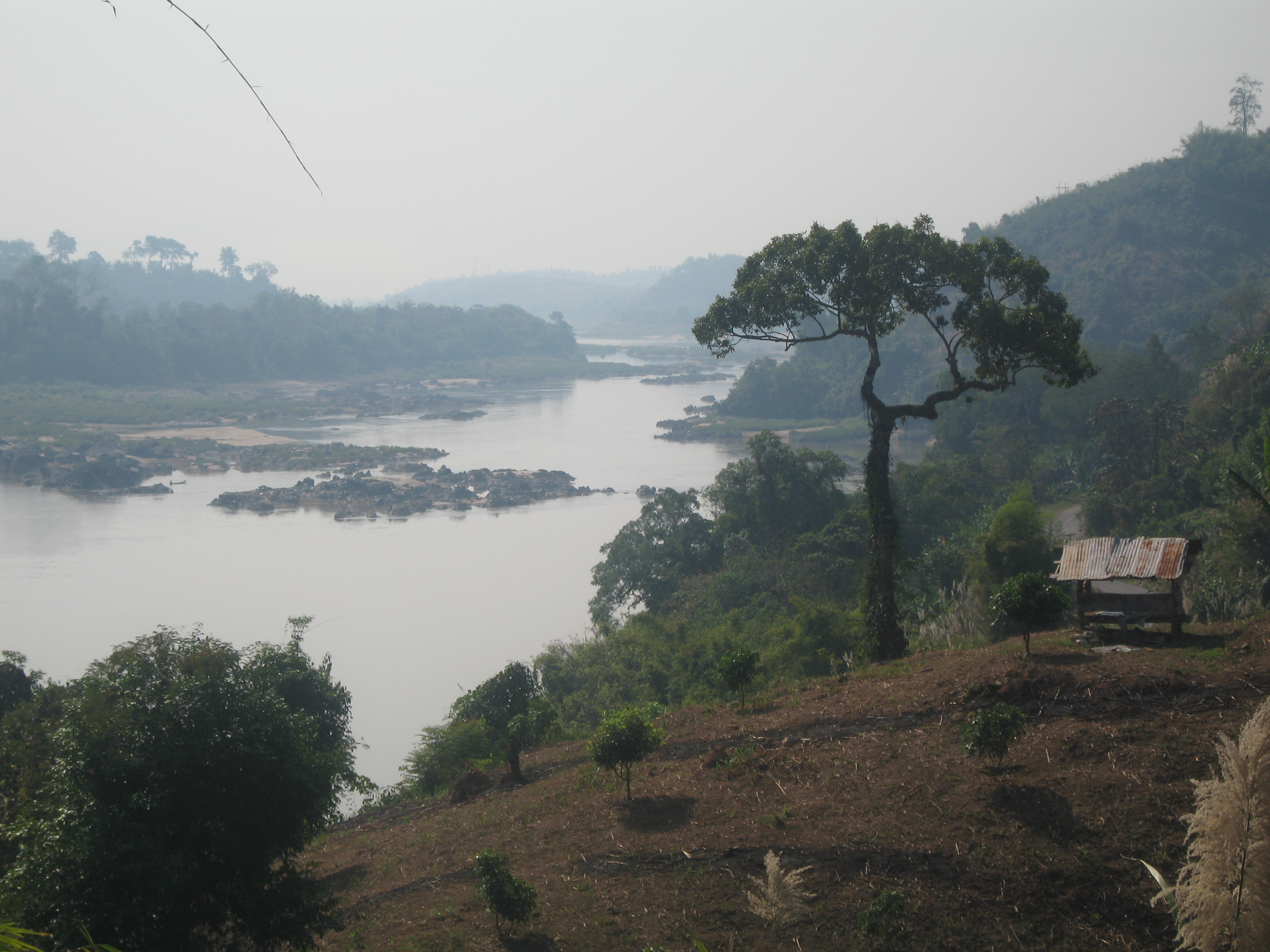
The Mekong River in Thailand
My first boat ride on the Mekong River fulfilled a long-held dream. I had pictured its tiny rivulets beginning high in the eastern mountains of Tibet before heading southward, passing through six countries before finally fanning out into Vietnam’s southern delta in hundreds of web-like streams. For much of its 2,800-mile course, the Mekong River was still a natural, free river. Three bridges span the river in Southeast Asia, one at Vientiane, built in 1990; one in Pakse, Laos, opened in 2000, and one recently completed in Vietnam.
China has built seven dams on the Mekong, in Yunnan Province, but so far the river is undammed in Southeast Asia, where it remains a main artery of travel and sustenance. But, the river’s wildest days are clearly over. China plans to build six more dams along its course. It’s estimated the river’s full hydroelectric potential is equal to the annual petroleum production of Indonesia. China now controls its flow through Southeast Asia. Laos and Thailand have built dams on Mekong tributaries. Laos is counting on exporting hydroelectric energy as a capital resource to energy-starved countries. Proposals to put more dams on the Mekong in Laos, Thailand, Cambodia and Vietnam haven’t yet borne fruit, but its only a matter of time.
“Without doubt, no other river, over such a length, has a more singular or remarkable character.”––Francis Garnier, co-leader, French Commission Expedition to the Mekong River, 1866.
The next morning I boarded a bus to Nong Khai. An ancient, battered TV and CD player was wired above the driver’s seat. A Thai teenager scanned a magazine with nude centerfolds, and two foreigners were speaking Dutch. The Mekong flowed by only a few hundred feet away for most of the ride. Willem Leutner, in his fifties, a red-cheeked high school psychology teacher, was on holiday. He was being befriended by a barefooted, drunken Thai man, who was shouting louder and louder as if that could make Leutner understand Thai. The driver and passengers all ignored the drunk, his slurred speech and his embarrassing encounter with the foreigner.
“In Thailand,” Leutner said, “most rural people believe in spirits. That means this man is not himself now. He’s under the control of an evil spirit, and if they do something to embarrass him they make him lose face, plus they would also lose face too because they would have to show their emotions. Thais always try not to show their emotions in public. They feel sorry for someone who does. So they just ignore him.”
It was his third trip to Thailand. “The Dutch are the Chinese of Europe,” he said. “You will see us everywhere.” He described his recent vacation to Malawi, where he said the women taught him to dance from the hips down. But, Thailand, he said, it has something even more special. He lived with a Thai woman for six months. “The place has woken me up to something inside me that I never thought I had,” he said. “I have a different energy inside me now. I am growing inside. I will return to teach in a few months, but I will come back to live here later. I’ve discussed it with friends in Holland. They don’t understand.” Scenes of modern Thailand flashed by. A barefooted rice farmer knee-deep in water talking on his cellphone. Small engine-powered plows, replacing the water buffalo, furrowed straight rows in flooded rice paddies. The road entered Nong Khai lined by verdant ponds filled with two-foot lily pads and pink flowers. The drunk Thai was sleeping peacefully.

River bank farming in Thailand
A Way Station at Nong Khai
That evening, I dropped into The Meeting Place, a legendary expat bar to visit with the owner, Alan Patterson, an Australian, who was something of a Mr. Fix-It for expats. From his bar-restaurant-guesthouse, he provided immigration forms to cross the border, or he might try to sell you a house, a banana plantation, a fish farm–or just introduce you to aging Vietnam veterans who lived in the area in small houses or rooms with a Thai wife or girlfriend. They congregated to The Meeting Place both day and night to while away the time.
“This is command central,” said Patterson, who had lived in Nong Khai for nine years. He sat behind his horseshoe shaped desk surrounded by a computer, a TV tuned to CNN, a fax, several mobile phones, three clocks showing time for Bangkok, Perth and Honolulu, and assorted sales brochures and maps.
Expats and Thais kept kept drifting in as we talked. “About 80 expats live in the area, and maybe 20 in town,” he said. “They come in and out and they don’t get on each others’ nerves too much. A lot of them are sick with this or that, living on their government checks. They’re good for the economy.” Then his voiced trailed off. “There aren’t many Americans in the area––easily four times more Germans, Dutch and Finnish.”
From his desk, Patterson managed his Web site which promoted the Mekong River area and his business schemes. “We had beautiful houses built here in the boom era that still haven’t been sold,” he said. “Prices started around 1 million baht (US $30,000). You get great value for your money. I want to build a retirement community here for vets––and make sure they don’t get jerked around by the Thai mafia.”
Leaving, I noticed a bar tab list nailed to the wall alongside large magazine centerfolds of Asian women. “VICTIMS,” it read, followed by 10 scribbled names, ending with the name, “God.”
“An Englishman wrote that. He makes us laugh a lot,” said a red-haired man sitting at the bar, one forearm tattooed with “Airborne” and the other “Singha,” a Thai beer.
Looking at a row of weathered foreigners sitting on the bar stools in mid-day took me back to a feeling of Vietnam. Lke clockwork, paranoia surfaced in the room. A white-haired, haggard man with a pockmarked, swollen face, his nose a dull purple, slurred, “You look like you’re from Langley. CIA, right? I can always tell. You’re from Langley, right?” Everyone’s head turned to look. We were on Vietnam and Laos time, a long time ago, and it was time to leave.
The riverfront of Nong Khai was lined with restaurants––all with a verandah view of the Mekong flowing past. At sunset, the sky and river took turns mirroring red, orange, pink, gold, deep blue-gray and black. Then the lights of Friendship Bridge flashed on linking Thailand to Laos in a tiny chain of gold. Vientaine awaited across the river. (Part II to come)
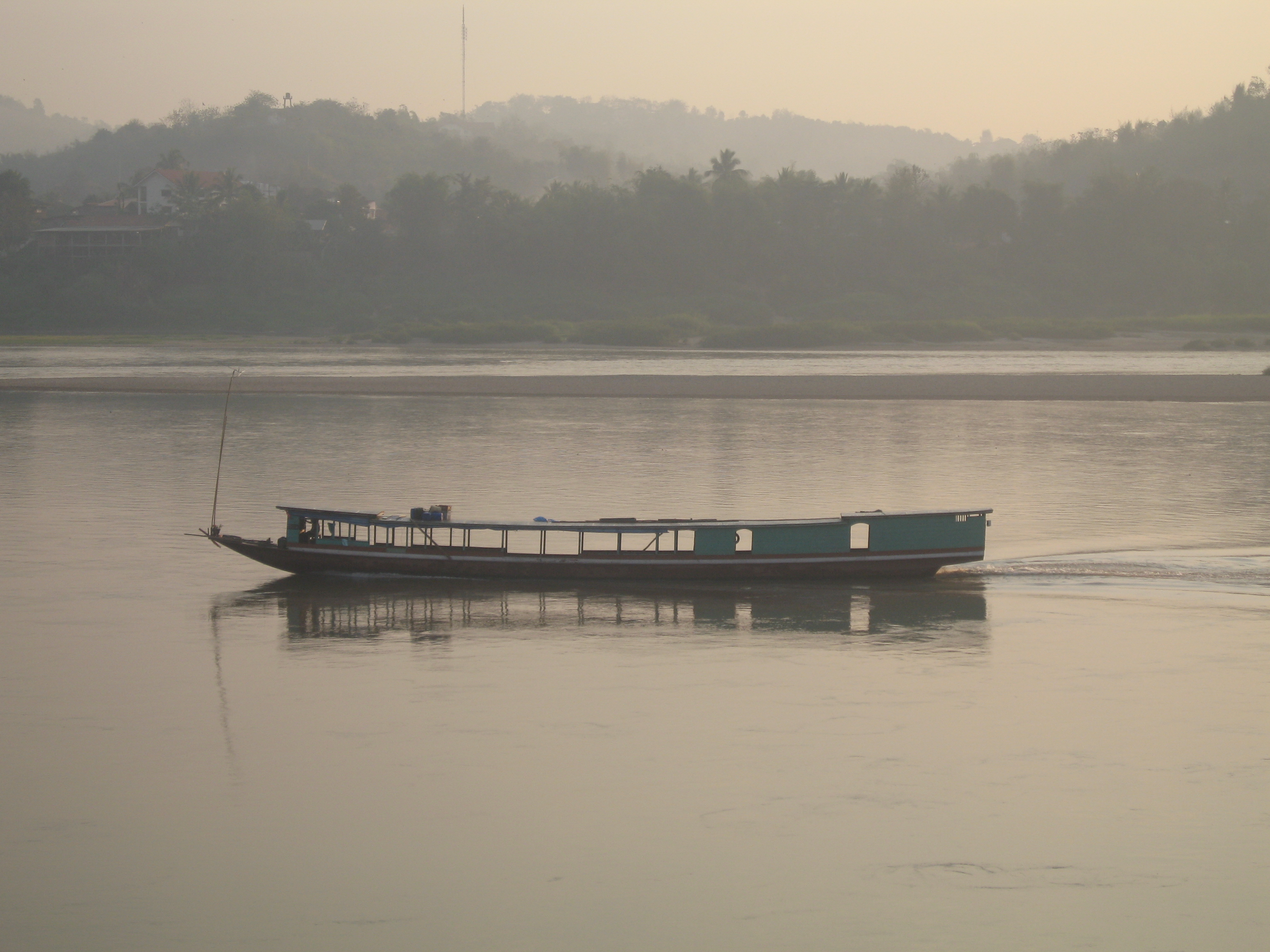
An empty passenger boat on the Mekong River
getting to know you, getting to know all about you
Posted: May 11, 2011 Filed under: articles, people, states of mind Leave a comment Getting to know, or thinking that you know, anyone is not easy, particularly so in a different culture where it can be a mysterious and often frustrating experience. A philosopher of language, Ludwig Wittgenstein knew it was normal for most people to go around believing that they understood what other people were saying simply because of the words they used, but he also knew that really understanding what anyone says is a difficult task that requires work and thought. Especially so in dealing with people whose background or culture is vastly different, truly foreign. At one place he says:
One human being can be a complete enigma to another. We learn this when we come into a strange country with entirely strange traditions; and, what is more, even given a mastery of the country’s language. We do not understand the people. (And not because of not knowing what they are saying themselves.) We can not find our feet with them.
The word in German that was translated as “feet” actually employs an idiom that literally says: We can not find ourselves in them. Of course, we can’t find ourselves in anyone period, but his point underscored the dangers of assuming you understand correctly or were understood correctly, or that everyone is feeling, seeing, agreeing or disagreeing based on the same perceptions or assumptions and even if they were, words and language have to be used with as much simplicity, precision, patience and humility as we can muster.
to the future?
Posted: May 5, 2011 Filed under: articles, states of mind, time, space Leave a comment An institute affiliated with Oxford University is studying the future with the goal of making some fairly rational predictions of where humans might be in hundreds of thousands, millions and billions of years from now––not an easy task to be sure with no real guarantee that humans, at least as we know them, will continue to exist. An interesting article which sketches some possibilities can be found here, but first read the quotation below:
Only 0.01 percent of all species that have ever existed continue to do so. We happen to be one of them, for now. When Rees looked at the myriad ways in which the present is more perilous than the past in his 2003 book “Our Final Hour,” he set the odds of human extinction in the next century at 50 percent.
Bostrom, the Oxford philosopher, puts the odds at about 25 percent, and says that many of the greatest risks for human survival are ones that could play themselves out within the scope of current human lifetimes. “The next hundred years or so might be critical for humanity,” Bostrom says, listing as possible threats the usual apocalyptic litany of nuclear annihilation, man-made or natural viruses and bacteria, or other technological threats, such as microscopic machines, or nanobots, that run amok and kill us all.
lunch with Harold Bloom
Posted: April 22, 2011 Filed under: articles, books, interviews, people Leave a comment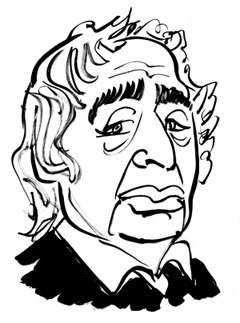
At 80, critic Harold Bloom says he should have departed this world seven times by now, but thank goodness he hasn’t. His 39th book, The Anatomy of Influence: Literature as a Way of Life (published this month by Yale), is due out now. For a dash of Bloomian spirit, see this lunchtime interview in Vanity Fair, click here. Along with Stanley Cavell, Bloom is the best guide to Emerson that we have, and he calls Emerson, in this interview, the “best mind ever to come out of America.”
from the Edge
Posted: April 17, 2011 Filed under: articles, people Leave a commentThe Edge website: Here’s a sample of the quality of input re: the nuclear disaster in Japan:
The Nuclear Accident in Japan & Systemic Risk
J. DOYNE FARMER Chaos Theory Pioneer; McKinsey Professor, Sante Fe, Institute; Co-Founder, former Co-President of The Prediction Company
 “The prognosis for nuclear accidents based on simple historical extrapolation is disturbing. After roughly 14,000 cumulative years of nuclear plant operation, we have now had three major accidents. If we ramp up nuclear power by a factor of ten, which is necessary to make a significant contribution to mitigate global warming, we will increase from the 442 reactors that we currently have to about 5000. Historical extrapolation predicts that we should then expect an accident of the magnitude of the current Japan disaster about once a year.
“But I don’t trust the historical method of estimating. Three events are unlikely to properly characterize the tails of the distribution. My personal choice for a really nasty nuclear scenario goes as follows: Assume the developed world decides to ramp up nuclear power. The developing world will then demand energy independence and follow suit. For independence you need both reactors and fuel concentrators. There will be a lot of debate, but in the end the countries with stable governments will get them. With a fuel concentrator the waste products of the reactor can be used to make weapons grade fuel, and from there making a bomb is fairly easy. Thus, if we go down the path of nuclear expansion, we should probably assume that every country in the world will eventually have the bomb. The Chernobyl disaster killed the order of ten thousand people: A nuclear explosion could easily kill a million. So all it will take is for a “stable government” to be taken over by the wrong dictator, and we could have a nuclear disaster.
“I’m not an actuary, so you shouldn’t trust my estimates. To bring the actuaries into the picture, anyone who seriously advocates nuclear power should lobby to repeal the Price-Anderson Act, which requires U.S. taxpayers to shoulder the costs of a really serious accident. The fact that the industry demanded such an act suggests that they do not have confidence in their own product. If the act were repealed, we would have an idea what nuclear power really costs. As it stands, all we know is that the quoted costs are much too low.
“Danger is not the only property that makes nuclear power exceptional. Even neglecting the boost in cost that would be caused by repeal of the Price-Anderson Act, the cost curve for nuclear power is remarkable. My group at the Santa Fe Institute has collected data on the cost and production of more than 100 technologies as a function of time. In contrast to all other technologies, the cost of nuclear power has roughly remained constant for 50 years, despite heavy subsidies. This cannot be blamed entirely on the cost of safety and regulation, and after Japan, is anyone really willing to say we shouldn’t pay for safety? In contrast, during the same period solar power has dropped by a factor of roughly a hundred, making its current cost roughly equal to nuclear. Wind power is now significantly cheaper than nuclear. Solar will almost certainly be significantly cheaper than nuclear within a decade, roughly the time it takes to build a nuclear plant.”
Let’s hope the disaster in Japan puts the stake through the heart of the nuclear power plant industry. General Electric should be working now to dominate the solar, wind and wave energy systems of the future, because that’s clearly the road we’re going down from now on. People simply will no longer trust the folks who say nuclear engineering is fail safe, when failure, probable failure, has such dire consequences, not to mention Farmer’s realistic fear about the problem of nuclear waste and how it can be reprocessed to build atomic weapons.
Naipaul’s strange masque
Posted: March 26, 2011 Filed under: articles, books, people Leave a comment I’m 115 pages into V.S. Naipaul’s The Masque of Africa, and it’s one of the weirdest books I’ve ever read; so strange, you’re afraid to speak about how odd it is. After finishing Naipaul’s biography, it’s clear he was brought up with a fear of blacks and what they represented to his class of East Asian-Indian Trinidadian society. It’s something he was never able to leave behind. The book is about a six-month trip he took through the heart of old Africa, in the sense that he was in search of whatever remnants of primeval tribal culture he could find, particularly the spiritual and religious aspects. Certainly, a promising subject for him. But to watch him flounder around, you wonder is this the same writer of the earlier nonfiction books who could take apart a culture in 50 pages? The problem is you can’t be sure of what he’s trying to do here. It may be the ultimate writer’s fatigue or possibly an experiment, some new approach to storytelling (that so far he and I both seem to be trying to untangle). He’s a master of prose. We know that, but the prose here is constantly exuding irony (intended and not intended), condescension, put-ons, farce and cascades of clunky one-liners that highlight naiveté, stupidity, obtuseness, ignorance, on top of which he casts himself as a an awkward character whose rapport with his subjects is based on all of the above. It’s such a literary wreck, you’re forced to keep reading for the wrong reasons. There must be a point to it all, but so far it has eluded him and me. I have no choice but to keep reading in hope of the best and enthralled that it may be what it appears to be––simply bad, a writer whose style and personality have broken down but in a bravura act been put on display for all to see. A sort of ultimate who cares after the Nobel Prize. I just got the quirkiness of the style: it’s Dick and Jane go to Africa. That makes me, and you, the readers, children who will read any little story that keeps chugging along. A sample:
Since life (and death) are so full of snares, there are many ablutions to be done and many taboos to be observed. It is better to be barefoot. For the high priests especially it is taboo to have the soles of their feet covered; these important people must always have a link to the earth. If they are caught wearing shoes, they can be fined. Full shoes are allowed in some shrines, but not slippers. Wherever the high priest walks becomes holy, because he is the physical representation of the spirits, and is possessed by the spirits. The high priest wears white and carries a broom in his hand. The broom stands for his cleansing function.
Naipaul: the calypso rambler
Posted: March 22, 2011 Filed under: articles, books, fiction 2 Comments The V.S. Naipaul biography (The World Is What It Is) is done, confirming the tiresome personality which has become so much of his myth. Fortunately, his biographer chose to treat the negative aspects of his personality as matter of fact; he had no choice; from Naipaul’s beginning as a teenager, it was apparent he was destined to be insecure, egocentric and cruel, seeing himself as privileged. He is impervious and unconcerned about his failings as a human being. He’s cultivated, and had it cultivated for him by others, a myth that he sacrificed all for his art, but I don’t see it that way. To say that, is to say you have no responsibility to the people around you, whether casual strangers or loved ones. He is routinely awful to too many people. About the only thing positive that can be said for his cruelty and rudeness is that he does it to people face to face, with no pretension. There’s an element of sadism here, the small boy who enjoys torturing the weak and unsuspecting. But enough of that. “Enough,” in fact, is his biographer’s , Patrick French’s, last word in the book, which stops at 1996. In a footnote, French writes, “but more later.” It must be said, I have nothing but admiration for Naipaul’s cooperation with his biographer, allowing him full access to all his papers, etc., and in his comments to his biographer admitting his failings in so many areas regarding those who he loved and who loved him. His mother died estranged from her son. It’s one of the great tragedy’s of his life, which he didn’t comment on.
But I don’t care about Naipaul’s personality. Many people are loaded down with flaws that make them pretentious and unpleasant. But none of them, and few others in the world, can come even close to touching Naipaul’s artistry and vision. It’s perhaps a small stretch to suggest that he changed, at least among a certain circle of intellectuals (left), the way people looked at the third world, and the so-called responsibility of the West. I read A Bend in the River when it was published in 1979 and thought it a masterpiece, which it is. It was written in the period of his great nonfiction books. I was first attracted by his nonfiction writing, which still holds me, and, because of its structure, mostly still holds together, still offering great lessons through its weaving of history, exacting details, personalities and, most essentially, Naipaul’s hardcore distrust of shibboleths and the fashionably correct. At bottom, I guess, it’s his very distrust (and lack of compassion) of other human beings for not taking greater responsibility over their lives that he uses to color his point of view regarding the West and the so-called third world or emerging nations, or the rest of the world. Anyway, his books have been a necessary corrective, truly a monumental achievement, in the literary sense. So now I’m reading his newest book, A Masque of Africa, which starts off with some of the most awkward prose ever written, at least the first 40 pages or so. At the same time, I’m reading his essay on Conrad in Literary Occasions. It’s as if the writing is by two different people. More on this later. There are some signs that Naipaul is mellowing a bit in old age. As his ego melts down, he’ll have much to reckon with, but he can also say that he’s created an unmatchable body of world-class literature. The books will stand for a long time, the rest is soon dust, and eventually the books will be too.
Philip Larkin
Posted: March 5, 2011 Filed under: articles, people, poetry, writing Leave a comment I’m nearing the end of Andrew Motion’s Philip Larkin: A Writer’s Life. Larkin’s essence is best captured in a description made by his longest-running girlfriend, Monica Jones, who decided that his tombstone should bear the word, “Writer,” not poet, and she’s so very right. Larkin started life wanting to be a novelist and wrote two good novels, before hitting a wall and ultimately abandoning two uncompleted novels. But his full-time turn to poetry continued the voice of the novels, in condensed, contained stories grounded in stripped down quotidian, demotic language, concerned with everyday life and, particularly, his personal fears and insecurities. His thousands of letters to his girlfriends and friends, in the reading, are close equivalents to the gist that makes up his poetry, by that I mean you often get exact glimpses of his poetic voice and are put in that place, in the states of mind, from which his poems arise. Aesthetically, he pushed romanticism out the door, but ironically the intensity of his art, and the body of the poems––the personae that they create––re-romanticized, if you will, his effort. He credits Thomas Hardy in his evolution, but there seems an unbridgeable gap between the two. Larkin’s language is post-modern, absolutely taken down to the bone. Hardy was still writing as if poetry needed to be beautified, something Larkin avoided. He wanted simply to give each word the space to live, individually and, finally, collectively. That esthetic is absolutely essential to his being able to write about what he does with such affect. I’m not sure, but maybe Larkin’s intention was never to devalue romanticism by avoiding it, but rather to renew it by rummaging around in hopes of finding it in the banality of life, to invest it with the seriousness it deserves in light of the recognition that ordinariness is all that we have. That is not to say that everything is ordinary, in the sense of routine. The point is also that all we have is what we get, as Larkin might say, and what we get is raw, unshaped, discrete, often quite beyond our control, so we must stand up to that face to face. Something along this line is touched on in his Paris Review interview:
INTERVIEWER
Do you feel happiness is unlikely in this world?
LARKIN
Well, I think if you’re in good health, and have enough money, and nothing is bothering you in the foreseeable future, that’s as much as you can hope for. But “happiness,” in the sense of a continuous emotional orgasm, no. If only because you know that you are going to die, and the people you love are going to die.
Elliot said something perfect about Larkin, while remaining neutral: “He can make words do what he wants.” At any rate, I’m glad finally to have discovered Larkin. He gives me something I need––art made from within our time based on an interesting sensibility of thought within a common feeling or moment.
The Etiquette of Freedom
Posted: February 6, 2011 Filed under: articles, books, buddhism, people, reviews, writing Leave a comment This essay originally appeared in The Kyoto Journal, issue No. 76.
The conversation between poets Gary Snyder and Jim Harrison in The Etiquette of Freedom, based on several days spent together while walking over the hills of southern coastal California, is a rare meeting of minds and personalities. A DVD film, The Practice of the Wild, co-produced by Will Hearst and Harrison, accompanies the book, which also contains a generous selection of poems that illustrate Snyder’s ideas. What we have here is a treasure: a rambling conversation between two of America’s most original poets––clear-eyed, unsentimental outsiders, both outdoors men who have spent their life probing the nature of nature.
In Asian terms, Snyder, 80, is the host of the book and film, and Harrison, 73, is the guest. A lifelong fan of Snyder’s work, Harrison assumes a dual role of interviewer—drawing Snyder out, opening up themes, offering him a stage to hold forth, which he does in his usual sharp, light and clear way. We know this encounter is the real thing when Harrison tosses out one of his favorite quotes of D. H. Lawrence that he frequently uses on his own interlocutors: “The only aristocracy is that of consciousness.” It’s easily passed over, but Snyder bites into the moment and their two minds engage:
GS: What do you think he meant by that?
JH: I think he meant that the person who is most conscious lives the most intensely––if “intensity” is the real pecking order, since life is so limited in length, as we are both aware of vividly––
GS: The most vividly. I’m not sure I agree with how he meant that, but that’s a good question.
JH: Why do you disagree?
GS: Oh, because it’s too spectacular, too romantic.
JH: Well, so was he.
GS: Of course. At any rate, you could set that beside an East Asian idea of the aristocracy of consciousness, and a Chinese or Korean idea of that would be much calmer, much cooler. Not like a hard glowing gem-like flame, not like a flaming candle burning out––
JH: That’s what Kobun Chino Sensei said; they criticized his friend Deshimaru because he said, “You must pay attention as if you had a fire burning in your hair.” And Kobun said, “You must pay attention as if you were drawing a glass of water.
GS: Oh, that’s better.
JH: The concept of the divine ordinary.
The title, The Etiquette of Freedom, comes from one of his early seminal essays, at the heart of The Practice of the Wild (1990), which explores his ideas behind the terms Nature, the Wild and Wilderness. In their fullness, the three terms are meant to encompass all aspects of phenomenal life, the whole of creation, a process in which humans are one part (though vastly threatening to the other parts). He wrote: “The lessons we learn from the wild become the etiquette of freedom [for humans].” Approaching Nature from the largest perspective, says Snyder, has sometimes caused him to be misunderstood.
GS: People, including environmentalists, have not taken well to the distinctions I tried to make between Nature, the wild and wilderness. You know, I want to say again, the way I want to use the word “Nature” would mean the whole universe.
JH: Truly.
GS: Yes, like in physics.
JH: Right, exactly.
GS: So not the outdoors.
JH: No. That’s a false dichotomy.
GS: Yes.
JH: –or a dualism.
GS: Yes, Nature is what we’re in.

gary snyder
The term “wild,” as used by Snyder, is a metaphor for the natural processes within Nature when least affected by man’s disproportionately heavy hand (but even our destructive, consumptive role is part of the natural process, as Nature, in the broadest sense, is constantly engaged in a vastly complicated destruction, consumption and renewal). Fully understanding these terms is conjoined by the role of time as measured in hundreds of thousands and millions of years and not at the rate of humankind’s anthropocentric perspective. For more on these terms, see The Practice of the Wild, where he wrote, “Nature is not a place to visit, it is home,” and, in a prophetic stroke: “It is the present time, the 12,000 or so years since the ice age and the 12,000 thousand or so years yet to come, that is our territory. We will be judged or judge ourselves by how we have lived with each other and the world during these two decamillennia.” For more on his ideas on bioregionalism and environmental issues, see Turtle Island(1974), his homage to North America, and his other essay collections and talks: The Real Work (1980),A Place in Space (1995) and Back on the Fire (2007). All of Snyder’s essays are gems. Those on Buddhist themes are filled with poetic prose rising to the level of inspired teishos.
The title, The Etiquette of Freedom, functions as a loaded metaphor, speaking of the importance of living in Nature with a humbleness that reflects humans’ disproportionate role—and responsibility—within the natural processes of creation and life and death. Etiquette means to show respect to a person or occasion. We see this attitude reflected worldwide in ancient cultures when someone asks for understanding before taking a creature’s life or before felling a tree for a home. By exercising an “etiquette” relationship with Nature, we can realign our sense of place and in turn, we experience a greater correctness in a more responsible relationship with Nature. Snyder himself has come to personify a meme which evolved out of the counterculture movment and has been absorbed into mainstream culture: the way to a richer life is to settle in, to reinhabit a rural area, to learn the names of the plants and animals, the geology, the history of the indigenous people, to study the folklore, to engage in civic life, to pay attention to the schools, to deepen one’s sense of self, to live life fully as a thoughtful member of a bioregion in which one strives to play a grateful and productive role. It is a meme for a practical, reality-based approach to life, and one which he played a major role in creating.

Poets Snyder and Harrison with Snyder’s dog Emi
The interplay between the individual and Nature has been Snyder’s subject since his first translations of Cold Mountain (Han-shan) poems as a student at Berkeley. For more than 50 years, he has been the American poet who has most fully embraced the subject of Nature, and the nature of consciousness. In 1955, he left America for Japan to study Zen. His public life began, in a way, as a fictional character in the novel Dharma Bums (1958), in which Jack Kerouac created a charismatic, heroic character named Japhy Ryder (Gary Snyder)—a young, self-assured American poet and outdoors man. In the late-60s, when he returned from Japan to live in America again, he immediately became a central figure in the evolving counterculture. His influence was based on his poetry and his practical ideas of returning to the land, which were embraced as a rallying cry by many young people, and canny elders. His approach was an extension of Emerson’s and Thoreau’s ideas on self-reliance and nature, and Buddhist philosophy. Wary of becoming a counterculture spokesperson, he quickly retreated to live in the isolated Sierra foothills near Nevada City, where he worked on his craft. After Turtle Island, he assumed a role of poet and environmental social critic. In his late period, he taught at the University of California at Davis, while continuing to publish poems and essays. Since then, the mythology surrounding him as a teacher has deepened. Over the coming decades, his work will travel well beyond America’s shores, and one feels the mythology has only just begun.
Snyder’s work has always been aligned with his commitment to Zen. Looking back now, his poetry and essays fan out like one long scroll of his life, a record of what he’s seen and felt and learned. To throw him together here with Jim Harrison’s highly refined Ikkyu-like spirit is a gift—two American poets who have extended the lineage of Emerson and Thoreau (Dogen and Han-shan)—two old men, well-seasoned and free, walking and talking, and turning the wheel.
Review photographs copyrighted San Simeon Films.
 the roy hamric journal