
clive james’ flowering
Posted: May 6, 2011 Filed under: books, poetry, writing 1 Comment The Australian native Clive James, one of the writers who has dominated British journalism and criticism in the past decades, is undergoing a late blooming in his poetry, unfortunately the offshoot of some serious illnesses. He’s one of those essential British writers, like Martin Amis and Christopher Hitchens, who is hard to keep up with because of their prolific outpouring. His blog, click here, is one of the best on poetry and art. For a good close reading of his poetry, see this article in The Australian. For essential, confirmational reading, see his “Five Favorite Poets” essay on his blog. His prose glows when he writes about poetry. Here’s a poem from his Website:
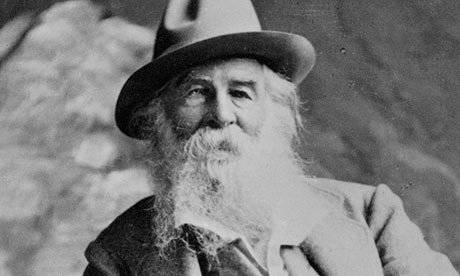
 Whitman and the Moth
Van Wyck Brooks tells us Whitman in old age
Sat by a pond in nothing but his hat,
Crowding his final notebooks page by page
With names of trees, birds, bugs and things like that.
The war could never break him, though he’d seen
Horrors in hospitals to chill the soul.
But now, preserved, the Union had turned mean:
Evangelizing greed was in control.
Good reason to despair, yet grief was purged
By tracing how creation reigned supreme.
A pupa cracked, a butterfly emerged:
America, still unfolding from its dream.
Sometimes he rose and waded in the pond,
Soothing his aching feet in the sweet mud.
A moth he knew, of which he had grown fond,
Perched on his hand as if to draw his blood.
But they were joined by what each couldn’t do,
The meeting point where great art comes to pass –
Whitman, who danced and sang but never flew,
The moth, which had not written Leaves of Grass,
Composed a picture of the interchange
Between the mind and all that it transcends
Yet must stay near. No, there was nothing strange
In how he put his hand out to make friends
With such a fragile creature, soft as dust.
Feeling the pond cool as the light grew dim,
He blessed new life, though it had only just
Arrived in time to see the end of him.
––The New Yorker
Ian McEwan on Updike
Posted: May 4, 2011 Filed under: books, fiction, interviews, people Leave a commentMcEwan was interviewed on some of his favorite books, and he launched into an appreciation of John Updike. He’s called him ‘the greatest novelist writing in English at the time of his death’.
Interviewer: What is it about Updike that deserves that praise?
Rabbit At Rest
McEwan: Great sentence-maker; extraordinary noticer; wonderful eye for detail; great fondler of details, to use Nabokov’s phrase. Huge comic gift, finding its supreme expression in the Bech trilogy. A great chronicler, in the Rabbit tetralogy, of American social change in the 40 years spanned by those books. Ruthless about women, ruthless about men. (Feminists are wrong to complain. There’s a hilarious streak of misanthropy in Updike). He reminds us that all good writing, good observation contains a seed of comedy. A wonderful maker of similes. His gift was to render for us the fine print, the minute detail of consciousness, of what it’s like in a certain moment to be another person, to inhabit another mind. In that respect, Angstrom will be his monument.
And it goes on…click here to read the full interview.
lunch with Harold Bloom
Posted: April 22, 2011 Filed under: articles, books, interviews, people Leave a comment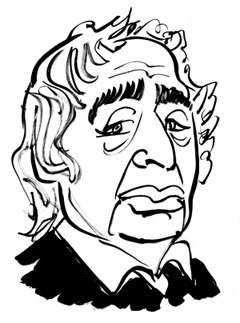
At 80, critic Harold Bloom says he should have departed this world seven times by now, but thank goodness he hasn’t. His 39th book, The Anatomy of Influence: Literature as a Way of Life (published this month by Yale), is due out now. For a dash of Bloomian spirit, see this lunchtime interview in Vanity Fair, click here. Along with Stanley Cavell, Bloom is the best guide to Emerson that we have, and he calls Emerson, in this interview, the “best mind ever to come out of America.”
john jeremiah sullivan
Posted: April 2, 2011 Filed under: books, people, writing Leave a comment JJS, that would be John Jeremiah Sullivan, writes about DFW, that would be David Foster Wallace’s posthumous novel The Pale King, read Death coming for our spirits, in an essay in GQ that hits the target and goes right through it to the other side, leaving you with some certainty that DFW, who is often called a “generational writer,” (which underrates his importance), has been deciphered, but of course that’s creating another fiction, and this is sounding a bit like DFW so check out the essay here, because it’s a watermark in appreciation. The bits about Cormac McCarthy are interesting, as if DFW saw him as his polar opposite, a writer trying to create mountains in a sea of sand. In sections of the uncompleted novel, DFW pays homage to McCarthy’s high-art prose style, or he recognizes its usefulness in shrouding everything in nobility. The photograph shows DFW’s jottings on a book from his library, which is now in the DFW collection at the University of Texas.
Graham Greene
Posted: April 1, 2011 Filed under: books, people, writing Leave a comment
Graham Greene in mid-life
Our worst enemies
here are not
the ignorant
and the simple,
however cruel;
our worst enemies
are the intelligent
and corrupt.
––Graham Greene,
in The Human Factor
Name dropping
Posted: March 31, 2011 Filed under: books, fiction, people, writing 2 Comments Check out page 295 of Jim Harrison’s newest novella collection, The Farmer’s Daughter, when you see a copy. He kindly slipped my name into one sentence in this force majeure book, particularly the first two novellas: The Farmer’s Daughter and Brown Dog Redux. There’s simply no writer like Jim Bear. He shares his buddy Thomas McGuane’s luminous language plus an always beating, warm heart, making for characters that are the closest you’ll ever get to pulsing human blood on the printed page. Plus funny, out loud laughing.
Naipaul’s strange masque
Posted: March 26, 2011 Filed under: articles, books, people Leave a comment I’m 115 pages into V.S. Naipaul’s The Masque of Africa, and it’s one of the weirdest books I’ve ever read; so strange, you’re afraid to speak about how odd it is. After finishing Naipaul’s biography, it’s clear he was brought up with a fear of blacks and what they represented to his class of East Asian-Indian Trinidadian society. It’s something he was never able to leave behind. The book is about a six-month trip he took through the heart of old Africa, in the sense that he was in search of whatever remnants of primeval tribal culture he could find, particularly the spiritual and religious aspects. Certainly, a promising subject for him. But to watch him flounder around, you wonder is this the same writer of the earlier nonfiction books who could take apart a culture in 50 pages? The problem is you can’t be sure of what he’s trying to do here. It may be the ultimate writer’s fatigue or possibly an experiment, some new approach to storytelling (that so far he and I both seem to be trying to untangle). He’s a master of prose. We know that, but the prose here is constantly exuding irony (intended and not intended), condescension, put-ons, farce and cascades of clunky one-liners that highlight naiveté, stupidity, obtuseness, ignorance, on top of which he casts himself as a an awkward character whose rapport with his subjects is based on all of the above. It’s such a literary wreck, you’re forced to keep reading for the wrong reasons. There must be a point to it all, but so far it has eluded him and me. I have no choice but to keep reading in hope of the best and enthralled that it may be what it appears to be––simply bad, a writer whose style and personality have broken down but in a bravura act been put on display for all to see. A sort of ultimate who cares after the Nobel Prize. I just got the quirkiness of the style: it’s Dick and Jane go to Africa. That makes me, and you, the readers, children who will read any little story that keeps chugging along. A sample:
Since life (and death) are so full of snares, there are many ablutions to be done and many taboos to be observed. It is better to be barefoot. For the high priests especially it is taboo to have the soles of their feet covered; these important people must always have a link to the earth. If they are caught wearing shoes, they can be fined. Full shoes are allowed in some shrines, but not slippers. Wherever the high priest walks becomes holy, because he is the physical representation of the spirits, and is possessed by the spirits. The high priest wears white and carries a broom in his hand. The broom stands for his cleansing function.
Naipaul: the calypso rambler
Posted: March 22, 2011 Filed under: articles, books, fiction 2 Comments The V.S. Naipaul biography (The World Is What It Is) is done, confirming the tiresome personality which has become so much of his myth. Fortunately, his biographer chose to treat the negative aspects of his personality as matter of fact; he had no choice; from Naipaul’s beginning as a teenager, it was apparent he was destined to be insecure, egocentric and cruel, seeing himself as privileged. He is impervious and unconcerned about his failings as a human being. He’s cultivated, and had it cultivated for him by others, a myth that he sacrificed all for his art, but I don’t see it that way. To say that, is to say you have no responsibility to the people around you, whether casual strangers or loved ones. He is routinely awful to too many people. About the only thing positive that can be said for his cruelty and rudeness is that he does it to people face to face, with no pretension. There’s an element of sadism here, the small boy who enjoys torturing the weak and unsuspecting. But enough of that. “Enough,” in fact, is his biographer’s , Patrick French’s, last word in the book, which stops at 1996. In a footnote, French writes, “but more later.” It must be said, I have nothing but admiration for Naipaul’s cooperation with his biographer, allowing him full access to all his papers, etc., and in his comments to his biographer admitting his failings in so many areas regarding those who he loved and who loved him. His mother died estranged from her son. It’s one of the great tragedy’s of his life, which he didn’t comment on.
But I don’t care about Naipaul’s personality. Many people are loaded down with flaws that make them pretentious and unpleasant. But none of them, and few others in the world, can come even close to touching Naipaul’s artistry and vision. It’s perhaps a small stretch to suggest that he changed, at least among a certain circle of intellectuals (left), the way people looked at the third world, and the so-called responsibility of the West. I read A Bend in the River when it was published in 1979 and thought it a masterpiece, which it is. It was written in the period of his great nonfiction books. I was first attracted by his nonfiction writing, which still holds me, and, because of its structure, mostly still holds together, still offering great lessons through its weaving of history, exacting details, personalities and, most essentially, Naipaul’s hardcore distrust of shibboleths and the fashionably correct. At bottom, I guess, it’s his very distrust (and lack of compassion) of other human beings for not taking greater responsibility over their lives that he uses to color his point of view regarding the West and the so-called third world or emerging nations, or the rest of the world. Anyway, his books have been a necessary corrective, truly a monumental achievement, in the literary sense. So now I’m reading his newest book, A Masque of Africa, which starts off with some of the most awkward prose ever written, at least the first 40 pages or so. At the same time, I’m reading his essay on Conrad in Literary Occasions. It’s as if the writing is by two different people. More on this later. There are some signs that Naipaul is mellowing a bit in old age. As his ego melts down, he’ll have much to reckon with, but he can also say that he’s created an unmatchable body of world-class literature. The books will stand for a long time, the rest is soon dust, and eventually the books will be too.
Bedside books
Posted: February 26, 2011 Filed under: books, people, writing Leave a comment
Books by Rembrandt (Iphone photograph)
–The World Is What It Is, The authorized biography of V.S. Naipaul by Patrick French. This looks to be a rock solid, no holds barred appreciation of the ruthless artistry of the Calypso Rambler.
–The Letters of Alan Ginsberg edited by Bill Morgan. A best of the best of AG’s some 3,000-plus letters.
–The Selected Letters of Alan Ginsberg and Gary Snyder edited by Bill Morgan. The two lions of spring who made it to be lions of winter.
–Philip Larkin by Andrew Motion. Someone should do a study on the art of profanity as irony and satire, using the correspondence of Larkin and the chattering conversations of Larkin and Amis. William Empson?
The Etiquette of Freedom
Posted: February 6, 2011 Filed under: articles, books, buddhism, people, reviews, writing Leave a comment This essay originally appeared in The Kyoto Journal, issue No. 76.
The conversation between poets Gary Snyder and Jim Harrison in The Etiquette of Freedom, based on several days spent together while walking over the hills of southern coastal California, is a rare meeting of minds and personalities. A DVD film, The Practice of the Wild, co-produced by Will Hearst and Harrison, accompanies the book, which also contains a generous selection of poems that illustrate Snyder’s ideas. What we have here is a treasure: a rambling conversation between two of America’s most original poets––clear-eyed, unsentimental outsiders, both outdoors men who have spent their life probing the nature of nature.
In Asian terms, Snyder, 80, is the host of the book and film, and Harrison, 73, is the guest. A lifelong fan of Snyder’s work, Harrison assumes a dual role of interviewer—drawing Snyder out, opening up themes, offering him a stage to hold forth, which he does in his usual sharp, light and clear way. We know this encounter is the real thing when Harrison tosses out one of his favorite quotes of D. H. Lawrence that he frequently uses on his own interlocutors: “The only aristocracy is that of consciousness.” It’s easily passed over, but Snyder bites into the moment and their two minds engage:
GS: What do you think he meant by that?
JH: I think he meant that the person who is most conscious lives the most intensely––if “intensity” is the real pecking order, since life is so limited in length, as we are both aware of vividly––
GS: The most vividly. I’m not sure I agree with how he meant that, but that’s a good question.
JH: Why do you disagree?
GS: Oh, because it’s too spectacular, too romantic.
JH: Well, so was he.
GS: Of course. At any rate, you could set that beside an East Asian idea of the aristocracy of consciousness, and a Chinese or Korean idea of that would be much calmer, much cooler. Not like a hard glowing gem-like flame, not like a flaming candle burning out––
JH: That’s what Kobun Chino Sensei said; they criticized his friend Deshimaru because he said, “You must pay attention as if you had a fire burning in your hair.” And Kobun said, “You must pay attention as if you were drawing a glass of water.
GS: Oh, that’s better.
JH: The concept of the divine ordinary.
The title, The Etiquette of Freedom, comes from one of his early seminal essays, at the heart of The Practice of the Wild (1990), which explores his ideas behind the terms Nature, the Wild and Wilderness. In their fullness, the three terms are meant to encompass all aspects of phenomenal life, the whole of creation, a process in which humans are one part (though vastly threatening to the other parts). He wrote: “The lessons we learn from the wild become the etiquette of freedom [for humans].” Approaching Nature from the largest perspective, says Snyder, has sometimes caused him to be misunderstood.
GS: People, including environmentalists, have not taken well to the distinctions I tried to make between Nature, the wild and wilderness. You know, I want to say again, the way I want to use the word “Nature” would mean the whole universe.
JH: Truly.
GS: Yes, like in physics.
JH: Right, exactly.
GS: So not the outdoors.
JH: No. That’s a false dichotomy.
GS: Yes.
JH: –or a dualism.
GS: Yes, Nature is what we’re in.

gary snyder
The term “wild,” as used by Snyder, is a metaphor for the natural processes within Nature when least affected by man’s disproportionately heavy hand (but even our destructive, consumptive role is part of the natural process, as Nature, in the broadest sense, is constantly engaged in a vastly complicated destruction, consumption and renewal). Fully understanding these terms is conjoined by the role of time as measured in hundreds of thousands and millions of years and not at the rate of humankind’s anthropocentric perspective. For more on these terms, see The Practice of the Wild, where he wrote, “Nature is not a place to visit, it is home,” and, in a prophetic stroke: “It is the present time, the 12,000 or so years since the ice age and the 12,000 thousand or so years yet to come, that is our territory. We will be judged or judge ourselves by how we have lived with each other and the world during these two decamillennia.” For more on his ideas on bioregionalism and environmental issues, see Turtle Island(1974), his homage to North America, and his other essay collections and talks: The Real Work (1980),A Place in Space (1995) and Back on the Fire (2007). All of Snyder’s essays are gems. Those on Buddhist themes are filled with poetic prose rising to the level of inspired teishos.
The title, The Etiquette of Freedom, functions as a loaded metaphor, speaking of the importance of living in Nature with a humbleness that reflects humans’ disproportionate role—and responsibility—within the natural processes of creation and life and death. Etiquette means to show respect to a person or occasion. We see this attitude reflected worldwide in ancient cultures when someone asks for understanding before taking a creature’s life or before felling a tree for a home. By exercising an “etiquette” relationship with Nature, we can realign our sense of place and in turn, we experience a greater correctness in a more responsible relationship with Nature. Snyder himself has come to personify a meme which evolved out of the counterculture movment and has been absorbed into mainstream culture: the way to a richer life is to settle in, to reinhabit a rural area, to learn the names of the plants and animals, the geology, the history of the indigenous people, to study the folklore, to engage in civic life, to pay attention to the schools, to deepen one’s sense of self, to live life fully as a thoughtful member of a bioregion in which one strives to play a grateful and productive role. It is a meme for a practical, reality-based approach to life, and one which he played a major role in creating.

Poets Snyder and Harrison with Snyder’s dog Emi
The interplay between the individual and Nature has been Snyder’s subject since his first translations of Cold Mountain (Han-shan) poems as a student at Berkeley. For more than 50 years, he has been the American poet who has most fully embraced the subject of Nature, and the nature of consciousness. In 1955, he left America for Japan to study Zen. His public life began, in a way, as a fictional character in the novel Dharma Bums (1958), in which Jack Kerouac created a charismatic, heroic character named Japhy Ryder (Gary Snyder)—a young, self-assured American poet and outdoors man. In the late-60s, when he returned from Japan to live in America again, he immediately became a central figure in the evolving counterculture. His influence was based on his poetry and his practical ideas of returning to the land, which were embraced as a rallying cry by many young people, and canny elders. His approach was an extension of Emerson’s and Thoreau’s ideas on self-reliance and nature, and Buddhist philosophy. Wary of becoming a counterculture spokesperson, he quickly retreated to live in the isolated Sierra foothills near Nevada City, where he worked on his craft. After Turtle Island, he assumed a role of poet and environmental social critic. In his late period, he taught at the University of California at Davis, while continuing to publish poems and essays. Since then, the mythology surrounding him as a teacher has deepened. Over the coming decades, his work will travel well beyond America’s shores, and one feels the mythology has only just begun.
Snyder’s work has always been aligned with his commitment to Zen. Looking back now, his poetry and essays fan out like one long scroll of his life, a record of what he’s seen and felt and learned. To throw him together here with Jim Harrison’s highly refined Ikkyu-like spirit is a gift—two American poets who have extended the lineage of Emerson and Thoreau (Dogen and Han-shan)—two old men, well-seasoned and free, walking and talking, and turning the wheel.
Review photographs copyrighted San Simeon Films.
 the roy hamric journal