
Dreams
Posted: December 14, 2014 Filed under: articles, buddhism, states of mind | Tags: the subconscious, zen dreams Leave a commentTwo Dreams:
Roxy Pays a Visit
Jan. 9, 1989
 My friend, the writer Roxy Gordon, and I are standing beside each other, watching life-sized skeletons dancing in the air. The sounds of rattling bones surround us. Suddenly, I turn into an owl, and I hoot three times deeply, hoo, hoo, hoo. Then I’m awake in my bed, and I’m still hooting in the dark. Who, who, who?
Fly Me to the Moon
May 27, 1989
I’m in a small room talking with a monk. He doesn’t want to answer my questions. He’s called away and leaves me alone in the house. I look through the rooms for books, poems or writing of any type to read. I find a magazine and some old books about stars. I see a scroll painting sticking out from under the monk’s bed. I feel cheap and phony for nosing around behind his back.
Then the monk returns, and we are standing outside in the dark. There’s a threat of danger from somewhere, and the monk says, okay. Suddenly, we’re flying through the vast, cold sky with the moon on our right. We fly through space until we suddenly enter heaven. We turn around and fly faster, downward toward Earth. Then a spacecraft is shooting at us. The monk creates a cloud cover to enter Earth’s atmosphere undetected. Suddenly, I notice several hundred babies are flying behind us and they are in our care — all pure and ready to be born.
When we land on Earth, the babies disappear, and I say, “Be careful, they’ll try to get you.” Then I’m back in the monk’s room. We’re aware someone is searching for us, and we have to leave.
For Ikkyu
Posted: September 7, 2014 Filed under: buddhism, people, poetry, states of mind, writing Leave a comment
Spoon strikes cup,
Sound made flesh
Each time the door opens
Something is given and given up
Upon waking: The corpse dances
In the empty casket
Rock on the ground
Moon in the cosmos –
Breathe this.
Red Pine: A Timely Interview On Release Of Yellow River Odyssey
Posted: July 25, 2014 Filed under: articles, books, buddhism, interviews, people, photography Leave a comment
The Sinosphere blog of The New York Times has published an interview with Bill Porter, who also publishes translations of Chinese texts under the pseudonym of Red Pine, upon the release of his Yellow River Odyssey, a travel journal written just prior to China’s emergence into the modern world. His extensive photographs of the trip capture a China that has largely disappeared. Many of Red Pine’s books are now bestsellers in China, after being translated from English into Chinese, including his translations and commentaries on Buddhist poems and sutras. The interview is by China correspondent Ian Johnson, and can be read here.
Yellow River Odyssey is published by Chin Music Press.
Zen Teacher Ruben Habito: Good Interview
Posted: July 15, 2014 Filed under: articles, books, buddhism, people Leave a comment Ruben Habito, my Zen teacher for many years, who will always be a core presence in my life, continues on his path, bringing Zen to Texas, writing his many books on Zen, and opening himself and his zendo to teaching anyone who seeks a way into Zen practice or a way to experience their own religion more intimately. Over the years, his students have been agnostics, Jews, Christians, and members of other faiths, all seeking to experience life more deeply and simply. This interview, which appeared in Tricycle, is typical of Ruben, gently building bridges that can lead Christians and others into Zen practice, pointing to the connections that bind us all to each thing. I wrote a chapter on Ruben in my travel/memoir, which is sitting silently now unable to find an agent or publisher. If for no other reason, I would like the book to be published if only to spread the word about Ruben’s unique life, profound understanding of people, and his unwavering commitment to compassion. As more years pass without seeing him, I miss him more and more while at the same time feeling his presence grow even deeper.
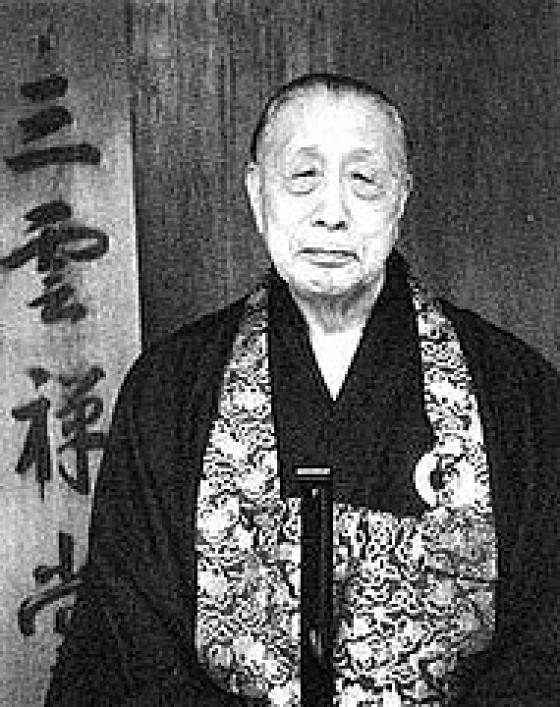
Roshi Koun Yamada, Ruben Habito’s teacher
Kyoto: Walking One Step at a Time
Posted: July 2, 2014 Filed under: books, buddhism, places, sight seeing Leave a comment “Mountains walking is just like humans walking. Do not doubt mountains walking even though it does not look like human walking.” – Dogen, Jan. 19, 1200, Kyoto, Kyoto Prefecture, Japan.
Where else better to take a thoughtful walk than in Kyoto, home to so many worthies who have graced its streets and paths. Ted Taylor and Michael Lambe have put together a paean to walking through Japan’s most intimate city, savouring the ancient temples and today’s artful graffiti. The anthology, Deep Kyoto Walks, includes Pico Iyer and others, and this is one of those books that takes you to where you didn’t know you wanted to go. Sixteen writers who know Kyoto pay tribute to life in the city of “Purple Hills and Crystal Streams,” offering a testament to the art of contemplative city walking.
“I had to acknowledge that I had to come to Japan in order to see that a 7-Eleven here was just as Japanese — as foreign — as any meditation hall, and no less full of wonder…” – Pico Iyer, Into the Tumult

About That Bowl
Posted: June 29, 2014 Filed under: buddhism, poetry, states of mind Leave a commentAbout That Bowl
Round it is, the bowl I placed
in a hut in a mountain valley.
For a moment, its dominion
arises, a matter of form and space,
or so one thinks – that bowl and
emptiness – giving and taking
like nothing else.
But it’s not about one or the other –
or wilderness or hearth. In usefulness,
wildness is swept away,
for a moment, but then it returns
like nothing else.
Morning Practice
Posted: June 28, 2014 Filed under: buddhism, poetry, writing Leave a commentMorning Practice
When my eyes open at dawn’s light
the question naturally arises,
whose arms are these – flaccid pink
skin draping off brittle bones?
On the pillow there’s some long hairs – mine
or the two dogs, Roxy and Daisy, sleeping on
the bed? Before, the long hairs were always
a woman’s, her body pressed close
in the morning chill.
Now part of my lung is gone, infiltrated
by swarming molecules hungry to
devour my breath. It’s rationed now.
My heart beats harder to help
its neighbor. My heart’s comforting
sound fills my chest, but my morning
cough sounds like a sick man.
One beat, one breath….
Good practice for a lazy man.
As Su Tung p’o said,
“I’m a tired horse unharnessed at last.”
Minding My Time
Posted: June 27, 2014 Filed under: buddhism, poetry, states of mind, writing Leave a commentMinding My Time
Awash in mind time. Mind’s always mattering,
mothering: words, sensations, feelings always
forming stuff. Words always mattering
in Universe of Matter. That’s all (not really for
Roy & Laddawan and the Thai band playing Eric Clapton).
Mind called self is just the go-between
for no-body. Big Self mothers every thing
– knows like a bone every thing’s just co-
existing meaning-matter like mothering sky.
Right now in Chiang Mai at 1:18 a.m.
as a tiny candle lantern rises golden
in the night like a star.
Edward Slingerland on Wu-Wei
Posted: June 26, 2014 Filed under: articles, buddhism, people, states of mind, time, space Leave a comment
Wu-Wei.
There are two very interesting articles in the new Edge issue. The first, by Terence McKenna, ranges freely all over the map and makes many interesting observations about the chemical processes that involve mind, cognition, language and blissing out…lots of attention is given to the role of ego, its development, non-development, etc. It’s imminently worth reading for its many gem-like insights.
Also, see the article by Edward Slingerland (scroll down on the Edge website) on the role of wu-wei, sometimes deceptively called “non-action,” in Chinese culture. He’s the author of Effortless Action: Wu-wei as Conceptual Metaphor and Spiritual Ideal in Early China. It’s actually a process of checking on the ego…something the world, the politicians and each of us needs to give ever greater attention. His website is here.
The two articles, in many ways, complement each other.
Here’s a taste of where Slingerland is going with his latest (2014) book on wu-wei, Trying Not to Try.
“In a lot of my recent work I’ve been arguing that these early Chinese models of ethical reasoning, ethical training are psychologically much more, from a modern perspective, more plausible than some modern Western ideas. In some ways I’m arguing that the early Chinese got some stuff right that we got wrong in the Western philosophical tradition. They like to hear that. And I believe this is true. They were very sophisticated moral psychologists, and they’ve got some insights into the way that we reason about morality and the way we train people that I think are a really important corrective to the way we’ve been thinking about ethics in the West.

Edward Slingerland
“But on the other hand I am a critic of certain aspects of the modern Chinese state, and I also worry about the rate of development. I was there in the 80s in mainland China, and going from Taiwan to mainland China was like going in a time machine. Taiwan was relatively modernized. I don’t know how I got to Hong Kong, but I took a boat up the Pearl River from Hong Kong to Canton, to Guangzhou. It was an overnight boat, and I got out in the morning and it was like I’d gone back in time 100 years; there were no cars, no motorcycles, everyone was riding bikes. It was an unbelievable change. Now I go back to Guangzhou and there’s these superhighways and these huge buildings, and it all happened—well, that was not that long ago. So the rate of change is wild. It’s just incomprehensible. I just wonder about how sustainable it is, because it’s creating a lot of wealth inequality and a lot of dislocation.
“I still have my area that is my specialty and now I’m going to bring these new tools to bear on that specialty. A good example is that Effortless Action book back in 2003 that was my transformed dissertation. I have an argument there that one way to look at the trajectory of Chinese thought is that it’s driven by this tension I call “the paradox of wu-wei.” Wu-wei is effortless action or spontaneity. They all want you to be wu-wei, but none of them think you are right now. You’ve got to try to be wu-wei, but how do you try not to try? How do you try to be spontaneous?
 “So, I call it the paradox of wu-wei, and I argue it’s at the center of all their theorizing about other things. Their theories about human nature, their theories about self-cultivation, their theories about government—these are all ways of grappling with this central tension that’s driving a lot of the theorizing. That claim got criticized, so my former advisor wrote a very scathing critique of it. A lot of people didn’t buy this claim that, first of all, it’s really a paradox, and second of all that it really has any kind of central prominence in early Chinese thought.
“One of the things I’ve been able to do to with the new knowledge I’ve gained from the sciences is come back to this, revisit this topic again, and say, look, from a cognitive neuroscientific perspective, we actually understand why this is a paradox, why using cognitive control to shut down cognitive control is tricky—it’s inherently tricky. We have a lot of evidence from social psychology and sports science and other areas that show that in fact effortless, spontaneous action is very desirable, because hot cognition is very powerful. Work on the power of the unconscious, the adaptive unconscious. We also, from an evolutionary perspective, have an understanding of why the fact that the paradox is a paradox is why it gets focused on.
“Essentially in our theories about where large scale societies come from, the crucial role is played by trust and commitment. It’s really crucial, if we’re going to cooperate I’ve got to believe that you’re committed to this religion or belief system that we are sharing and not just in it for your own good. There’re lots of ways I can assess your commitment. One of them is whether or not you’re being spontaneous. If I see evidence of cognitive control in you, I start to think that maybe something’s going on, because when we’re being conscious and using cognitive control, we’re often doing it to deceive or lie or figure out what’s best for us. The Chinese believe when you’re in wu-wei, you have this power called “de”. It’s like a charismatic virtue. People like you, people trust you. I’m arguing that we can understand this from a naturalistic perspective as the attractiveness someone who is spontaneous kicks off, and for very good game theoretical reasons. Basically you can relate it directly to evolutionary concerns about cooperation.”
Read Stonehouse In Troubled Times
Posted: May 30, 2014 Filed under: buddhism, people, poetry 1 Comment
IPhone photograph
Scorpion tails and wolf hearts overrun the world everyone has a trick to get ahead but how many smiles in a lifetime how many moments of peace in a day who knows a toppled cart means try another track when trouble strikes there is no time for shame this old monk isn’t just talking he’s trying to remove your obstacles and chains
– From The Zen Works of Stonehouse: Poems and Talks of a 14th Century Chinese Hermit, translated by Red Pine (Counterpoint 1999).
 the roy hamric journal