
Sounds like Wittgenstein, but isn’t
Posted: November 22, 2011 Filed under: buddhism, poetry, states of mind Leave a commentNothing Is Always Absolutely So
This came to me today on the Oxford Dictionary’s Word of the Day , and is associated with Theodore H. Sturgeon (1918–85, born Edward Hamilton Waldo), a U.S. science fiction writer.
Very rich in multiple meanings, it speaks in that fine musical way beyond concreteness of language, moving on into another unfixed place in our mind.
Reading Stonehouse
Posted: August 3, 2011 Filed under: books, buddhism, poetry Leave a comment Stonehouse, the Zen hermit poet of 14th century China, writes so simply his wisdom often escapes the reader who is tangled up in the flow of words and images. Translated by Red Pine, the book remains a classic.
Look for the real and it becomes more distant/ try to end delusions and they just increase/ followers of the Way have a place that stays serene/ when the moon is in the sky it’s reflection is in the waves
Bedside Books
Posted: July 24, 2011 Filed under: books, buddhism, people, reviews 1 Comment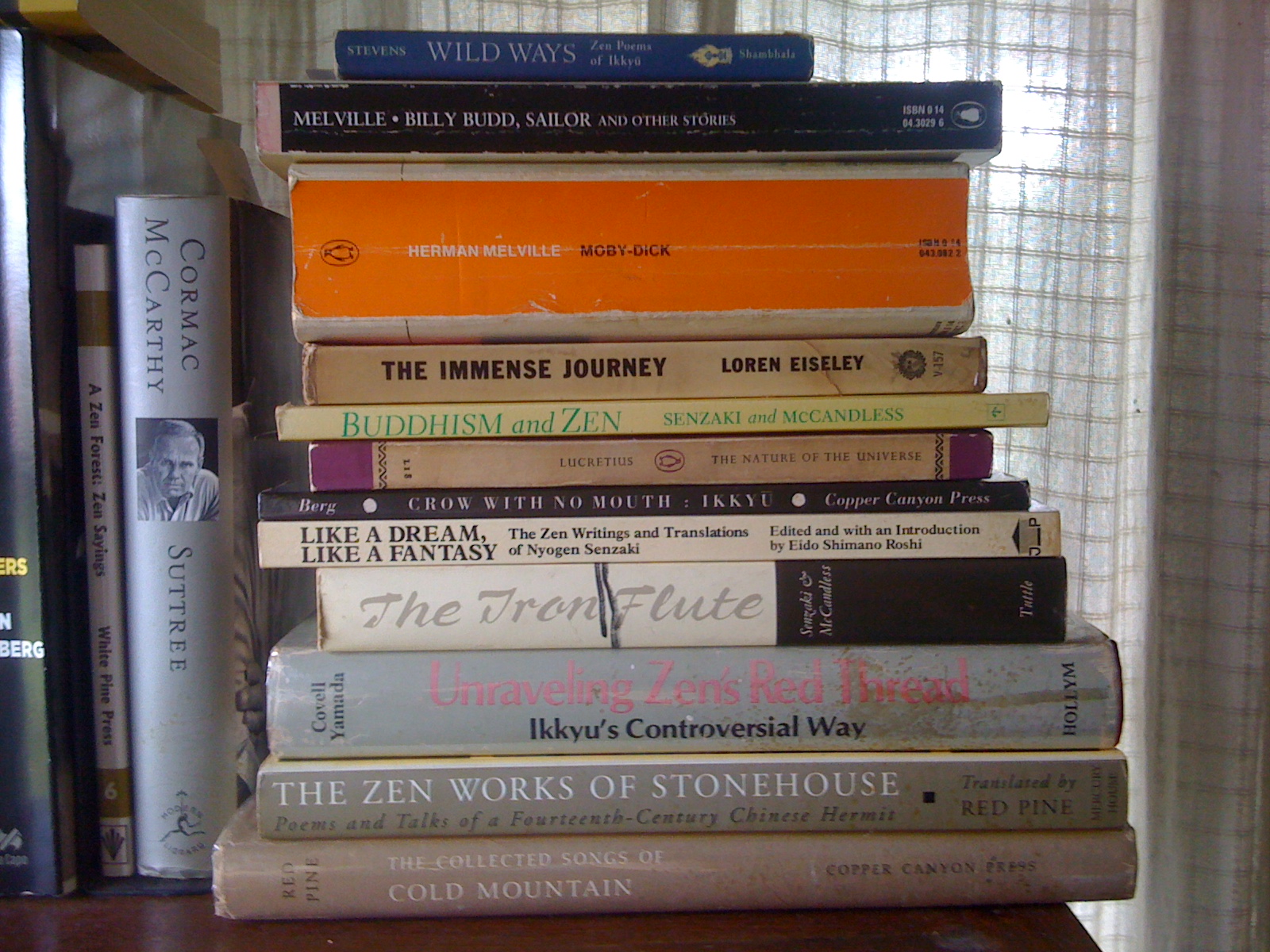
I haven’t read much in Zen for the past year, because I had over read. It’s ok to read too much Zen starting out because there’s a need to be filled, to be satiated, a lot of history and people to absorb and put into place. Afterwards, moderate careful re-reading is called for to check your new perceptions against old feelings and understanding. As we get older, all re-reading quickly becomes less satisfying or more rewarding––it’s a test of earlier states of mind.
Like a Dream, Like a Fantasy by Nyogen Sensaki (1876 to 1958) is a fruitful return to one of the most enigmatic and admirable Zen men in America. His Japanese mother died at his birth in Russia (his father may have been Chinese). He was adopted by a Japanese monk-Kegon scholar and raised in monasteries in Japan where he eventually rejected “Cathedral” Zen. The clue to his subsequent vagabond wanderings from Japan to San Francisco to Los Angeles (to the Heart Mountain World War II internment camp in Wyoming) is his growing up without knowing his mother or father. He felt most comfortable losing himself in anonymity, disappearing, but his calling was Zen and he always had a group of Zen students attending his “floating” zendo; he supported himself in humble odd jobs and donations from students. He was quietly teaching Zen in the 30s-40s when there were no Zen teachers in the US. A beautiful poet, he wrote a poem each year dedicated to his teacher-mentor, Soen Shaku, which he read in a talk he would give in a rented auditorium. Other Zen greats who were kindred spirits and friends were D.T. Suzuki and Soen Nakagawa. There are at least four or five key books of his writings in English besides LDLF: Buddhism and Zen and The Iron Flute, where he comments on 100 Zen koans are highly recommended. See also Zen Flesh, Zen Bones by Reps which contains more of his essays.
The Zen Works of Stonehouse translated by Red Pine. Subtitle: Poems and talks of a 14th Century Zen Master. Stonehouse (born 1272), a largely unknown Zen-hermit-poet before Red Pine’s book, ranks alongside Han-shan as the two exemplar hermit-poets of China. The reason is simple: he wrote a fully shaped, free verse picture of his life in the mountains, an unsentimental summing up, and his clear voice takes you into his daily routine. Autobiography underrates the accomplishment.
The Poems of Cold Mountain translated by Red Pine; Writen sometime between 600 to 900 A.D., Han-shan epitomizes the free-spirited, go-my-own way Zen life. Stories about him and his buddy Pick-Up who worked in the kitchen of the Kuo Ch’ing Monastery abound for their exploits as crazy talking, carefree misfits.
The Nature of the Universe by Lucretius. I’m totally deficient in reading Greek and Latin writers and philosophers so after reading about Lucretius’s shaping influence on critic Harold Bloom this book caught my eye at the neighborhood used bookstore, plus it’s a beautiful 1955 copy of a Penguin Classic with a purple-bordered cover.
Unraveling Zen’s Red Thread by Covell and Yamada. Ikkyu was one of the premier Zen men of Japanese popular culture who is known for his iconoclastic life among the wine shops and ladies of the night, all well documented in his tangy poems. This reading, including Crow With No Mouth translated by Berg and Wild Ways by Stevens, seems to have let me down. Maybe it’s related to a fundamental loss in the movement of his particular language from Japanese to English. I’m far less taken in by his mind and perceptions, and that’s a loss because I’m fascinated by his life.
CPA: photographs from Asia
Posted: June 14, 2011 Filed under: buddhism, photography Leave a comment
move over stevie ray vaughn
CPA is a photographic and editorial Web site that specializes in historical and contemporary photographs from Asia, the Mid East and other areas. It is run by a gang of Asian specialist, all wise and gifted people. To see a treasure house of images from Asia, check out CPA here. The site can be searched for various cities, ethnic groups, themes, people and other topics. Much historical work and loving attention to details can be seen on the site, which is the most thorough you’ll find outside a major museum. A great resource for people who enjoy travel, whether on the road or in an armchair.
Thomas Merton’s photograph of God
Posted: May 13, 2011 Filed under: buddhism, people, photography Leave a comment
Thomas Merton named this photograph “The Sky Hook,” but he wrote, “It is the only known picture of God.” See my essay Thomas Merton: Looking Through the Window in the On the Record listing.
Thoreau’s koan
Posted: April 25, 2011 Filed under: buddhism, people, states of mind Leave a comment
“I long ago lost a hound, a bay horse and a turtle dove, and am still on their trail. Many are the travelers I have spoken to concerning them, describing their tracks and what calls they answered to. I have met one or two who have heard the hound and the tramp of the horse and even seen the dove disappear behind a cloud, and they seemed as anxious to recover them as if they had lost them themselves.”
Zen sayings
Posted: March 6, 2011 Filed under: buddhism, poetry, states of mind Leave a comment
People use it
daily,
not knowing it.
––From A Zen Forest; ink drawing, butterfly, by Jim Crump
Bop till you drop
Posted: February 11, 2011 Filed under: buddhism Leave a comment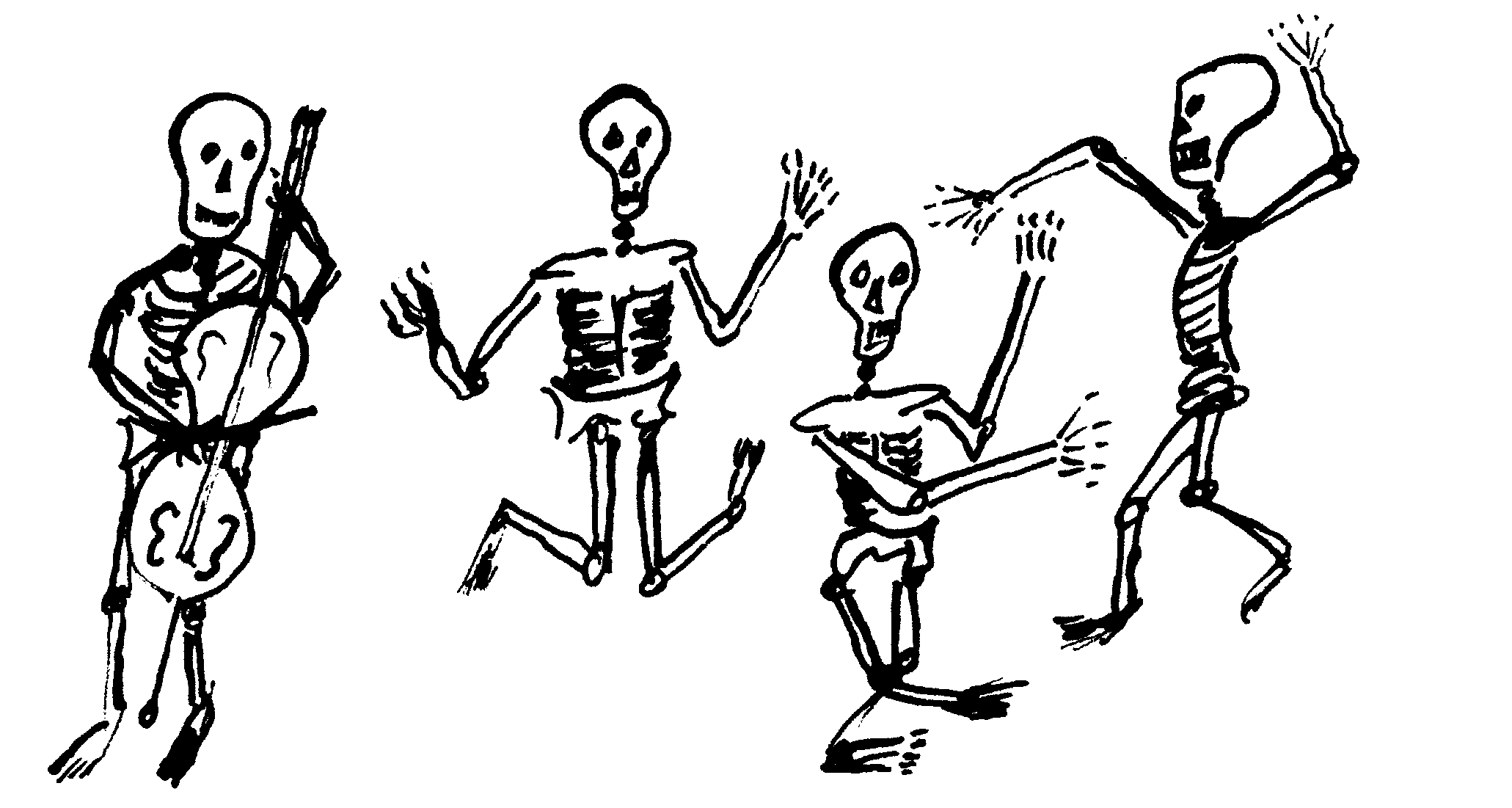
Ink drawing, The Skeleton Dance, by my friend Jim Crump.
He dies,
I die–
Where can we
meet?
–From A Zen Forest
thinking of cold mountain
Posted: February 8, 2011 Filed under: buddhism, poetry, states of mind Leave a commentZen sayings
Posted: February 7, 2011 Filed under: buddhism, photography, poetry, states of mind, writing 2 Comments
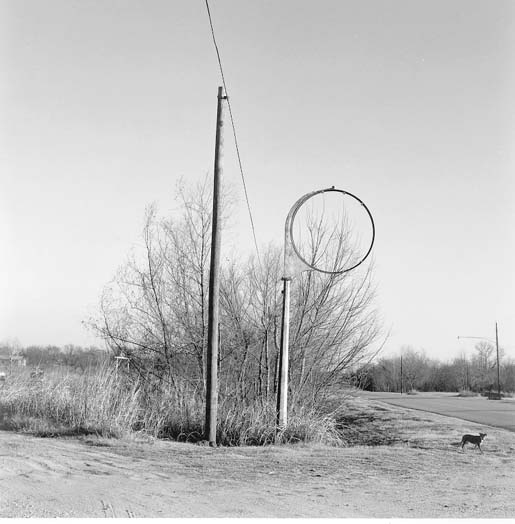
empty circle & dog (photograph Roy Hamric)
Looking
forward only,
Not knowing how
to look back.
– from A Zen Forest
 the roy hamric journal