
The Etiquette of Freedom
Posted: February 6, 2011 Filed under: articles, books, buddhism, people, reviews, writing Leave a comment This essay originally appeared in The Kyoto Journal, issue No. 76.
The conversation between poets Gary Snyder and Jim Harrison in The Etiquette of Freedom, based on several days spent together while walking over the hills of southern coastal California, is a rare meeting of minds and personalities. A DVD film, The Practice of the Wild, co-produced by Will Hearst and Harrison, accompanies the book, which also contains a generous selection of poems that illustrate Snyder’s ideas. What we have here is a treasure: a rambling conversation between two of America’s most original poets––clear-eyed, unsentimental outsiders, both outdoors men who have spent their life probing the nature of nature.
In Asian terms, Snyder, 80, is the host of the book and film, and Harrison, 73, is the guest. A lifelong fan of Snyder’s work, Harrison assumes a dual role of interviewer—drawing Snyder out, opening up themes, offering him a stage to hold forth, which he does in his usual sharp, light and clear way. We know this encounter is the real thing when Harrison tosses out one of his favorite quotes of D. H. Lawrence that he frequently uses on his own interlocutors: “The only aristocracy is that of consciousness.” It’s easily passed over, but Snyder bites into the moment and their two minds engage:
GS: What do you think he meant by that?
JH: I think he meant that the person who is most conscious lives the most intensely––if “intensity” is the real pecking order, since life is so limited in length, as we are both aware of vividly––
GS: The most vividly. I’m not sure I agree with how he meant that, but that’s a good question.
JH: Why do you disagree?
GS: Oh, because it’s too spectacular, too romantic.
JH: Well, so was he.
GS: Of course. At any rate, you could set that beside an East Asian idea of the aristocracy of consciousness, and a Chinese or Korean idea of that would be much calmer, much cooler. Not like a hard glowing gem-like flame, not like a flaming candle burning out––
JH: That’s what Kobun Chino Sensei said; they criticized his friend Deshimaru because he said, “You must pay attention as if you had a fire burning in your hair.” And Kobun said, “You must pay attention as if you were drawing a glass of water.
GS: Oh, that’s better.
JH: The concept of the divine ordinary.
The title, The Etiquette of Freedom, comes from one of his early seminal essays, at the heart of The Practice of the Wild (1990), which explores his ideas behind the terms Nature, the Wild and Wilderness. In their fullness, the three terms are meant to encompass all aspects of phenomenal life, the whole of creation, a process in which humans are one part (though vastly threatening to the other parts). He wrote: “The lessons we learn from the wild become the etiquette of freedom [for humans].” Approaching Nature from the largest perspective, says Snyder, has sometimes caused him to be misunderstood.
GS: People, including environmentalists, have not taken well to the distinctions I tried to make between Nature, the wild and wilderness. You know, I want to say again, the way I want to use the word “Nature” would mean the whole universe.
JH: Truly.
GS: Yes, like in physics.
JH: Right, exactly.
GS: So not the outdoors.
JH: No. That’s a false dichotomy.
GS: Yes.
JH: –or a dualism.
GS: Yes, Nature is what we’re in.

gary snyder
The term “wild,” as used by Snyder, is a metaphor for the natural processes within Nature when least affected by man’s disproportionately heavy hand (but even our destructive, consumptive role is part of the natural process, as Nature, in the broadest sense, is constantly engaged in a vastly complicated destruction, consumption and renewal). Fully understanding these terms is conjoined by the role of time as measured in hundreds of thousands and millions of years and not at the rate of humankind’s anthropocentric perspective. For more on these terms, see The Practice of the Wild, where he wrote, “Nature is not a place to visit, it is home,” and, in a prophetic stroke: “It is the present time, the 12,000 or so years since the ice age and the 12,000 thousand or so years yet to come, that is our territory. We will be judged or judge ourselves by how we have lived with each other and the world during these two decamillennia.” For more on his ideas on bioregionalism and environmental issues, see Turtle Island(1974), his homage to North America, and his other essay collections and talks: The Real Work (1980),A Place in Space (1995) and Back on the Fire (2007). All of Snyder’s essays are gems. Those on Buddhist themes are filled with poetic prose rising to the level of inspired teishos.
The title, The Etiquette of Freedom, functions as a loaded metaphor, speaking of the importance of living in Nature with a humbleness that reflects humans’ disproportionate role—and responsibility—within the natural processes of creation and life and death. Etiquette means to show respect to a person or occasion. We see this attitude reflected worldwide in ancient cultures when someone asks for understanding before taking a creature’s life or before felling a tree for a home. By exercising an “etiquette” relationship with Nature, we can realign our sense of place and in turn, we experience a greater correctness in a more responsible relationship with Nature. Snyder himself has come to personify a meme which evolved out of the counterculture movment and has been absorbed into mainstream culture: the way to a richer life is to settle in, to reinhabit a rural area, to learn the names of the plants and animals, the geology, the history of the indigenous people, to study the folklore, to engage in civic life, to pay attention to the schools, to deepen one’s sense of self, to live life fully as a thoughtful member of a bioregion in which one strives to play a grateful and productive role. It is a meme for a practical, reality-based approach to life, and one which he played a major role in creating.

Poets Snyder and Harrison with Snyder’s dog Emi
The interplay between the individual and Nature has been Snyder’s subject since his first translations of Cold Mountain (Han-shan) poems as a student at Berkeley. For more than 50 years, he has been the American poet who has most fully embraced the subject of Nature, and the nature of consciousness. In 1955, he left America for Japan to study Zen. His public life began, in a way, as a fictional character in the novel Dharma Bums (1958), in which Jack Kerouac created a charismatic, heroic character named Japhy Ryder (Gary Snyder)—a young, self-assured American poet and outdoors man. In the late-60s, when he returned from Japan to live in America again, he immediately became a central figure in the evolving counterculture. His influence was based on his poetry and his practical ideas of returning to the land, which were embraced as a rallying cry by many young people, and canny elders. His approach was an extension of Emerson’s and Thoreau’s ideas on self-reliance and nature, and Buddhist philosophy. Wary of becoming a counterculture spokesperson, he quickly retreated to live in the isolated Sierra foothills near Nevada City, where he worked on his craft. After Turtle Island, he assumed a role of poet and environmental social critic. In his late period, he taught at the University of California at Davis, while continuing to publish poems and essays. Since then, the mythology surrounding him as a teacher has deepened. Over the coming decades, his work will travel well beyond America’s shores, and one feels the mythology has only just begun.
Snyder’s work has always been aligned with his commitment to Zen. Looking back now, his poetry and essays fan out like one long scroll of his life, a record of what he’s seen and felt and learned. To throw him together here with Jim Harrison’s highly refined Ikkyu-like spirit is a gift—two American poets who have extended the lineage of Emerson and Thoreau (Dogen and Han-shan)—two old men, well-seasoned and free, walking and talking, and turning the wheel.
Review photographs copyrighted San Simeon Films.
the military & mindfulness
Posted: January 17, 2011 Filed under: articles, buddhism, states of mind Leave a commentA New York Times story today looked at the problem of US soldiers processing an overload of data and making split-second decisions which can save lives or mistakenly take lives.
The military is experimenting with training the soldiers in “mindfulness,” and its methods sound like a crude version of Vipasanna meditation techniques. I’m wondering if the military is aware of the parallels. If not, someone needs to clue the psychologists behind the training program in on one of the world’s oldest, proven techniques for increasing mindfulness.
Here’s a clip from the story, which is linked here.
“The military is trying novel approaches to helping soldiers focus. At an Army base on Oahu, Hawaii, researchers are training soldiers’ brains with a program called “mindfulness-based mind fitness training.” It asks soldiers to concentrate on a part of their body, the feeling of a foot on the floor or of sitting on a chair, and then move to another focus, like listening to the hum of the air-conditioner or passing cars.
“The whole question we’re asking is whether we can rewire the functioning of the attention system through mindfulness,” said one of the researchers, Elizabeth A. Stanley, an assistant professor of security studies at Georgetown University. Recently she received financing to bring the training to a Marine base, and preliminary results from a related pilot study she did with Amishi Jha, a neuroscientist at the University of Miami, found that it helped Marines to focus.”
time, space
Posted: September 5, 2010 Filed under: buddhism, photography Leave a comment
Sept. 4, 11 a.m., small Thai figurines performing the Khon dance in a spirit house (Iphone photograph)
Red Pine: language, poetry, translation
Posted: August 14, 2010 Filed under: articles, buddhism, people, poetry, writing Leave a commentThis essay by Red Pine was first presented as part of the Simmons College International Chinese Poetry Conference, Oct. 8-10, 2004. For more on him, see the On the Record postings.
Dancing with the Dead: Language, Poetry and the Art of Translation
By Red Pine
Every time I translate a book of poems, I learn a new way of dancing. The people with whom I dance, though, are the dead, not the recently departed, but people who have been dead a long time. A thousand years or so seems about right. And the music has to be Chinese. It’s the only music I’ve learned to dance to.
I’m not sure what led me to this conclusion, that translation is like dancing. Buddhist meditation. Language theory. Cognitive psychology. Drugs. Sex. Rock and Roll. My ruminations on the subject go back more than twenty-five years to when I was first living in Taiwan. One day I was browsing through the pirated editions at Caves Bookstore in Taipei, and I picked up a copy of Alan Ginsberg’s Howl. It was like trying to make sense of hieroglyphics. I put it back down and looked for something else. Then a friend loaned me a video of Ginsberg reading Howl. What a difference. In Ginsberg’s voice, I heard the energy and rhythm, the sound and the silence, the vision, the poetry. The same thing happened when I read some of Gary Snyder’s poems then heard him read. The words on a page, I concluded, are not the poem. They are the recipe, not the meal, steps drawn on a dance floor, not the dance.
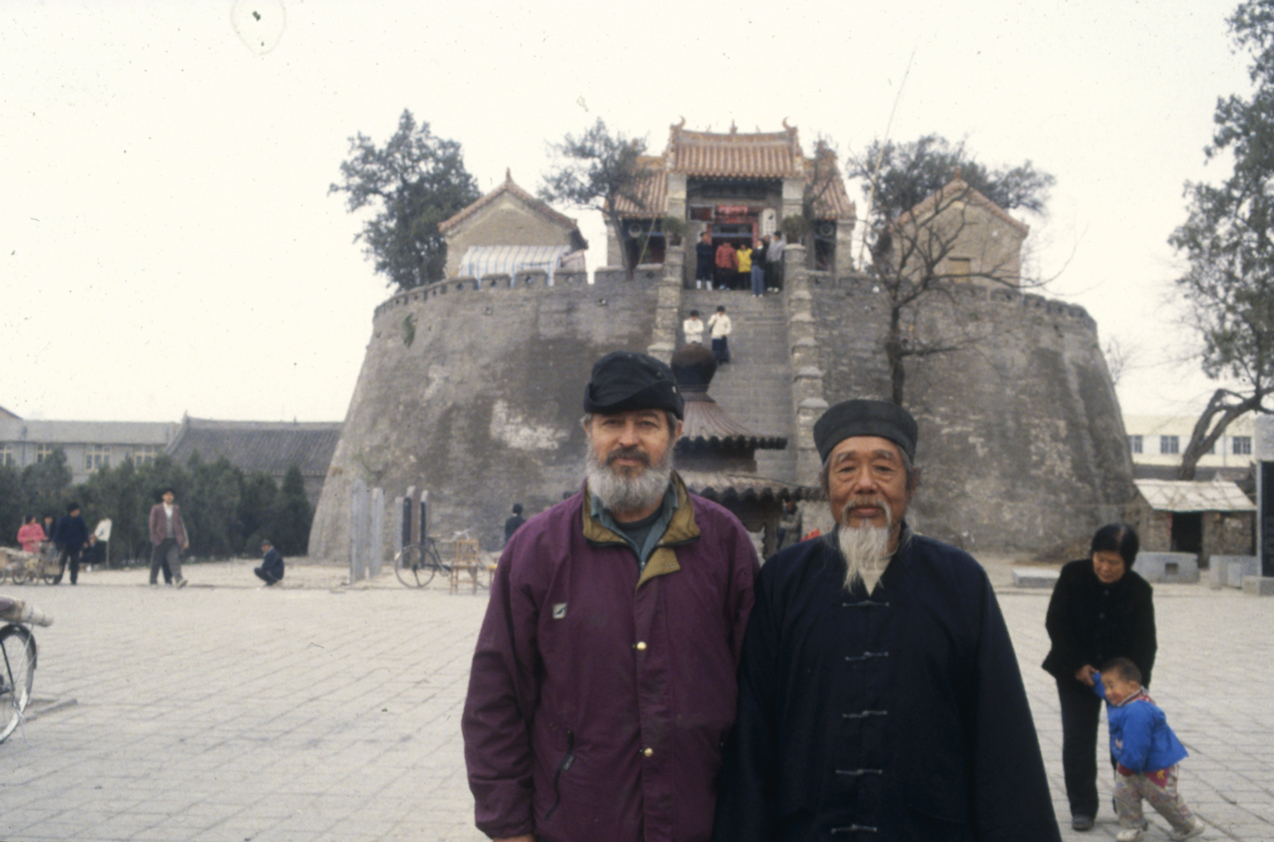
Red Pine with Taoist priest at Lao-tzu's observatory (photograph: Red Pine)
For the past hundred thousand years or so, we human beings have developed language as our primary means of communication—first spoken language and more recently written language. We have used language to convey information to each other, to communicate. But there are a set of questions just below the surface that we prefer not to address. How well does language do what we think it does? And what does it do? The reason we prefer not to address such questions is because language is so mercurial. We can never quite pin it down. It is forever in flux. And it is forever in flux, because we, its speakers and writers and translators, are forever in flux. We can’t step into the same thought twice. We might use or read or hear the same word twice, but how can it mean the same thing if the person who uses or reads or hears that word is not the same person? We speak of language, as if it was a fixed phenomenon, and we teach it and learn it, as if it was carved in stone. But it is more like water, because we are more like water. Language is at the surface of the much deeper flux that is our riverine minds. Thus, if we approach translation by focusing on language alone, we mistake the waves for the river, the tracks for the journey.
But this isn’t all. Many linguists and anthropologists are of the opinion that language was developed by early humans not simply for the purpose of communication but for deception. All beings communicate with each other, but at least on this planet only humans deceive each other. And for such deception, we rely primarily on language. It isn’t easy for us to hide our feelings and intentions in our facial or bodily expressions, but language offers ready and endless opportunities for altering and manipulating the truth. Thus, the question for a translator is not only the efficiency of language, but its truthfulness. That is, does it actually do what we think it does, and does what it does have any basis other than in fiction?
We live in worlds of linguistic fabrication. Pine trees do not grow with the word “pine” hanging from their branches. Nor does a pine tree “welcome” anyone to its shade. It is we who decide what words to use, and, like Alice, what they mean. And what they mean does not necessarily have anything to do with reality. They are sleights of the mind as well as the hand and the lips. And if we mistake words for reality, they are no longer simply sleights but lies. And yet, if we can see them for what they are, if we can see beyond their deception, they are like so many crows on the wing, disappearing with the setting sun into the trees beyond our home. This is what poetry does. It brings us closer to the truth. Not to the truth, for language wilts in such light, but close enough to feel the heat.
According to the Great Preface to the Book of Odes, the Chinese character for poetry means “words from the heart.” This would seem to be a characteristic of poetry in other cultures as well—that it comes from the heart, unlike prose, which comes from the head. Thus, prose retains the deceptive quality of language, while poetry is our ancient and ongoing attempt to transcend language, to overcome its deceptive nature by exploring and exposing the deeper levels of our consciousness and our emotions. Though poetry is still mediated by language, it involves a minimal use of words, and it also weakens the dominance of language through such elements as sound and silence, rhythm and harmony, elements more common to music than logic. In poetry, we come as close as we are likely to get to the meaning and to the heart of another.
This, too, isn’t all. Poetry is not simply “words from the heart.” A poet doesn’t make a poem so much as discover a poem, maybe in a garden or a ghetto, maybe in a garbage dump or a government corridor, or in a galaxy of stars. In poetry, we go beyond ourselves to the heart of the universe, where we might be moved by something as small as a grain of sand or as great as the Ganges.
So what does all this mean for the translator? For me it means that I cannot simply limit myself to the words I find on the page. I have to go deeper, to dive into the river. If language is our greatest collective lie, poetry is our attempt to undo that deception. When I translate a poem, I don’t think of the Chinese on the page as the poem, only evidence of the existence of a poem. Poetry shows itself in words, and words are how we know it. But words are only the surface. Even after poets give their discoveries expression in language, they continue to discover a poem’s deeper nuances, and they make changes: maybe a few words, maybe a few lines, maybe much more. The poem, as I see it, is a never-ending process of discovery. And it isn’t just language. It’s the unspoken vision that impels a poet and to which the poet tries to give expression. But the poet never gives complete expression to that vision, only a few fragments from a kaleidoscopic insight, a few steps on the dance floor impelled by music even the poet hears only imperfectly.
Then a translator comes along, and things change. It is only then that the poet no longer dances alone but with a partner. And together they manifest a deeper insight into the poem, into the music that motivates the dance. Thus, I have come to realize that translation is not just another literary art, it is the ultimate literary art, the ultimate challenge in understanding as well as performance. For me, this means a tango with Li Bai, a waltz with Wei Yingwu, a dance with the dead.
copyright@Bill Porter aka Red Pine
Bedside books II
Posted: August 7, 2010 Filed under: books, buddhism, poetry, writing Leave a commentBangkok Found: Reflections on the City by Alex Kerr. Thailand’s culture is not as highly defined as Japan, and a reliable guide is essential to take one down the roadmap into the origins and esthetics of the country’s food, architecture, design, dance, etiquette and other unique traits. You finish the book feeling you have seen a new Bangkok, a new Thailand, the same as before but deeper now and still mystifying.
 Inside the Whale and Other Essays by George Orwell. Orwell’s prose is always like a fresh drink of water, not overpowering but deeply affecting. He was an early champion of Henry Miller’s Tropic of Cancer, recognizing him as the embodiment of Whitman, a tramp-philosopher outside the circle of conventional society and literature. Orwell’s Politics Vs Literature and Politics and the English Language must be read by all young writers.
Jack Kerouac: Selected Letters 1957-1969. What’s amazing about this volume is that all–ALL–of his major novels were completed by 1957, before his fame. The letters among all the young writers who made up the Beat movement now constitute an American history of soul and intellect among a group of red-blooded poets who were an antidote to the beginning of America’s loss of heart. The tale of Kerouac’s final days has no silver lining. This volume should be followed by the long essay on Kerouac’s funeral by his old friend John Holmes, one of the finest things ever written about him.
 Saving Daylight by Jim Harrison. It’s hard to pick a favorite book of poems by Harrison, but this may be it for its blend of American and Asian flavors set in a homely scene of everyday urgency, of a unique voice on a moment-to-moment quest for more experiences, more abundance of life. This book should be read with his After Ikkyu.
Sexuality and the Psychology of Love by Sigmund Freud. That Freud is discounted in many circles today misses the point. Bloom rightly tells us that Freud is really writing a form of literature cast as a pseudo science (or theory at least), a literature of consciousness and its imagined affects and effects. For a novelist, he’s indispensable: just put his insights below the surface of your characters and you’re off to the races inside the human soul. For a reader, you may squirm at times, but you’re glued to the page because you recognize the unfolding of life, yours and others.
Ikkyu and The Crazy Cloud Anthology by Sonja Arntzen. Ikkyu was the Billy the Kid Zen poet of Medieval Japan who lived with the outlaws and flowers of the night in between trips to his solitary mountain hut and his occasional stint as abbot of some big Zen monastery. A deliciously split personality, he wasn’t willing to give up any element that reminded him that he was human, at-large in life which is not giving away anything free. He left us his life in poems.
the Kyoto Journal: Silk Road
Posted: July 28, 2010 Filed under: buddhism, places Leave a comment
The Kyoto Journal’s new issue is devoted to the Silk Road, and it surpasses even their usual best efforts. To see selected articles and the content, click here.
A Zen man in Texas
Posted: July 12, 2010 Filed under: buddhism, people, writing 11 CommentsA Vietnamese Monk in Grand Prairie and a Philipino Zen Master in Dallas
There is nothing either good or bad, but thinking makes it so––William Shakespeare, Hamlet, Act II
Part I
Thich Tre Hien was a small, wiry Vietnamese monk with a wispy, white beard who had studied for nine years in a Zen monastery in Japan. In early 1988, on a hot summer day in Grand Prairie, Texas, he noticed three men and a woman pacing back and forth on the sidewalk opposite his house, which served as a Vietnamese Buddhist Temple. They carried handmade signs with English writing. Tre Hien’s English was simple, but he could read the writing: “No Vietnamese here,” “Buddhism is a godless religion” and “Repent.” A few cars honked horns as they drove past the house in the blue-collar neighborhood, where many people worked on assembly lines for the large aircraft and automotive manufacturing plants.

Ven. Thich Tre Hien died on 8/8/10
Assigned to Texas a few years earlier by his Vietnamese Buddhist order, he opened his home-temple, Chua Phap Quang (Lotus Dharma) in a suburb just beyond the Dallas city limits to servethe large Vietnamese community. Most were recent refugees who were known as “the boat people,” for their commitment to risk it all to get out of Communist-controlled Vietnam. Grand Prairie, with its redneck reputation, is a long downtown strip of commercial stores on US 180 running west out of Dallas. Southern Baptist fundamentalist churches dominate the area.
Stories about the demonstration appeared in the Dallas newspapers. A few days later, I visited Tre Hien to what was going on. The white clapboard house was shaded by towering pecan trees on a spacious lot surrounded by a well-tended garden of roses and native wildflowers in full bloom, offering bursts of color and beauty in an otherwise drab, car-in-the-yard neighborhood. There were ferns and flowering bushes, bird feeders, wind chimes and a rock pathway winding along the side of the house, where several old cars were parked outside a side door. Dozens of shoes were scattered in front of the door.
I peaked through the screen door into a kitchen. A half dozen Vietnamese sitting on the floor turned to look, a silent pause during an evening meal of noodle soup. Tre Hin came to the door, business like, walking in the slightly flat-footed way that comes from years in a Japanese monastery. He motioned for me to take off my shoes and come inside. Tre Hien was the first true Zen man I had ever met. I say that having never heard him give a teisho, or Zen talk, but based on our conversations in simple English, I am sure of it.
“Please sit, have tea,” he said, smiling. I smiled at everyone and took a seat on the kitchen floor beside a low table holding bowls of pungent Asian food. Tre Hin wore brown, baggy pants and a light yellow T-shirt. A white-haired Vietnamese woman silently cut vegetables, her teeth stained dark red from chewing betel nut. I could see Tre Hein’s sleeping mat on the floor in his bedroom. A bookshelf with a Kuan Yin statue was next to his sleeping mat. He said he didn’t teach Americans at his temple because his English was too poor. Yes, I could meditate in the temple room of the house anytime I wished. There were also two Americans who had recently ordained as a monk living in a small room in the back of the house.
Later that evening, after a large bowl of noodles and duck egg soup, and many cups of tea, I meditated for thirty minutes alone in the temple room, the first time I had actually meditated anywhere outside of my house. The living room had been converted into a temple room with a bright red carpet and a three-foot gold Buddha statue surrounded by a display of flowers from the garden. Chalky spirals of pungent incense drifted across the Buddha’s downcast eyes. I was certain it was the biggest Buddha statue ever to appear in Grand Prairie. I was happy to be sitting alone in the room, breathing slower and slower with the muffled sounds of Vietnamese coming from the kitchen. The sound of Tre Hien’s faint voice steadily rose and fell. I felt like a foreigner in another country––a little self-conscious, on-show. But I began to feel at home in a house full of Vietnamese immigrants.
My legs were in the half-lotus position. A few months before, I had started sitting in my home. As my leg muscles relaxed, I felt a comforting strength rise up my spinal column. After a few minutes, my breathing was almost imperceptible, and my back and shoulders grew more erect. My attention focused on the movement of my breath in and out. I felt a bridge opening up between my head and my stomach, air coming in through my nose, slowly expanding my lungs, expanding my stomach slightly, before passing out again, ever more slowly and naturally. My stomach muscles moved like a bellows, drawing in, expanding, and letting go naturally. The space in my mind cleared as my breath and thoughts moved slower and slower. My body, breath and mind settled and, most important, I was aware of the settling and yet removed at the same time. I smiled inside.
I was 46 years old. I sensed that I had finally found a place that I had been moving toward ever since I read a 61-page book on Zen Buddhism published by The Peter Pauper Press in 1959, when I was seventeen. It was a collection of excerpts from books by D.T. Suzuki. The book had found me early, but why had it taken so long for the journey from that little book to meditating in Tre Hien’s house in Grand Prairie?
Sitting in his temple that night instantly connected me to the tradition of formal Buddhist meditation in a practice that is thousands of years old, a structured, practical way to pursue a well-worn path of fulfilling growth, a way to take hold of one’s life. Tre Hien had come from the East to a redneck suburban neighborhood in Texas to offer me a place to experience my breath slowly moving in and out. He had created a place where I could still my thoughts and energize my mind and body. When I meditate now, decades later, I can taste exactly what it was like to meditate that first time in his home-temple. Tre Hien’s journey from the East to Grand Prairie was the reverse of the journey I took West as a young army recruit, assigned to Vietnam in the first wave of a few hundred Americans who entered the country in 1961, and then again as a grown man ready to start a new life in Thailand.
For two years, I sat three or four nights a week in the temple, along with a fellow American, Ananda, aka Steve Emory, a lanky, 6-foot, 4-inch Dallas native in his early thirties who had lived in the temple for the past year. Gentle and soft-spoken, Ananda guided me into a regular meditation practice and brought me along so that within two months I could in the full-lotus position for a two-hour meditation period with three breaks of five minutes walking meditation. Together, we deepened our practice together, usually ending the night with tea in the kitchen.
After meditation, Tre Hien frequently joined us as we sat on the floor at the low kitchen table. I watched him carefully, but nothing ever seemed to happen out of the ordinary. Then I understood that was it. Nothing out of the ordinary. What is is. It’s an amazing teaching to truly absorb and fully practice. We shared simple conversations, but, even more important, we shared time together and we were comfortable sitting in the silent house sipping tea.
One night, he asked, “How is your meditation?”
“Sometimes things feel far away, ” I said.
“You’re always closer than you think,” he said. That became a teaching that has never left me.
Over the next two years, the little home-temple attracted more Vietnamese. A few Americans drifted in and out, but few stayed around long enough to developed a rigorous meditation practice. The temple had many Vietnamese supporters, but few practiced meditation. Eventually, the home-temple expanded into a large, red brick temple constructed in a vacant area behind the house.
It was timer me to find another place where I could meet more people interested in meditation and Zen. Somehow, I came across the name of Sister Pascaline, a Catholic nun who lived at a retreat in Sand Springs, Oklahoma. I wrote her a letter asking if she knew of a meditation group in the Fort Worth-Dallas area. She immediately wrote back: Ruben Habito. He lived in Dallas. I called and he answered. Yes, he had just started sitting with two or three people a few evenings each week in a room in a small house near the Southern Methodist University campus. Bring your zafu, he said, you’re welcome to join us. There’s a Zen saying: When you’re ready, the teacher will appear. I didn’t know it at the time, but an authorized Zen teacher had finally come to Texas. He was ready to organize a zendo, and I had found my second teacher.
asian moments
Posted: July 11, 2010 Filed under: books, buddhism, people, writing Leave a commentA letter from Red Pine recalling the entrance way into the house of writer John Blofeld in Bangkok:
“I have a black and white photograph of John Blofeld’s yin-yang designed doorway, leading into his garden, at his old home in Bangkok.
Over the doorway was written the first part of the last line of a four-line Li Pai poem: There’s another world.
The rest of the line would have added: Beyond the world of man.”
time, space
Posted: July 7, 2010 Filed under: buddhism, photography, time, space Leave a comment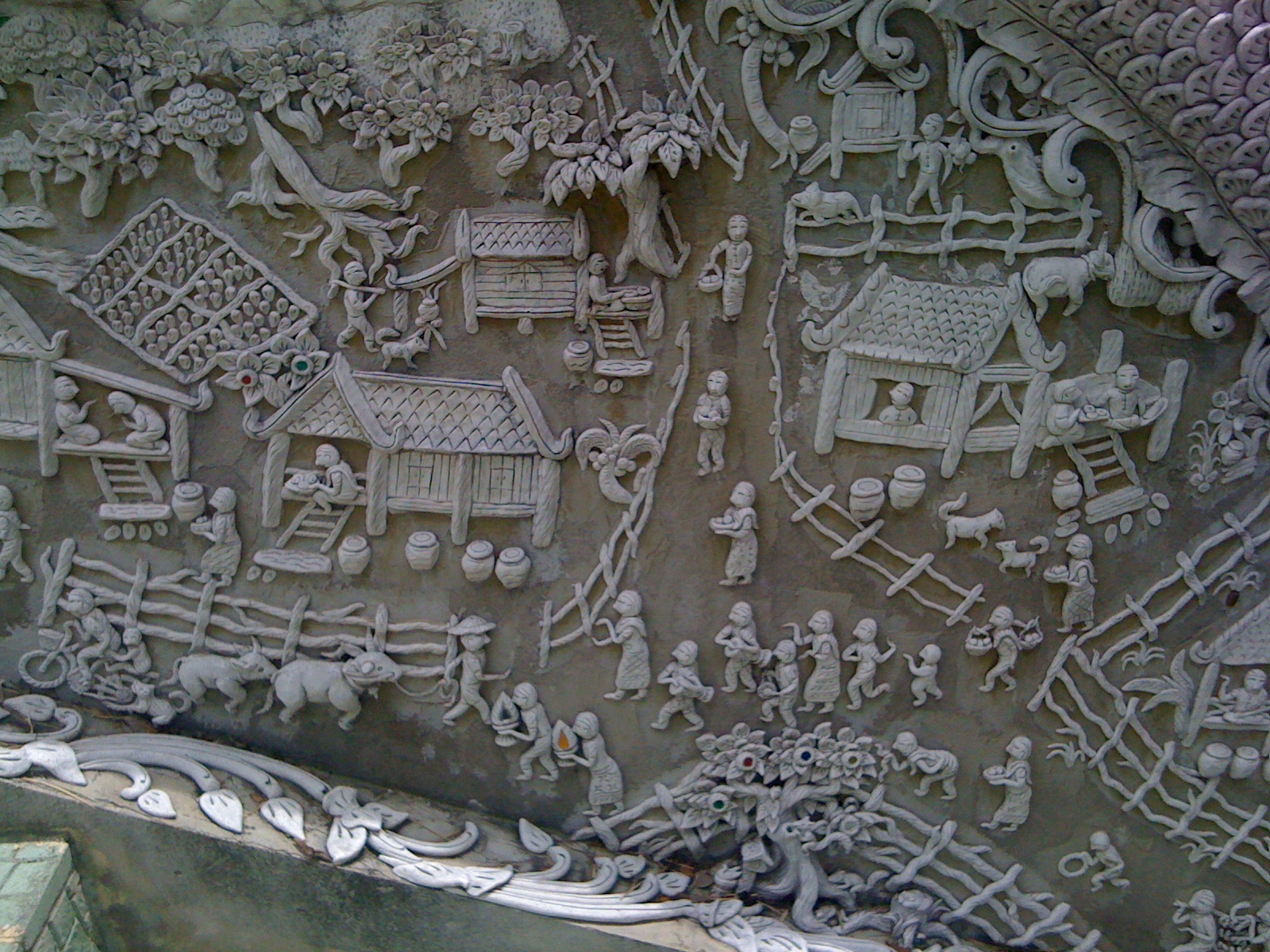
July 6, 3:44 p.m., moulding bas relief of traditional village life on temple stairs in Mae Lim, Thailand. (Iphone photograph)
Zen Baggage by bill porter (red pine)
Posted: July 2, 2010 Filed under: books, buddhism, people, reviews 4 Comments
This review is scheduled to appear in The Kyoto Journal.
Zen Baggage: A Pilgrimage to China by Bill Porter. Berkeley: Counterpoint Press, 359 pp., $16.95 (paper).
You wonder how a book like Zen Baggage could be written. First, who would have guessed that China’s legendary Zen temples would rise from the ashes of the Cultural Revolution and prosper in the new century? And second, what Western writer could pull off a history of Zen in China and then go on to paint a vivid picture of contemporary life in China’s most legendary Zen temples and monasteries?

bill porter in Port Townsend, Washington (2010). photograph by Julie Anand
The only writer I know who could do that justice is Bill Porter, also known as Red Pine, the éminence grise of translators and commentators on Zen and Taoist poetry and texts. In this latest, most personal, travel book, Porter is back on the fertile ground he covered so well in Road to Heaven: Encounters with Chinese Hermits.
Thanks to that book, we know that Taoist hermits continued to practice and live in their remote huts in the Chungnan Mountains throughout the era of China’s Red Guards. The book was a revelation to Westerners and it seems to have fascinated many Chinese as well: the Chinese translation is now in its sixth printing under the title Hidden Orchids of Deserted Valleys.
Porter makes it clear that the average Chinese doesn’t quite know what to make of the legendary Zen temples and monasteries that have become heavily visited pit stops on a sort of Zen Tourist Highway running from Beijing to Hong Kong. Most of the temples are thriving: attracting more monks, building academies, expanding zendos, and refurbishing, enlarging, and promoting themselves in close—maybe too close—cooperation with the Chinese authorities, all under the auspices of a program that seems more intent upon raking in tourists’ money than in preserving the cultural legacy of Zen. The current government’s new relationship with Zen temples seems to be motivated in part by a desire to be more respectful and tolerant than the Communist regimes of the past, and its view that Zen is a non-threatening, home-grown, institution that promotes responsibility and discipline.
Zen being Zen, the abbots of these ancient temples are only too happy to accept whatever benefits accrue from the government’s new view of things. They remember all too well the days when monks were rounded up and abused, and temples were gutted or shut. Now abbots can easily meet the government’s modest expectations while also scooping up hoards of badly needed yuan from the bus loads of Chinese tourists who flock to the temples’ trinket shops to buy T-shirts, tea sets and kitschy souvenirs. The money is wisely used to build sub-temples in remote locations where monks can practice without being put on public view.
Porter’s personality comes through vividly in Zen Baggage, and it contains sketches of his earlier life in Taiwan, his frequent travels to China, and, most revealingly, his on-the-road personae as he makes his six-week, 2,500-mile, temple-hopping pilgrimage, which was largely a catch-up journey to supplement his many previous visits. He is on intimate terms with many of the temple abbots and others that he meets on his trip. In contrast, in Road to Heaven, during his forays into the rugged Chungnan Mountains (home of the hermits), he was on new ground ferreting out the names of hermits and the mountains where they were living, and then he tracked them down. What was most surprising about his first encounters with these Taoist solitaries, both men and women, is how seldom they showed surprise at the appearance of this bearded foreigner–if, indeed, they perceived him as a foreigner. He seemed to have been expected.
Zen Baggage is soaked in wisdom so subtle it is almost invisible. I was three-quarters of the way into it, for example, when I realized I’d easily absorbed a chronology of the major Chinese Zen patriarchs along with the distinctive swerves and turns that collectively make up Zen’s birth, its crucial philosophical debates, its divisions, its flowering in the sixth century, its slow decline, and its diffusion in the world.
Porter’s personal Taoist/Zen style of travel gives his journey an interesting edge. Whether he’s interviewing the abbot of a legendary temple or eating sweet cakes at a truck stop, he lashes it all together in a bundle of concrete details that help illuminate the tales, metaphysics, koans, and esoterica of early Zen. He has read so deeply in Zen, Taoism and Buddhism that he could be the abbot of any of these legendary temples––to the benefit of the temples and monks––but it’s clear that most, if not all, of the abbots and monks he talked with would laugh at such a suggestion. Throughout Asia, Zen too often remains the “property” of individual countries, whereas in the West it’s readily perceived as open to all equally. In all his encounters, you get the feeling that in only a few cases was there a true meeting of minds. Many Chinese sized Porter up as just another Westerner who spoke good Chinese, and had no knowledge of his translation work or of his life (not that he cared), and most probably weren’t interested anyway. The prevailing orthodoxy seemed to be: “We’re the only ones who can translate the texts, who understand Zen––Westerners can’t get it.” But as history reminds us, Buddhism is international: the Chinese texts the abbots depend upon were carried back to China from India by Chinese pilgrims and translated from Sanskrit and other languages. In Porter’s many trips to China over the past two decades, we have an apposite addition to the history of Buddhism: a Western pilgrim who traveled to the East to get Chinese texts to translate into English.
On this latest trip, he bounced down China’s buzzing highways in buses to report to the world (or the English-speaking West), on what grew from those early Chinese translations into Zen. This recounting of how Zen was born and thrived in China (for a while), then died out, and is now being reborn closes China’s Buddhist/Zen circle, for the time being at least.
Along with his translations (11 so far), Porter’s two travel books are singular achievements that break new ground in our understanding of Zen and Taoism in contemporary China. My guess is that we can expect more travel books from him that will flesh out the on-the-ground story of Zen and Taoism, and that they will showcase his two greatest assets as a writer: his independence as a scholar and his practical knowledge of whatever he calls his personal blending of Taoism and Zen.
The travel books most closely resemble the work of his mentor John Blofeld (1913-1987), the British writer and translator of Buddhist texts, who gave Porter the encouragement that led to his first translation in 1983, Cold Mountain Poems. Like Blofeld, Porter uses his unique skills as a translator and his talents as a travel writer to bring to life Buddhism’s past and present.
 the roy hamric journal