
east texas backwoods churches
Posted: May 8, 2010 Filed under: photography, places Leave a commentFor many years, I drove to East Texas to document backwoods churches at a time when they were disappearing rapidly. A few were still in use. I have enough pictures to make a good book, and I’m going through them now with that in mind. I’ll post a few of these pictures occasionally. Their sense of space, the architecture and simple craftsmanship still speak strongly to me. Click on galeria de vistas to see more photographs.

Sharp’s Chapel, west of Newton, Texas
mcmurtry’s west
Posted: April 23, 2010 Filed under: people, places, reviews, writing Leave a commentLast night, I finished my third reading of Walter Benjamin at the Dairy Queen, Larry McMurtry’s autobiography/memoir and a serious meditation on story telling. For me, it’s a definitive work on growing up in Texas when the last links to the frontier were dying away. McMurtry’s family included early frontier settlers and his own young life, by today’s standards, was close to a frontier cowboy’s life. He grew up as a working cowboy until he went off to college. The contrast between his cowboy life and achieving the status of being one of the world’s most accomplished readers and bookmen is bracing. His approach to reading was more disciplined than mine, but we share many of the same memories of books and bookstores that entered our lives at close to the same time. We share the belief that if we don’t read at least a few hours every day we are deprived. The number of times that he mentions Hemingway, Mailer and Kerouac is significant. They dominated the scene as we grew up. In Bloom’s phrase, they made a space for themselves at the expense of others, and the space is not shrinking. Reading about another’s life whose interests are close to yours is like reading your own life in a way. It’s hard to think of another writer with whom I share so much. McMurtry has had a sometimes testy, adversarial relationship with Texas writers (he probably doesn’t think so), which took Texas writers by surprise. The state had never had that sort of East Coast rivalry. McMurtry’s good side is the respect he pays to out-of-the-way places and people, his people really. He learns of his Pulitzer Prize when he is speaking at a small college in Uvalde, Texas. He drives to almost the end of the road in Texas, to Pampa, to dedicate a library. He really eats regularly at the Dairy Queen, where he reads his Walter Benjamin. He has one of the biggest used bookstores in America, with 250,000 titles and counting, in his hometown of Archer City, population under 1,000 folks. It pleases me that the library I sold sits mainly on his bookstore’s shelves. One of McMurtry’s books that will live a long time is Walter Benjamin. His other recent nonfiction books, Roads and Books will be followed by one on his women friends, and then, I hope, by a book solely devoted to his reading. Combined, they add up to a rich portrait of who he is, where he’s from, and how the life of the mind blossoms on its own terms.
On the American West, there’s no better guide than McMurtry. Some quotations:
My grandparents were, potent word, pioneers. They came to an unsettled place, a prairie emptiness, a place where no past was––no Anglo-Saxon past, at least, and not even much Native American past. Comanches, Kiowas, Kickapoos, and other tribal nomads had passed over and no doubt occasionally camped on the low hill where my grandparents stopped their wagon and made their home place.
–––
The myth of the American cowboy was born of a brief twenty years’ activity just before railroads criss-crossed the continent north-south and east-west, making slow movement of livestock impractical. The romantic phase of cowboying ended well before my father was born, and yet its legacy of habit, costume, assumption, and to a reduced extent, practice formed the whole world I was born into in 1936.
–––
What rodeos, movies, Western art, and pulp fiction all miss is the overwhelming loneliness of the westering experience. When my uncles (and even my father, for a year or two) were cowboying in the Panhandle they would eagerly ride horseback as much as thirty-five miles to a dance or social, and then ride back and be ready for work at dawn…. Many Westerners were alone so much that loneliness was just in them, to a degree that finally made domestic and social relations difficult, if not secondary.
–––
Cowboys are thought to be fearless, whereas my years as a cowboy were predominately fearful. Nothing that happened to me personally ever fit the archetype. I grew up on a rocky hill with an abundance of rattlesnakes yet never had a close brush with a snake. Stampedes are a staple of Western autobiography, generally made to seem terrifying. And yet I participated merrily in such modest stampedes as came my way, racing happily along beside the cattle, glad for a break in the boredom…
–––
When I consider my books I sometimes feel the same uneasy breeze that my father felt as he contemplated the too meager acres where his own life began and ended. My achievement may not be too different from his; it may consist mainly of the good name I bore and the gifted and responsible son [James McMurtry, the singer] I will pass it on to. I think two or three of my books are good, just as he thought two or three of the many horses that he owned were good… . I would have liked my fiction to have a little more poise, a little more tact––but those are qualities that seem to have found their way into my son’s songs, and that is satisfaction enough.
the junkman
Posted: April 16, 2010 Filed under: articles, buddhism, people, places Leave a commentThe Songkran water festival is over, and street life returns to normal. The neighborhood’s singing junkman peddles by on his tricycle with the first of the morning’s cast-offs culled from his rounds, a Thai flag fluttering in the breeze behind the cart that overflows with oddities, a single plastic leg, a motorcycle wheel, bright scraps of cloth, a few water gun rifles and pistols, some clay pots. He has a handsome movie star Western face, confident, secure. It says, “I’m a loner. I love my life.” He uses his time efficiently, always busy, resourceful. By evening, he’s parked beside Heaven’s Beach, the local Rasta bar, and the cart is a rolling found-art exhibit, its sides covered with his neat, handwritten Thai script quoting Buddhist aphorisms: Silence Speaks Loudly, Think Like a Flower, A Strong Tree has Deep Roots.
songkran
Posted: April 15, 2010 Filed under: people, places Leave a commentThais have a three-day festival called Songkran. Everybody throws water on everybody. We’re washing away our sins and getting ready to plant seeds before the next rains. It comes on what is annually the hottest days of the year. Tomorrow will be 104 degrees, which feels like the sun has dropped down to 12 feet above your head. The streets along the moat around the old city are jammed with pickup trucks filled with people in the back throwing water and people lined along the sidewalks throwing water. Water guns shaped like exotic space weapons give everyone equal power. The devious use ice-cold water which briefly paralyzes the unsuspecting victim. Women and young girls’ bodies are soaked, their clothing pressed tightly against their breasts. Young men are in full macho mode. Naturally, some people drink too much, motorcycles flip on the slick pavement, fender-benders plonk right and left, an angry temper flares, but really it’s a million smiles flashing, especially from the wide-eyed young watching their elders play like children. It’s a public ritual of rejuvenation and unfortunately, I can’t imagine it happening like this in the United States. Europe, maybe in France. England, never. Italy, maybe. Style note: Western cowboy hats are in.
hunter thompson in laos
Posted: April 11, 2010 Filed under: people, places, writing | Tags: articles, reviews Leave a comment
the lan xang hotel lobby in Vientiane. the hotel is unchanged basically from when it was built by the Soviet government. it sports a cavernous restaurant and a night club with a live band and rotating singers. Vientiane is a wonderful city, not least because it rests on the banks of the Makong River.
Assuming stories you’ve written will stay active online is always a costly mistake, particularly with newspapers. This strange little story about Hunter Thompson’s (click on the above underlined and it should open PDF files) stay at the Lan Xang Hotel in Vientiane about the time Saigon fell led to a recent post on a Laotian chat group called Samakomlao. A poster named “Communist man” wrote: “Roy Hamric is mad man, now he is in the mad house in Xieng Mai [Chiang Mai].” I don’t know where the Laotians found the article, but it stirred a lively pro and con over whether I had defamed the country by suggesting that illegal drugs could be found in Vientiane today. Of course they can, but you’d have to be truly mad to pursue that line of inquiry very far, since you never know when the Communist government could make use of a few foreigners arrested for using illegal drugs. Avoid them at all cost, I’d say, the risk is too high. But in Hunter’s days it wasn’t so, and I’m sure he found drugs of all kinds everywhere in Vientiane. Also, below I’ve posted a picture of him and David Andelman, who was then a The New York Times correspondent covering the final days. David sent me some memories of their time together. I think one of the things to remember about Hunter, as a person, is something Jerry Hopkins said in an interview I did with him (he lives with his wife in a rice farming community in northeast Thailand). The author of the Jim Morrison biography and a Rolling Stone Magazine alum, he said, “He had a voice like Fred MacMurray’s. My God, I thought, no wonder straights like to talk to him.” MacMurray’s voice had a deep, avuncular tone, a quintessential good-guy quality. If you listen to earlier audio tapes of Thompson’s voice, before his health declined, it’s not the voice of a hipster or madman. Maybe that’s why Bill Murray’s portrayal has a true ring to it.

David Andelman, NYTimes, and Thompson in Vientiane
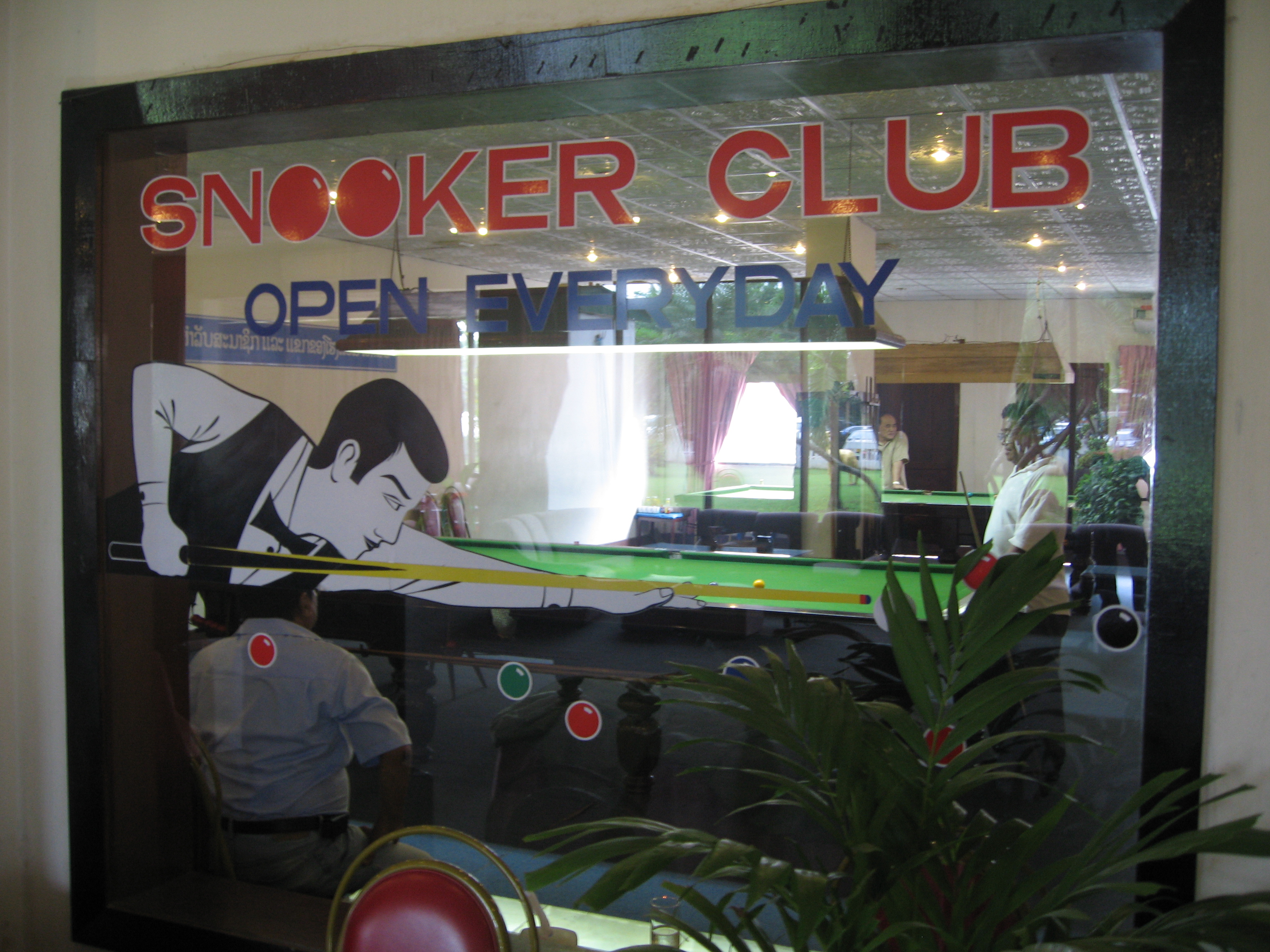
the lan xang hotel has the best billiards tables in Laos.
 the roy hamric journal
