
clive james’ flowering
Posted: May 6, 2011 Filed under: books, poetry, writing 1 Comment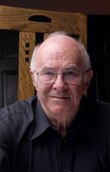 The Australian native Clive James, one of the writers who has dominated British journalism and criticism in the past decades, is undergoing a late blooming in his poetry, unfortunately the offshoot of some serious illnesses. He’s one of those essential British writers, like Martin Amis and Christopher Hitchens, who is hard to keep up with because of their prolific outpouring. His blog, click here, is one of the best on poetry and art. For a good close reading of his poetry, see this article in The Australian. For essential, confirmational reading, see his “Five Favorite Poets” essay on his blog. His prose glows when he writes about poetry. Here’s a poem from his Website:
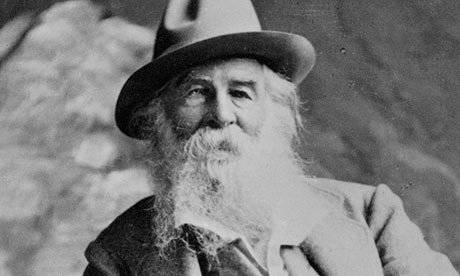
 Whitman and the Moth
Van Wyck Brooks tells us Whitman in old age
Sat by a pond in nothing but his hat,
Crowding his final notebooks page by page
With names of trees, birds, bugs and things like that.
The war could never break him, though he’d seen
Horrors in hospitals to chill the soul.
But now, preserved, the Union had turned mean:
Evangelizing greed was in control.
Good reason to despair, yet grief was purged
By tracing how creation reigned supreme.
A pupa cracked, a butterfly emerged:
America, still unfolding from its dream.
Sometimes he rose and waded in the pond,
Soothing his aching feet in the sweet mud.
A moth he knew, of which he had grown fond,
Perched on his hand as if to draw his blood.
But they were joined by what each couldn’t do,
The meeting point where great art comes to pass –
Whitman, who danced and sang but never flew,
The moth, which had not written Leaves of Grass,
Composed a picture of the interchange
Between the mind and all that it transcends
Yet must stay near. No, there was nothing strange
In how he put his hand out to make friends
With such a fragile creature, soft as dust.
Feeling the pond cool as the light grew dim,
He blessed new life, though it had only just
Arrived in time to see the end of him.
––The New Yorker
Zen sayings
Posted: March 6, 2011 Filed under: buddhism, poetry, states of mind Leave a comment
People use it
daily,
not knowing it.
––From A Zen Forest; ink drawing, butterfly, by Jim Crump
Philip Larkin
Posted: March 5, 2011 Filed under: articles, people, poetry, writing Leave a comment I’m nearing the end of Andrew Motion’s Philip Larkin: A Writer’s Life. Larkin’s essence is best captured in a description made by his longest-running girlfriend, Monica Jones, who decided that his tombstone should bear the word, “Writer,” not poet, and she’s so very right. Larkin started life wanting to be a novelist and wrote two good novels, before hitting a wall and ultimately abandoning two uncompleted novels. But his full-time turn to poetry continued the voice of the novels, in condensed, contained stories grounded in stripped down quotidian, demotic language, concerned with everyday life and, particularly, his personal fears and insecurities. His thousands of letters to his girlfriends and friends, in the reading, are close equivalents to the gist that makes up his poetry, by that I mean you often get exact glimpses of his poetic voice and are put in that place, in the states of mind, from which his poems arise. Aesthetically, he pushed romanticism out the door, but ironically the intensity of his art, and the body of the poems––the personae that they create––re-romanticized, if you will, his effort. He credits Thomas Hardy in his evolution, but there seems an unbridgeable gap between the two. Larkin’s language is post-modern, absolutely taken down to the bone. Hardy was still writing as if poetry needed to be beautified, something Larkin avoided. He wanted simply to give each word the space to live, individually and, finally, collectively. That esthetic is absolutely essential to his being able to write about what he does with such affect. I’m not sure, but maybe Larkin’s intention was never to devalue romanticism by avoiding it, but rather to renew it by rummaging around in hopes of finding it in the banality of life, to invest it with the seriousness it deserves in light of the recognition that ordinariness is all that we have. That is not to say that everything is ordinary, in the sense of routine. The point is also that all we have is what we get, as Larkin might say, and what we get is raw, unshaped, discrete, often quite beyond our control, so we must stand up to that face to face. Something along this line is touched on in his Paris Review interview:
INTERVIEWER
Do you feel happiness is unlikely in this world?
LARKIN
Well, I think if you’re in good health, and have enough money, and nothing is bothering you in the foreseeable future, that’s as much as you can hope for. But “happiness,” in the sense of a continuous emotional orgasm, no. If only because you know that you are going to die, and the people you love are going to die.
Elliot said something perfect about Larkin, while remaining neutral: “He can make words do what he wants.” At any rate, I’m glad finally to have discovered Larkin. He gives me something I need––art made from within our time based on an interesting sensibility of thought within a common feeling or moment.
Philip Larkin’s nothing
Posted: February 23, 2011 Filed under: people, poetry, writing Leave a commentWonderful wording by Philip Larkin, from the poem “I Remember, I Remember.“
“Nothing, like something, happens anywhere.”
or, Something, like nothing, happens anywhere, or
Nothing like something happens anywhere or
Something like nothing happens anywhere…
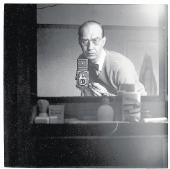
self portrait by Philip Larkin
I’m reading the Larkin biography by Andrew Motion, after having learned a great deal about Larkin from reading Kinsley Amis’s and Martin Amis’s writings about him. Larkin was one of those people everyone knows, on the surface, but who only a few people are allowed to know well over a long period of time. The stereotype of his “ordinariness,” of course , is a total fraud.
It can have only survived because of his looks, which through photographs placed him in the company of a passing face in the crowd. On the other hand, everyone who really knew him found him physically striking, and, if they were allowed entre into his world, they knew his mind was on fire. What let him down were the little things, and by that I mean those little things that become big things when we’re adults. One’s traits. The tip-off to Larkin’s character is his women pals. He had good ones, and for a long time, juggling them one, two or three at a time.
Something said early in the book about God wanting people to exercise their desires [that would be the Old Testament God, since the New Testament God is nowhere to be found], to seek abundance in life, resonates in Larkin’s life. His fears and inhibitions stimulated his desires which were met, judging from what I can see, about as well as anyone’s. But he didn’t think so, and on that he largely based his art. He early saw how life’s so-called ordinariness was the unrelieved companion of desire and pleasure, and an antidote to fear, and of course, in his art, he forsook standard romanticism to drive that point home.
It has led to the common misunderstanding of his work that haunts all original writers for years after their work is completed, until ultimately the work is seen fresh by a new generation for what it really is. The New Romanticism.
thinking of cold mountain
Posted: February 8, 2011 Filed under: buddhism, poetry, states of mind Leave a commentZen sayings
Posted: February 7, 2011 Filed under: buddhism, photography, poetry, states of mind, writing 2 Comments
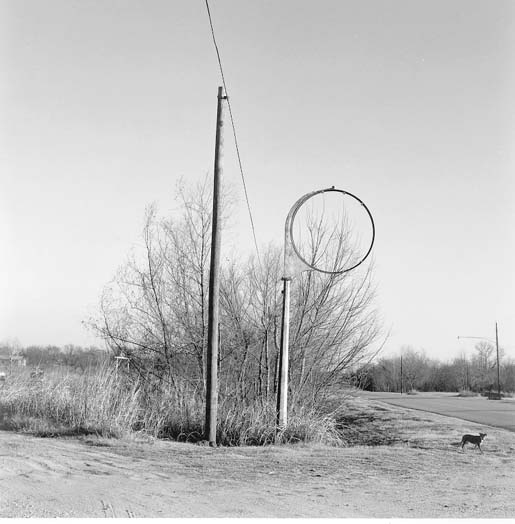
empty circle & dog (photograph Roy Hamric)
Looking
forward only,
Not knowing how
to look back.
– from A Zen Forest
a poem by Roxy Gordon
Posted: January 21, 2011 Filed under: people, poetry Leave a commentRoxy “Coyote Boy” Gordon, writer-poet-songwriter
Posted: January 16, 2011 Filed under: books, people, poetry, writing Leave a comment
Drawing by Roxy Gordon
This post is long overdue, because in some way I refuse to accept that the Coyote Boy is gone. His life was very intense, but surrounded by a calm circle, a powerful aura that honored the idea of one-of-a-kind. He was a writer, artist and singer-songwriter. Sometimes Breeds, Smaller Circles and other of his books can be found on ABE, the used book website
 I’m reprinting two pieces by Roxy that give a feel for how he saw the world. Later, I’ll publish some of his poetry, which comes from the “Tough School” of poetry.
The West Texas Town of El Paso
by Roxy Gordon
[Edited by Judy Gordon]
This all starts in San Francisco, North Beach, hanging out with famous writers.
In those days I still wore western shirts, couldn’t buy one there. I decided it
was time to go home. We left in a little red Ford full of a dog, cats, two of
our friends and our new born baby. A big rent trailer on behind. Nobody but
me seemed willing to drive. We got lost in some town in Wyoming, middle of
the night. A policeman stopped us, looked into the car and couldn’t believe what
he saw. He figured the best thing to do was help us out of town. Before the sun
was up, I was seeing trees in the middle of the highway. We found Denver,
spent a day recovering and headed over Raton Pass. We made Texas, spent
some time building a fence, and decided to go back to San Francisco. We
stopped south of Santa Fe and had a conversation, decided Albuquerque, but
we couldn’t find anybody we knew there. Judy had never been to El Paso. I was
young and stupid, said let’s go.
We made El Paso middle of the afternoon, bought a newspaper and found a
trailerhouse for rent out on the river road. It was cheap. We moved in two
hours later. The bathroom overflowed. And we were right next to a railroad exchange.
Not good for sleeping.
Judy got a job in a printshop. She had learned typesetting in Austin, when she
worked for Bill Wittliff’s Encino Press. Wittliff wrote the screenplay for
Lonesome Dove. We decided to move out of that trailerhouse, found an ad in
the paper for a house on Blanchard. It was a big, beautiful house just across the
street from the University of Texas at El Paso. It was on a hill; from the side
porch, you could see Juarez and the Franklin Mountains. The old lady who
owned it was from Mexico. She could hardly speak English. She lived in a little
house out back. She spent most of her time in Mexico. She was gone when her
house was broken into. I called the cops and a kid came. He stationed me at the
front door to catch the burglar if the kid could run him out. Like a fool, I
actually stood there. Then Judy set herself on fire – blazing grease on the
kitchen stove.
Judy worked at the printshop and I changed my kid’s diapers. My first book,
Some Things I Did, arrived in the mail. It was published by Bill Wittliff. I set
it on top of the refrigerator. The little TV was on top of the refrigerator. We
watched Ed Sullivan.
My guitar amplifier picked up a radio station. We listened to that and watched
Gunsmoke on TV. One day I called Judy to the window to see a very tall, pretty
girl hitchhiking. She wore black leather shorts. She passed up several cars for a
guy on a motorcycle. One day, I walked across the street to UTEP. I went to the
student union, looked at the students. They looked like students I’d seen from UT
to California to Minnesota. They are all grandparents now. My friend, David
Phillips, called me to say he and his wife, Carol, were about to visit her mother in
El Paso. I drove down to try and find them, found David walking up the street
looking like Kris Kristofferson. Later, we went to Carol’s momma’s house. She
told me my writing informed her generation about what our generation was all
about. Carol and David divorced after that and Carol told me David and I were
too Texan for her to stand. Last I heard, she was in New York writing songs.
The freezeplugs rusted out on the Ford. I let it sit for a couple of days, then
fixed it with some kind of plastic goo. I got a job at an advertising agency,
writing print and TV. Judy got fired from her job because she mixed up pages
on a book. I walked to work in bright El Paso sunshine, got there every morning
for a meeting. Roy Chapman ran the agency. He’d been the host of a kids’ TV
show in El Paso. It was called Uncle Roy. He was not my idea of an uncle. He
was a mean old man, kept telling me to get out of my chair at the meeting so he
could sit down. My co-writer was a middle-age German who lived miles south
in Mexico, but spent the week in El Paso. The agency had two major accounts,
a bank in El Paso and Weaver Scopes. The German and I made up TV
commercials for the bank, had apples and oranges rolling around. I wrote a
piece for Weaver rifle scopes. Somebody rewrote it. Whoever did not
understand how scopes work. I had a fit. That may have been the beginning of
the end of my advertising career.
Judy and I drove the plastic-fixed Ford around El Paso. We saw pretty girls
walking on the streets. We saw cripples. We went to the dollar drive-in movie,
three for a dollar. Went to the A&W Root Beer Drive-in. We walked on El Paso
Street, had beggars after us. One afternoon a young woman tried to sell us her baby.
We left in the wounded Ford and headed north for Albuquerque. Marty Robbins,
I have been to the city of El Paso.
=====================================================
(Published by Coleman Chronicle & DV, 29 December, 1998.)
=====================================================
Why There Were So Many Presidents of the U.S. on The Fort Peck Reservation
by Roxy “First Coyote Boy” Gordon
(With thanks to Walley Cantrell, Edited by Judy Gordon]
About a hundred years ago, the white Bureau of Indian Affairs decided Indian kids
needed to go to what they called boarding school. Those kids, little kids and old,
were taken away from home to live nine months a year at boarding school.
The Indian agent would send his police to round-up all the kids and what some
of the parents did was round-up the kids and head for the hills. But the cops
would catch most and put them into a wagon to head for boarding school.
They deloused these kids and dressed them civilized, cut their hair and took
them off to learn white men’s ways.
One time a bunch of little boys got rounded-up at Fort Peck, Montana. Those
cops put them in a big room at the boarding school. The kids huddled up all
close together and didn’t know what to do.
After awhile, a big boy came by. He’d been at boarding school before. He
decided to play a joke on the little boys. The big boy said, “Listen, if you
don’t tell them your names, then they’ll let you loose and you can all go home.”
The little boys thought that was a good idea.
So the teachers took them into a big room and a man with a big book asked
them, “Tell me your names.” No little boy would say a word. They thought by
being quiet, then they could go on home.
But then the superintendent saw they wouldn’t say anymore, so he locked
the door and went looking for help. The superintendent found a priest and
asked them what they might do. Those little boys needed names. “At least,”
the priest said, “I can name a few.”
The priest said to the little boys, “I’m going to give you big time names. You
will never be ashamed.” “You,” he said, “you over there with the brown hair,
you are George Washington. You with the red shirt, you are Thomas Jefferson.
You with no front teeth, you are Teddy Roosevelt. And you the one with
worn-out cowboy boots, you are Abraham Lincoln. You with the green eyes,
you are Andrew Jackson. You by the window, you are John Adams.” The
priest went on and on.
The little boys didn’t know what to do. They were still named things like
Afraid Of His Tracks and Horse’s Ghost and Ground Squirrel and names like
that. But after they stayed a few years at the school, they got used to their new
names. And they kept on using those names all their lives.
So that’s why, 50 years later, George Washington, Thomas Jefferson, Teddy
Roosevelt, Abraham Lincoln, Andrew Jackson and John Adams all lived up in
Montana on the Fort Peck Reservation.
New Bloom poetry anthology: Last Poems
Posted: October 1, 2010 Filed under: books, poetry Leave a comment Till I End My Song is Harold Bloom’s latest anthology of poems, in this case “last poems” of one hundred influential poets. The poems are “sometimes the literal end and other times the imagined” conclusion to a poetic career, offering a final view of a poet’s character and the inevitability of death. Bloom is a unique guide to such a collection featuring Eliot, Pope, Yeats, Whitman, Dickinson, and Shakespeare, but also more neglected poets such as Conrad Aiken, William Cowper, Edwin Arlington Robinson, George Meredith and Louis MacNeice. More at Amazon here.
Walt Whitman on modern American poetry
Posted: September 19, 2010 Filed under: articles, people, poetry, writing 1 Comment
This is a prophetic excerpt from Walt Whitman’s Collected Prose on the future of American poetry. Right on the mark, for me, when I think of my two favorite poets, Gary Snyder and Jim Harrison, who have just published a new book, The Etiquette of Freedom, a conversation between two writers filled with vitalism.
POETRY TODAY IN AMERICA—THE FUTURE
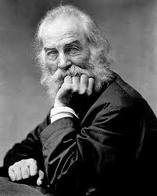
walt whitman
The poetry of the future, (a phrase open to sharp criticism, and not satisfactory to me, but significant, and I will use it)—the poetry of the future aims at the free expression of emotion, (which means far, far more than appears at first,) and to arouse and initiate, more than to define or finish. Like all modern tendencies, it has direct or indirect reference continually to the reader, to you or me, to the central identity of everything, the mighty Ego. It is more akin, likewise, to outside life and landscape, (returning mainly to the antique feeling,) real sun and gale, and woods and shores—to the elements themselves—not sitting at ease in parlor or library listening to a good tale of them, told in good rhyme. Character, a feature far above style or polish—a feature not absent at any time, but now first brought to the fore—gives predominant stamp to advancing poetry.
 the roy hamric journal