
For Ikkyu
Posted: September 7, 2014 Filed under: buddhism, people, poetry, states of mind, writing Leave a comment
Spoon strikes cup,
Sound made flesh
Each time the door opens
Something is given and given up
Upon waking: The corpse dances
In the empty casket
Rock on the ground
Moon in the cosmos –
Breathe this.
Tomdispatch: The Website We All Need
Posted: August 27, 2014 Filed under: states of mind Leave a comment
Here’s the website that I’ve been looking for…it draws events together in articles that outline (the most we can hope for) how our intwined world has lurched into a frightening brew of churning events that largely eludes comprehension.
Anthony Bourdain: Good Interview On The World and Reality
Posted: August 7, 2014 Filed under: interviews, people, states of mind, Uncategorized Leave a comment Anthony Bourdain has helped put much needed reality into the world of television, with his shows No Reservations and Parts Unknown, while his books deliver good writing and interesting takes on life. Here’s a good interview with him on Blogs of War. Check it out here.
A quote from the interview:
“My crew has NEVER been treated so well – by total strangers everywhere. We had heard that Persians are nice. But nicEST? Didn’t see that coming. It’s very confusing. Total strangers thrilled to encounter Americans, just underneath the inevitable “Death To America” mural. The gulf between perception and reality, between government policy and what you see on the street and encounter in people’s homes, in restaurants – everywhere – it’s just incredible. There’s no way to be prepared for it.”
The Art of Governing
Posted: August 6, 2014 Filed under: people, states of mind Leave a comment
Confucius, born 511 B.C.
In a country well governed,
poverty is something to be ashamed of.
In a country badly governed,
wealth is something to be ashamed of.
– Confucius
Suetonius, Tacitus, Livy: Life Lessons
Posted: July 29, 2014 Filed under: people, states of mind Leave a comment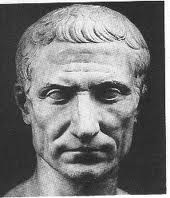
Suetonius
“Nothing is more unpredictable than the mob, nothing more obscure than public opinion, nothing more deceptive than the whole political system.”― Suetonius
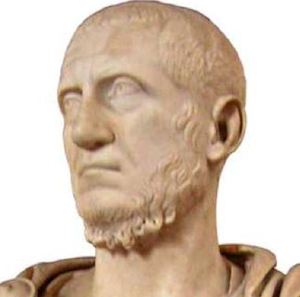
Tacitus
Fear is not in the habit of speaking truth; when perfect sincerity is expected, perfect freedom must be allowed; nor has anyone who is apt to be angry when he hears the truth any cause to wonder that he does not hear it. – Tacitus
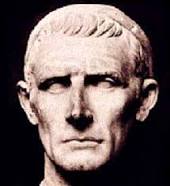
Livy
He was always before men’s eyes; a course of action which, by increasing our familiarity with great men, diminishes our respect for them. – Livy
Wislawa Szymborska: Where Were You When I Needed You?
Posted: July 11, 2014 Filed under: people, poetry, states of mind, writing 3 Comments
A Poem
By Wisława Szymborska
Nothingness unseamed itself for me too.
It turned itself wrong side out.
How on earth did I end up here—
head to toe among the planets,
without a clue how I used not to be.
O you, encountered here and loved here,
I can only guess, my arm on yours,
how much vacancy on that side went to make us,
how much silence there for one lone cricket here,
how much nonmeadow for a single sprig of sorrel,
and sun after darknesses in a drop of dew
as repayment—for what boundless droughts?
Starry willy-nilly! Local in reverse!
Stretched out in curvatures, weights, roughnesses, and motions!
Time out from infinity for endless sky!
Relief from nonspace in a shivering birch tree’s shape!
Now or never wind will stir a cloud,
since wind is exactly what won’t blow there.
And a beetle hits the trail in a witness’s dark suit,
testifying to the long wait for a short life.
And it so happened that I’m here with you.
And I really see nothing
usual in that.
—Translated from the Polish by Clare Cavanagh
“The world — whatever we might think when terrified by its vastness and our own impotence, or embittered by its indifference to individual suffering, of people, animals, and perhaps even plants, for why are we so sure that plants feel no pain; whatever we might think of its expanses pierced by the rays of stars surrounded by planets we’ve just begun to discover, planets already dead? still dead? we just don’t know; whatever we might think of this measureless theater to which we’ve got reserved tickets, but tickets whose lifespan is laughably short, bounded as it is by two arbitrary dates; whatever else we might think of this world — it is astonishing.” – Wisława Szymborska (died February 11, 2012).

Bedside Books – Gore Vidal and Chalmers Johnson: Men of Conscience
Posted: July 9, 2014 Filed under: articles, books, people, states of mind 2 Comments
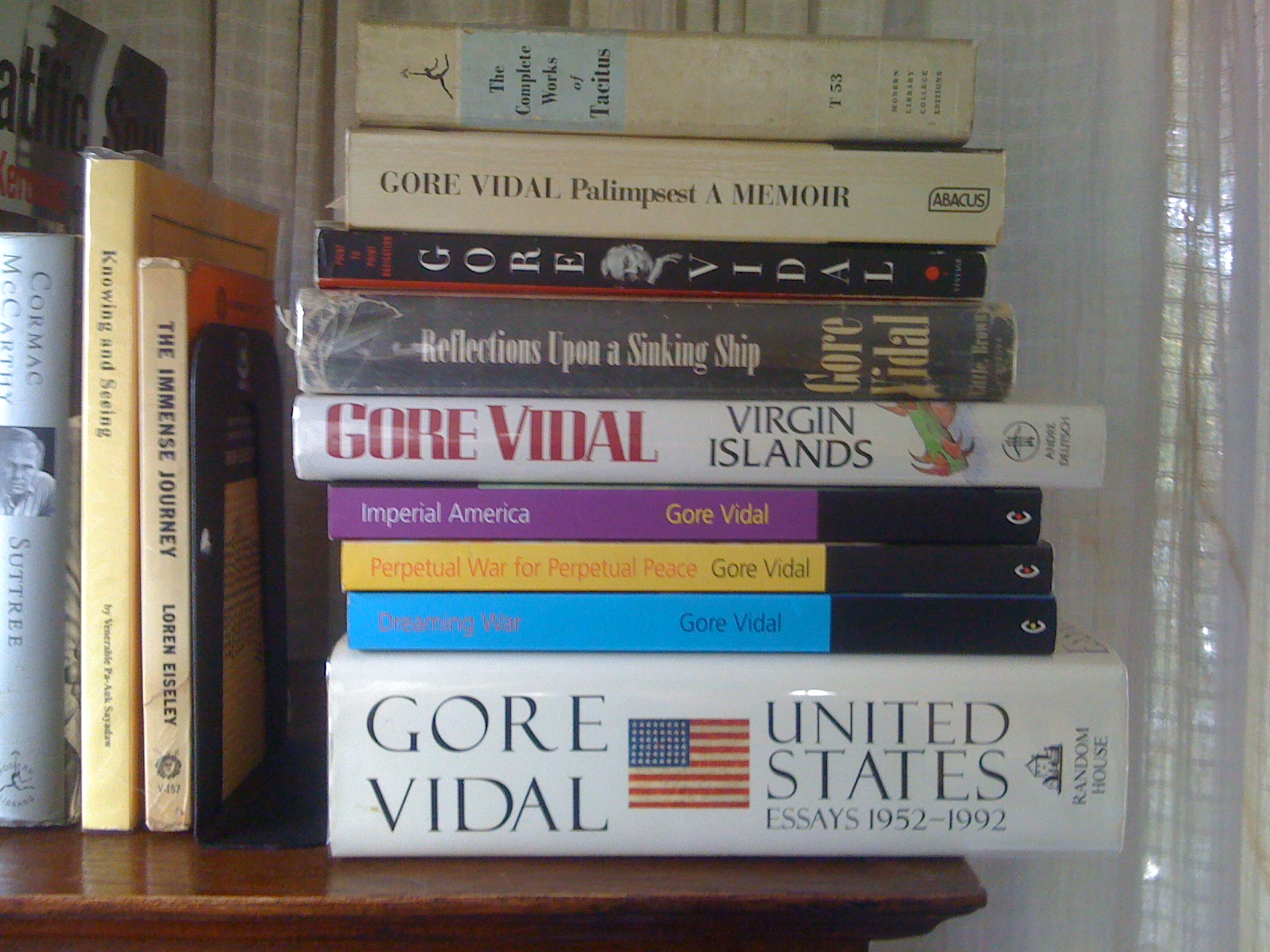
I found a clean copy of a Modern Library edition of The Complete Works of Tacitus at the Lost Bookstore, picked it up, and put it on top of Gore Vidal’s last three essay collections. In his snappy, trenchant prose, Vidal tells us how the US methodically cast itself as savior and circus-master of the world, while neatly positioning itself to dominate the world economy and thereby emerge as an empire far surpassing Rome but sharing many of the same traits. Our empire truly began in 1949 with the end of WWII. Unfortunately, our course has led to a state of perpetual war, overt and covert, around the world and weakened us morally and economically.
 “Vidal’s imagination of American politics is so powerful as to compel awe.” – Harold Bloom, The New York Review of Books.
Vidal, citing stats from the American Federation of Scientists, lists more than 200 overt or covert military operations around the world from 1949 until the 2000s, and we’re still at it. The number of US military bases in foreign lands stands somewhere around 730. And now the US and China are in danger of reheating the Cold War.
Empire translates to control of resources in order to sustain itself: read oil, gas, key minerals, water, basic food sources, etc. The thought-processes involved in creating an empire can be benign and enlightened (bringing better days to some client states) but also entail darker deeds (reversing or thwarting the legitimate will of a client state) which build up the very things that lead to an empire’s collapse. The myth sustains the doing, but the darker deeds belie the myth and lead to dysfunction when the citizenry tires, sees through the myth and set out for themselves to go their own way, or to try to change the system through legitimate or illegitimate means.
What I like about Vidal is his Man of Letters approach. His essay collections, spanning 60 years, focus on literature, people, history and politics. He is America’s truest popular historian, constantly debunking myths and pretensions. His historical fiction chronicles key decades and figures in American history. The most bracing wit since Oscar Wilde, his ice-like prose glides over the surface of key events and figures, throwing off dazzling phrases and insights that light up serious, core issues.
On the issue of empire, even deeper and more rigorous – but equally clear and compelling – is the work of Chalmers Johnson of the University of California at San Diego, whose final books in the 2000s established the case for an American foreign policy which has been based too often on means that would not be countenanced by the American people: political assassinations, derailing liberal movements in foreign countries, supporting brutal regimes and on and on…the approach has been patriarchal and condescending, assuming we know better than the people themselves in foreign countries. Doing less would have saved the US from many disgraceful acts and led to more respect in the world, but that has not been the way of the US in this century or the last.
 An obituary in The New York Times (Johnson died in 2010), said:
“Summarizing the series in “Dismantling the Empire,” Dr. Johnson said that “blowback” means more than a negative, sometimes violent reaction to United States policy. “It refers to retaliation for the numerous illegal operations we have carried out abroad that were kept totally secret from the American public,” he wrote.
“This means that when the retaliation comes, as it did so spectacularly on Sept. 11, 2001, the American public is unable to put the events in context. So they tend to support acts intended to lash out against the perpetrators, thereby most commonly preparing the ground for yet another cycle of blowback.”
“To maintain its empire, he said, the United States “will inevitably undercut domestic democracy.”
In a review of “The Sorrows of Empire” in The New York Times, Ronald Asmus, a deputy assistant secretary of state under President Bill Clinton, wrote that the book was “a cry from the heart of an intelligent person who fears that the basic values of our republic are in danger.” He added that it “conveys a sense of impending doom rooted in a belief that the United States has entered a perpetual state of war that will drain our economy and destroy our constitutional freedoms.”
Here are the last books each for Johnson and Vidal, which taken together spell out how the US sank to the current pitiful state of affairs, and, by implication, point to the way out – how things can be reversed and the people can regain control of the political system, taking it away from the wishes of the few – corporate America and secret bureaucracies – who are accountable only to lax, Congressional overseers who essentially ignore the values and conscience of the American people.
Johnson:
The Sorrows of Empire: Militarism, Secrecy, and the End of the Republic
Blowback: The Costs and Consequences of American Empire
Dismantling the Empire: America’s Last Best Hope
Vidal:
The Last Empire: Essays 1992-2000
Perpetual War for Perpetual Peace
Imperial America: The United States of Amnesia
Now, I’m ready to return to Tacitus, who, in telling us how the Roman Empire fell, tells our own story. Character and conscience are all. I’ll give Vidal the last word:
“Those Americans who refuse to plunge blindly into the maelstrom of European and Asiatic politics are not defeatist or neurotic,” he wrote. “They are giving evidence of sanity, not cowardice, of adult thinking as distinguished from infantilism. They intend to preserve and defend the Republic. America is not to be Rome or Britain. It is to be America.”
About That Bowl
Posted: June 29, 2014 Filed under: buddhism, poetry, states of mind Leave a commentAbout That Bowl
Round it is, the bowl I placed
in a hut in a mountain valley.
For a moment, its dominion
arises, a matter of form and space,
or so one thinks – that bowl and
emptiness – giving and taking
like nothing else.
But it’s not about one or the other –
or wilderness or hearth. In usefulness,
wildness is swept away,
for a moment, but then it returns
like nothing else.
Minding My Time
Posted: June 27, 2014 Filed under: buddhism, poetry, states of mind, writing Leave a commentMinding My Time
Awash in mind time. Mind’s always mattering,
mothering: words, sensations, feelings always
forming stuff. Words always mattering
in Universe of Matter. That’s all (not really for
Roy & Laddawan and the Thai band playing Eric Clapton).
Mind called self is just the go-between
for no-body. Big Self mothers every thing
– knows like a bone every thing’s just co-
existing meaning-matter like mothering sky.
Right now in Chiang Mai at 1:18 a.m.
as a tiny candle lantern rises golden
in the night like a star.
Edward Slingerland on Wu-Wei
Posted: June 26, 2014 Filed under: articles, buddhism, people, states of mind, time, space Leave a comment
Wu-Wei.
There are two very interesting articles in the new Edge issue. The first, by Terence McKenna, ranges freely all over the map and makes many interesting observations about the chemical processes that involve mind, cognition, language and blissing out…lots of attention is given to the role of ego, its development, non-development, etc. It’s imminently worth reading for its many gem-like insights.
Also, see the article by Edward Slingerland (scroll down on the Edge website) on the role of wu-wei, sometimes deceptively called “non-action,” in Chinese culture. He’s the author of Effortless Action: Wu-wei as Conceptual Metaphor and Spiritual Ideal in Early China. It’s actually a process of checking on the ego…something the world, the politicians and each of us needs to give ever greater attention. His website is here.
The two articles, in many ways, complement each other.
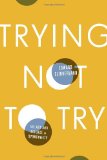
Here’s a taste of where Slingerland is going with his latest (2014) book on wu-wei, Trying Not to Try.
“In a lot of my recent work I’ve been arguing that these early Chinese models of ethical reasoning, ethical training are psychologically much more, from a modern perspective, more plausible than some modern Western ideas. In some ways I’m arguing that the early Chinese got some stuff right that we got wrong in the Western philosophical tradition. They like to hear that. And I believe this is true. They were very sophisticated moral psychologists, and they’ve got some insights into the way that we reason about morality and the way we train people that I think are a really important corrective to the way we’ve been thinking about ethics in the West.

Edward Slingerland
“But on the other hand I am a critic of certain aspects of the modern Chinese state, and I also worry about the rate of development. I was there in the 80s in mainland China, and going from Taiwan to mainland China was like going in a time machine. Taiwan was relatively modernized. I don’t know how I got to Hong Kong, but I took a boat up the Pearl River from Hong Kong to Canton, to Guangzhou. It was an overnight boat, and I got out in the morning and it was like I’d gone back in time 100 years; there were no cars, no motorcycles, everyone was riding bikes. It was an unbelievable change. Now I go back to Guangzhou and there’s these superhighways and these huge buildings, and it all happened—well, that was not that long ago. So the rate of change is wild. It’s just incomprehensible. I just wonder about how sustainable it is, because it’s creating a lot of wealth inequality and a lot of dislocation.
“I still have my area that is my specialty and now I’m going to bring these new tools to bear on that specialty. A good example is that Effortless Action book back in 2003 that was my transformed dissertation. I have an argument there that one way to look at the trajectory of Chinese thought is that it’s driven by this tension I call “the paradox of wu-wei.” Wu-wei is effortless action or spontaneity. They all want you to be wu-wei, but none of them think you are right now. You’ve got to try to be wu-wei, but how do you try not to try? How do you try to be spontaneous?
 “So, I call it the paradox of wu-wei, and I argue it’s at the center of all their theorizing about other things. Their theories about human nature, their theories about self-cultivation, their theories about government—these are all ways of grappling with this central tension that’s driving a lot of the theorizing. That claim got criticized, so my former advisor wrote a very scathing critique of it. A lot of people didn’t buy this claim that, first of all, it’s really a paradox, and second of all that it really has any kind of central prominence in early Chinese thought.
“One of the things I’ve been able to do to with the new knowledge I’ve gained from the sciences is come back to this, revisit this topic again, and say, look, from a cognitive neuroscientific perspective, we actually understand why this is a paradox, why using cognitive control to shut down cognitive control is tricky—it’s inherently tricky. We have a lot of evidence from social psychology and sports science and other areas that show that in fact effortless, spontaneous action is very desirable, because hot cognition is very powerful. Work on the power of the unconscious, the adaptive unconscious. We also, from an evolutionary perspective, have an understanding of why the fact that the paradox is a paradox is why it gets focused on.
“Essentially in our theories about where large scale societies come from, the crucial role is played by trust and commitment. It’s really crucial, if we’re going to cooperate I’ve got to believe that you’re committed to this religion or belief system that we are sharing and not just in it for your own good. There’re lots of ways I can assess your commitment. One of them is whether or not you’re being spontaneous. If I see evidence of cognitive control in you, I start to think that maybe something’s going on, because when we’re being conscious and using cognitive control, we’re often doing it to deceive or lie or figure out what’s best for us. The Chinese believe when you’re in wu-wei, you have this power called “de”. It’s like a charismatic virtue. People like you, people trust you. I’m arguing that we can understand this from a naturalistic perspective as the attractiveness someone who is spontaneous kicks off, and for very good game theoretical reasons. Basically you can relate it directly to evolutionary concerns about cooperation.”
 the roy hamric journal