
Dylan, Bloom, misreading
Posted: June 20, 2010 Filed under: articles, interviews, people, writing Leave a comment
Christmas in the Heart, Dylan's seasonal holiday songs
I’m a fan of Harold Bloom’s literary criticism, and his theory of misreading. It’s a complicated theory, but it hinges on the idea that most critics and the general public misunderstand the work of really new artists upon inception, and it can take generations for the real meaning/stance to be clearly understood and felt. Nowhere is that more true than with singer-poet Bob Dylan, much of whose work is wildly misunderstood. Chronicles, the autobiography he released a few years ago, was greeted by many who said that Dylan’s memoir was a put-on, loaded with irony, and meant to toy with his public image. Applying Bloom’s theory, which is right on target in this case, it’s the opposite. Dylan was just being himself, honestly and sincerely. The strange thing about Dylan is that a big segment of the public mind has never grown up over the years and figured him out. It continues to misread him and his work. Here’s a small bit from an interview Dylan did on the release of an album of Christmas songs last year (I missed its release entirely). The full interview is worth reading because it brings out the on-going misreading. What is at stake here goes back to Dylan’s emergence as an artist with a larger-than-life image. Why that should be so may take another generation to fully understand. My guess is that his least appreciated, so-called “minor” songs now will become the most appreciated, and most of the popular, so-called classic songs will become less important because they will lack the context of the time in which they were created.
BF: Some critics don’t seem to know what to make of this record. Bloomberg news said, “Some of the songs sound ironic. Does he really mean have yourself a Merry Little Christmas?” Is there any ironic content in these songs?
BD: No not at all. Critics like that are on the outside looking in. They are definitely not fans or the audience that I play to. They would have no gut level understanding of me and my work, what I can and can’t do – the scope of it all. Even at this point in time they still don’t know what to make of me.
BF: Derek Barker in the Independent, compared this record with the shock of you going electric. So many artists have released Christmas records, from Bing Crosby to Huey Piano Smith. Why is it a shock if you do it?
BD: You’ll have to ask them.
Global Portraits 2
Posted: June 15, 2010 Filed under: fiction, people, writing Leave a commentNo. 2 in a series of short fiction sketches that say something about the cultural mix that’s going on in Asia. To see all the fiction pieces, go to “Categories” and click on the “fiction” link.
2
The guy has a chicken neck, soft rolls of fat under his chin, wispy white hair. He’s like a boy in front of the most beautiful girl in the village. His eyes never leave me. He says go out, go to room. I think: Go out with this old animal again? I tell myself––Pai, if pay enough, go. I test his money. A little bar-fly girl in a black and white school uniform walks by in her white sneakers, bouncing up and down, like this, to Proud Mary.
“I see that little girl likes you,” I say, using my best smile. “I help you. You want her? Only $60.”
He said the name of Jesus, the God. “No, honey. I like you. Don’t you want to go with me?” he says.
“I want to go,” I say, “but I have to ask for a lot of money. I have to pay rent. I have two children.”
“I seen the scar,” he says.
My head was a broken plate from tequila the night before. All the dancers went to Mr. Spicy’s after work. Men went crazy buying us drinks. We had a lot of fun. Now I feel like somebody kick me in the head. He says again, “Don’t you like me, darlin’? I need another tequila.”
“Me, too,” I say. I start to feel better because that was my 74th drink this month. I made 65 drinks before the twelfth day. Now the mamasan knows I work hard to make money. $1 a drink for me. $3 for the bar. Then the old animal who is covered in tatoos says he needs another tequila to make his carrot grow. When I don’t understand, I smile and laugh. “Me too,” I said. One more dollar. He smiles and nods. Momasan walks around the dance floor, “Tomorrow, everything 50 percent off,” she says. “Not me,” says Blue.
The old animal says it’s time to put up or shut up. I know shut up means to keep quiet. Finally, he says, “Well? Let’s go, honey…”
I say, “You give me $100, Ok? We go now.” That’s how I got $30 to send to my mom yesterday. My mom’s in jail in Burma. Two more years. I want her with me. I need her close. I’m a baby too, really. I want to cry all the time.
Tomorrow night Blue and I go to the temple for Macha Bucha––about the Buddha talks to people. I will pray to take care of my mom and to live to be old with my children.
The next night all the temples in the town filled with people. The moon rose big and red like millions of nights before on this night in May. Pai and her two children prayed for her mother, and she prayed to be a good mother and to have a good heart.
favorite novels list
Posted: June 14, 2010 Filed under: books, fiction, writing Leave a commentHere’s a favorite novels list from a close friend. I post it because I have read only three of the novels, and it opens up new possibilities for me.
Camus, The Stranger
McCarthy, Blood Meridian
Faulkner, Absalom, Absalom!
DeLillo, Libra
Dickens, Dombey and Son
Johnson, Tree of Smoke
Banks, Affliction
––By Jim Giles, who taught English at what’s now The University of North Texas when I was student there.
chiang mai sketch
Posted: June 13, 2010 Filed under: people, places, writing | Tags: chiang mai sketches Leave a commentThis is an excerpt from my unpublished travel book. I’ll be posting some sketches that capture a little of the cultural mix tha t’s going on in Asia. To see more, go to “On the Record” and click on the sketches links.
1.
“That summer I went back to Vietnam, that was a strange one. Speed and cocaine was everywhere, my kids were goin’ crazy and somebody with BB guns shot the eyes out of two cows in my pasture. I finally found my youngest son in a county-line motel room filled with dirty clothes and eight other run-away kids. He was 17 then, going out with girls 23 years old. I mean beautiful girls, the prettiest in the county. My oldest son was let out of jail early ’cause he was a ‘model prisoner.’ Hell, how proud was that supposed to make me?
“Then I started getting calls on the answering machine, ‘We’re going to kill your family.’ ‘Your time’s up, hombre, say adios.’ My wife, who’d just turned Pentecostal, had done said goodbye to me. Really she didn’t say anything––she was just gone. Even took the curtains and the lawn chairs. The youngest boy, the gigolo, he finally took a high school test and placed in the Top 5 percent in the country––the Top 5. He’s smart, but stubborn. Now he’s the youngest electrician in Junction, Colorado. Joined the Pentecostals. Goes regular. Got some credit cards. Sends me a little money sometimes, but he never writes.
“I got arthritis, a big belly. It’s hard to walk. My mother’s lingering. Yesterday, my sister says, ‘I want those blue Limoge bowls.’ I said, ‘Hell, your mother’s not dead. What are you talking about?’ Then I got to thinking, and told her, ‘Ok, tell mother to get some of those stickers. Put names on the bottom of things. Then there won’t be no fighting when she goes.’ Truth was, I wanted Dad’s trunk with the old uniforms in it. He worked for the Texaco gas station when people at those stations wore real uniforms, hats, special belts, and all.
“My mother, she made me proud yesterday. She said, ‘You got good boys now.’ My oldest boy, he’s in China now. Married a Chinese gal, real cute, in San Diego after the Navy. Her father is something in their government. The boy don’t work. Says they’re tearing down all the old things in Beijing. He says they got a lot of that to knock down.
“It’s the same everywhere, I guess. Except we got a black man president now. It’s about time, I say. After I came back from Vietnam and the Airborne, I seen the world clear. I seen it for real. It’s what it is. A blessing in the center of sorrow. I dispatched the two cows, dressed them out, filled the freezer, had meat for a year, and I said to myself, it’s time to go to Vietnam. I nearly died over there two times. Once with the Airborne on Nui Cuong Mountain. Then again last year on that same mountain. “I told myself I was going to climb to the top of that mountain again, to see it all again, and I did, but it didn’t mean anything. I didn’t recognize anything. It looked like no one had ever been there. Getting back down, it nearly killed me. It turned dark, and I was on the ground – couldn’t walk. Thought I was dying. My guide, who was a good kid – I seen that when he first started to cut trail going up the mountain – he said, ‘Look at the stars, mister. They’re beautiful.’ I thought, ‘Son, I’m dying here right now.’
“Then I see the damn stars – they were beautiful. It felt like they had come down and were touching me. I said, get your ass up, you’re not dying here. The boy, he about carried me down the mountain. I think he understood what it was all about.” copyright@roy hamric
Khao San Road
Posted: June 11, 2010 Filed under: books, places, writing 2 CommentsAn earlier version of this article originally appeared in The National Post in Canada.
By Roy Hamric
The most famous road on the Asian backpacker’s tour is only a few blocks long, and it’s in the center of Bangkok. It’s called, Khao San Road, and it’s been a required backpackers stop for nearly thirty years. The road’s image was jolted into destination status by the movie “The Beach,” starring Leonardo DiCaprio and directed by Denny Boyle of “Trainspotting” fame. Based on a 1996 first novel by Alex Garland, it’s a quirky, improbable story of a 20-something, idealistic American named Richard, who checks into a guesthouse on Khao San Road, where he meets an older, mentally rattled character called “Daffy Duck,” who babbles on mysteriously about a secret island. The next morning, there’s a map to the island pinned on Richard’s door. He goes to the stranger’s room only to find him dead––his wrist slit. Too make a long, and not too interesting story, short, Richard is lured to the mysterious island—where he’s caught up in an idyllic milieu of an exotic international crowd of dreamers, misfits, run-aways and crazies. Over zealous critics compared the book to the works of Golding and Joseph Conrad, with touches (to set the record straight) of Looney Tunes, “Apocalypse Now” and Nintendo psychology thrown in for the ride.
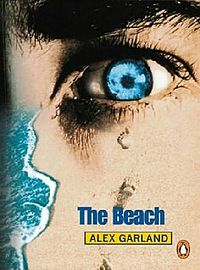
a Penguin paperback cover
As the book begins, Richard steps out of a taxi on Khao San Road. Garland wrote: “When you hit Bangkok, the Khao San Road is the first place you come. It’s a decompression chamber between East and West.”
When I stepped out of a taxi on Khao San Road on a sweltering mid-afternoon, there was a sense of arrival––books and movies do that to you––and a sense of departure as well, to be fully accurate, for everyone, the foreigners at least, was in arriving or departing mode, just passing through. If this place were on the old Silk Road, it would be at an oasis, a spot where everyone on the road that day stopped at night to exchange the word of the day. It felt like that type of place, a place that existed for its convenience, to share warnings, to offer advice, to meet friendly traveling companions.
For me, Khao San Road stands for a single, throw-away line in Garland’s novel, when Richard, trying to explain what he’s looking for, says only two words, “something different.” For more and more people something different is exactly what they’re looking for, but they don’t know where or what it is. Only a few months earlier, I had pulled up my roots to build a new life in Thailand. I had read about Khao San Road. I was curious, but I expected it to be just more media hype.
The first day, it was sensory overload. A few feet away from the taxi, the sounds of Hank Williams’ “Hey, good lookin’, what’ cha got cookin” blared from a boom box. Across the street a boom box was blasting Bob Marley’s “I Shot the Sheriff.” Music as the home you left behind… The shops along the road wedged old and new Bangkok side by side: trinket shops housed in one-story, weathered teak buildings with coruscated aluminum roofs jammed next to modern, air-conditioned Internet cafes, ATM machines, silver and gold exchanges, 7-Eleven stores, travel agencies, walk-up or walk-down back alley guest houses, tailor shops, pirated cassettes and CDs spread out on tables, street-bistro cafes, and a swirl of dozens of languages gave it all a world bazaar atmosphere, not to mention the smells wafting from restaurants with dishes from Thailand, America, China, Israel, Italy, India and Nepal.
Fresh-faced, Midwestern American farm girls were having their hair done in African braids by Thai women to the beat of pop songs coming from 5-foot TV screens. Fresh tattoos were being etched into the arms, ankles and shoulders of first-time teenage travelers. The in-tattoo for young women was a black, “linked chain” design around an ankle, and for young men, a large Thai warrior “spirit” figure, with bulging eyes, a grimacing expression and a ready sword in hand.
At nightfall, the frenetic pace eases, and the police close off the street. Shop owners move tables outside to catch a whiff of cool breeze. In the twilight, neon lights wrap a soft glow around the faces of people who you watched arrive during the day, and they’re now studying the new people struggling to pull their backpacks out of taxis, in search of a cheap room and some nightlife. The Thais have a word for what’s going on here, “saduak,” convenient, easy––make it easy, take it easy. Come to Bangkok, come to Khao San Road, it’s easy, it’s convenient, and it’s where you can learn the latest news.
My room for the night was 10X10-feet, just about large enough for a good size bed, but clean and quiet, and early the next morning I was back on the road––who were all these people streaming in and out, and what’s going on in their heads? I dropped into Buddies Beer Garden, which is really a restaurant & swimming pool, a blend of Southern California and Dali Lama decor, one of the hotter hangouts complete with lithe, young Thai women splashing in the swimming pool in back. I spotted a group of people sitting at a nearby table, backpacks leaning against their chairs. Were they Americans? You couldn’t be sure. Everybody dresses alike here––cheap Thai, Indonesian or Nepal baggy pants and T-shirts with catchy phrases (I’m a Yao), and lots of silver, stones and beads around ankles, wrists, and necks, plus various ornaments in ears, noses, lips and navels. With practice, you can gauge how long a traveler has been on the road in Asia by their tan: a two-week soft tan, a two-month soft brown, a six-month dark brown and a six-month-plus weathered leather look.
“Did you say you’ve been to Cambodia?” I asked a very attractive girl who had a dark brown tan. “We just came from Cambodia,” she said in an American accent. Her name was Hillary Glenn, and this was her fourth time passing through Khao San Road. She was surprised she’d seen so few Americans here. “We normally try to meet up with British or Dutch travelers,” she said. This reminded me of a Dutch man on holiday I had met earlier in Vientiane. “The Dutch are the Chinese of Europe,” he said. “You will find us everywhere.”
Hillary was traveling with two Americans that she’d just met in Cambodia and they planned to leave the next day for Koi (island) Phi Phi near Krabi, where a lot of the filming was done for “The Beach.” It was a little known island on the western side of Thailand’s lower peninsula, but it has turned into an eco- controversy ever since the movie production crew uprooted trees and replanted various areas with more film-worthy foliage. The publicity was a magnet that has drawn backpackers to the semi-isolated islands that dot Thailand’s gulf. After that, Hillary said the place to be was Koi Pha Ngan, an island famous for its monthly “Full Moon Party” (disco in the sand). Some people believe Garland’s novel was modeled on the Koi Pha-Ngan scene, with its Dionysian nights of dancing ravers, moonlight swimming and howling at the moon. At another table were three Swedish college girls on a two-week holiday. Carola Bragen, 29, a social work major, said her group came to the road not knowing what to expect. Garland’s novel had recently made the Swedish best-seller list. “You see it in a lot of peoples’ backpacks now,” she said. “We just knew this was a backpackers’ place.”
The road’s cultural mish-mash has a legitimate buzz on arrival, but to some long-timers here, the road’s best days are already long gone, and the novel and movie was the coup de grace.
“Khao San Road has changed,” said a man named Steve, who said he now lives near the road. He comes for coffee and to check out the scene, but he spent the past six years moving between Cambodia and Thailand. A wizened, bone thin expat, he dressed in the cool-is-uncool style. He wore checkered Bermuda shorts, high top black tennis shoes, and a T-shirt that said, “I’m Pol Pot.” He lived in a nearby $60-a-month room where he made miniature metal sculptures that sold in some of the local shops. Sipping a cup of adrenalin-charged Thai coffee, he scanned the street. “Before, this place was a lot quieter with mainly a few backers, trekkers passing through, and junkies,” he said. “The place had a seedy, low-end appeal. Very, very cheap. People came, stayed a few days and left. It’s a completely different crowd now. Lots of partying, people on the make. You see a lot of beautiful foreign women. It’s right at the point of turning yuppie. The more neon, the more yuppies. You don’t see that many Americans. It’s mainly Germans, British, Japanese, the Scandinavian countries.
“The newest bar up the street is straight out of America. In some ways, Khao San Road is one of the worst places in Thailand now. There are so many stupid, rude foreigners concentrated here. In the places I go to regularly, I see how the Thai staff really feels about most foreigners who come here. The good side is that the guest houses are still cheap. Rooms for $5 or $10. The money is good for the Thais, of course, and the money is spreading. The next ‘in’ place is Phra Athit Road, where Khao San Road curves and changes its name.”
Anyone doubting that Khao San Road has changed need look no further than the 50-some e-mail shops that have mushroomed in the past few years. Internet N/B, one of the larger shops, was filled with people doing the Internet, or eating or heading upstairs for a quick three-dollar massage (Thai or Swedish).
The owner, Napporn Bhuttan, said business was always good and was clearing several thousand dollars a month, and the road is the most computer-concentrated area of Bangkok. “The market has been slowing for the past year, but now it’s getting better again,” he said. Down the street at Gulliver’s Traveler’s Tavern, a Thai lady, Thanyatorn Srisit, who had the very casual glowing look of someone who knows she’s beautiful, was holding court with two young, tattoo-covered Americans. In a well-tailored dark blue blouse and a black ankle-length skirt with a slit discreetly rising up to mid-thigh, she fingered the cellular phone resting beside her glass of white wine. The owner of a antique fashion store on Rambutri Road, she said the road is what it is. It’s more for tourists than Thais, “but Thais are starting to come here now, to party with the foreigners and to practice their English.”
“Europeans come here to buy cheap clothes,” she said. “They ship them back and sell them to shops and make a good profit.” She said Khao San Road doesn’t have the wild night life one finds on the infamous Pat Pong Road. “Khao San isn’t for the ‘working woman,’” she said, using the polite term for ladies of the night. “There’s not too many working women here––a little bit.” She’s was right. I’d seen none of the hard-core hookers of Bangkok’s sex industry, but you did notice another type of attractive Thai woman on the road when party-time started around 10 p.m.: they were more casually dressed, and, maybe, just liberated Thai women who had day jobs, but who also liked to have fun with fralongs (foreigners).
The road’s reputation as a heavy drug scene was myth, Srisit said. “Drugs are not openly used or available,” she said. “But you see some people who have done drugs.” Earlier, on a restaurant bulletin board, I had seen a notice appealing for donations for foreigners in Bangkok prisons––mostly for drug offenses. There even a mini-tour offer for backpackers to visit prisoners with gifts of food or books, in exchange for a chance to hear hair-raising tales of misadventure.
One of the young Americans sharing Srisit’s table, his forearm covered with Thai spirit tattoos, was sorry his vacation was ending when he’d just discovered the road. “We can’t stay longer,” he said. “Yes, but you’ll be back,” said Thanyatorn.
As my time on the road was winding down, I guessed that most of the passers-through here, asked where they went in Asia, would mention Khao San Road. It had claimed their imaginations and was now a social calling card: “I spent three days on Khao San, were you there?”
Kipling’s overused line about “East is East and West is West” catches the “something different” search that’s going on with people around the world. But when he said “and never the twain shall meet,” he was wide of the mark, and he certainly knew better. It was a poem written for the popular magazines, for the armchair travelers back home. The East and West have been meeting, and blending, since history began. The fusion between East and West really has no beginning or end, but has been ever present and on- going. What’s happening on Khao San Road is a mini-version of the world to come, everyone bumping against everyone else, exactly like some bustling oasis city on the Silk Road 3,000 years ago, when a Greek, Chinese or Iranian traveler stopped over at a village bar and said, “East is East and West is West, here’s to us all…” or some such sentiment.
Garland’s young seeker had the right instinct. There is something different to be experienced by being at-large in the world, something not to be missed, and it’s taking place in cities everywhere. I could only bathe in the mysterious mix of signs and cultures that swirled around Khao San Road. It was a good place to visit.
When I left Khao San Road it quickly became a few memories of a few blocks on a longer road signifying something much larger. Probably Garland’s young man was really just trying to say he was searching for a place where he could see himself clearly without all the cultural baggage that we carry along in our lives. Everyone’s coming together on Khao San Road is just one more step in searching for that place.
Lines of thought
Posted: June 7, 2010 Filed under: books, people, states of mind, writing Leave a commentGleanings from reading Pater, Kerouac and Emerson:
“We have an interval, and then our place knows us no more. Some spend this interval in listlessness, some in high passions, the wisest, at least among ‘the children of this world,’ in art and song. For our one chance lies in expanding that interval, in getting as many pulsations as possible into the given time.
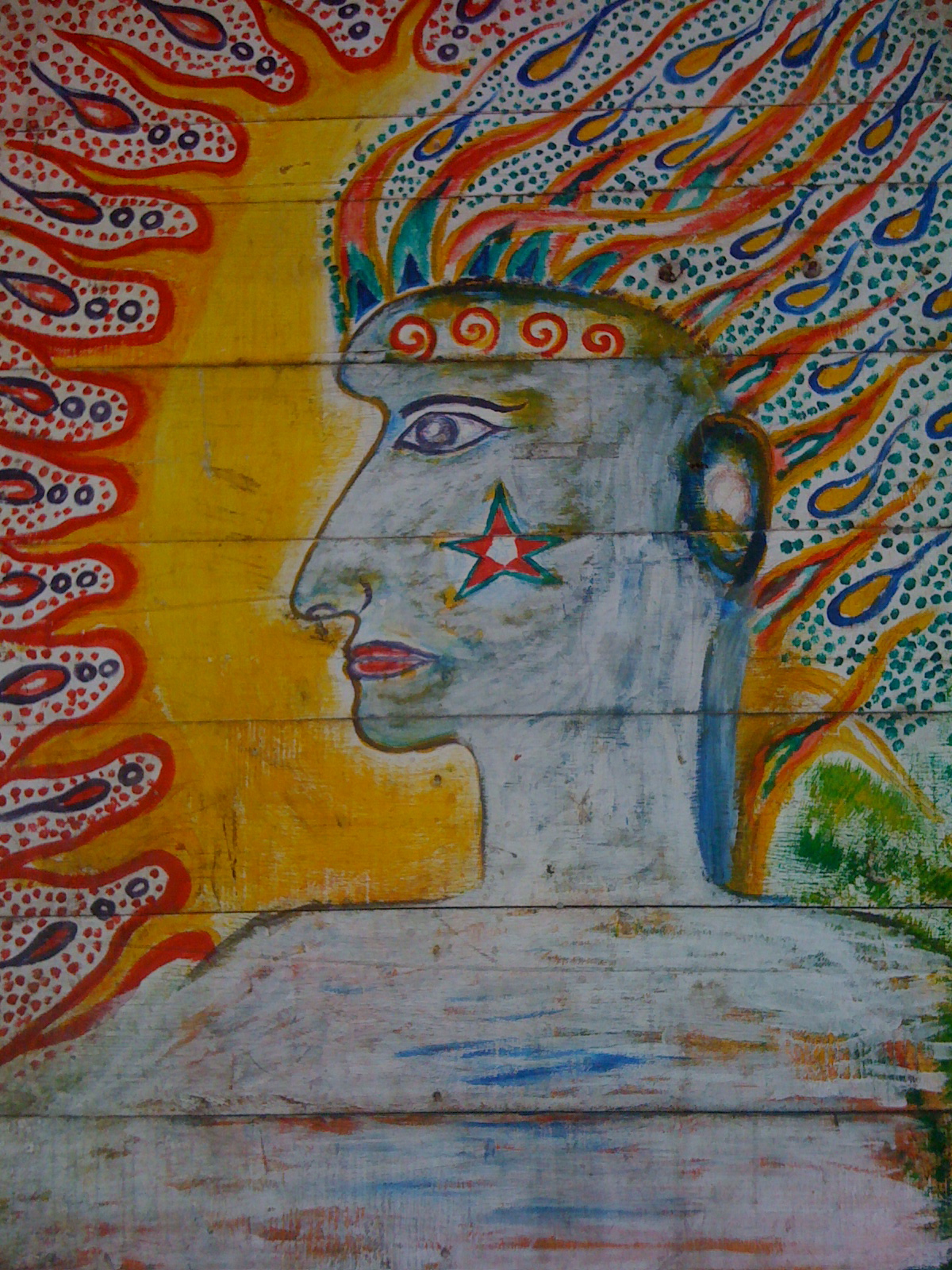
burning man, painting in Cafe del Sol, Chiang Mai
“….Great passions may give us this quickened sense of life, ecstasy and sorrow of love, the various forms of enthusiastic activity, disinterested or otherwise, which come naturally to many of us. Only be sure it is passion––that it yields you this fruit of a quickened, multiplied consciousness. Of this wisdom, the poetic passion, the desire for beauty, the love of art for art’s sake, has most; for art comes to you professing frankly to give nothing but the highest quality to your moments as they pass, and simply for those moments’ sake.”––Walter Pater, The Renaissance
“Believe in the holy contour of life.”––Belief & Technique of Modern Prose, Jack Kerouac
Emerson, in his Journal: “The days come and go like muffled and gray figures sent from a distant party, but they say nothing and if we do not use the gifts they bring, they carry them silently away.”
bedside books
Posted: June 3, 2010 Filed under: books, reviews, writing Leave a commentNovels and Novelist by Harold Bloom; his essay connecting Hemingway to Emerson, Whitman and Stevens, and to Pater’s theme that we have an interval and then our place knows us no more, sums up why Hemingway’s stories and several novels are quintessentially American. Bloom writes judicial estimations of virtually all of the Western canon in this and another complementary volume.
Must We Mean What We Say by Stanley Cavell; his first book, written in a burst of manic philosophical creativity shortly after his doctoral dissertation and before his The Claim of Reason; his essay on Lear’s avoidance of love makes a nice bookend to Empson’s essay on Lear seen as renunciation of responsibility (see below). I like one review that said this work “reintroduced the book [literature] to philosophy.”
The Renaissance by Walter Pather; beautiful, well-carved prose in the service of the fully tasted, lived life through the prism of Europe’s intellectual and artistic flowering.
From the Land of Shadows by Clive James; I’m fascinated by his prosecutorial technique of finding a moral or intellectual opening and building the opposite case. The very high end of personal journalism/essays.
How the Swans Came to the Lake by Rick Fields; a history of Buddhism in America; affirms an Asiatic bedrock in American culture, especially as literary influence.
Pieces of My Mind by Frank Kermode; finely seasoned and reasoned literary essays.
Pleasing Myself by Frank Kermode; refreshing for nuanced judgment and lack of critical malice.
Emerson’s Fall by B. L. Packer; a dissection of the arc of Emerson’s heroic intellectual packaging of an American mind.
Back to the Sources edited by Harry W. Holtz; a thorough guide into the Kaballah, Talmud, Midrash, Hasidic masters, Biblical narrative and poetry, and more.
The Books in My Life by Henry Miller; personal, unbounded prose energy focused on a search for kindred spirits in print.
The Gary Snyder Reader by Gary Snyder; a sure-footed, pure American spirit in service to literature and community.
A Moveable Feast by Ernest Hemingway; pent-up revenge, traces of fear, defensiveness and edenic loss; a sad song to consciousness in the spirit of the Romantic poets by a writer who places emotion beneath the surface of his prose.
The Structure of Complex Words by William Empson; a down-to-earth linguistic, literary criticism, bracing for the attention it demands; I’ve already downloaded free copies of Seven Types of Ambiguity and Some Versions of Pastoral; such an original sensibility.
hunter thompson in Laos
Posted: May 16, 2010 Filed under: people, places, writing 5 Comments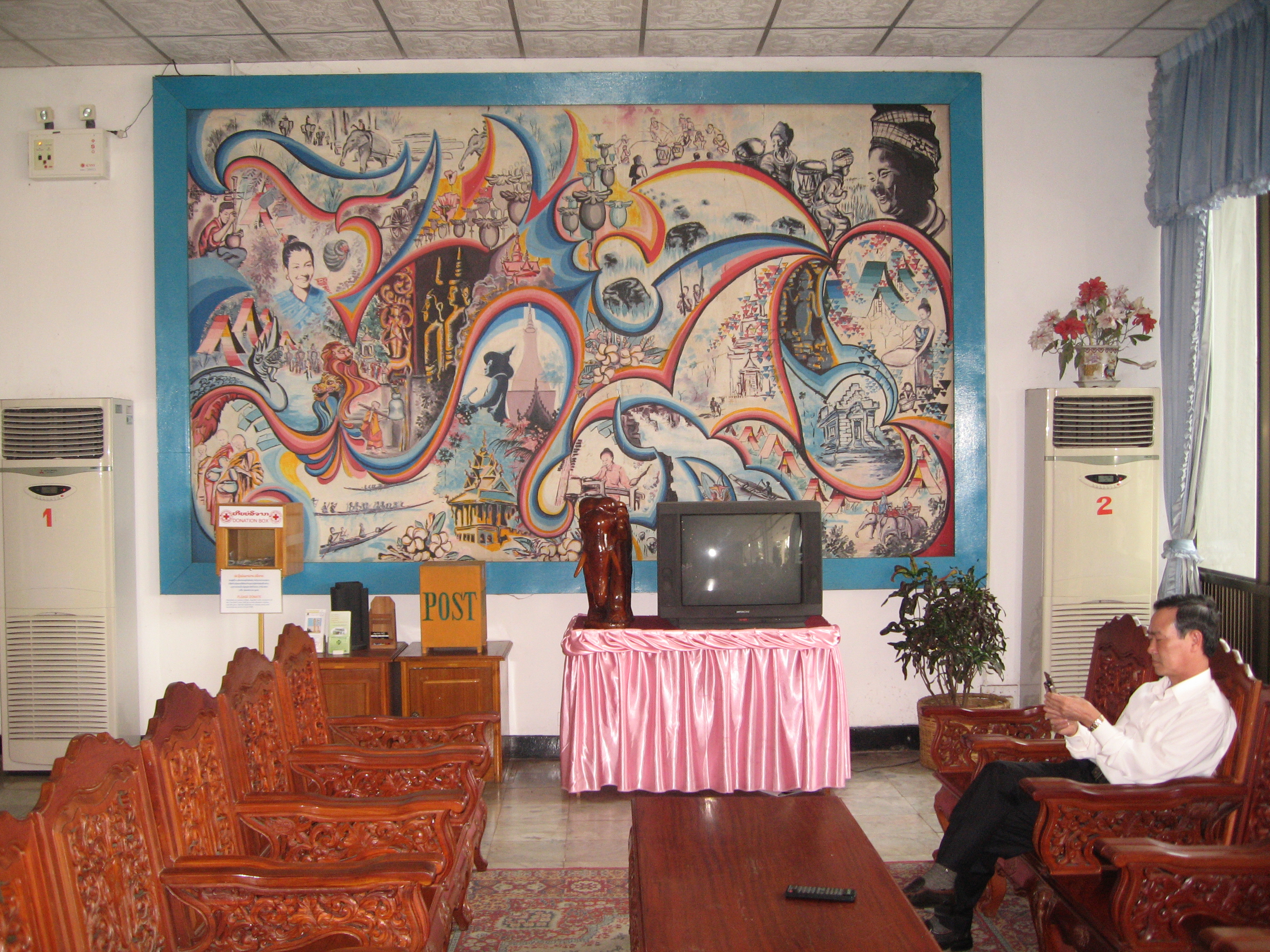
land xang hotel lobby
This is an expanded version of an article that appeared in The Magazine in The Bangkok Post.
hunter thompson in Laos
By Roy Hamric
“Laos is as different from Vietnam as Big Sur is from Long Island”––Hunter S. Thompson
I had a reservation to see if I could locate traces of the ghost of writer Hunter Thompson in Vientiane. It had been about 10 years since I had visited the Laotian capital, a time when most of the downtown streets were still dirt.
The Laos visa process at Friendship Bridge took about five minutes. Emerging from 33 years of Communist rule, Vientiane, the once delicate Laotian capital with about 500,000 people, had the frayed look of an Eastern European city, signaled by the dominance of the imposing government buildings on the city’s main boulevard, Tannon Phon Kheng. The best display of nightlife was still Fa Nyum Road, named for Laos’ first king, a burgeoning strip of restaurants and guesthouses fronting the Mekong River. The city overflowed with backpackers and hardy tourist types.
Following the Communist Pathet Lao takeover in 1975, Laos was a closed society until 1989, when it slowly began accepting Westerners back into the country. The Communist regime proclaimed 1997 the “Year of the Visitor.” The country is still scrambling to accommodate the growing number of tourists, and there’s still only a half dozen or so functioning ATMs. The local media is still heavily censored. Personal mail is still routinely opened and inspected. The sewer system has been under construction for decades.
At nightfall, the riverside filled up with tourists and Laotian couples holding hands––everyone eating, drinking and people-watching along the boulevard with its floating bamboo restaurants and street food vendors. Laotian women, decked out in their elegant long skirts and smooth, coal-black hair, made up for the city’s tapped down, controlled feel. I checked into the Land Xang Hotel, which means Land of a Million Elephants, once the finest in the capital.
I had a reservation for Room 224, where Hunter Thompson said he had stayed for two weeks. He arrived in late April 1975 after spending a few pressure-filled weeks reporting on the final days before the fall of Saigon for Rolling Stone magazine. He left a curious account of his stay at the Lane Xang in an odd, short piece called “Checking into the Lang Xang,” published in Songs of the Doomed, Gonzo Paper III.
When he arrived in Vientiane, Thompson was dejected and angry. The relationship between him and his longtime editor, Jann Wenner, had fallen apart at the worst possible moment. A few weeks earlier, Wenner had pulled out of a book deal with Thompson to cover the 1976 presidential campaign. Then Wenner unexpectedly asked Thompson to cover the fall of Saigon. As he was working on the story, Thompson learned that his group medical insurance provided by Rolling Stone had been withdrawn along with expense money to cover the assignment. His support had evaporated. His relationship with Rolling Stone was never the same following Saigon. Ten years later, his story on the collapse of Saigon finally appeared in Rolling Stone. Classic Thompson, it showed his uncanny ability to put his finger on the heart of a story, even as Saigon was in a frenzied free-fall.
When he finally left Saigon in the final days, he could have sought out Hong Kong, Bangkok or the Philippines, but he chose Vientiane as a place to unwind, to go over his notes and consider his alternatives. He arrived around 2 a.m. during a drenching monsoon rain. He told the Land Xang desk clerk he wanted a king-sized bed, quick access to the swimming pool and a view of the Mekong River that flowed past only a few hundred feet in front of the long, two-story hotel. The hotel has a massive lobby, a cavernous dinning room, a beautiful English-style Billiards Room and an exotic disco with soft-eyed hostesses. The hotel’s Massage and Sauna Center located beside the swimming pool is still noted for the masseuses who provide room service.

room 222 with the 15-foot hallway
After checking myself into the Land Xang there was some confusion about the exact room Thompson stayed in. After inspecting several nearby rooms, I decided that Thompson had gotten his room number wrong, or the room he stayed in had been renumbered. Whatever happened, the room he describes in his story is Room 222, which was still almost exactly as described: “A rambling suite of rooms half hidden under the top flight of a wide white-tiled stair ramp that rose out of the middle of the Land Xang lobby. When I first went into 224 [sic], it took me about two minutes to find the bed; it was around the corner and down a fifteen-foot hallway from the refrigerator and the black-leather topped bar and the ten-foot catfish-skin couch and five matching easy chairs and the hardwood writing desk and the sliding glass doors on the pool-facing balcony outside the living room. At the other end of the hallway, half hidden by the foundation of the central stairway, was another big room with a king-size bed, another screened balcony, another telephone and another air-conditioner, along with a pink-tiled bathroom with two sinks, a toilet and a bidet and deep pink bathtub about nine-feet long.”
At any rate, I quickly settled into Thompson’s strange “half hidden” suite of rooms and that evening I couldn’t stop my mind from imagining Gonzo-like goings on. Of course, the clerks at the Land Xang know nothing of Hunter Thompson or his fame. Many people may think it odd to make anything out of a certain room where someone stayed 33 years ago. My answer is simply that each of us finds personal connections to things that have indefinable meanings, much like Thompson, as a young writer, made a pilgrimage to Ketchum, Idaho, in 1964, to see the place where one of his heroes, Ernest Hemingway, spent his final days before he committed suicide in 1961. When we travel, it’s easy to get lost in the newness of the present and to overlook what happened in places before we arrived.
The Land Xang was perfect for Thompson. Its disco still offers a traditional Asian band with rotating singers and lovely hostesses in spiky, high heels who quickly place their hands on your leg and rest their head on your shoulder. There’s no written account of how Thompson filled his two weeks in Vientiane. The best guess is that it involved burst of manic writing, wiring Western Union dispatches to California, lots of Laotian marijuana, long stretches of sitting at an outdoor restaurant next to the Mekong River, probably some of the local snake moonshine, a few pipes of opium, probably long stretches of pondering the star-filled sky over the flowing Mekong. I’m certain some nights were spent in the dark recesses of The White Rose club, checking out the night life at the one of the most notorious bars in Asia, renowned for its beautiful women and hard-to-distinguish transvestites. Dire tales abounded in the 60s and 70s of soldiers on R&R and visiting government officials who took beautiful ladies out of The White Rose only to discover when sober that the beauties weren’t ladies.

andelman and thompson in Vientiane
At any rate, shortly after arriving, Thompson looked up the New York Times correspondent David Andelman, and they spent some time together going around Vientiane.
“I had been filing quite relentlessly from there for some weeks,” Andelman told me, recalling those days. “I had, of course, heard of him, though I was not aware that he’d been in Vietnam before he arrived in Laos. As I recall, he said that he was finishing up a major Vietnam piece and then intended to turn his attention to Laos. But I’m not sure how intense that attention was. Most of the time, as I recall, he spent trying to score the ‘finest weed ever produced on the planet,’ and he seemed to be quite successful.
“At the time, Vientiane was very much an open city. The bar girls still plied their trade nightly at the White Rose which Peter Kann [a Wall Street Journal reporter] and I closed up some weeks later, the girls going across the river to Thailand the next morning, really marking the end of the Royalist regime in Laos and the arrival in power of the Pathet Lao.
“For a price, and Hunter did seem quite flush at the time, there was very little that was not obtainable. As I recall, Hunter vanished as suddenly and mysteriously as he arrived. I don’t remember seeing any piece that materialized out of his visit to Vientiane. I was aware of his Gonzo reputation, so his search for the perfect weed more amused than surprised me. He seemed so intense about it––more so than any other goal in fact––even though he was soaking in all sorts of other details, scenarios, and dialogue that could have produce a vivid piece if he ever got to the point of writing it, which seemed only a part of his ‘mission’ to Laos. I also recall that at times his circuits seemed pretty fried.”
Thompson had successfully decamped from the manic days of a crumbling Saigon to deceptively tranquil Vientiane. With his acute sense of the possible and probable, he knew the government had only a few days left. In May, 1975, a few weeks after Thompson departed, the government fell to the Pathet Lao and the White Rose closed. The Communists quickly isolated the country from the West and sent tens of thousands of Laotians and ethnic group members to prisons and reeducation camps.
Thompson, in his prime, absorbed Laos’ benighted strangeness and beauty. He glimpsed the final days of Vientaine, before it was smothered by a repressive Communist regime. Thompson despised and raged against dark forces wherever he found them. At the brink of its fall, Laos had so little and lost so much.
In some ways, Thompson’s long strange trip through life was just beginning. His writing captured his times and the imagination of millions of readers. Thirty years later, on Feb. 20, 2005, Thompson, like Hemingway, shot himself in the head in his home, the “fortified compound” he called Owl Farm, in Aspen, Colorado. What reads like a short, personal note written to himself a few days before his death, titled “Football Season is Over,” is now called the “suicide note”: “No More Games. No More Bombs. No More Walking. No More Fun. No More Swimming. 67. That is 17 years past 50. 17 more than I needed or wanted. Boring. I am always bitchy. No Fun — for anybody. 67. You are getting Greedy. Act your old age. Relax—This won’t hurt.”
It’s nice to believe that Room 222 in the Land Xang Hotel in a bygone, sleepy old Vientiane made a positive change in Thompson’s life when he needed it. With the arrival of Pathet Lao cadre, everything changed overnight. But a few things stayed the same. As I ventured out of the Land Xang the next morning, I learned that drugs, as always, were everywhere, in spite of the Communist government or maybe because of it.
The taxi driver turned around, grinning.
“You want ganja?”
“No ganja,” I said. “Too dizzy.”
He nodded, appearing to understand.
“Opium?” he asked.
gary snyder: Danger on Peaks
Posted: May 13, 2010 Filed under: buddhism, people, poetry, reviews, writing Leave a commentThis review appeared in The Kyoto Journal:
Gary Snyder: Danger on Peaks
By Roy Hamric
“There is a point you can make that anything looked at with love and attention becomes very interesting,” – Gary Snyder. *
Gary Snyder’s Danger On Peaks, his 10th book of poetry, is further proof that since he first published Rip Rap in 1959 we’ve been in the midst of a rare weaving of life and art.
In a few more decades, it will probably be clear that Snyder has claimed the role of world icon of American poetry, bridging East and West, and his life will be a potent force as a model of committment to community and the natural world.
But what will become even clearer is that Snyder’s closest peers are not only Han Shan, Stonehouse, Bassho, Ikkyu and the other red-blooded, Zen poets whose voices Snyder has extended into modern times, but also Thoreau, William Carlos Williams, Wallace Stephens and his close fellow Beat poets.

gary snyder
Snyder’s cultural impact in America and beyond has been two-fold – practically useful and spiritually useful, in the sense of giving coming generations a model of creative responsibility and right thinking. Over time, my feeling is that his poetic and social influence will likely trump even Thoreau’s place as a writer and man of nature. It will, at the least, be seen as a twentieth century extension of Thoreau’s fierce independence of nature. Such is Snyder’s accomplishment since his famous reading at the Six Gallery in San Francisco 50 years ago.
Danger On Peaks is probably the most free and personal of his poetry books so far. It’s not Old Man Snyder’s wisdom finally revealed, but it is wise. In his poetry, he’s never preached. Each poem hoes the Zen line in each line – naming and pointing. Simple, and yet…
Snyder’s poetry, even for America, is rigorous and hardy, a West Coast counterpart to a venerable American-consciousness lineage, inaugurated by Emerson. And yet, Snyder is also a true man of Zen. How the two esthetics mix is up to each reader to decide. But by looking at his poetry and his writing about poetry, we do get a clearer understanding of his art.
For starters, go back to a criticism that Emerson made, measuring the poets of his day. He said poetry should be written so that meaning trumps meter, which is not to say that poetry should be without meter. Real meaning must carry the day. But what is real meaning? Beside Emerson’s esthetic, which he struggled to apply in his own poetry, largely unsuccessfully, let’s place a question Snyder asked in an essay in A Sense of Place: “Is art an imposition of order on chaotic nature, or is art [also read language] a matter of discovering the grain of things, of uncovering the measured chaos that structures the natural world?” Add to that his view that the world is itself an on-going “making poem,” and we’re off into new esthetic territory. Snyder has laid down markers on how and why his poetry works. Naturally, it is closely linked to his spiritual search, which eventually led him, in 1956, to Zen practice in Kyoto. Extended zazen practice makes one extra sensitive to the role of words and language and their effects on mind. From there, it’s a small step to see the practice of poetry as words that find their right place, which approach consciousness, rather than are made by consciousness.
Snyder would, of course, cringe at being called a Zen poet. He is a poet in the fullest sense, writing in an American-Asian poetry lineage of anti-romanticism and modernism –no matter how far back Zen poetry extends in historical time, it is esthetically modern because it doesn’t rely on symbolic, theological or mythological influences.
Before he had met Allen Ginsberg and Jack Kerouac and before he had arrived in Kyoto, Snyder, at age 24, had already seen his course: in a letter to his Buddhist pal PhilipWhalen in1954, fives years before Rip Rap was published, he wrote:
“I come to think more and more, poetry is a process and should be, in a Buddhist sort of way, didactic and sensual.” It all comes down to that: a poetry of attention, almost invisibly instructive, and usually without a pronounced message – a fundamental reliance on words and ordinary reality to carry the “message” rather than tropes or symbols. Let “just that” create the meaning, thank you. The world “making” itself through open mind. The wise and instinctive will see.
While this is an old chestnut in Zen, it was no small feat for an unpublished, young American poet to base his esthetics on – “just that,” freshly seen and vividly laid down.
Snyder has always been wisely reticent in talking about his Zen practice. If we are lucky, though, we someday will get an autobiographical account of his Zen journey, and the people in his life.
In his Paris Review interview in 1992, he speculated a little on the role of zazen in his poetry.
“This taught me something about the nature of thought, and it led me to the conclusion – in spite of some linguists and literary theorists of the French ilk – that language is not where we start thinking. We think before language, and thought images come into language at a certain point. We have fundamental thought processes that are prelinguistic. Some of my poetry reaches back to that.”
Again, in an essay, “Language Goes Two Ways,” in A Place in Space, he talked about, “The way to see with language, to be free with it and to find it a vehicle of self-transcending insight, is to know both mind and language extremely well and to play with their many possibilities without any special attachment. In doing this, a language yields up surprises and angles that amaze us and that can lead back to unmediated, direct experience.” He went on to say, “But, creativity is not a unique, singular, godlike act of ‘making something.’ It is born of being deeply immersed in what is – and then seeing the overlooked connections, tensions, resonances, shadows, reversals, retellings. What comes forth is new.”
The book is composed of six sections. Part one opens with a series of poems built around Snyder’s 1945 ascent of Mt. St. Helens (the year of Hiroshima) and its later eruption in 1980. The book ends in the period of 9/11 and the destruction of the carved Buddhas of Bamiyan Valley by the Taliban in Afghanistan. Between, we get a full range of auto-biographical moments, (truck stops, freeways, community workshops), glimpses of the natural world (mountains, rivers, fields, fauna), home life in the foothills of the San Juan Mountains, epiphanies, memories of earlier life, loves, the rhythm of friendship, his mother, assorted prose and haiku combinations and a final blessing gatha.
Here’s a sample of three short poems of the 97 poems that make up the book – many long, complex and demanding of multiple readings:
Steady, They Say
Clambering up the rocks of a dry wash gully,
Warped sandstone, by the San Juan River,
look north to stony mountains
shifting clouds and sun
– despair at how the human world goes down
Consult my old advisers
“steady,” they say
“today”
Work Day
They want –
Short lengths of 1” schedule 40 PVC
A 10’ chimney sweeping brush
Someone to grind the mower blades
A log chain,
My neighbors’ Spring Work
Chainsaw dust
Clay-clod stuck spade
Apple blossoms and bees
April Calls and Colors
Green steel waste bins
flapping black plastic lids
gobbling flattened cardboard,
far off, a backup beeper.
Like the coyote, the Native American symbol Snyder helped to put back into public consciousness in the early 60s, he has assumed many roles: mountain lookout, sailor, poet, translator, Buddhist, life-long meditator, counter-culture hero, essayist, agitator, government official and academic, while always casting a calm Bodhisattva aura as a worker for a better world.
This book is a hearty gift, another testament of art and faith from a rare talent. The poems show us again that the world of art and artful living is here now before our eyes and ears. Only the bravest poets have the confidence and mastery to rely on the ordinary to achieve the extraordinary. Traditionally, that has been the work of religious teachers.
Finally, here’s Snyder himself, as poet, on the mystery of mind and poetry:
How Poetry Comes to Me
It comes blundering over the
Boulders at night, it stays
Frightened outside the
Range of my campfire
I go to meet it at the
Edge of the light
*Paris Review Interview, 1992.
poem for red pine
Posted: May 7, 2010 Filed under: buddhism, poetry, writing Leave a comment
Bill Porter went West, took a new name––and came back from the East to spread the word.
A master of the shadow art, he trails behind, recasting Chinese ideograms into new lines for English minds.
He works from a second floor study in Port Townsend, deciphering black strokes from faraway days with sharp eyes, diamond mind––a time when hearts burned: writers of the Silent Word.
On the wall, a Tibetan tanka, and a small painting of bamboo with a poem by Wang Wei.
Through a window, the Cascade Mountains. Through another window, the ocean. Through another window, the branch of a plum tree.
Pine trees and bamboo sway in the morning wind.
Light brightens a new day as the pine tree’s shadow disappear, leaving no trace.
 the roy hamric journal