
Martin Amis: ‘What a country!’
Posted: July 5, 2012 Filed under: books, people Leave a comment
There’s been a rash of stories about British novelist Martin Amis and his move to Brooklyn, which isn’t surprising to anyone who has followed his career. When Kingsley Amis was teaching at Princeton for one year when Martin was a child, on Christmas Kingsley gave his son a present of firecrackers. “What a country!” thought young Martin. For a full lineup of interviews over the years and lots of other good information, his official website is here. Amis is now in the hometown of Whitman, Miller and Mailer.
Jack’s Bongo Car
Posted: June 9, 2012 Filed under: photography Leave a comment
A painted section on Jack’s Bongo Car
Bedside Books
Posted: June 8, 2012 Filed under: books, fiction, people Leave a comment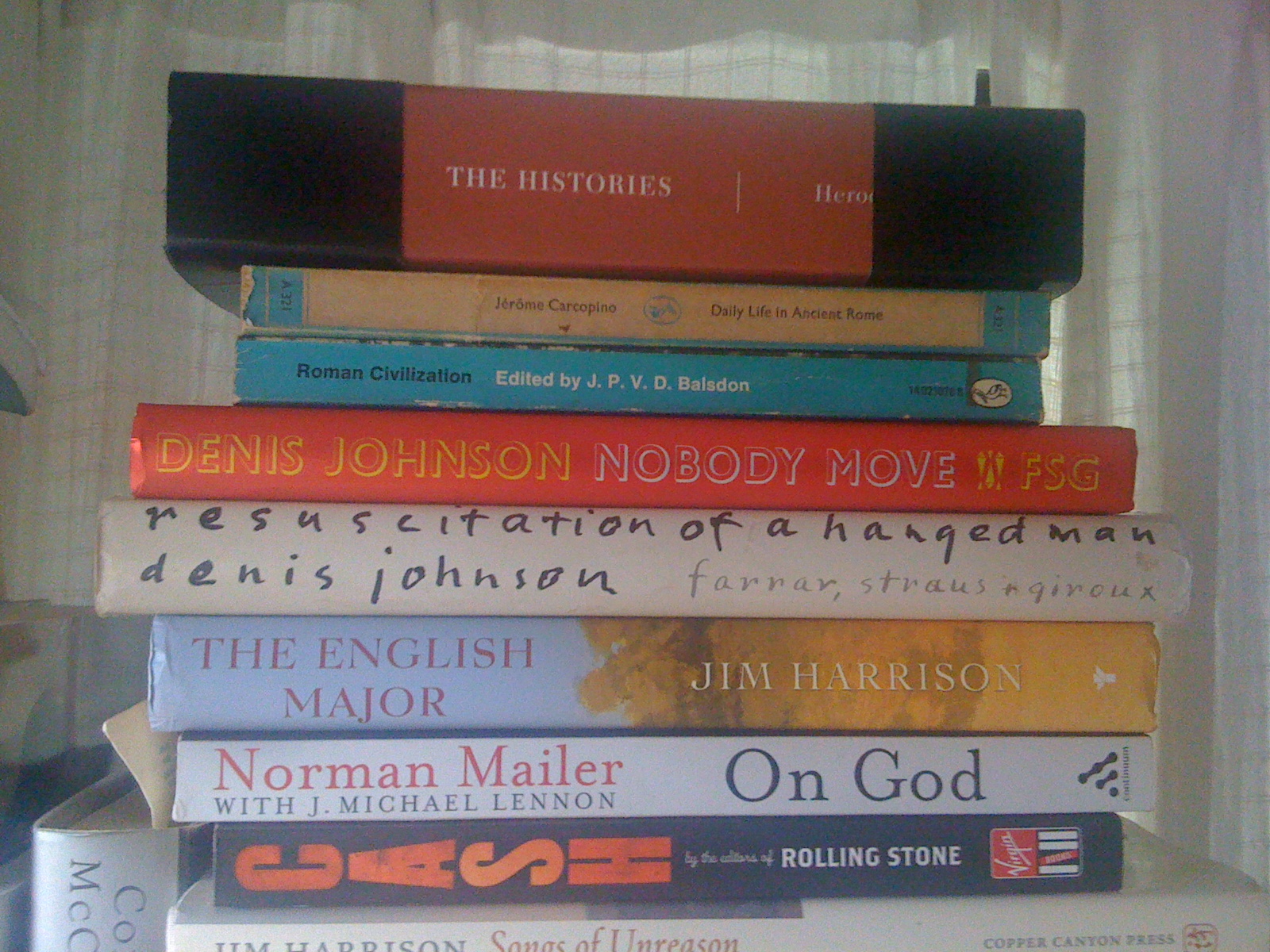
Nobody Move & Resuscitation of a Hanged Man by Denis Johnson – Both of the men in these two novels are specialties of Johnson: flawed souls who could fall apart in uncountable ways because their lives have been lived on the other side of normal sensibility for too long. In Nobody Move, a darker than dark crime noir, Jimmy Luntz discovers he can pull the trigger – kill people. He’s taken up by Anita, “another class of person,” a woman way too good for him, a rare beauty, an American Indian who has entered the world of the “other” people. That means both us and a world we can’t see, but she can. She has stunning beauty masking strength, a real aphrodisiac. She talks to spirits. She is braver than brave. She sees into Jimmy’s soul and figures what the hell, he’ll keep her alive for a while longer or die trying. This is Johnson in a stripped down prose, non-stop action, real suspense, everything – as always in his writing – charged and alive. There couldn’t be a better dark jaunt with two desperate, fascinating losers. Real fear – or is it empathy – arose when I read this tale. Of course, you want to rescue Anita, you don’t want her to go away, but…this is crime noir in spades. Good stuff involving bikers and people who collect money for gamblers and loan sharks and drug dealers. Oh, yes, Luntz sings in a Barbershop Chorus. It’s set around Bakersfield, California, and the Feather River – need I say more. Ok, more…at the end, we’re not sure if Anita dies. They might reunite, but they’ve been, as some say, through a grinder turned by some very bad people.
In Resuscitation of a Hanged Man, Leonard English drives into Provincetown on Cape Cod to start a job as a radio disk jockey and private detective with no experience in either. Men on the street are wearing skirts. He falls for Leanna, a beautiful gay woman he’s assigned to follow, and she’s attracted by his deep communion with God, or what God might radiate if He wanted to bring people to his side, as Lenny might say. Lenny has saintly, apocalyptic visions in which the entire world is charged with God’s spirit, which ultimately leads him to shoot the hat off the local Catholic bishop, or so he imagines. This is Johnson loading up the deck with opposing symbols: sexuality, faith, love and reality. In another life, Leonard must have followed Moses into the desert and enjoyed every minute of it. Normal life in other words is sorely lacking all around, a big disappointment if God is real. He can’t decide. Why all the waiting around? To survive, Leonard has focused his attention on attention itself, and he’s wired into everything around him save for the ability to live a normal life. Again, this is a type of character that Johnson can do better than anyone. At some point, Johnson discovered that he could write about the feelings of consciousness, not the normal feelings consciousness produces but the feeling of feelings themselves. Hard to explain, but I’ve often felt drunk or stoned when reading Johnson as he gets into the mind of these type of people, and I guess that’s the highest tribute I could pay him (no pun there, right?). I’m included in a place few writers can create. I’m not sure if it erases literature and exposes life or if life is erased exposing the power of words. Johnson’s ability to handle people who experience spiritual feelings reminds me of Norman Mailer, another writer who treated spirituality and God with real seriousness. I’ve also just finished On God, a conversation with Mailer with promptings by J. Michael Lennon. It would have been something to have brought Mailer and Johnson together to talk about some of these matters and how they can play out in people’s lives. Mailer was a Manichean gnostic; Johnson, I think, is probably religious in the sense that he is drawn to the mystery, or else he’s in deep as a practicing born-again Christian. Both men shun religion in the hands of institutions, as well-intentioned as some of them are, but we know from history many have not been well-intentioned as they went forward. Mailer speaks revealingly of the role of ceremony. Johnson has pegged the disturbed fringes, and the loners, as where the most inspired God-seekers reside. That reminds me of Updike’s Lillies of the Field, which has a wonderful section on people who ban together in search of God, as in Waco, Texas, many years ago, one of a long list of apocalyptic callings.
The English Major by Jim Harrison – Back to Jim Harrison again, and in this novel he’s on a roving romp. The character Cliff (as in fallen off) is who Denis Johnson’s flawed lost souls would be if they could get a ticket to a normal life. Cliff gets by. A normal guy, not brilliant, but smarter than most, not full of himself because he’s had too much of a normal life, lacking in a wide range of experiences which he’s now ready to rectify because he finds himself recently divorced and free to wither away or flourish at 60 years old. Is it too old to live out some fantasies? No way…he’s soon driving across America with a former high school student he taught some 20 years ago. His ambition is to travel to all the states and to rename them and their state bird. It’s a grand, large project and Cliff carries it off with aplomb while Harrison drops his perennial wisdom gems for over preened souls: get out of your chair, eat something different, roll the dice of life and double down till you win or understand something valuable. Harrison has perfected a style that rests partially on his non-stop ability to unfurl the discursive in-the-moment workings of Cliff’s mind. Cliff, it turns out, has been selling himself too cheap, and there’s a glimmer toward the end that at 60 he still has something to offer younger, attractive women, but that intimation is left as is, and he rolls back to where he started in life, into his mother and grandmother’s abandoned home, an adventure ended that has shown him he’s ready to knock on new doors, and he’s not nearly the same person as when he set out. Being on the road is a good thing indeed.
Daily Life in Ancient Rome by Jerome Carcopino – We leave the Roman consuls and dictators behind in this wonderful book of daily life in the Roman Republic in the second century A.D. This is a type of history that we need more of, as my friend Red Pine says, taking us to the places where significant things occurred. It’s one thing to read about the exploits of the grand names of Roman history and quite another to read about the non-exploits of the nameless in history, where most history really takes place. To read the story of Rome’s evolution as a city, the nature of its streets, its apartments, its shops, its public baths, the theater, the public forums, the nature of education, prostitution, marriage, sexuality, religion, the morning routine after awakening, breakfasts and the evening meals, the nature of clothing, the look of the sleeping quarters, the kitchen, it all adds up to create a living backdrop where the betrayals and bravery of the Roman elite are played out. It brings far away quite close.
Red Pine in New York Review of Books
Posted: May 30, 2012 Filed under: books, buddhism, people, poetry Leave a comment Red Pine, aka Bill Porter, has a couple of new books underway in various stages of completion. An article in the New York Review of Books runs down his latest activities, including the receipt of a Guggenheim grant, which is so well deserved.
In the NYRB article, he was asked by a Chinese man to explain what is Zen:
“Zen is like a cup of tea,” he replied “On one level you can see the teacup and you can admire it. You can look at the tea and admire it and its flavor. But then you have to drink it. When you drink it you have the real cup of tea. But what is it? It’s gone: it’s the memory of the taste, the sensation in your mouth.
“China has a great Olympics program but not everyone in China should train for six hours a day. Likewise, being a hermit is not for everyone. It’s like spiritual graduate school.
“You spend most of your time chopping firewood and hauling water. This becomes part of your practice. Many people go in the spring and leave in the autumn. They don’t have the spiritual practice to sustain them during the winter.
“A man, somewhat perplexed, stood up: “You are a westerner, of course, and in the United States Christianity is the main religion. But you practice Buddhism. Can you explain why?”
“Porter paused for a few seconds, sensing that the man might be one of China’s burgeoning ranks of Christians. Then he said, “Christianity asks you to believe in things that you can’t see: that there’s a god, that he had a son and so on. In Buddhism there is that too—there’s a paradise and so on. But in Zen Buddhism it’s mainly about your mind and your heart. You believe in something that is in your heart. That is something not abstract but real.”
Porter has completed a book on the Silk Road, and he’s working on another travel book about early Chinese poets.
Larry McMurtry’s Booked Up bookstore
Posted: May 26, 2012 Filed under: books, people, writing 2 Comments
The novelist and bookman, Larry McMurtry, opened Booked Up, a bookstore in his West Texas boyhood home of Archer City, Texas, many years ago. The bookstore is one of the finest and largest used bookstores in the world. Word has circulated that he will liquidate most of the stock and keep only his main store which is located near his home a few blocks away, where he has a personal library of around 30,000 books. Estimates of the number of his books in all his stores, which were abandoned buildings in the town, range from 300,000 to 400,000 books. The dispersion of his well-bought books will be a great loss to readers.
Clive James on William Empson
Posted: May 26, 2012 Filed under: people, poetry, states of mind, writing Leave a commentHere is a short remembrance by Clive James on William Empson that was posted on Poetry.
What word is this?
Posted: May 5, 2012 Filed under: photography, places, states of mind Leave a comment
Abandoned church near Newton, Texas; photography by Roy Hamric
Bedside Books
Posted: May 1, 2012 Filed under: books, people, writing Leave a comment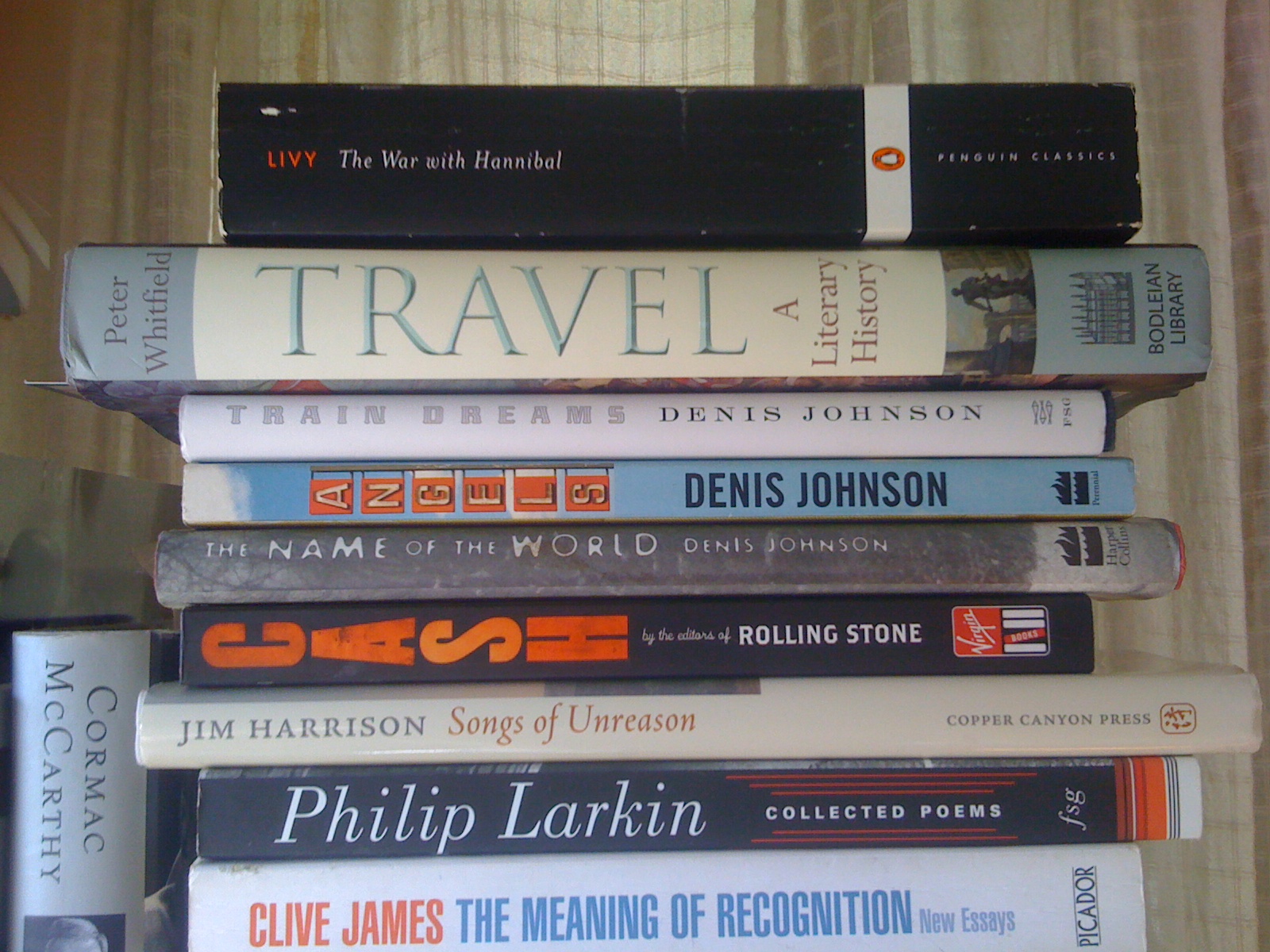
The War with Hannibal by Livy: This was a great read distinguished by a consistent narrative drama chronicling Hannibal’s failed (barely) attempt to conquer the Roman empire. Hannibal was something of a military genius, certainly a relentlessly ambitious general, who led a largely mercenary army that spoke many different languages through decades of war with Rome. His elephants. His crossing of the Alps. He tested the Romans’ endurance, and they proved themselves absolutely resolute, even when he was knocking on their doorstep. He called forth a number of brilliant Roman generals, ending with Scipio who took the reins in the bleakest of times. He was still in his early 20s when he took command, after the death in battle of his father at the hands of Hannibal’s army. I don’t want to stop reading about the Romans, but I’ve nearly exhausted the stock in the local used bookstores so now I’ll have to make a list of the Penguin edition Roman history classics that I haven’t read and order them.
Travel: A Literary History by Peter Whitfield: This is required reading for anyone who loves real travel literature. It’s a comprehensive look at what we must call travel writing, but the story is always so much more in the hands of the masters. This survey goes back to the story of the Jewish people’s journey through the desert, and evolves through the centuries as travel stories change with the texture of the times, ranging from pilgrimage, exploration, conquest, adventure, science and the “search for the self.” Whitfield, a sharp intellect, is more than capable of expanding our mind about the role of the writer who sets out to record a journey, and what such books say about both the writer and the culture that produces them. As Robert Louis Stevenson said, “There is no foreign land; it is the traveler only who is foreign.” There are generous quotations from the earliest to the latest writers who take on the stories of their travels. Paul Theroux is immensely appreciated by Whitfield, as are Thoreau, Gary Snyder and Jack Kerouac. His assurance makes Whitfield brave enough to draw in such American writers who are not in the traditional travel-writing genre: the last three, of course, touch on the nature of inner journeys or attention to a place. It takes someone with his literary abilities, learning, and reading to do this type of history justice, and he does.
Train Dreams by Denis Johnson: I mentioned a review of this book in a post a month or so ago. This novella is what it’s cracked up to be: a perfect, short narrative that draws you into a simple man’s life as the U.S. western frontier is closing. The mesmerizing and poetic language is haunting, a quality that Johnson has in aces. It’s very hard for me to make comparisons with Johnson, which is a sign of uniqueness. Something of Hemingway’s pristine sharpness, especially in the art of staying on the story’s pitch so that it never wavers. Something of Faulkner’s way with common folk, but the expansiveness of Johnson’s talent allows him to treat all people with precision. His unique gift centers on people in search of a spiritual awakening. In the story of Grainier this never surfaces. Grainier is too simple to even address those types of questions in his mind: but he’s there as a full human being, and the death of his wife and young daughter send him into remorse and haunting dreams, which he survives. A seldom seen acquaintance calls him a hermit of the mountains and deep forest, which shocks him. A simple soul beautifully captured in a story that stops more or less in his mid-thirties, yet he goes on to live another thirty some years before his death in the mid-60s. I hope the telling of the second half of his life will be given to us later. It deserves to be placed beside Jim Harrison’s Legends of the Fall. Two short masterpieces capturing the American West.
Cash by The Editors of Rolling Stone: Johnny Cash, like all great artists, seemed to be playing out his life and his art all at the same time, shake and mix. He did it with his song lyrics and his voice, and it’s pretty clear he’s not going to go away, and he will emerge as one of the great singer-storytellers of our time, along with Dylan. They both share many traits, and they recognized their religious kinship and folk-country roots. The fact that the last three of Cash’s recordings were among the best he ever did is amazing, and a hats off to producer Rick Ruben of heavy metal fame who understood Johnny Cash and allowed and challenged him to do those last CDs that covered some great Americana songs and also some of the wilder, modern singer-artists like Kurt Cobain, et al. Cash’s version of Hurt is going down in the Great All-Time Book of Songs. And this book is one of those great reads, a blend of hagiography, utterly appropriate in this case, and quick-take journalism of sundry days in Cash’s life as viewed by a vagabond writer on an assignment. Cash was an open guy, at home in his skin, and he had an ability to see himself and wasn’t afraid to use his bad side to make good art. His story was played out to a large extent on the stage of life for all to see, or at least enough of it for us also to learn something about the art of myth-making. But Cash shines through for who he was, even acknowledging the myth-making. Managing the elements of an artist’s life isn’t a simple matter of myth-making. The elements have to be there. The outlaw spirit. A truth-teller. A willing disciple of the dark forces. A good, tender heart. The spirit of an artist. The touch of a poet. Cash had it all, and he turned it into a redemption story, a man expressing his deepest soul in song. Dylan writes about Cash in Chronicles, his brilliant autobiography: After praising “I Walk the Line” and the early Sun Records artists, he says: “Johnny Cash’s records were the same, but they weren’t what you expected. Johnny didn’t have a piercing yell, but 10,000 years of culture fell from him. He could have been a cave dweller. He sounds like he’s at the edge of the fire, or in the deep snow or in a ghostly forest, the coolness of conscious, obvious strength, full tilt and vibrant with danger…Johnny’s voice was so big, it made the world grow small.”
Bill
Posted: April 12, 2012 Filed under: poetry, writing Leave a commentI knew a cowboy in Texas named Bill.
I guess I wanted him as a Father.
But he was a loner. He wouldn’t drive
till after midnight. He liked empty roads.
This cowboy made moonshine
in the woods, kept a spiral notebook
in his khaki shirt pocket, read science fiction.
He said
We’re reachin’ out from inside. We know there
ain’t no real heaven. But maybe
that’s still where we’ll all end up––out there.
How we’ll be…
He wanted to know where West was
or he got nervous. He couldn’t handle
compliments or prosperity.
He liked without better.
This cowboy was brave,
and knew not to show it.
But this cowboy wanted
reassurance too. He didn’t
want it from people.
He wanted it from the sky.
Minding My Time
Posted: April 11, 2012 Filed under: poetry, states of mind, writing Leave a commentMinding My Time
Awash in mind time.
Mind’s always mattering:
sensations, feelings
always forming.
Words always mattering
in Universe of Matter––
That’s all
(not really for Roy & Laddawan
and the Thai band playing
Eric Clapton).
Not to mind called self
that’s just the go-between
for no-body.
Big Self is every thing.
Knows like the bone in your
eye every thing’s just co-
existing meaning matter
of meaning-ness.
Right now
at 1:18 a.m.
as a tiny candle lantern rises
golden in the night sky
like a star.

