
Where does good come from?
Posted: April 20, 2011 Filed under: people, states of mind Leave a comment The biologist, E. O. Wilson, is ready to launch another revolution in understanding how humans are made up and why they do what they do. Currently, he’s convinced that genetic predisposition (DNA) drives humans to form groups and that altruistic acts that could even threaten one’s own survival are a result of DNA, rather than a product of the reigning biological theory of “kin survival,” which says humans make altruistic sacrifices for kin in a self-interested way, i.e. to preserve those closest to them. A fierce fight is developing, which takes us into the heart of whether morality is somehow embedded in the human instinct, or not. What’s at stake here is the old issue of nature vs nurture; is morality in some way a part of our genetic DNA make up or is it culturally derived? There are a lot of slippery slopes, but I’m betting on Wilson. For a good article summarizing the issues involved, click here.
James Franco on directing Blood Meridian
Posted: April 19, 2011 Filed under: Uncategorized 1 Comment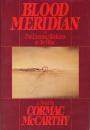
First edition dust jacket
Here’s an excerpt from an entertainment Website on Franco talking about getting the job to direct Blood Meridian. He’s also got a project underway to direct Faulkner’s As I Lay Dying.
“As for Blood Meridian, which has its own remarkable and distinctive prose style and includes scenes of nightmarish violence which should prove tough to translate to screen, Franco said he got the gig by shooting a test sequence from the book, with all the trappings (among them Luke Perry). Mark Pellegrino (a.k.a. Jacob from Lost) played the Judge — one of the most horrific villains ever to grace a work of American fiction — and the sequence also starred the likes of Scott Glenn, Luke Perry, and Franco’s brother Dave, also an actor.
“Franco said: ‘We made that as a way to convince Scott Rudin to give us the rights. It was like, why should he give it to me when Ridley Scott didn’t make it? So I called him up and said, “I’m planning on doing this. You don’t have to give me any money, I can finance this shoot. Would you just wait? Don’t do anything with it until I show this to you.” And I showed it to him and he loved it.'”
To see the entire article, click here. For the 1992 interview with Cormac McCarthy in The New York Times, click here.
from the Edge
Posted: April 17, 2011 Filed under: articles, people Leave a commentThe Edge website: Here’s a sample of the quality of input re: the nuclear disaster in Japan:
The Nuclear Accident in Japan & Systemic Risk
J. DOYNE FARMER Chaos Theory Pioneer; McKinsey Professor, Sante Fe, Institute; Co-Founder, former Co-President of The Prediction Company
 “The prognosis for nuclear accidents based on simple historical extrapolation is disturbing. After roughly 14,000 cumulative years of nuclear plant operation, we have now had three major accidents. If we ramp up nuclear power by a factor of ten, which is necessary to make a significant contribution to mitigate global warming, we will increase from the 442 reactors that we currently have to about 5000. Historical extrapolation predicts that we should then expect an accident of the magnitude of the current Japan disaster about once a year.
“But I don’t trust the historical method of estimating. Three events are unlikely to properly characterize the tails of the distribution. My personal choice for a really nasty nuclear scenario goes as follows: Assume the developed world decides to ramp up nuclear power. The developing world will then demand energy independence and follow suit. For independence you need both reactors and fuel concentrators. There will be a lot of debate, but in the end the countries with stable governments will get them. With a fuel concentrator the waste products of the reactor can be used to make weapons grade fuel, and from there making a bomb is fairly easy. Thus, if we go down the path of nuclear expansion, we should probably assume that every country in the world will eventually have the bomb. The Chernobyl disaster killed the order of ten thousand people: A nuclear explosion could easily kill a million. So all it will take is for a “stable government” to be taken over by the wrong dictator, and we could have a nuclear disaster.
“I’m not an actuary, so you shouldn’t trust my estimates. To bring the actuaries into the picture, anyone who seriously advocates nuclear power should lobby to repeal the Price-Anderson Act, which requires U.S. taxpayers to shoulder the costs of a really serious accident. The fact that the industry demanded such an act suggests that they do not have confidence in their own product. If the act were repealed, we would have an idea what nuclear power really costs. As it stands, all we know is that the quoted costs are much too low.
“Danger is not the only property that makes nuclear power exceptional. Even neglecting the boost in cost that would be caused by repeal of the Price-Anderson Act, the cost curve for nuclear power is remarkable. My group at the Santa Fe Institute has collected data on the cost and production of more than 100 technologies as a function of time. In contrast to all other technologies, the cost of nuclear power has roughly remained constant for 50 years, despite heavy subsidies. This cannot be blamed entirely on the cost of safety and regulation, and after Japan, is anyone really willing to say we shouldn’t pay for safety? In contrast, during the same period solar power has dropped by a factor of roughly a hundred, making its current cost roughly equal to nuclear. Wind power is now significantly cheaper than nuclear. Solar will almost certainly be significantly cheaper than nuclear within a decade, roughly the time it takes to build a nuclear plant.”
Let’s hope the disaster in Japan puts the stake through the heart of the nuclear power plant industry. General Electric should be working now to dominate the solar, wind and wave energy systems of the future, because that’s clearly the road we’re going down from now on. People simply will no longer trust the folks who say nuclear engineering is fail safe, when failure, probable failure, has such dire consequences, not to mention Farmer’s realistic fear about the problem of nuclear waste and how it can be reprocessed to build atomic weapons.
the Edge
Posted: April 16, 2011 Filed under: Uncategorized Leave a comment
Could you explain the Third Culture?

Brockman, Warhol & Dylan, circa late 60s
In 1959 CP Snow noted in his book The Two Cultures that, during the 30s, literary intellectuals took to referring to themselves as “the intellectuals”, as though there were no others. This new definition excluded scientists such as the astronomer Edwin Hubble, the mathematician John von Neumann, and the physicists Albert Einstein and Niels Bohr. In the second edition, Snow added a new essay, optimistically suggesting that a “third culture” would emerge and close the communications gap between the literary intellectuals and the scientists. Although I borrow Snow’s phrase, it does not describe the third culture that he predicted. Literary intellectuals are not communicating with scientists. Scientists are communicating directly with the general public, and in doing so they are taking the place of the traditional intellectual in rendering visible the deeper meanings of our lives, redefining who and what we are.
Which new writers, scientists and artists should we be following at the moment?
Research psychologist Daniel Kahneman, who won a Nobel Prize for the creation of behavioural economics, is one. Jeff Bezos, Larry Page, Sergey Brin, Dean Kamen, Nathan Myhrvold, Jimmy Wales and Salar Kamangar all came to an Edge seminar to hear him lecture. Kahneman is not exactly a household name — yet among many of the leading thinkers in psychology, he ranks at the top of the field.
What is it that gets you interested in a person or their work?
I am interested in people who can take the materials of the culture in the arts, literature and science and put them together in their own way. We live in a mass-produced culture where many people, even many established cultural arbiters, limit themselves to secondhand ideas. Show me people who create their own reality, who don’t accept an ersatz, appropriated reality. Show me the empiricists (and not just in the sciences) who are out there doing it, rather than talking about and analysing the people who are doing it.
How do you find these people?
It’s all based on word of mouth and reputation. Edge, contrary to how it may appear, is not exclusive. Elitist, yes, but in the good sense of an open elite, based on meritocracy. The way someone is added to the Edge list is when I receive a word from a Steven Pinker, a Brian Eno, a Martin Rees, an Ian McEwan or a Richard Dawkins, telling me to do so. It’s as simple as that and I don’t recall ever saying no in such circumstances.
States of mind: Joseph Conrad
Posted: April 11, 2011 Filed under: Uncategorized Leave a comment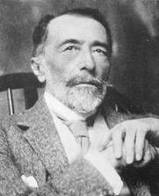
“When once the truth is grasped that one’s own personality is only a ridiculous and aimless masquerade of something hopelessly unknown the attainment of serenity is not very far off.”––Joseph Conrad, letter to Edward Garrett
john jeremiah sullivan
Posted: April 2, 2011 Filed under: books, people, writing Leave a comment JJS, that would be John Jeremiah Sullivan, writes about DFW, that would be David Foster Wallace’s posthumous novel The Pale King, read Death coming for our spirits, in an essay in GQ that hits the target and goes right through it to the other side, leaving you with some certainty that DFW, who is often called a “generational writer,” (which underrates his importance), has been deciphered, but of course that’s creating another fiction, and this is sounding a bit like DFW so check out the essay here, because it’s a watermark in appreciation. The bits about Cormac McCarthy are interesting, as if DFW saw him as his polar opposite, a writer trying to create mountains in a sea of sand. In sections of the uncompleted novel, DFW pays homage to McCarthy’s high-art prose style, or he recognizes its usefulness in shrouding everything in nobility. The photograph shows DFW’s jottings on a book from his library, which is now in the DFW collection at the University of Texas.
Graham Greene
Posted: April 1, 2011 Filed under: books, people, writing Leave a comment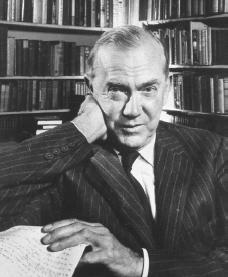
Graham Greene in mid-life
Our worst enemies
here are not
the ignorant
and the simple,
however cruel;
our worst enemies
are the intelligent
and corrupt.
––Graham Greene,
in The Human Factor
Name dropping
Posted: March 31, 2011 Filed under: books, fiction, people, writing 2 Comments Check out page 295 of Jim Harrison’s newest novella collection, The Farmer’s Daughter, when you see a copy. He kindly slipped my name into one sentence in this force majeure book, particularly the first two novellas: The Farmer’s Daughter and Brown Dog Redux. There’s simply no writer like Jim Bear. He shares his buddy Thomas McGuane’s luminous language plus an always beating, warm heart, making for characters that are the closest you’ll ever get to pulsing human blood on the printed page. Plus funny, out loud laughing.
Naipaul’s strange masque
Posted: March 26, 2011 Filed under: articles, books, people Leave a comment I’m 115 pages into V.S. Naipaul’s The Masque of Africa, and it’s one of the weirdest books I’ve ever read; so strange, you’re afraid to speak about how odd it is. After finishing Naipaul’s biography, it’s clear he was brought up with a fear of blacks and what they represented to his class of East Asian-Indian Trinidadian society. It’s something he was never able to leave behind. The book is about a six-month trip he took through the heart of old Africa, in the sense that he was in search of whatever remnants of primeval tribal culture he could find, particularly the spiritual and religious aspects. Certainly, a promising subject for him. But to watch him flounder around, you wonder is this the same writer of the earlier nonfiction books who could take apart a culture in 50 pages? The problem is you can’t be sure of what he’s trying to do here. It may be the ultimate writer’s fatigue or possibly an experiment, some new approach to storytelling (that so far he and I both seem to be trying to untangle). He’s a master of prose. We know that, but the prose here is constantly exuding irony (intended and not intended), condescension, put-ons, farce and cascades of clunky one-liners that highlight naiveté, stupidity, obtuseness, ignorance, on top of which he casts himself as a an awkward character whose rapport with his subjects is based on all of the above. It’s such a literary wreck, you’re forced to keep reading for the wrong reasons. There must be a point to it all, but so far it has eluded him and me. I have no choice but to keep reading in hope of the best and enthralled that it may be what it appears to be––simply bad, a writer whose style and personality have broken down but in a bravura act been put on display for all to see. A sort of ultimate who cares after the Nobel Prize. I just got the quirkiness of the style: it’s Dick and Jane go to Africa. That makes me, and you, the readers, children who will read any little story that keeps chugging along. A sample:
Since life (and death) are so full of snares, there are many ablutions to be done and many taboos to be observed. It is better to be barefoot. For the high priests especially it is taboo to have the soles of their feet covered; these important people must always have a link to the earth. If they are caught wearing shoes, they can be fined. Full shoes are allowed in some shrines, but not slippers. Wherever the high priest walks becomes holy, because he is the physical representation of the spirits, and is possessed by the spirits. The high priest wears white and carries a broom in his hand. The broom stands for his cleansing function.
Naipaul: the calypso rambler
Posted: March 22, 2011 Filed under: articles, books, fiction 2 Comments The V.S. Naipaul biography (The World Is What It Is) is done, confirming the tiresome personality which has become so much of his myth. Fortunately, his biographer chose to treat the negative aspects of his personality as matter of fact; he had no choice; from Naipaul’s beginning as a teenager, it was apparent he was destined to be insecure, egocentric and cruel, seeing himself as privileged. He is impervious and unconcerned about his failings as a human being. He’s cultivated, and had it cultivated for him by others, a myth that he sacrificed all for his art, but I don’t see it that way. To say that, is to say you have no responsibility to the people around you, whether casual strangers or loved ones. He is routinely awful to too many people. About the only thing positive that can be said for his cruelty and rudeness is that he does it to people face to face, with no pretension. There’s an element of sadism here, the small boy who enjoys torturing the weak and unsuspecting. But enough of that. “Enough,” in fact, is his biographer’s , Patrick French’s, last word in the book, which stops at 1996. In a footnote, French writes, “but more later.” It must be said, I have nothing but admiration for Naipaul’s cooperation with his biographer, allowing him full access to all his papers, etc., and in his comments to his biographer admitting his failings in so many areas regarding those who he loved and who loved him. His mother died estranged from her son. It’s one of the great tragedy’s of his life, which he didn’t comment on.
But I don’t care about Naipaul’s personality. Many people are loaded down with flaws that make them pretentious and unpleasant. But none of them, and few others in the world, can come even close to touching Naipaul’s artistry and vision. It’s perhaps a small stretch to suggest that he changed, at least among a certain circle of intellectuals (left), the way people looked at the third world, and the so-called responsibility of the West. I read A Bend in the River when it was published in 1979 and thought it a masterpiece, which it is. It was written in the period of his great nonfiction books. I was first attracted by his nonfiction writing, which still holds me, and, because of its structure, mostly still holds together, still offering great lessons through its weaving of history, exacting details, personalities and, most essentially, Naipaul’s hardcore distrust of shibboleths and the fashionably correct. At bottom, I guess, it’s his very distrust (and lack of compassion) of other human beings for not taking greater responsibility over their lives that he uses to color his point of view regarding the West and the so-called third world or emerging nations, or the rest of the world. Anyway, his books have been a necessary corrective, truly a monumental achievement, in the literary sense. So now I’m reading his newest book, A Masque of Africa, which starts off with some of the most awkward prose ever written, at least the first 40 pages or so. At the same time, I’m reading his essay on Conrad in Literary Occasions. It’s as if the writing is by two different people. More on this later. There are some signs that Naipaul is mellowing a bit in old age. As his ego melts down, he’ll have much to reckon with, but he can also say that he’s created an unmatchable body of world-class literature. The books will stand for a long time, the rest is soon dust, and eventually the books will be too.
 the roy hamric journal