
favorite novels list
Posted: June 14, 2010 Filed under: books, fiction, writing Leave a commentHere’s a favorite novels list from a close friend. I post it because I have read only three of the novels, and it opens up new possibilities for me.
Camus, The Stranger
McCarthy, Blood Meridian
Faulkner, Absalom, Absalom!
DeLillo, Libra
Dickens, Dombey and Son
Johnson, Tree of Smoke
Banks, Affliction
––By Jim Giles, who taught English at what’s now The University of North Texas when I was student there.
chiang mai sketch
Posted: June 13, 2010 Filed under: people, places, writing | Tags: chiang mai sketches Leave a commentThis is an excerpt from my unpublished travel book. I’ll be posting some sketches that capture a little of the cultural mix tha t’s going on in Asia. To see more, go to “On the Record” and click on the sketches links.
1.
“That summer I went back to Vietnam, that was a strange one. Speed and cocaine was everywhere, my kids were goin’ crazy and somebody with BB guns shot the eyes out of two cows in my pasture. I finally found my youngest son in a county-line motel room filled with dirty clothes and eight other run-away kids. He was 17 then, going out with girls 23 years old. I mean beautiful girls, the prettiest in the county. My oldest son was let out of jail early ’cause he was a ‘model prisoner.’ Hell, how proud was that supposed to make me?
“Then I started getting calls on the answering machine, ‘We’re going to kill your family.’ ‘Your time’s up, hombre, say adios.’ My wife, who’d just turned Pentecostal, had done said goodbye to me. Really she didn’t say anything––she was just gone. Even took the curtains and the lawn chairs. The youngest boy, the gigolo, he finally took a high school test and placed in the Top 5 percent in the country––the Top 5. He’s smart, but stubborn. Now he’s the youngest electrician in Junction, Colorado. Joined the Pentecostals. Goes regular. Got some credit cards. Sends me a little money sometimes, but he never writes.
“I got arthritis, a big belly. It’s hard to walk. My mother’s lingering. Yesterday, my sister says, ‘I want those blue Limoge bowls.’ I said, ‘Hell, your mother’s not dead. What are you talking about?’ Then I got to thinking, and told her, ‘Ok, tell mother to get some of those stickers. Put names on the bottom of things. Then there won’t be no fighting when she goes.’ Truth was, I wanted Dad’s trunk with the old uniforms in it. He worked for the Texaco gas station when people at those stations wore real uniforms, hats, special belts, and all.
“My mother, she made me proud yesterday. She said, ‘You got good boys now.’ My oldest boy, he’s in China now. Married a Chinese gal, real cute, in San Diego after the Navy. Her father is something in their government. The boy don’t work. Says they’re tearing down all the old things in Beijing. He says they got a lot of that to knock down.
“It’s the same everywhere, I guess. Except we got a black man president now. It’s about time, I say. After I came back from Vietnam and the Airborne, I seen the world clear. I seen it for real. It’s what it is. A blessing in the center of sorrow. I dispatched the two cows, dressed them out, filled the freezer, had meat for a year, and I said to myself, it’s time to go to Vietnam. I nearly died over there two times. Once with the Airborne on Nui Cuong Mountain. Then again last year on that same mountain. “I told myself I was going to climb to the top of that mountain again, to see it all again, and I did, but it didn’t mean anything. I didn’t recognize anything. It looked like no one had ever been there. Getting back down, it nearly killed me. It turned dark, and I was on the ground – couldn’t walk. Thought I was dying. My guide, who was a good kid – I seen that when he first started to cut trail going up the mountain – he said, ‘Look at the stars, mister. They’re beautiful.’ I thought, ‘Son, I’m dying here right now.’
“Then I see the damn stars – they were beautiful. It felt like they had come down and were touching me. I said, get your ass up, you’re not dying here. The boy, he about carried me down the mountain. I think he understood what it was all about.” copyright@roy hamric
sight seeing
Posted: June 11, 2010 Filed under: people, photography, sight seeing Leave a comment
I like the distortion and colors in this self-portrait reflection on an aluminum water container on the roof of a building. (Iphone photograph)
Khao San Road
Posted: June 11, 2010 Filed under: books, places, writing 2 CommentsAn earlier version of this article originally appeared in The National Post in Canada.
By Roy Hamric
The most famous road on the Asian backpacker’s tour is only a few blocks long, and it’s in the center of Bangkok. It’s called, Khao San Road, and it’s been a required backpackers stop for nearly thirty years. The road’s image was jolted into destination status by the movie “The Beach,” starring Leonardo DiCaprio and directed by Denny Boyle of “Trainspotting” fame. Based on a 1996 first novel by Alex Garland, it’s a quirky, improbable story of a 20-something, idealistic American named Richard, who checks into a guesthouse on Khao San Road, where he meets an older, mentally rattled character called “Daffy Duck,” who babbles on mysteriously about a secret island. The next morning, there’s a map to the island pinned on Richard’s door. He goes to the stranger’s room only to find him dead––his wrist slit. Too make a long, and not too interesting story, short, Richard is lured to the mysterious island—where he’s caught up in an idyllic milieu of an exotic international crowd of dreamers, misfits, run-aways and crazies. Over zealous critics compared the book to the works of Golding and Joseph Conrad, with touches (to set the record straight) of Looney Tunes, “Apocalypse Now” and Nintendo psychology thrown in for the ride.
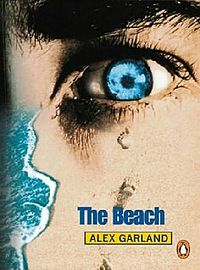
a Penguin paperback cover
As the book begins, Richard steps out of a taxi on Khao San Road. Garland wrote: “When you hit Bangkok, the Khao San Road is the first place you come. It’s a decompression chamber between East and West.”
When I stepped out of a taxi on Khao San Road on a sweltering mid-afternoon, there was a sense of arrival––books and movies do that to you––and a sense of departure as well, to be fully accurate, for everyone, the foreigners at least, was in arriving or departing mode, just passing through. If this place were on the old Silk Road, it would be at an oasis, a spot where everyone on the road that day stopped at night to exchange the word of the day. It felt like that type of place, a place that existed for its convenience, to share warnings, to offer advice, to meet friendly traveling companions.
For me, Khao San Road stands for a single, throw-away line in Garland’s novel, when Richard, trying to explain what he’s looking for, says only two words, “something different.” For more and more people something different is exactly what they’re looking for, but they don’t know where or what it is. Only a few months earlier, I had pulled up my roots to build a new life in Thailand. I had read about Khao San Road. I was curious, but I expected it to be just more media hype.
The first day, it was sensory overload. A few feet away from the taxi, the sounds of Hank Williams’ “Hey, good lookin’, what’ cha got cookin” blared from a boom box. Across the street a boom box was blasting Bob Marley’s “I Shot the Sheriff.” Music as the home you left behind… The shops along the road wedged old and new Bangkok side by side: trinket shops housed in one-story, weathered teak buildings with coruscated aluminum roofs jammed next to modern, air-conditioned Internet cafes, ATM machines, silver and gold exchanges, 7-Eleven stores, travel agencies, walk-up or walk-down back alley guest houses, tailor shops, pirated cassettes and CDs spread out on tables, street-bistro cafes, and a swirl of dozens of languages gave it all a world bazaar atmosphere, not to mention the smells wafting from restaurants with dishes from Thailand, America, China, Israel, Italy, India and Nepal.
Fresh-faced, Midwestern American farm girls were having their hair done in African braids by Thai women to the beat of pop songs coming from 5-foot TV screens. Fresh tattoos were being etched into the arms, ankles and shoulders of first-time teenage travelers. The in-tattoo for young women was a black, “linked chain” design around an ankle, and for young men, a large Thai warrior “spirit” figure, with bulging eyes, a grimacing expression and a ready sword in hand.
At nightfall, the frenetic pace eases, and the police close off the street. Shop owners move tables outside to catch a whiff of cool breeze. In the twilight, neon lights wrap a soft glow around the faces of people who you watched arrive during the day, and they’re now studying the new people struggling to pull their backpacks out of taxis, in search of a cheap room and some nightlife. The Thais have a word for what’s going on here, “saduak,” convenient, easy––make it easy, take it easy. Come to Bangkok, come to Khao San Road, it’s easy, it’s convenient, and it’s where you can learn the latest news.
My room for the night was 10X10-feet, just about large enough for a good size bed, but clean and quiet, and early the next morning I was back on the road––who were all these people streaming in and out, and what’s going on in their heads? I dropped into Buddies Beer Garden, which is really a restaurant & swimming pool, a blend of Southern California and Dali Lama decor, one of the hotter hangouts complete with lithe, young Thai women splashing in the swimming pool in back. I spotted a group of people sitting at a nearby table, backpacks leaning against their chairs. Were they Americans? You couldn’t be sure. Everybody dresses alike here––cheap Thai, Indonesian or Nepal baggy pants and T-shirts with catchy phrases (I’m a Yao), and lots of silver, stones and beads around ankles, wrists, and necks, plus various ornaments in ears, noses, lips and navels. With practice, you can gauge how long a traveler has been on the road in Asia by their tan: a two-week soft tan, a two-month soft brown, a six-month dark brown and a six-month-plus weathered leather look.
“Did you say you’ve been to Cambodia?” I asked a very attractive girl who had a dark brown tan. “We just came from Cambodia,” she said in an American accent. Her name was Hillary Glenn, and this was her fourth time passing through Khao San Road. She was surprised she’d seen so few Americans here. “We normally try to meet up with British or Dutch travelers,” she said. This reminded me of a Dutch man on holiday I had met earlier in Vientiane. “The Dutch are the Chinese of Europe,” he said. “You will find us everywhere.”
Hillary was traveling with two Americans that she’d just met in Cambodia and they planned to leave the next day for Koi (island) Phi Phi near Krabi, where a lot of the filming was done for “The Beach.” It was a little known island on the western side of Thailand’s lower peninsula, but it has turned into an eco- controversy ever since the movie production crew uprooted trees and replanted various areas with more film-worthy foliage. The publicity was a magnet that has drawn backpackers to the semi-isolated islands that dot Thailand’s gulf. After that, Hillary said the place to be was Koi Pha Ngan, an island famous for its monthly “Full Moon Party” (disco in the sand). Some people believe Garland’s novel was modeled on the Koi Pha-Ngan scene, with its Dionysian nights of dancing ravers, moonlight swimming and howling at the moon. At another table were three Swedish college girls on a two-week holiday. Carola Bragen, 29, a social work major, said her group came to the road not knowing what to expect. Garland’s novel had recently made the Swedish best-seller list. “You see it in a lot of peoples’ backpacks now,” she said. “We just knew this was a backpackers’ place.”
The road’s cultural mish-mash has a legitimate buzz on arrival, but to some long-timers here, the road’s best days are already long gone, and the novel and movie was the coup de grace.
“Khao San Road has changed,” said a man named Steve, who said he now lives near the road. He comes for coffee and to check out the scene, but he spent the past six years moving between Cambodia and Thailand. A wizened, bone thin expat, he dressed in the cool-is-uncool style. He wore checkered Bermuda shorts, high top black tennis shoes, and a T-shirt that said, “I’m Pol Pot.” He lived in a nearby $60-a-month room where he made miniature metal sculptures that sold in some of the local shops. Sipping a cup of adrenalin-charged Thai coffee, he scanned the street. “Before, this place was a lot quieter with mainly a few backers, trekkers passing through, and junkies,” he said. “The place had a seedy, low-end appeal. Very, very cheap. People came, stayed a few days and left. It’s a completely different crowd now. Lots of partying, people on the make. You see a lot of beautiful foreign women. It’s right at the point of turning yuppie. The more neon, the more yuppies. You don’t see that many Americans. It’s mainly Germans, British, Japanese, the Scandinavian countries.
“The newest bar up the street is straight out of America. In some ways, Khao San Road is one of the worst places in Thailand now. There are so many stupid, rude foreigners concentrated here. In the places I go to regularly, I see how the Thai staff really feels about most foreigners who come here. The good side is that the guest houses are still cheap. Rooms for $5 or $10. The money is good for the Thais, of course, and the money is spreading. The next ‘in’ place is Phra Athit Road, where Khao San Road curves and changes its name.”
Anyone doubting that Khao San Road has changed need look no further than the 50-some e-mail shops that have mushroomed in the past few years. Internet N/B, one of the larger shops, was filled with people doing the Internet, or eating or heading upstairs for a quick three-dollar massage (Thai or Swedish).
The owner, Napporn Bhuttan, said business was always good and was clearing several thousand dollars a month, and the road is the most computer-concentrated area of Bangkok. “The market has been slowing for the past year, but now it’s getting better again,” he said. Down the street at Gulliver’s Traveler’s Tavern, a Thai lady, Thanyatorn Srisit, who had the very casual glowing look of someone who knows she’s beautiful, was holding court with two young, tattoo-covered Americans. In a well-tailored dark blue blouse and a black ankle-length skirt with a slit discreetly rising up to mid-thigh, she fingered the cellular phone resting beside her glass of white wine. The owner of a antique fashion store on Rambutri Road, she said the road is what it is. It’s more for tourists than Thais, “but Thais are starting to come here now, to party with the foreigners and to practice their English.”
“Europeans come here to buy cheap clothes,” she said. “They ship them back and sell them to shops and make a good profit.” She said Khao San Road doesn’t have the wild night life one finds on the infamous Pat Pong Road. “Khao San isn’t for the ‘working woman,’” she said, using the polite term for ladies of the night. “There’s not too many working women here––a little bit.” She’s was right. I’d seen none of the hard-core hookers of Bangkok’s sex industry, but you did notice another type of attractive Thai woman on the road when party-time started around 10 p.m.: they were more casually dressed, and, maybe, just liberated Thai women who had day jobs, but who also liked to have fun with fralongs (foreigners).
The road’s reputation as a heavy drug scene was myth, Srisit said. “Drugs are not openly used or available,” she said. “But you see some people who have done drugs.” Earlier, on a restaurant bulletin board, I had seen a notice appealing for donations for foreigners in Bangkok prisons––mostly for drug offenses. There even a mini-tour offer for backpackers to visit prisoners with gifts of food or books, in exchange for a chance to hear hair-raising tales of misadventure.
One of the young Americans sharing Srisit’s table, his forearm covered with Thai spirit tattoos, was sorry his vacation was ending when he’d just discovered the road. “We can’t stay longer,” he said. “Yes, but you’ll be back,” said Thanyatorn.
As my time on the road was winding down, I guessed that most of the passers-through here, asked where they went in Asia, would mention Khao San Road. It had claimed their imaginations and was now a social calling card: “I spent three days on Khao San, were you there?”
Kipling’s overused line about “East is East and West is West” catches the “something different” search that’s going on with people around the world. But when he said “and never the twain shall meet,” he was wide of the mark, and he certainly knew better. It was a poem written for the popular magazines, for the armchair travelers back home. The East and West have been meeting, and blending, since history began. The fusion between East and West really has no beginning or end, but has been ever present and on- going. What’s happening on Khao San Road is a mini-version of the world to come, everyone bumping against everyone else, exactly like some bustling oasis city on the Silk Road 3,000 years ago, when a Greek, Chinese or Iranian traveler stopped over at a village bar and said, “East is East and West is West, here’s to us all…” or some such sentiment.
Garland’s young seeker had the right instinct. There is something different to be experienced by being at-large in the world, something not to be missed, and it’s taking place in cities everywhere. I could only bathe in the mysterious mix of signs and cultures that swirled around Khao San Road. It was a good place to visit.
When I left Khao San Road it quickly became a few memories of a few blocks on a longer road signifying something much larger. Probably Garland’s young man was really just trying to say he was searching for a place where he could see himself clearly without all the cultural baggage that we carry along in our lives. Everyone’s coming together on Khao San Road is just one more step in searching for that place.
time, space
Posted: June 10, 2010 Filed under: photography, places, time, space Leave a comment
June 10, 3:22 p.m., looking down from a rooftop in Chiang Mai (Iphone photograph)
space, time
Posted: June 10, 2010 Filed under: photography, places, time, space Leave a comment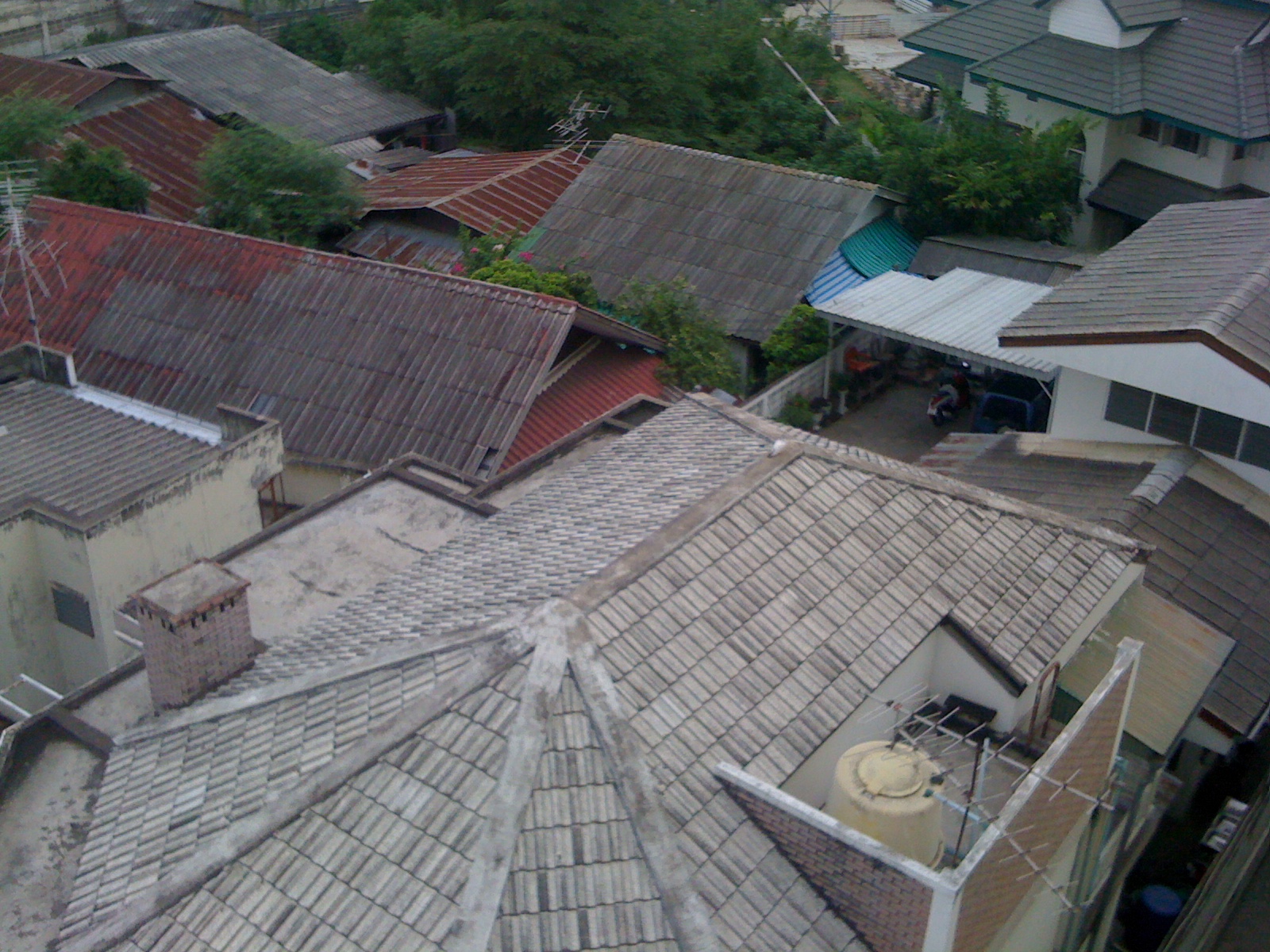
June 10, 3:12 p.m., a cloudy day on a rooftop in Chiang Mai (Iphone photograph)
Lines of thought
Posted: June 7, 2010 Filed under: books, people, states of mind, writing Leave a commentGleanings from reading Pater, Kerouac and Emerson:
“We have an interval, and then our place knows us no more. Some spend this interval in listlessness, some in high passions, the wisest, at least among ‘the children of this world,’ in art and song. For our one chance lies in expanding that interval, in getting as many pulsations as possible into the given time.
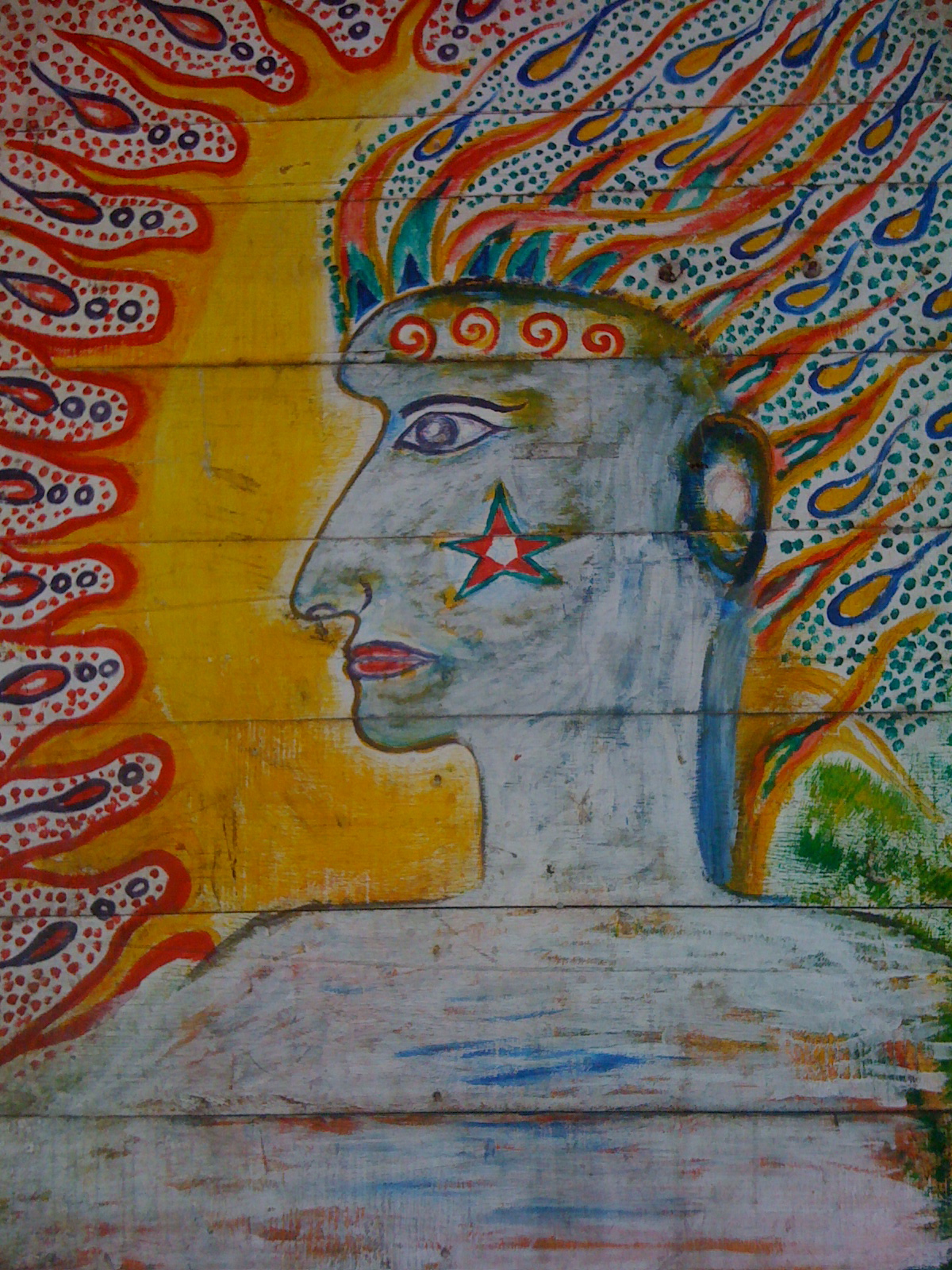
burning man, painting in Cafe del Sol, Chiang Mai
“….Great passions may give us this quickened sense of life, ecstasy and sorrow of love, the various forms of enthusiastic activity, disinterested or otherwise, which come naturally to many of us. Only be sure it is passion––that it yields you this fruit of a quickened, multiplied consciousness. Of this wisdom, the poetic passion, the desire for beauty, the love of art for art’s sake, has most; for art comes to you professing frankly to give nothing but the highest quality to your moments as they pass, and simply for those moments’ sake.”––Walter Pater, The Renaissance
“Believe in the holy contour of life.”––Belief & Technique of Modern Prose, Jack Kerouac
Emerson, in his Journal: “The days come and go like muffled and gray figures sent from a distant party, but they say nothing and if we do not use the gifts they bring, they carry them silently away.”
time, space
Posted: June 6, 2010 Filed under: photography, time, space Leave a comment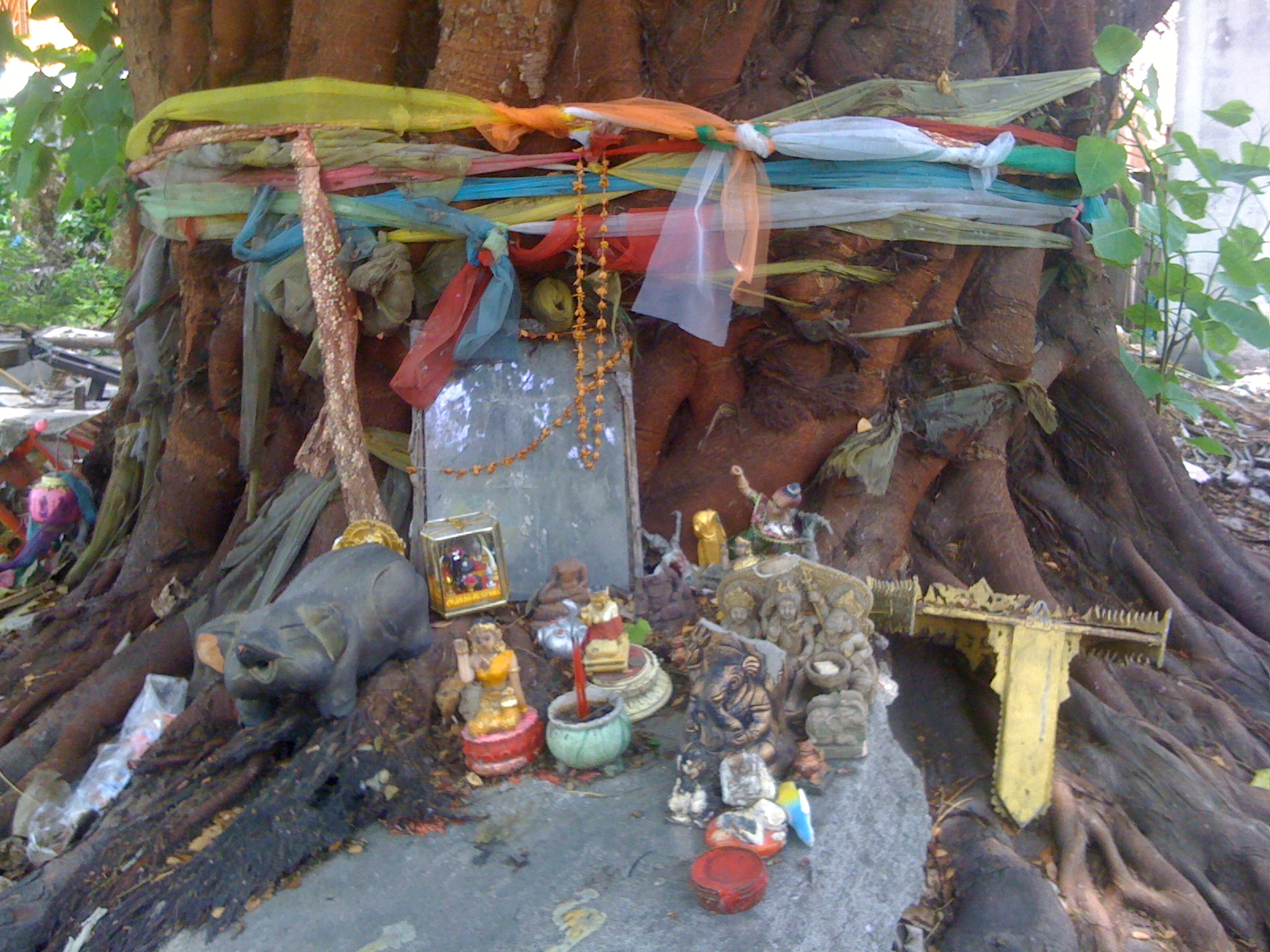
June 6, 9:50 a.m., offerings to a spirit tree near Rachawitte Road (Iphone photograph)
why Stanley Cavell?
Posted: June 5, 2010 Filed under: articles, books, people, states of mind 1 CommentI was first attracted to Stanley Cavell’s study of Thoreau, The Senses of Walden, and his deep probing of Emerson’s ideas in essays throughout his many books. All his books circle around American thought, American originality, while pulling in Wittgenstein, Kirkegarde, J.L. Austin, Heidegger, and others, with a commitment to use ordinary language and works of literature as a common ground of thought through which we all can assess and explore life, not something separate from philosophy but a living part of a philosophy that identifies itself with a deeper sense of experience. I think the passage below from the preface to Must We Mean What We Say?, as well as any, summarizes his intent and purpose:
“I suppose that the idea of the philosopher as guide was formed in me in resistance to the still current idea of the philosopher as guard. So I should perhaps add that at no period in my life has it occurred to me that philosophical problems are unreal, that is, that they could be cured and philosophy thus ended, as if left behind. The problems I was concerned with are better expressed as about the all but unappeasable craving for unreality. Kant’s diagnosis of such perplexities was as “transcendental illusions.
“I had in Must We Mean What We Say? already suggested understanding the philosophical appeal to the ordinary in relation to Kant’s transcendental logic, namely, as the sense of uncovering the necessary conditions of the shared world, but not until the second essay in the book, The Availability of Wittgenstein’s Later Philosophy, was I able to give a certain textuality to this relation to Kant, at the point at which Wittgenstein in Investigations announces that “Our investigation….is directed not toward phenomena, but, as one might say, toward the ‘possibilities’ of phenomena.” And it would not be until the Claim of Reason that I would feel I had secured some significant progress in assessing the difference it makes that Wittgenstein sees illusions of meaning as something to which the finite creature is subject chronically, diurnally, as if in every word beyond the reach of the philosophical system. The idea that there is no absolute escape from (the threat of) illusions and the desires constructed from them says there is no therapy for this, in the sense of a cure for it…[that] was evidently something that captured my fascination halfway through Must We Mean What We Say? with Samuel Beckett’s Engame––in effect a study of the circumstances that say, “You’re on Earth, there is no cure for that.”
time, space
Posted: June 5, 2010 Filed under: time, space Leave a comment
June 5, 10:17 a.m., a flower salesman on Rachawitte Road in Chiang Mai (Iphone photograph)
 the roy hamric journal