
Haiku By Issa, (1763–1827)
Posted: February 27, 2015 Filed under: buddhism, people, poetry, writing | Tags: Haiku poetry, Japanese poet Issa Leave a comment
Natural Circles, iPhone photograph by Roy Hamric
Mosquito at my ear –
does it think
I’m deaf?
James Fenton’s Paean to Mexico
Posted: February 26, 2015 Filed under: articles, books, people, poetry, writing | Tags: James fenton on writing, james fenton's paean to Mexico Leave a comment
Christopher Hitchens, James Fenton, Martin Amis, Paris 1979
Here is a beautiful prose poem by James Fenton on Mexico that celebrates attention to place, while also offering a primer on how to ignite creativity – always a solitary exercise. A friend reminds me of the story of Fenton riding on the top of a North Vietnamese army tank that breached the gates of the Presidential Palace during the fall of Saigon in 1975. Has any great poet had such a send-off story to mark the eve of their career? His experience in Vietnam and Cambodia from summer 1973 form sections of All the Wrong Places (1988), a collection of essays.
Chiang Mai Sketch II
Posted: February 24, 2015 Filed under: articles, buddhism, people, space 1 Comment2.
This is an excerpt from an unpublished travel book. copyright@roy hamric
“The guy has a chicken neck, soft rolls of fat under his chin, wispy white hair. He’s like a little boy in front of the most beautiful girl in the village. His eyes never leave me. He says go out, go to room. I think: Go out with this old animal or not?
“I tell myself again – Pai, if pay enough, never say no. I decide to test his money. A little bar-fly girl in a black and white school uniform flits by in her white sneakers, bouncing up and down like this to Proud Mary on the jukebox.
“I see that little girl likes you, I say, using my best smile. I help you. You want her? Only $60 dollar.
“He said the name of Jesus, the God. ‘No, honey. I like you. Don’t you want to go with me?’
“I want to go, I said, but I have to ask for a lot of money. I have to pay rent. I have two children.”
“My head was a broken plate from tequila the night before. After work all the dancers went to Mr. Spicy’s. The men went crazy buying us drinks. We had a lot of fun. Now I feel like dry shit.
“He says again, ‘Don’t you like me, darlin’? I need another tequila.’
“‘Me, too, I said. I start to feel better because that was my 74th drink this month. I make 65 drinks before the first twelve days of the month. Now the mamasan knows I work hard to make money. $1 a drink for me, and $3 for the bar.
“Then the old animal says he needs more tequilla to make his carrot grow. When I don’t understand what they say, I smile and laugh. ‘Me too,’ I said. One more dollar. He smiles and nods his head. Then Little Sue dropped her bikini top and waved it around the stage. Big cheers. Everybody clapped. I can’t do that. Embarrassed too much. Momasan walks around the dance floor, laughing: ‘Tomorrow, everything is 50 percent off,’ she says. ‘Not me,’ said Blue.
“Tomorrow night Blue and I go to the temple for Makha Bucha, about the Buddha talking to people. I will pray to take care of my mother and live to be old with my children.
“The old animal said, ‘Ok, put up or shut up.’ I know what shut up means so I stopped talking. Maybe he will buy me another drink.
“I told him, ‘You give me $100, Ok? We go now.’ That’s how I got the $30 to send to my mother this month. My mom’s in Burma in jail. Two more years. I need her with me. I’m a baby too, really. I need her close. I want to cry all the time.”
And the next night the temples filled with people. The moon was big and red like tens of millions of nights before on the full moon of the third lunar month. Pai and her two children prayed for her mother in Burma, and she prayed to have a good heart and be a good mother.
Ajahn Chah On Meditation
Posted: February 17, 2015 Filed under: books, buddhism, states of mind, time, space | Tags: meditation advice, Thudong monks Leave a comment
When sitting in meditation, say, “That’s not my business” with every thought that appears. – From No Ajahn Chah
Lary Wallace’s Take On Stoicism
Posted: February 15, 2015 Filed under: articles, buddhism, states of mind, writing | Tags: stoicism and Buddhism, Stoicism begrudged place in philosophy Leave a comment
Epictetus
My friend Lary Wallace tackles why stoicism is largely misunderstood and not viewed as an early, elegant philosophy, a view I’ve come to share and ponder. The whereof probably stems from the early coupling of stoicism with Sparta and the fearsome emergence of the single-minded, nearly unconquerable Greeks of that era, who encouraged endurance in the face of physical hardship. Endurance translates to a honing of the will, or a view of the mind, of what Wallace calls “indifference.” That’s a really tricky term with shades akin to the Buddhist idea of “letting go,” a way to encourage non-attachment – again a tricky term.
When we’re in this area of Truths, deep understanding, words blur and it brings us to a place where truths slide around and through each other, a philosophical fusion. Anyway, Lary is, as usual, on target in his essay, which can be found here in Aeon, a new online cultural journal that’s one of the best serious websites going now. Look at it…
David Carr: RIP
Posted: February 13, 2015 Filed under: articles, books, people, writing | Tags: david carr was no Brian Williams Leave a comment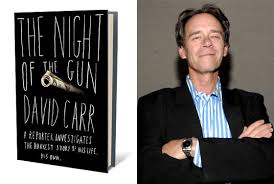

David Carr, 58, died on the job at The New York Times on Thursday. He was one of the great ones: no pretence, accurate, compassionate, humble. He knew his job as a journalist was not to be part of the story, but to serve the story through facts, from which a truth might be born in and of itself, or as part of a larger story pieced together from multiple sources. I haven’t read his autobiography, The Night of the Gun, which chronicled his drug addiction during the 1980s, but I’m sure it’s him, and it’s good. Here’s a link to media bistro with Carr talking about his first big break in journalism. Also see the other videos featuring Carr at this site.
A Voice Like Sand and Glue, But Listen To It
Posted: February 13, 2015 Filed under: music, people | Tags: Dylan and Sinatra, Dylan sings Sinatra, Dylan: a voice like sand and glue Leave a comment
Click here to hear Full Moon and Empty Arms.
Dylan Sings American Classics
Posted: February 9, 2015 Filed under: articles, music, people, states of mind | Tags: Dylan and Sinatra, Dylan opens up the American song cannon, Dylan stands next to Sinatra, Shadows in the Night 1 CommentTypically, skepticism and misapprehension have greeted Dylan’s newest release, Shadows In The Night, based on one of Sinatra’s most enduring classic albums. The lead in the New York Times said, “It’s not a joke.” What disservice…Mark my words: This album will live. Dylan’s recording of under appreciated, early Americana folk music, his own blues songs, and especially this album, which puts him beside Sinatra, the other most enduring singer of the 20th century, will eventually rest beside the best of Dylan’s work. As Dylan said about the recording: it “uncovers” the songs. More generous was this review in The Telegraph: “Dylan sings Sinatra? It shouldn’t work but Shadows In The Night is quite gorgeous, the sound of an old man picking over memories, lost loves, regrets, triumphs and fading hopes amid an ambient tumble of haunting electric instrumentation. It is spooky, bittersweet, mesmerisingly moving and showcases the best singing from Dylan in 25 years. The very concept seems outrageous, which is perhaps why Dylan’s management have been at pains to insist it is not a Sinatra tribute. One was a vocal giant with perfect mix of tone, technique and emotional expression. The other has a voice that David Bowie described as “like sand and glue,” (and that was intended as a compliment). They are artists we listen to for very different reasons. Shadows In The Night is a perfect blend of those heartbreaking classics, digging beneath self-pity to reveal deeper relationship truths.”
Ralph Waldo Emerson: Give All To Love
Posted: January 28, 2015 Filed under: people, poetry, states of mind Leave a comment
The first stanza of Emerson’s Give All To Love:
Give all to love;
Obey thy heart;
Friends, kindred, days,
Estate, good-fame,
Plans, credit and the Muse —
Nothing refuse.
Atticus Lish’s Novel
Posted: January 19, 2015 Filed under: articles, interviews, people, writing Leave a comment By all accounts, Atticus Lish, the son of the editor Gordon Lish, has written a great American novel, in the fullest sense of American. Preparations For The Next Life… I haven’t read it yet, but I can’t resist helping to spread the word on this one. Here’s the New York Review of Books review, and several interviews with Lish on his background and how the book came together. Interview here, here and here.
Here’s the opening paragraph of the NYRB review by Cathleen Schine:
“Preparation for the Next Life, by Atticus Lish, is an astounding first novel about a world so large there is, sometimes, nowhere to go; a world so small the people in it, sometimes, get lost. The book has the boundless, epic exhilaration you expect to find only in a writer as mighty as, say, Walt Whitman. It is a love story, a war story, a tale of New York City in which familiar streets become exotic, mysterious, portentous, foul, magnificent. Some of it reads like poetry. All of it moves with a breathless momentum.”
 the roy hamric journal