
Kyoto: Walking One Step at a Time
Posted: July 2, 2014 Filed under: books, buddhism, places, sight seeing Leave a comment “Mountains walking is just like humans walking. Do not doubt mountains walking even though it does not look like human walking.” – Dogen, Jan. 19, 1200, Kyoto, Kyoto Prefecture, Japan.
Where else better to take a thoughtful walk than in Kyoto, home to so many worthies who have graced its streets and paths. Ted Taylor and Michael Lambe have put together a paean to walking through Japan’s most intimate city, savouring the ancient temples and today’s artful graffiti. The anthology, Deep Kyoto Walks, includes Pico Iyer and others, and this is one of those books that takes you to where you didn’t know you wanted to go. Sixteen writers who know Kyoto pay tribute to life in the city of “Purple Hills and Crystal Streams,” offering a testament to the art of contemplative city walking.
“I had to acknowledge that I had to come to Japan in order to see that a 7-Eleven here was just as Japanese — as foreign — as any meditation hall, and no less full of wonder…” – Pico Iyer, Into the Tumult

Joseph Rakowski’s Jim Harrison Interview; Best Lately
Posted: July 1, 2014 Filed under: books, people, writing Leave a comment
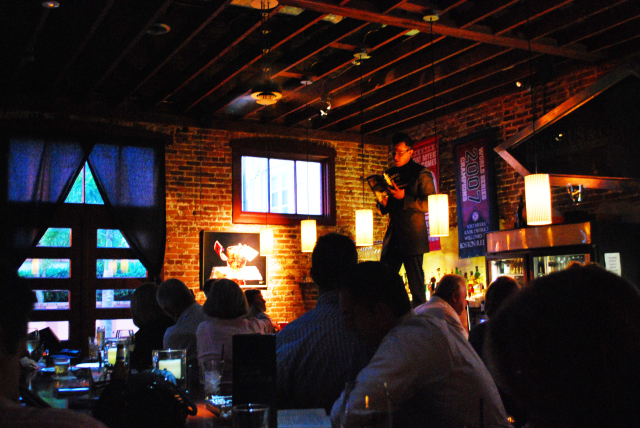
Jim Harrison’s amazing body of poems and fiction and, equally important, his way of life and mind, have a new fan, who has written one of the most interesting takes on Harrison I’ve read lately. Rakowski is a young writer whose first novel, The Delivery Cut, is in the early spirit of Thompson’s The Rum Diary, and he’s done a series of interesting reviews and interviews on the Three Guys One Book website. Here’s the first few hundred words of Rakowski’s long, perceptive review. The full story can be read here. What I like about Rakowski, besides his protective, tender response to Harrison, is this picture of Rakowski (below) reading from his novel while standing on top of a bar. Way to go…here’s Rakowski’s website
From Rakowski: “In the land of the blind, the one-eyed man is king. If you have read Jim Harrison, more than likely, you were blinded by his poetry and prose.
“I’ve heard of Jim Harrison since I was a young boy, but it wasn’t until I received a catalogue from Grove Atlantic that I sat down, away from my own selfish paperback endeavors, and decided to read nearly everything by one of the greatest American fiction writers of all time. What kind of egotistical, navel-gazing writer out there doesn’t take this opportunity? What more impetus does an aspirant literate need?
“After requesting everything Grove had to offer, I sent Copper Canyon a message requesting his poetry and hit the local library and bookstore for his earlier stuff. Within a week, I had received from Grove Atlantic Harrison’s memoir Off to the Side, his adventures as a roving gourmand The Raw and The Cooked, and his fictional novellas and novels Julip, The Summer He Didn’t Die, Returning to Earth, The English Major, The Great Leader, The River Swimmer, and Brown Dog. Copper Canyon sent me The Shape of the Journey and Songs of Unreason, nearly 600 pages of poetry. From the store, I purchased The Woman Lit by Fireflies, Dalva, Wolf and Legends of The Fall.
“Overall, the fifteen books weighed around twenty-five pounds in mental edibleness. I know because I put them on the scale at a grocery market impressed by the idea of the weight of one man’s knowledge.
“I started my journey on a plane to Boston reading his memoir and poetry. Harrison, which I will refer to intermittingly as Jim because I feel a part of his soul wove its way into mine, considers himself a poet first. It seemed like the auspicious place to start, though I am in the wolf stage of my life and Harrison is in the bear and raven.
“When I think of individual poems, I think of a completed, one or so page, story. As I finished The Shape of the Journey and Songs of Unreason, the first and last of Jim’s poetry, I realized I had not read one completed story at the ending of each poem. Instead, I’d watched as each poem escorted itself to the next, producing a book of a man’s life written doggedly over the course of his existence. Through poetry and in the beauty of morality, it was the most complete story I have ever read about a man’s life. It was chronological to the point of despair, complete to the point of tears, and maddening to the point of self-reflection.” …Continued…
About That Bowl
Posted: June 29, 2014 Filed under: buddhism, poetry, states of mind Leave a commentAbout That Bowl
Round it is, the bowl I placed
in a hut in a mountain valley.
For a moment, its dominion
arises, a matter of form and space,
or so one thinks – that bowl and
emptiness – giving and taking
like nothing else.
But it’s not about one or the other –
or wilderness or hearth. In usefulness,
wildness is swept away,
for a moment, but then it returns
like nothing else.
Morning Practice
Posted: June 28, 2014 Filed under: buddhism, poetry, writing Leave a commentMorning Practice
When my eyes open at dawn’s light
the question naturally arises,
whose arms are these – flaccid pink
skin draping off brittle bones?
On the pillow there’s some long hairs – mine
or the two dogs, Roxy and Daisy, sleeping on
the bed? Before, the long hairs were always
a woman’s, her body pressed close
in the morning chill.
Now part of my lung is gone, infiltrated
by swarming molecules hungry to
devour my breath. It’s rationed now.
My heart beats harder to help
its neighbor. My heart’s comforting
sound fills my chest, but my morning
cough sounds like a sick man.
One beat, one breath….
Good practice for a lazy man.
As Su Tung p’o said,
“I’m a tired horse unharnessed at last.”
Minding My Time
Posted: June 27, 2014 Filed under: buddhism, poetry, states of mind, writing Leave a commentMinding My Time
Awash in mind time. Mind’s always mattering,
mothering: words, sensations, feelings always
forming stuff. Words always mattering
in Universe of Matter. That’s all (not really for
Roy & Laddawan and the Thai band playing Eric Clapton).
Mind called self is just the go-between
for no-body. Big Self mothers every thing
– knows like a bone every thing’s just co-
existing meaning-matter like mothering sky.
Right now in Chiang Mai at 1:18 a.m.
as a tiny candle lantern rises golden
in the night like a star.
Edward Slingerland on Wu-Wei
Posted: June 26, 2014 Filed under: articles, buddhism, people, states of mind, time, space Leave a comment
Wu-Wei.
There are two very interesting articles in the new Edge issue. The first, by Terence McKenna, ranges freely all over the map and makes many interesting observations about the chemical processes that involve mind, cognition, language and blissing out…lots of attention is given to the role of ego, its development, non-development, etc. It’s imminently worth reading for its many gem-like insights.
Also, see the article by Edward Slingerland (scroll down on the Edge website) on the role of wu-wei, sometimes deceptively called “non-action,” in Chinese culture. He’s the author of Effortless Action: Wu-wei as Conceptual Metaphor and Spiritual Ideal in Early China. It’s actually a process of checking on the ego…something the world, the politicians and each of us needs to give ever greater attention. His website is here.
The two articles, in many ways, complement each other.
Here’s a taste of where Slingerland is going with his latest (2014) book on wu-wei, Trying Not to Try.
“In a lot of my recent work I’ve been arguing that these early Chinese models of ethical reasoning, ethical training are psychologically much more, from a modern perspective, more plausible than some modern Western ideas. In some ways I’m arguing that the early Chinese got some stuff right that we got wrong in the Western philosophical tradition. They like to hear that. And I believe this is true. They were very sophisticated moral psychologists, and they’ve got some insights into the way that we reason about morality and the way we train people that I think are a really important corrective to the way we’ve been thinking about ethics in the West.

Edward Slingerland
“But on the other hand I am a critic of certain aspects of the modern Chinese state, and I also worry about the rate of development. I was there in the 80s in mainland China, and going from Taiwan to mainland China was like going in a time machine. Taiwan was relatively modernized. I don’t know how I got to Hong Kong, but I took a boat up the Pearl River from Hong Kong to Canton, to Guangzhou. It was an overnight boat, and I got out in the morning and it was like I’d gone back in time 100 years; there were no cars, no motorcycles, everyone was riding bikes. It was an unbelievable change. Now I go back to Guangzhou and there’s these superhighways and these huge buildings, and it all happened—well, that was not that long ago. So the rate of change is wild. It’s just incomprehensible. I just wonder about how sustainable it is, because it’s creating a lot of wealth inequality and a lot of dislocation.
“I still have my area that is my specialty and now I’m going to bring these new tools to bear on that specialty. A good example is that Effortless Action book back in 2003 that was my transformed dissertation. I have an argument there that one way to look at the trajectory of Chinese thought is that it’s driven by this tension I call “the paradox of wu-wei.” Wu-wei is effortless action or spontaneity. They all want you to be wu-wei, but none of them think you are right now. You’ve got to try to be wu-wei, but how do you try not to try? How do you try to be spontaneous?
 “So, I call it the paradox of wu-wei, and I argue it’s at the center of all their theorizing about other things. Their theories about human nature, their theories about self-cultivation, their theories about government—these are all ways of grappling with this central tension that’s driving a lot of the theorizing. That claim got criticized, so my former advisor wrote a very scathing critique of it. A lot of people didn’t buy this claim that, first of all, it’s really a paradox, and second of all that it really has any kind of central prominence in early Chinese thought.
“One of the things I’ve been able to do to with the new knowledge I’ve gained from the sciences is come back to this, revisit this topic again, and say, look, from a cognitive neuroscientific perspective, we actually understand why this is a paradox, why using cognitive control to shut down cognitive control is tricky—it’s inherently tricky. We have a lot of evidence from social psychology and sports science and other areas that show that in fact effortless, spontaneous action is very desirable, because hot cognition is very powerful. Work on the power of the unconscious, the adaptive unconscious. We also, from an evolutionary perspective, have an understanding of why the fact that the paradox is a paradox is why it gets focused on.
“Essentially in our theories about where large scale societies come from, the crucial role is played by trust and commitment. It’s really crucial, if we’re going to cooperate I’ve got to believe that you’re committed to this religion or belief system that we are sharing and not just in it for your own good. There’re lots of ways I can assess your commitment. One of them is whether or not you’re being spontaneous. If I see evidence of cognitive control in you, I start to think that maybe something’s going on, because when we’re being conscious and using cognitive control, we’re often doing it to deceive or lie or figure out what’s best for us. The Chinese believe when you’re in wu-wei, you have this power called “de”. It’s like a charismatic virtue. People like you, people trust you. I’m arguing that we can understand this from a naturalistic perspective as the attractiveness someone who is spontaneous kicks off, and for very good game theoretical reasons. Basically you can relate it directly to evolutionary concerns about cooperation.”
For Updike Fans: Revealing Review
Posted: June 23, 2014 Filed under: books, people, photography, reviews, writing Leave a comment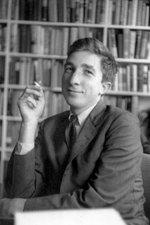
Here’s a Times Literary Supplement review of Begley’s biography of John Updike. It exposes elements of Updike’s life and character (most complex) that I suspected, but failed to fully understand. His muse was Eros. Elements of ecstasy and self-punishment abounded, all, of course, springing from a most privileged talent and, perhaps even, a full understanding of his source of power as a unique novelist. The writer as eager betrayer writ large. Alas, the complexity of self, art, creativity: it’s all spotlighted in this revealing review. The photograph: An empty page in the foreground, books in the background…an enigmatic, sly look.
Robert Silvers: The NYRB’s Guiding Light
Posted: June 16, 2014 Filed under: articles, books, people, writing Leave a comment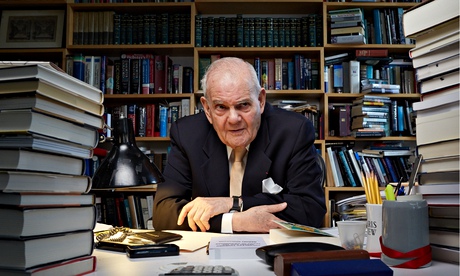
The editor at his desk.
The co-founder and editor of the peerless The New York Review of Books, Robert Silvers, is profiled in this Guardian story. The NYRB is the one English-language publication that covers the most essential ideas and people at the highest level of thought and writing. It’s irreplaceable and one wonders if there is an editor somewhere who can keep it at the pinnacle it has achieved, once Silvers puts down his pencil.
Steven Pinker Looks At Writing in 21st Century
Posted: June 10, 2014 Filed under: books, interviews, people, writing 2 Comments
A Conversation with Steven Pinker [6.9.14]
[This article from Edge by Steven Pinker mentions his forthcoming book The Sense of Style (to be released in September 2014), which looks at offering some prescriptions that move forward from the classic writing manual by Strunk and White. Sounds like it should be interesting… Roy Hamric]
WRITING IN THE 21ST CENTURY
I believe that science can inform all aspects of life, particularly psychology, my own favorite science. Psychology looks in one direction to biology, to neuroscience, to genetics, to evolution. And it looks in another direction to the rest of intellectual and cultural life—because what are the arts but products of the human mind which resonate with our aesthetic and emotional faculties? What are social issues but ways in which humans try to coordinate their behavior and come to working arrangements that benefit everyone? There’s no aspect of life that cannot be illuminated by a better understanding of the mind from scientific psychology. And for me the most recent example is the process of writing itself.
I’m a psychologist who studies language—a psycholinguist—and I’m also someone who uses language in my books and articles to convey ideas about, among other things, the science of language itself. But also, ideas about war and peace and emotion and cognition and human nature. The question I’m currently asking myself is how our scientific understanding of language can be put into practice to improve the way that we communicate anything, including science?
In particular, can you use linguistics, cognitive science, and psycholinguistics to come up with a better style manual—a 21st century alternative to the classic guides like Strunk and White’s The Elements of Style?
Writing is inherently a topic in psychology. It’s a way that one mind can cause ideas to happen in another mind. The medium by which we share complex ideas, namely language, has been studied intensively for more than half a century. And so if all that work is of any use it ought to be of use in crafting more stylish and transparent prose.
 From a scientific perspective, the starting point must be different from that of traditional manuals, which are lists of dos and don’ts that are presented mechanically and often followed robotically. Many writers have been the victims of inept copyeditors who follow guidelines from style manuals unthinkingly, never understanding their rationale.
For example, everyone knows that scientists overuse the passive voice. It’s one of the signatures of academese: “the experiment was performed” instead of “I performed the experiment.” But if you follow the guideline, “Change every passive sentence into an active sentence,” you don’t improve the prose, because there’s no way the passive construction could have survived in the English language for millennia if it hadn’t served some purpose.
The problem with any given construction, like the passive voice, isn’t that people use it, but that they use it too much or in the wrong circumstances. Active and passive sentences express the same underlying content (who did what to whom) while varying the topic, focus, and linear order of the participants, all of which have cognitive ramifications. The passive is a better construction than the active when the affected entity (the thing that has moved or changed) is the topic of the preceding discourse, and should therefore come early in the sentence to connect with what came before; when the affected entity is shorter or grammatically simpler than the agent of the action, so expressing it early relieves the reader’s memory load; and when the agent is irrelevant to the story, and is best omitted altogether (which the passive, but not the active, allows you to do). To give good advice on how to write, you have to understand what the passive can accomplish, and therefore you should not blue-pencil every passive sentence into an active one (as one of my copyeditors once did).
Ironically, the aspect of writing that gets the most attention is the one that is least important to good style, and that is the rules of correct usage. Can you split an infinitive, that is, say, “to boldly go where no man has gone before,”or must you say to “go boldly”? Can you use the so-called fused participle—”I approve of Sheila taking the job”—as opposed to “I approve of Sheila’s taking the job” (with an apostrophe “s”)? There are literally (yes, “literally”) hundreds of traditional usage issues like these, and many are worth following. But many are not, and in general they are not the first things to concentrate on when we think about how to improve writing.
 The first thing you should think about is the stance that you as a writer take when putting pen to paper or fingers to keyboard. Writing is cognitively unnatural. In ordinary conversation, we’ve got another person across from us. We can monitor the other person’s facial expressions: Do they furrow their brow, or widen their eyes? We can respond when they break in and interrupt us. And unless you’re addressing a stranger you know the hearer’s background: whether they’re an adult or child, whether they’re an expert in your field or not. When you’re writing you have none of those advantages. You’re casting your bread onto the waters, hoping that this invisible and unknowable audience will catch your drift.
The first thing to do in writing well—before worrying about split infinitives—is what kind of situation you imagine yourself to be in. What are you simulating when you write, and you’re only pretending to use language in the ordinary way? That stance is the main thing that distinguishes clear vigorous writing from the mush we see in academese and medicalese and bureaucratese and corporatese.
The literary scholars Mark Turner and Francis-Noël Thomas have identified the stance that our best essayists and writers implicitly adopt, and that is a combination of vision and conversation. When you write you should pretend that you, the writer, see something in the world that’s interesting, that you are directing the attention of your reader to that thing in the world, and that you are doing so by means of conversation.
 That may sound obvious. But it’s amazing how many of the bad habits of academese and legalese and so on come from flouting that model. Bad writers don’t point to something in the world but areself-conscious about not seeming naïve about the pitfalls of their own enterprise. Their goal is not to show something to the reader but to prove that they are nota bad lawyer or a bad scientist or a bad academic. And so bad writing is cluttered with apologies and hedges and “somewhats” and reviews of the past activity of people in the same line of work as the writer, as opposed to concentrating on something in the world that the writer is trying to get someone else to see with their own eyes.
That’s a starting point to becoming a good writer. Another key is to be an attentive reader. One of the things you appreciate when you do linguistics is that a language is a combination of two very different mechanisms: powerful rules, which can be applied algorithmically, and lexical irregularities, which must be memorized by brute force: in sum, words and rules.
All languages contain elegant, powerful, logical rules for combining words in such a way that the meaning of the combination can be deduced from the meanings of the words and the way they’re arranged. If I say “the dog bit the man” or “the man bit the dog,” you have two different images, because of the way those words are ordered by the rules of English grammar.
On the other hand, language has a massive amount of irregularity: idiosyncrasies, idioms, figures of speech, and other historical accidents that you couldn’t possibly deduce from rules, because often they are fundamentally illogical. The past tense of “bring” is “brought,” but the past tense of “ring” is “rang,” and the past tense of “blink” is “blinked.” No rule allows you to predict that; you need raw exposure to the language. That’s also true for many rules of punctuation. If I talk about “Pat’s leg,” it’s “Pat-apostrophe-s.” But If I talk about “its leg,” I can’t use apostrophe S; that would be illiterate. Why? Who knows? That’s just the way English works. Peole who spell possessive “its” with an apostrophe are not being illogical; they’re being too logical, while betraying the fact that they haven’t paid close attention to details of the printed page.
So being a good writer depends not just on having mastered the logical rules of combination but on having absorbed tens or hundreds of thousands of constructions and idioms and irregularities from the printed page. The first step to being a good writer is to be a good reader: to read a lot, and to savor and reverse-engineer good prose wherever you find it. That is, to read a passage of writing and think to yourself, “How did the writer achieve that effect? What was their trick?” And to read a good sentence with a consciousness of what makes it so much fun to glide through.
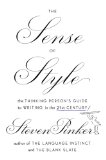 Any handbook on writing today is going to be compared to Strunk & White’s The Elements of Style, a lovely little book, filled with insight and charm, which I have read many times. But William Strunk, its original author, was born in 1869. This is a man who was born before the invention of the telephone, let alone the computer and the Internet and the smartphone. His sense of style was honed in the later decades of the 19th century!
We know that language changes. You and I don’t speak the way people did in Shakespeare’s era, or in Chaucer’s. As valuable as The Elements of Style is (and it’s tremendously valuable), it’s got a lot of cockamamie advice, dated by the fact that its authors were born more than a hundred years ago. For example, they sternly warn, “Never use ‘contact’ as a verb. Don’t say ‘I’m going to contact him.’ It’s pretentious jargon, pompous and self-important. Indicate that you intend to ‘telephone’ someone or ‘write them’ or ‘knock on their door.'” To a writer in the 21st century, this advice is bizarre. Not only is “to contact” thoroughly entrenched and unpretentious, but it’s indispensable. Often it’s extremely useful to be able to talk about getting in touch with someone when you don’t care by what medium you’re going to do it, and in those cases, “to contact” is the perfect verb. It may have been a neologism in Strunk and White’s day, but all words start out as neologisms in their day. If you read The Elements of Style today, you have no way of appreciating that what grated on the ears of someone born in 1869 might be completely unexceptionable today.
The other problem is that The Elements of Style was composed before there existed a science of language and cognition. A lot of Strunk and White’s advice depended completely on their gut reactions from a lifetime of practice as an English professor and critic, respectively. Today we can offer deeper advice, such as the syntactic and discourse functions of the passive voice—a construction which, by the way, Strunk & White couldn’t even consistently identify, not having being trained in grammar.
Another advantage of modern linguistics and psycholinguistics is that it provides a way to think your way through a pseudo-controversy that was ginned up about 50 years ago between so-called prescriptivists and descriptivists. According to this fairy tale there are prescriptivists who prescribe how language ought to be used and there are descriptivists, mainly academic linguists, who describe how language in fact is used. In this story there is a war between them, with prescriptivist dictionaries competing with descriptivist . dictionaries.
Inevitably my own writing manual is going to be called “descriptivist,” because it questions a number of dumb rules that are routinely flouted by all the best writers and had no business being in stylebooks in the first place. These pseudo-rules violate the logic of English but get passed down as folklore from one style sheet to the next. But debunking stupid rules is not the same thing as denying the existence of rules, to say nothing of advice on writing. The Sense of Style is clearly prescriptive: it consists of 300 pages in which I boss the reader around.
This pseudo-controversy was created when Webster’s Third International Dictionary was published in the early 1960s. Like all dictionaries, it paid attention to the way that language changes. If a dictionary didn’t do that it would be useless: writers who consulted it would be guaranteed to be misunderstood. For example, there is an old prescriptive rule that says that “nauseous,” which most people use to mean nauseated, cannot mean that. It must mean creating nausea, namely, “nauseating.” You must write that a roller coaster ride was nauseous, or a violent movie was nauseous, not I got nauseous riding on the roller coaster or watching the movie. Nowadays, no one obeys this rule. If a dictionary were to stick by its guns and say it’s an error to say that the movie made me nauseous, it would be a useless dictionary: it wouldn’t be doing what a dictionary has to do. This has always been true of dictionaries.
But there’s a myth that dictionaries work like the rulebook of Major League Baseball; they legislate what is correct. I can speak with some authority in saying that this is false. I am the Chair of the Usage Panel of The American Heritage Dictionary, which is allegedly the prescriptivist alternative to the descriptivist Webster’s. But when I asked the editors how they decide what goes into the dictionary, they replied, “By paying attention to the way people use language.”
Of course dictionary editors can’t pay attention to the way everyone uses language, because people use language in different ways. When you write, you’re writing for a virtual audience of well-read, literate fellow readers. And those are the people that we consult in deciding what goes into the dictionary, particularly in the usage notes that comment on controversies of usage, so that readers will know what to anticipate when they opt to obey or flout an alleged rule.
This entire approach is sometimes criticized by literary critics who are ignorant of the way that language works, and fantasize about a golden age in which dictionaries legislated usage. But language has always been a grassroots, bottom-up phenomenon. The controversy between “prescriptivists” and “descriptivists” is like the choice in “America: Love it or leave it” or “Nature versus Nurture”—a euphonious dichotomy that prevents you from thinking.
Many people get incensed about so-called errors of grammar which are perfectly unexceptionable. There was a controversy in the 1960s over the advertising slogan “Winston tastes good, like a cigarette should.” The critics said it should be “as a cigarette should” and moaned about the decline of standards. . A more recent example was an SAT question that asked students whether there was an error in “Toni Morrison’s genius allows her to write novels that capture the African American condition.” Supposedly the sentence is ungrammatical: you can’t have “Toni Morrison’s” as an antecedent to the pronoun “she.” Now that is a complete myth: there was nothing wrong with the sentence.
Once a rumor about a grammatical error gets legs, it can proliferate like an urban legend about alligators in the sewers. Critics and self-appointed guardians of the language will claim that language is deteriorating because people violate the rule—which was never a rule in the first place. It’s so much fun to be in high dudgeon over the decline of language and civilization that these critics don’t stop to check the rulebooks and dictionaries to discover how great writers write or to learn the logic of the English language.
Poets and novelists often have a better feel for the language than the self-appointed guardians and the pop grammarians because for them language is a medium. It’s a way of conveying ideas and moods with sounds. The most gifted writers—the Virginia Woolfs and H.G. Wellses and George Bernard Shaws and Herman Melvilles—routinely used words and constructions that the guardians insist are incorrect. And of course avant-garde writers such as Burroughs and Kerouac, and poets pushing the envelope or expanding the expressive possibilities of the language, will deliberately flout even the genuine rules that most people obey. But even non-avant garde writers, writers in the traditional canon, write in ways that would be condemned as grammatical errors by many of the purists, sticklers and mavens.
Another bit of psychology that can make anyone a better writer is to be aware of a phenomenon sometimes called The Curse of Knowledge. It goes by many names, and many psychologists have rediscovered versions of it, including defective Theory of Mind, egocentrism, hindsight bias, and false consensus. They’re all versions of an infirmity afflicting every member of our species, namely that it’s hard to imagine what it’s like not to know something that you do know.
It’s easiest to see it in children. In one famous experiment, kid comes into a room, opens a box of candy, finds pencils inside, and the kid is surprised. Then you say to him, “Now Jason’s going to come into the room. What does he think is in the box?” And the child will say “pencils.” Of course, Jason has no way of knowing that the box had pencils, but the first child is projecting his own state of knowledge onto Jason, forgetting that other people may not know what he knows.
Now we laugh at the kids, but it’s true of all of us. We as writers often use technical terms, abbreviations, assumptions about typical experimental methods, assumptions about what questions we ask in our research, that our readers have no way of knowing because they haven’t been through the same training that we have. Overcoming the curse of knowledge may be the single most important requirement in becoming a clear writer.
Contrary to the common accusation that academic writing is bad because professors are trying to bamboozle their audience with highfalutin gobbledygook, I don’t think that most bad prose is deliberate. I think it is inept. It is a failure to get inside the head of your reader. We also know from psychology that simply trying harder to get inside the head of your reader is not the ideal way to do it. No matter how hard we try, we’re at best okay, but not great, at anticipating another person’s state of knowledge.
Instead, you have to ask. You’ve got to show people a draft. Even if you’re writing for laypeople, your reviewers don’t all have to be laypeople; a colleague is better than no one. I’m often astonished at things that I think are obvious that turn out to be not so obvious to other people.
Another implication of the curse of knowl.edge is that having an editor is a really good thing. Supposedly there are writers who can dash off a perfectly comprehensible, clear, and coherent essay without getting feedback from a typical reader, but most of us don’t have that clairvoyance. We need someone to say “I don’t understand this” or ” What the hell are you talking about?” To say nothing of attention to the fine points of punctuation, grammar, sentence structure, and other ways in which a sophisticated copyeditor can add value to your written work.
How much of this advice comes from my experience as a writer and how much from my knowledge as a psycholinguist? Some of each. I often reflect on psychology behind the thousands of decisions I make as a writer in the lifelong effort to improve my prose, and I often think about how to apply experiments on sentence comprehension and the history of words and the logic (and illogic) of grammar to the task of writing. I might think, “, Aha, the reason I rewrote this sentence that way is because of the memory demands of subject versus object relative clauses,.”
This combination of science and letters is emblematic of what I hope to be a larger trend we spoke of earlier, namely the application of science, particularly psychology and cognitive science, to the traditional domains of humanities. There’s no aspect of human communication and cultural creation that can’t benefit from a greater application of psychology and the other sciences of mind. We would have an exciting addition to literary studies, for example, if literary critics knew more about linguistics. Poetry analysts could apply phonology (the study of sound structure) and the cognitive psychology of metaphor. An analysis of plot in fiction could benefit from a greater understanding of the conflicts and confluences of ultimate interests in human social relationships. The genre of biography would be deepened by an understanding of the nature of human memory, particularly autobiographical memory. How much of the memory of our childhood is confabulated? Memory scientists have a lot to say about that. How much do we polish our image of ourselves in describing ourselves to others, and more importantly, recollecting our own histories? Do we edit our memories in an Orwellian manner to make ourselves more coherent in retrospect? Syntax and semantics are relevant as well. How does a writer use the tense system of English to convey a sense of immediacy or historical distance?
 In music the sciences of auditory and speech perception have much to contribute to understanding how musicians accomplish their effects. The visual arts could revive an old method of analysis going back to Ernst Gombrich and Rudolf Arnheim in collaboration with the psychologist Richard Gregory Indeed, even the art itself in the 1920s was influenced by psychology, thanks in part to Gertrude Stein, who as an undergraduate student of William James did a wonderful thesis on divided attention, and then went to Paris and brought the psychology of perception to the attention of artists like Picasso and Braque. Gestalt psychology may have influenced Paul Klee and the expressionists. Since then we have lost that wonderful synergy between the science of visual perception and the creation of visual art.
Going beyond the arts, the social sciences, such as political, science could benefit from a greater understanding of human moral and social instincts, such as the psychology of dominance, the psychology of revenge and forgiveness, and the psychology of gratitude and social competition. All of them are relevant, for example, to international negotiations. We talk about one country being friendly to another or allying or competing, but countries themselves don’t have feelings. It’s the elites and leaders who do, and a lot of international politics is driven by the psychology of its leaders.
Even beyond applying the findings of psychology and cognitive science and social and affective neuroscience, it’s the mindset of science that ought to be exported to cultural and intellectual life as a whole. That consists in increased skepticism and scrutiny about factual conventional wisdom: How much of what you think is true really is true if you go to the, the numbers? For me this has been a salient issue in analyzing violence, because the conventional wisdom is that we’re living in extraordinarily violent times.
But if you take into account the psychology of risk perception, as pioneered by Daniel Kahneman, Amos Tversky, Paul Slovic, Gerd Gigerenzer, and others, you realize that the conventional wisdom is systematically distorted by the source of our information about the world, namely the news. News is about the stuff that happens; it’s not about the stuff that doesn’t happen. Human risk perception is affected by memorable examples, according to Tversky and Kahneman’s availability heuristic. No matter what the rate of violence is objectively, there are always enough examples to fill the news. And since our perception of risk is influenced by memorable examples, we’ll always think we’re living in violent times. It’s only when you apply the scientific mindset to world events, to political science and history, and try to count how many people are killed now as opposed to ten years ago, a hundred years ago, or a thousand years ago that you get an accurate picture about the state of the world and the direction that it’s going, which is largely downward. That conclusion only came from applying an empirical mindset to the traditional subject matter of history and political science.
The other aspect of the scientific mindset that ought to be exported to the rest of intellectual life is the search for explanations. That is, not to just say that history is one damn thing after another, that stuff happens, and there’s nothing we can do to explain why, but to relate phenomena to more basic or general phenomena … and to try to explain those phenomena with still more basic phenomena. We’ve repeatedly seen that happen in the sciences, where, for example, biological phenomena were explained in part at the level of molecules, which were explained by chemistry, which was explained by physics.
There’s no reason that that this process of explanation can’t continue. Biology gives us a grasp of the brain, and human nature is a product of the organization of the brain, and societies unfold as they do because they consist of brains interacting with other brains and negotiating arrangements to coordinate their behavior, and so on.
Now I know that there is tremendous resistance to this idea, because it’s confused with a boogeyman called “reductionism”—the fear that we must explain World War I in terms of genes or even elementary particles.
But explanation does not imply reduction. You reduce the building blocks of an explanation to more complex phenomena one level down, but you don’t discard the explanation of the phenomenon itself. So World War I obviously is not going to be explained in terms of neuroscience. On the other hand, World War I could be explained in terms of the emotions of fear and dominance and prestige among leaders, which fell into a deadly combination at that moment in history. And instead of just saying, “Well, that’s the way things are, and there’s nothing more we can say about it,” we can ask, , “Why do people compete for prestige? Why do people have the kinds of fears that they do?
The answer doesn’t have to be, “Because I said so” or “Because that’s the way it is.” You can ask, “How does the psychology of fear work? How does the psychology of dominance work? How does the psychology of coalitions work?” Having done that, you get a deeper understanding of some of the causes of World War I. That doesn’t mean you throw out the conventional history of World War I, it just means that you enrich it, you diversity it, you deepen it. A program of unifying the arts and humanities with the psychological sciences and ultimately the biological sciences promises tremendous increases of depth of understanding for all the fields.
I’m often asked, “Who are the leaders of this movement? Whose writings should we be reading and discussing?” But that misses the point. It’s not about individual people. It’s more revolutionary than just reading this, that or the other person. There has to be a change in mindset coming from both directions. It’s not just a question of getting traditional scholars from the humanities and social sciences to start incorporating more science, to start thinking more like scientists. It’s got to work the other direction as well. A lot of scientists really are philistines when it comes to history and political theory and philosophy. We need to break down the idea that there are these separate disciplines and modes of study.
In trying to figure out what would give us the deepest, most insightful, most informative understanding of the world and ourselves, we have to be aware of the turf battles: who gets the franchise for talking about what matters. That is one reason that there is cadre of traditional intellectuals who have been hostile to science. I’m not talking about the climate deniers or the vaccine kooks but those who resent the idea that the discussion of what matters, of morality, of politics, of meaning, of purpose should be taken on by these philistines called scientists or social scientists. They act as if the franchise for these heavyweight topics has been given to critics and literary scholars and commentators on religion.
But we need not give credence to people who are simply protecting their turf. It’s becoming increasingly clear over the decades and centuries that an understanding of science is central to our understanding of the deepest questions of who we are, where we came from, what matters. If you aren’t aware of what science has to say about who we are and what we’re like as a species, then you’re going to be missing a lot of insight about human life. The fact that this upsets certain traditional bastions of commentary shouldn’t matter. People always protect their turf.
That’s why I’m reluctant to answer when I’m asked who are the people we should be reading, what names can we associate with this approach. It’s not about people. It’s about the ideas, and the ideas inevitably come piecemeal from many thinkers. The ideas are refined, exchanged, accumulated, and improved by a community of thinkers, each of whom will have some a few ideas and a lot of bad ideas. What we’ve been talking about is a direction that I hope the entire intellectual culture goes in. It’s not about anointing some guru.
Another intellectual error we must be suspicious of is the ever-present tendency to demonize the younger generation and the direction in which culture and society are going. In every era there are commentators who say that the kids today are dumbing down the culture and taking human values with them. Today the accusations are often directed at anything having to do with the Web and other electronic technologies—as if the difference between being printed on dead trees and displayed as pixels on a screen is going to determine the content of ideas. We’re always being told that young people suck: that they are illiterate and unreflective and un-thoughtful, all of which ignores the fact that every generation had that said about them by the older generation. Yet somehow civilization persists.
An appreciation of psychology can remind us that we as a species are prone to these bad habits. When we comment on the direction that intellectual life is going, we should learn to discount our own prejudices, our own natural inclination to say “I and my tribe are entitled to weigh in on profound issues, but members of some other guild or tribe or clique are not.” And “My generation is the embodiment of wisdom and experience, and the younger generation is uncouth, illiterate, unwashed and uncivilized.” better
There is no conflict between the sciences and humanities, or at least there shouldn’t be. There should be no turf battle as to who gets to speak about what matters. What matters are ideas. We should seek the ideas that give us the deepest, richest, best-informed understanding of the human condition, regardless of which people or what discipline originates them. That has to include the sciences, but it can’t come only from the sciences. The focus should be on ideas, not on people, disciplines, or academic traditions.
Clive James’ Poetry in Full Bloom
Posted: June 3, 2014 Filed under: articles, books, people, poetry Leave a commentOne of my writer-heroes, Clive James, has been ill for the past several years yet his poetry burns anew even though it’s shadowed in sadness for a life fully lived and now in decline. Here are the last two stanzas to his recent poem, Event Horizon:
“Into the singularity we fly
After a stretch of time in which we leave
Our lives behind yet know that we will die
At any moment now. A pause to grieve,
Burned by the starlight of our lives laid bare,
And then no sound, no sight, no thought. Nowhere.
What is it worth, then, this insane last phase
When everything about you goes downhill?
This much: you get to see the cosmos blaze
And feel its grandeur, even against your will,
As it reminds you, just by being there,
That it is here we live or else nowhere.”
See his glorious website here.
TLS, May 10, 2013
 the roy hamric journal