
A Poem for Red Pine
Posted: January 26, 2014 Filed under: people, poetry, writing Leave a commentA Poem for Red Pine
Bill Porter went West, took a new name
and came back from the East to spread the word.
A master of the shadow art,
he trails behind
recasting Chinese ideograms into new lines
for English minds.
He works from a second floor study in Port Townsend,
deciphering black strokes from faraway days with sharp eyes,
diamond mind – a time of flaming hearts:
writers of the Silent Word.
On the wall of his study, a Tibetan tanka.
A small painting of bamboo with a poem by Wang Wei.
Through a window, the Cascade Mountains.
Through another window, the ocean.
Through another window, the branch of a plum tree.
Pine trees and bamboo sway in the morning wind.
Light brightens a new day
as the pine tree’s shadow disappears,
leaving no trace.
Big Bend Burro Lady, Judy Magers
Posted: January 25, 2014 Filed under: people, photography, places, writing 1 Comment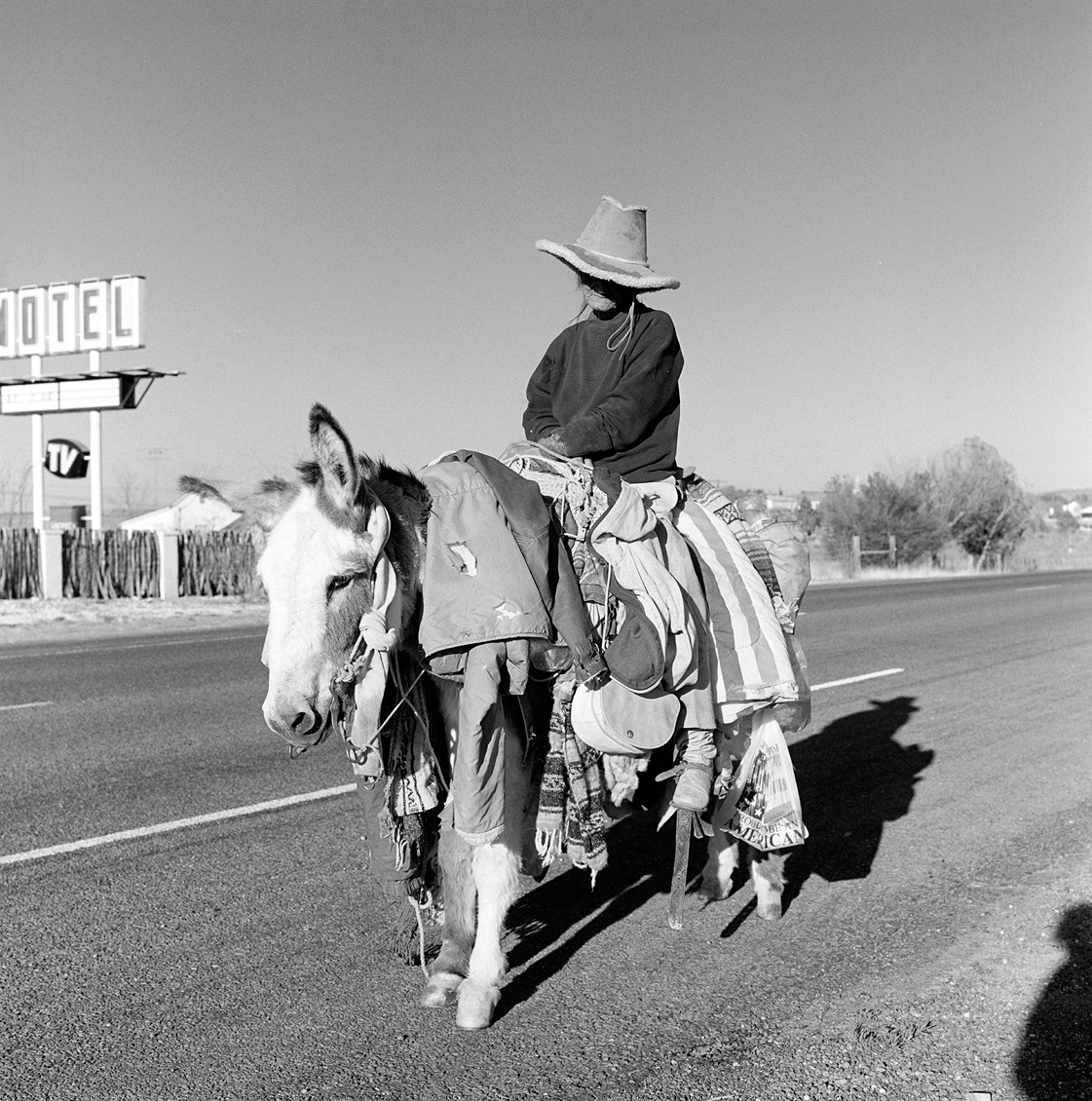
The Burro Lady of Big Bend; photograph copyright James Evans
By Roy Hamric
For decades, most folks in Far West Texas at one time saw Judy Magers on her burro riding along the side of the highway or camping next to the road. This story first appeared in 2008 in the Desert Candle, a cultural journal published in Alpine, Texas. Judy died of a heart attack on January 26, 2007, in Sierra Blanca.
We saw Judy about one mile east of Van Horn on Highway 90. She was sitting on the ground on the side of the road under a small tree and eating food with her fingers. A harsh, cold wind was blowing. Several plastic bags flapped loudly, caught on the barbed wire strands of a fence behind her. Her burro was still saddled, head down, bedecked with the rainbow-colored blankets and brightly colored strings that made it look like a psychedelic, walking Christmas present. The burro carried an assortment of blankets, ropes, bottles and storage bags that represented Judy and her way of life as a vagabond, a mysterious spirit with no home. She lived under the stars.
“Hi, how are you? Can I talk to you?” Laddawan, my Thai wife, asked through the car window. Judy nodded. We got out and Laddawan went over to her and sat down beside her. Laddawan’s puppy followed her and nestled down beside them.
Judy wore three or four coats. She had on white plastic boots with silver spurs. She wore a tight, white plastic skullcap that came down over her ears, making her look like a medieval apparition from a painting by Hieronymus Bosch. The skin on her face was swollen and raw and colored brownish red from the wind and years of living outdoors.
“Do you want some water?” Laddawan asked.
“No, thank you. I have some water.”
“Are you ok? What’s your name?”
“My name’s Judy. You have a beautiful puppy.”
“Yes, he is my baby. His name is Roxy. How old is your donkey?”
“Eight years.”
“Male or female?”
“Male.”
“Can I touch him?”
“Don’t get too close to him, because he might kick.”
“Oh, ok.”
“How old are you?” Laddawan asked.
“How old are you?” Judy asked.
“I’m 35.”
“I’m 29,” Judy said, smiling.
Laddawan laughed. “I’m from Thailand. I’m very interested in you. I like to talk with people – it makes me happy, because sometimes when I am alone I feel sad and homesick.
“You have to buy a radio,” Judy said.
“Do you have a radio?”
“Yes,” she said. “I have a small transistor radio.”
“And you listen to it?”
“Sometimes. I like Mexican music at night.”
“Do you have a problem with animals—tigers, javelina?” Laddawan asked.
“No,” Judy said. “I’ve never had a problem”
“Where are you going?”
“I’m lookin’ for some land to buy,” Judy said. “I hear they have cheap land over around Sanderson.”
“Why do you want land? Just to put some things?”
Judy nodded.
Judy said she roamed the lonely highways as far south as Terlingua near the Mexico border and from Sanderson to Van Horn to Fort Hancock.
“I don’t stop too much,” she said. She said she could average 12 to 15 miles a day, riding or walking alongside her burro.
“Can I take a picture with you?” Laddawan asked.
“You can take a picture of the burro, but I don’t want my picture taken.”
Judy got up and began fiddling with a rope tied to a fence post while I took a picture of her burro.
“If I see you later, can I talk to you again?” Laddawan asked.
“Ok”
Laddawan reached over and tried to shake Judy’s hand, holding two of her fingers.
“Ok, you have a good day,” Laddawan said. “I want to stop and talk to you whenever I see you. It’s nice to meet you.”
“Nice to meet you, too,” Judy said.
Back in the car, we made a U-turn across the highway, and Laddawan waved goodbye.
“I want to be friends with her,” Laddawan said, smiling. “Maybe someday I will live like that – a wandering nun.”

Judy camped on the side of the highway near Van Horn; photograph by Roy Hamric
Elephant Kingdom
Posted: January 19, 2014 Filed under: books, people, places, writing Leave a comment This book was a secret escape into another world, reminding me of the pleasures of childhood reading. It opened up a fascinating realm of nature and animals. I found a battered, spine-broken, worm-eaten edition that had passed through the Penang Library in 1959. It’s a two-track story: first, it’s the story of the Indian working elephant – jungle royalty. Second, it’s a record of a young Englishman’s life, who has been thrown into the job of a “teak wallah” for seven years in the mountainous areas around Chiang Mai in the early 1950s.
Essentially, he’s a clueless but eager, hardy soul who takes over the responsibility of managing a crew of clever and sometimes exasperating Thais and savvy hill tribe workers charged with cutting and hauling out of the deepest jungles of Northern Siam (now known as Thailand) timber that was prized for its strength and beauty. “These elephants possess the virtues of a crawler tractor, crane, bulldozer and tug combined in one package and are endowed with a high degree of intelligence,” wrote H.N. Marshall. In the 1950s, the area around Chiang Mai was still wild and dangerous, especially when sending the cut timber down the small streams into the Mae Ping River where the logs slowly worked their way downriver to the larger Chao Phraya, eventually arriving in Bangkok as long as four or five years later. Huge logjams blocked the river trip along the way, which had to be “un-jammed” by man or elephants in the most dangerous situations imaginable.
Opium crazed workers, pythons in the rafters, hunting game for fresh meat, the lore of treating sick elephants, the devotion of their mahout, berserk elephants on rampages defending their turf, night-stalking tigers, outlaws and bandits, marauding mosquitoes, flies, ants, termites, spiders and centipedes. It was a life and work few people could do. But he found the satisfaction that comes from doing work unimaginably hard, work one thought themselves incapable of doing.
Marshall wrote, in a goodbye tribute, in that effusive English language of his day: “On forested hills, in steamy valleys and swampy lowlands, in extremes of heat, wet and cold, and at all times of day and night, I had come to know the Indian elephants for what they are: the unquestioned Kings and Queens of the jungle.” The daily life he unfolds is warmer, simpler, richer and supremely demanding, a life few people could endure and which he must have carried like a dream through his routine life when he returned home to the easy comforts of England.
Time & Space
Posted: January 13, 2014 Filed under: books, places, time, space, writing 1 Comment
Monday, 11 a.m., January 13, 2014
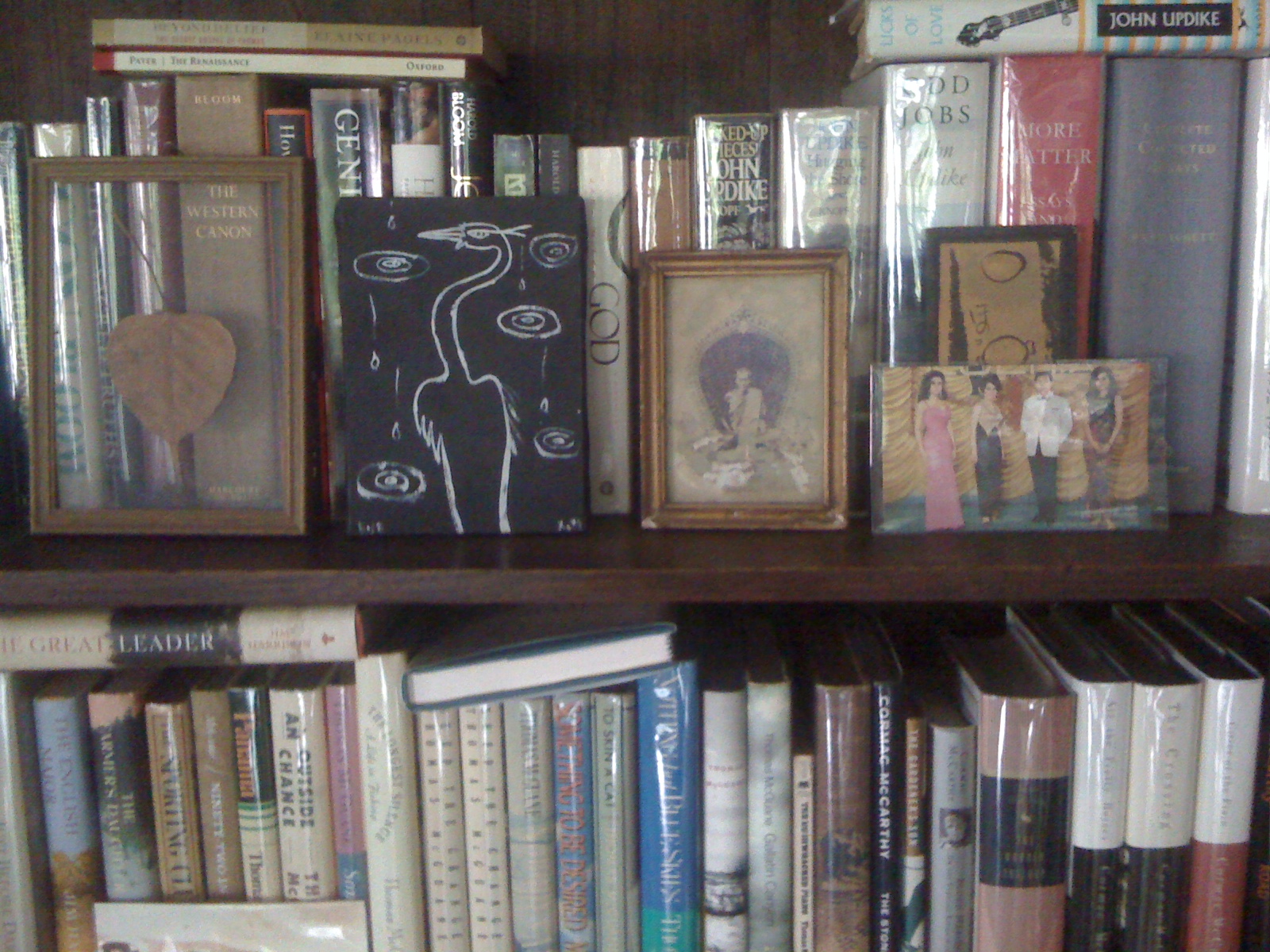
I sometimes call it an office, but it’s not that in any traditional sense. It’s a room lined with bookcases wherever a window isn’t located. Various small pictures rest on the bookcase shelves. Old postcards – one a picture of three women singers at the Lolita Club in Bangkok in the 1950s. Two small, framed, antique pictures of famous monks. A framed heart-shaped leaf from a Bodhi tree. A 6-foot, teak desk sits under four windows. The floor is teak. A sliding door opens onto a long porch, always offering shade. On the desk is a notebook computer, various black, gray, white and brown rocks worn smooth from years in local streams. A bronze turtle, a wooden frog, two small ivory horses. Two ivory-inlaid, small circular boxes from China. Two small, wooden elephants, two statues of the Buddha from China. Framed pictures on the wall include a Tibetan symbol for Om, a color photo of a sunset over the Rio Grande in the Big Bend, a picture of three wood ibises about to land on a river in East Texas, a small oil painting of a heron by Texas artist Frank Tolbert, Chinese calligraphy for the word Mu, a picture of Han Shan and Pick-up, a picture of Jiun’s calligraphy for the word Buddha. The books were mostly shipped here from the US, or were bought at local used bookstores. Most are old friends that have stood the test of time. This space helps to keep me alive, to keep me me, in the sense of being drawn into this mystery. My life.
Time & Space
Posted: January 12, 2014 Filed under: photography, time, space Leave a comment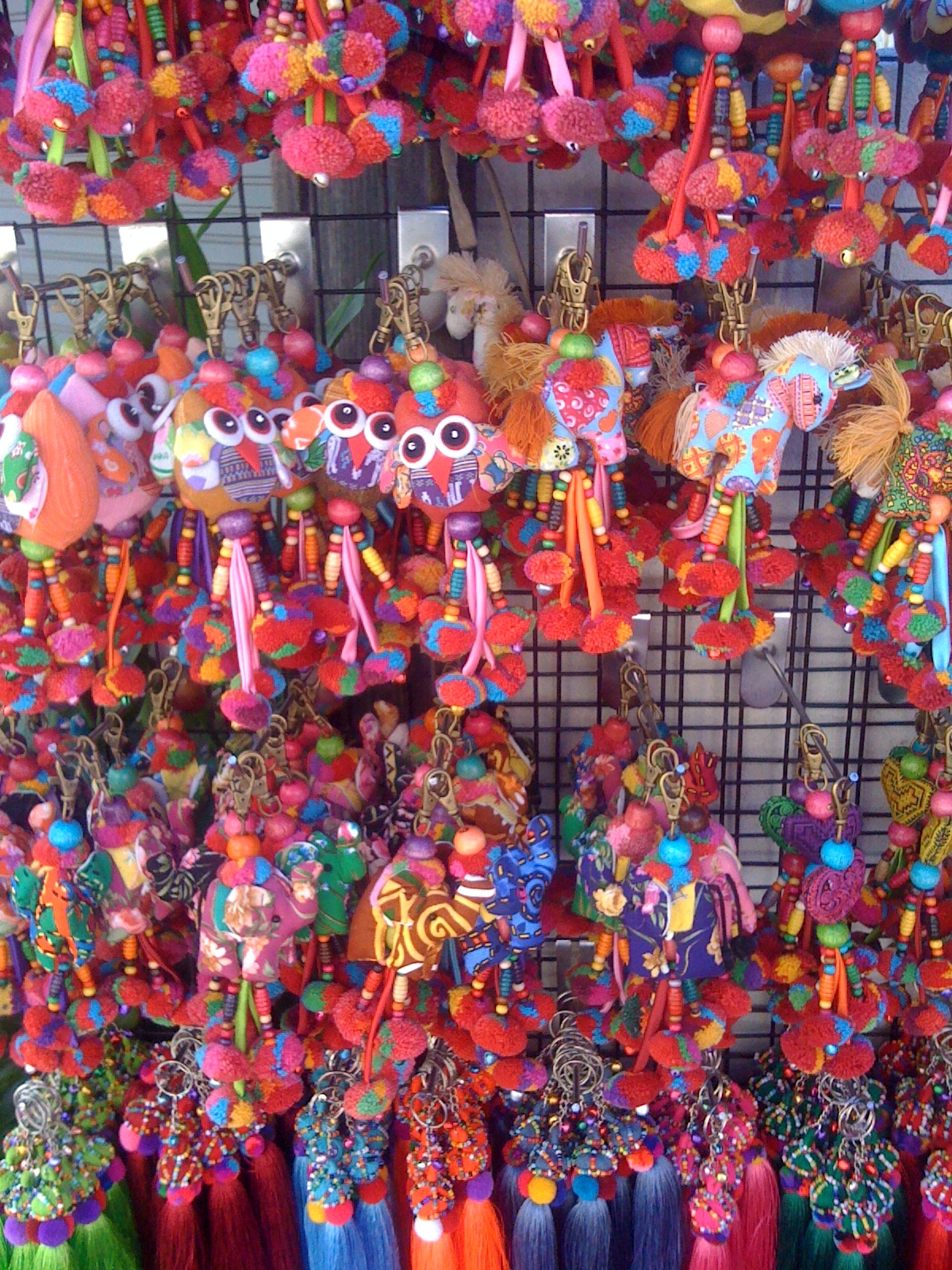
Sunday, 9:38 a.m., January 12, 2014. Small world of colour. IPhone
Red Pine’s Canny Commentaries on Buddhist Sutras
Posted: January 10, 2014 Filed under: articles, buddhism, people, states of mind, writing Leave a comment
Red Pine hitching a ride in China. Photograph by Ted Burger
Red Pine’s probing and understanding of the major Buddhist sutras: The Heart Sutra, The Platform Sutra of the Sixth Patriarch, The Diamond Sutra and, the latest, The Lankavatara Sutra, in addition to his earlier translation and commentary on The Tao Te Ching continue to deepen. With each translation his commentaries have grown more profound, especially on how all the sutras, taken together, form a whole, offering an approach to the difficult metaphysics that bewitch people looking for the answer to life’s riddles.
Red Pine’s latest commentary on the Lankavatara Sutra is a good example of how he draws all the sutras together. For instance:
“Buddhism is concerned with suffering, which is the inevitable result of desire. But the real issue is the self, which is the cause of the desire, which is the cause of the suffering. In the centuries following the Buddha’s Nirvana, instructions centered around a trio of concepts designed to focus attention in such a way that the nonexistence of the self would become evident and the liberation from suffering would follow. These included the five skandas (form, sensation, perception, memory and consciousness), the twelve ayatanas (six powers and six domains of sensations), and the eighteen dhatus (the ayatanas with the addition of six forms of consciousness). These were three views of the same thing: our mind.
“The were simply different ways of dividing any given moment of awareness into a manageable matrix to demonstrate to anyone willing to wander around these matrices that they contained the universe of our awareness, its inside and its outside, and yet they contained no self. This was their function: to show practitioners that there was no self.
“While these three schemes dealt with the problem of the self, they didn’t help explain how we become attached to a self in the first place, and how we go from attachment to detachment to liberation. Hence, to these were added three more schemes, all of which play a much larger role in the Lankavatara Sutra than the previous trio. The three new schemes are the five dharmas, the three modes of reality, and the eight forms of consciousness.
“The five dharmas divide our world into name, appearance, projection, correction knowledge and suchness. The three modes of reality do the same thing with imagined reality, dependent reality, and perfected reality; and the eight forms of consciousness include the five forms of sensory consciousness, conceptual consciousness, the will or self-consciousness, and an eighth form known as repository consciousness, where the seeds from our previous thoughts, words and deeds are stored and from which they sprout and grow.
“As with earlier trios of concepts, these were designed to account for our awareness without introducing the self. But they had the advantage of also providing a look at how our worlds of self-delusion and self-liberation come about, how enlightenment works, how we go from projection of name and appearance to correct knowledge of suchness, how we go from an imagined reality to a perfected reality, how we transform our eightfold consciousness into Buddhahood.
“….But then the Lankavatara Sutra sets all these schemes aside in the interest of urging us to taste the tea for ourselves….Cup of tea or not, no one said it was going to be easy…”
He goes on to explain how the Lankavatara confounded his understanding for 35 years. Everyone’s approach may differ, but a good step would be to try the sutras in a sequence such as this: the Tao Te Ching, The Heart Sutra, The Platform Sutra, The Diamond Sutra and the Lankavatara Sutra.
Red Pine always offers good advice. His life has been devoted to translating these sutras to deepen his own understanding and wisdom.
Also, as his wisdom – and his humor – ripen, he becomes more humble. The mark of a real teacher
Sight Seeing
Posted: January 9, 2014 Filed under: places, sight seeing, writing Leave a comment
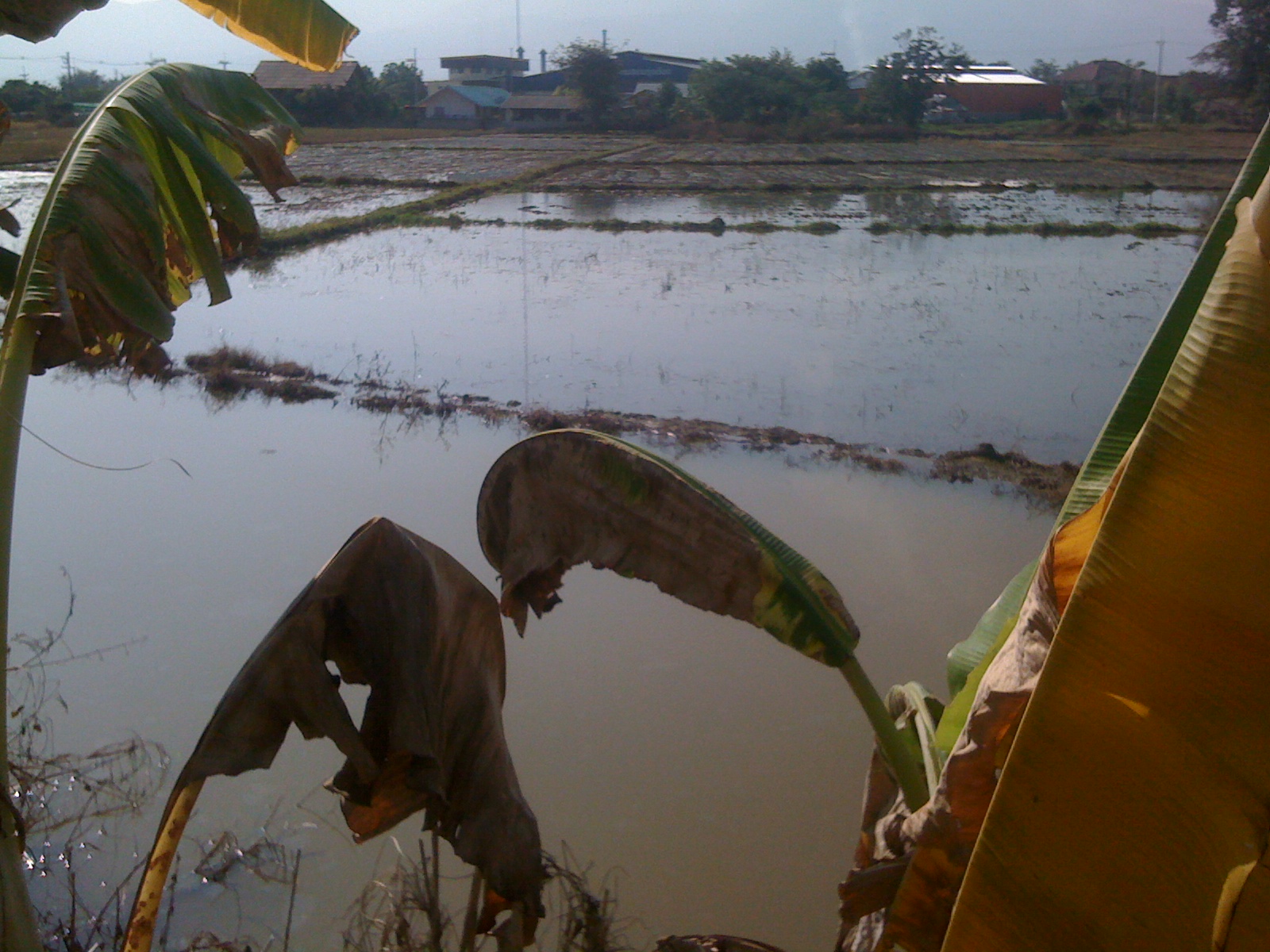
After weeks of cold nights and mild days, the air was dry this morning. The sun is warming the land. The light is bright, crisp, but it still holds a yellow tint as it rises into the dark blue sky. It can’t be Spring, but it feels like it. The neighborhood farmers wade calf-deep in the rice paddies. The separation dikes are rebuilt, water is draining into the square, sere paddies, some still showing the stubs of rice stalks burnt black after the last harvest. The light on the still water casts silver streaks across the surface. The yellow legs of white egrets, for a moment, hang back straight as they rise airborne, their wings moving slowly, wand-like over the Earth.
A tribute from the natural world. Last night, Katy the Cat caught a large mouse. Some remains, a head, hind legs and a few entrails, were left uneaten. She placed them near the water bowl in my office.
Red Pine’s Yellow River Odyssey
Posted: January 7, 2014 Filed under: articles, buddhism, people 1 Comment
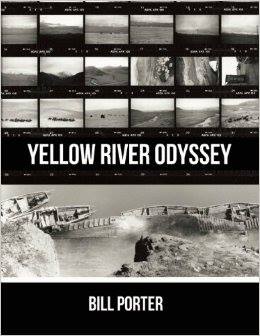
Bill Porter, aka Red Pine, has a new book scheduled to be released in February 2014, titled Yellow River Odyssey. It’s a collection of photographs and recollections of a trip along the river when China was just beginning to open up in small ways. The book is published by a great, small publisher called Chin Music Press based in Seattle. It is a bestseller in China, where it was first published.
I’ve also just come across a fan Facebook page for Porter, which you can see here.
Here’s the Amazon blurb on the book: “Bill Porter follows the Yellow River, the world’s sixth longest river, from its mouth to its source high in the Tibetan Plateau, a journey of more than three thousand miles through nine Chinese provinces. The trip takes the master translator into what was once the cradle of Chinese civilization and to the hometowns and graves of key historical figures such as Confucius, Mencius, Lao-tzu, and Chuang-tzu. Porter’s depth of knowledge of Chinese history and culture is unparalleled. Yellow River Odyssey, already a bestseller in China, reveals a complex, fascinating, contradictory country. Porter masterfully digs beneath China’s present-day materialism and the deep wounds of the Cultural Revolution to get at the roots of Chinese culture.”
Where’s Roxy Gordon?
Posted: January 5, 2014 Filed under: articles, buddhism, people, poetry, writing 2 Comments I looked for Roxy Gordon’s website today, and couldn’t find it. I’ve written his wife, Judy, for more information. I still can’t write about Roxy, who’s dead and buried outside of Talpa, Texas, near his “house up” home/campsite in West Texas. It’s one of those small, flat-top hills with the mesquite-desert spaces in between. Roxy was a writer-artist-musician-poet. Even more important, he had what Indians call medicine. People in Asia would say he was a man of The Way. He knew some things.
Here’s a link to Smaller Circles, his poem/talking word song (also the title for a book of poetry).
Here’s a poem/talking word song Indians.
Here’s a story written upon his death by a Dallas friend.
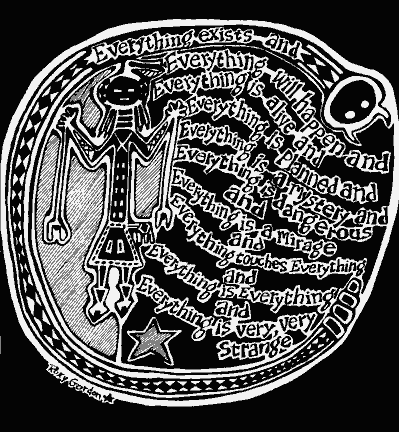
 Roxy Gordon, Dallas, circa 1980s
Time & Space
Posted: January 4, 2014 Filed under: buddhism, photography, states of mind, time, space Leave a comment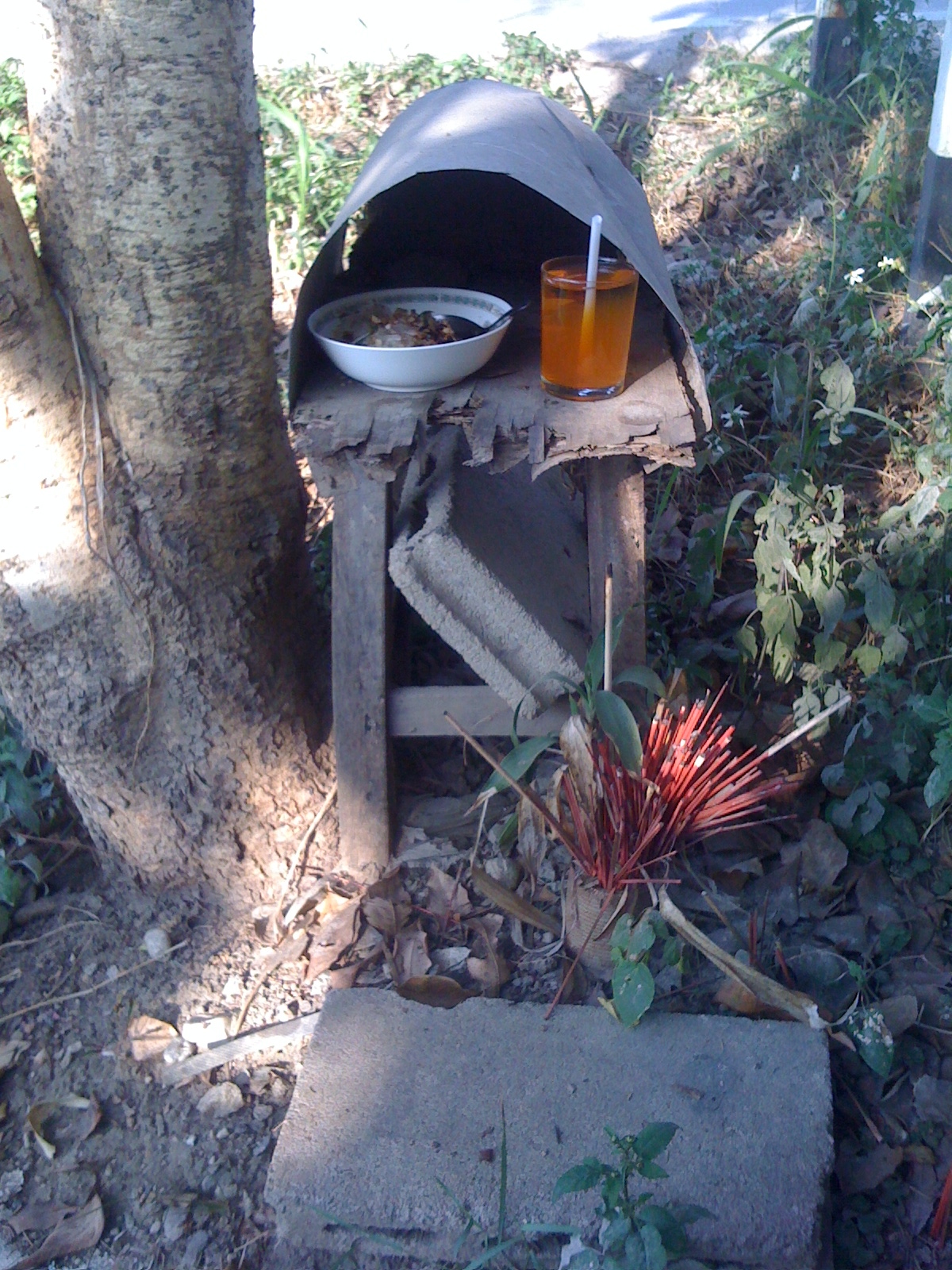
Saturday, 1:45 p.m., January 4, food for the spirits. iPhone
 the roy hamric journal