
Bedside books
Posted: February 26, 2011 Filed under: books, people, writing Leave a comment
Books by Rembrandt (Iphone photograph)
–The World Is What It Is, The authorized biography of V.S. Naipaul by Patrick French. This looks to be a rock solid, no holds barred appreciation of the ruthless artistry of the Calypso Rambler.
–The Letters of Alan Ginsberg edited by Bill Morgan. A best of the best of AG’s some 3,000-plus letters.
–The Selected Letters of Alan Ginsberg and Gary Snyder edited by Bill Morgan. The two lions of spring who made it to be lions of winter.
–Philip Larkin by Andrew Motion. Someone should do a study on the art of profanity as irony and satire, using the correspondence of Larkin and the chattering conversations of Larkin and Amis. William Empson?
Philip Larkin’s nothing
Posted: February 23, 2011 Filed under: people, poetry, writing Leave a commentWonderful wording by Philip Larkin, from the poem “I Remember, I Remember.“
“Nothing, like something, happens anywhere.”
or, Something, like nothing, happens anywhere, or
Nothing like something happens anywhere or
Something like nothing happens anywhere…

self portrait by Philip Larkin
I’m reading the Larkin biography by Andrew Motion, after having learned a great deal about Larkin from reading Kinsley Amis’s and Martin Amis’s writings about him. Larkin was one of those people everyone knows, on the surface, but who only a few people are allowed to know well over a long period of time. The stereotype of his “ordinariness,” of course , is a total fraud.
It can have only survived because of his looks, which through photographs placed him in the company of a passing face in the crowd. On the other hand, everyone who really knew him found him physically striking, and, if they were allowed entre into his world, they knew his mind was on fire. What let him down were the little things, and by that I mean those little things that become big things when we’re adults. One’s traits. The tip-off to Larkin’s character is his women pals. He had good ones, and for a long time, juggling them one, two or three at a time.
Something said early in the book about God wanting people to exercise their desires [that would be the Old Testament God, since the New Testament God is nowhere to be found], to seek abundance in life, resonates in Larkin’s life. His fears and inhibitions stimulated his desires which were met, judging from what I can see, about as well as anyone’s. But he didn’t think so, and on that he largely based his art. He early saw how life’s so-called ordinariness was the unrelieved companion of desire and pleasure, and an antidote to fear, and of course, in his art, he forsook standard romanticism to drive that point home.
It has led to the common misunderstanding of his work that haunts all original writers for years after their work is completed, until ultimately the work is seen fresh by a new generation for what it really is. The New Romanticism.
d.h. lawrence
Posted: February 20, 2011 Filed under: people, photography, states of mind, writing 1 Comment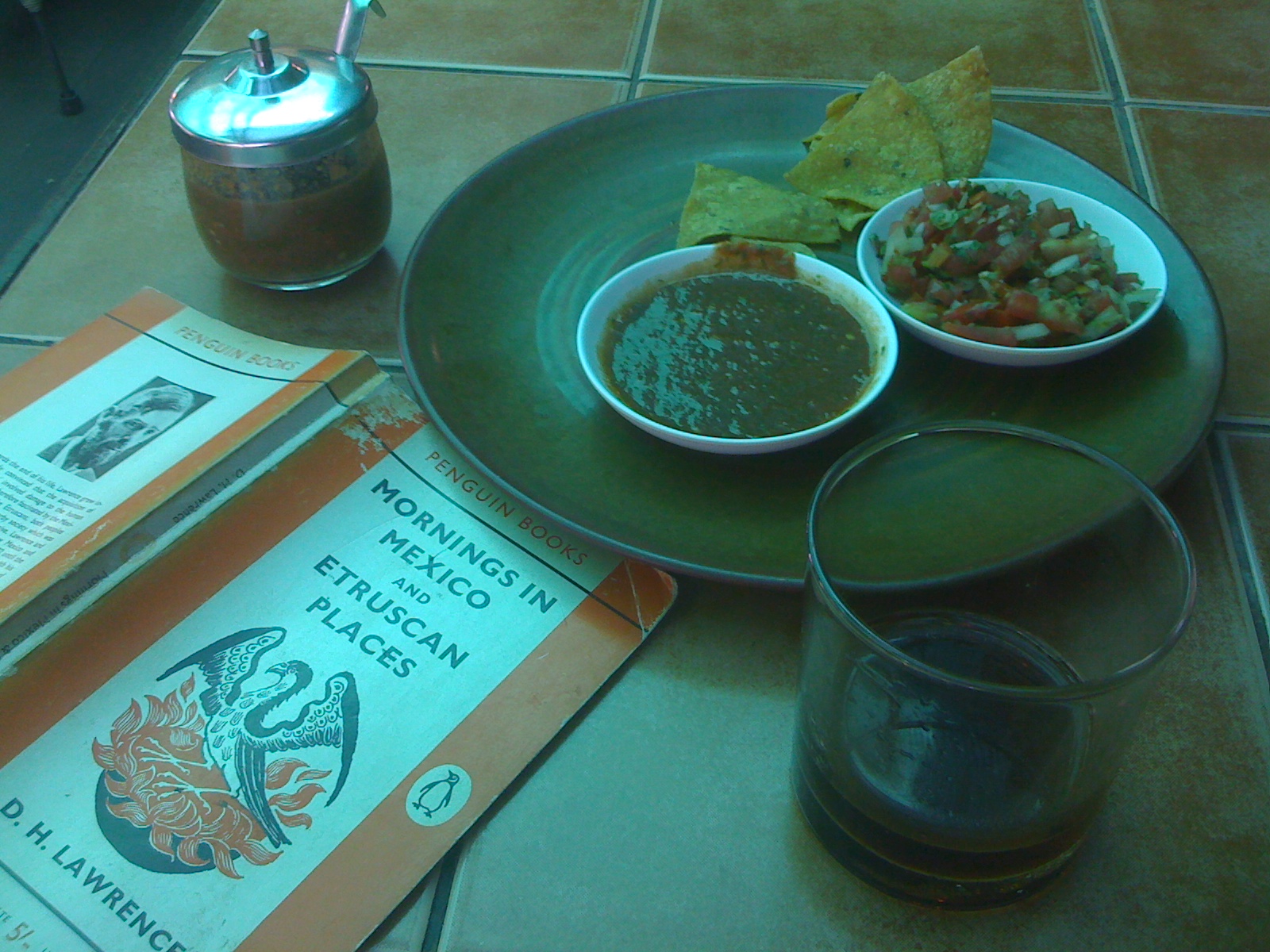
the phoenix on this Penguin cover makes it a classic (Iphone photograph)
I love dictionaries:
phoenix |ˈfēniks|noun (in classical mythology) a unique bird that lived for five or six centuries in the Arabian desert, after this time burning itself on a funeral pyre and rising from the ashes with renewed youth to live through another cycle.• a person or thing regarded as uniquely remarkable in some respect.
PHRASES rise like a phoenix from the ashes emerge renewed after apparent disaster or destruction.
ORIGIN from Old French fenix, via Latin from Greek phoinix ‘Phoenician, reddish purple, or phoenix.’ Phoenix 1 |ˈfēniks| |ˈfinɪks| |ˈfiːnɪks| Astronomya southern constellation (the Phoenix), west of Grus.• [as genitive ] ( Phoenicis |fēˈnīsis; -ˈnē-| |fɪˈniːsɪs|) used with a preceding letter or numeral to designate a star in this constellation :the star Delta Phoenicis.
ORIGIN Latin.Phoenix 2 |ˈfinɪks| |ˈfiːnɪks|the capital of Arizona; pop. 1,321,045. Its warm dry climate makes it a popular winter resort.
Bop till you drop
Posted: February 11, 2011 Filed under: buddhism Leave a comment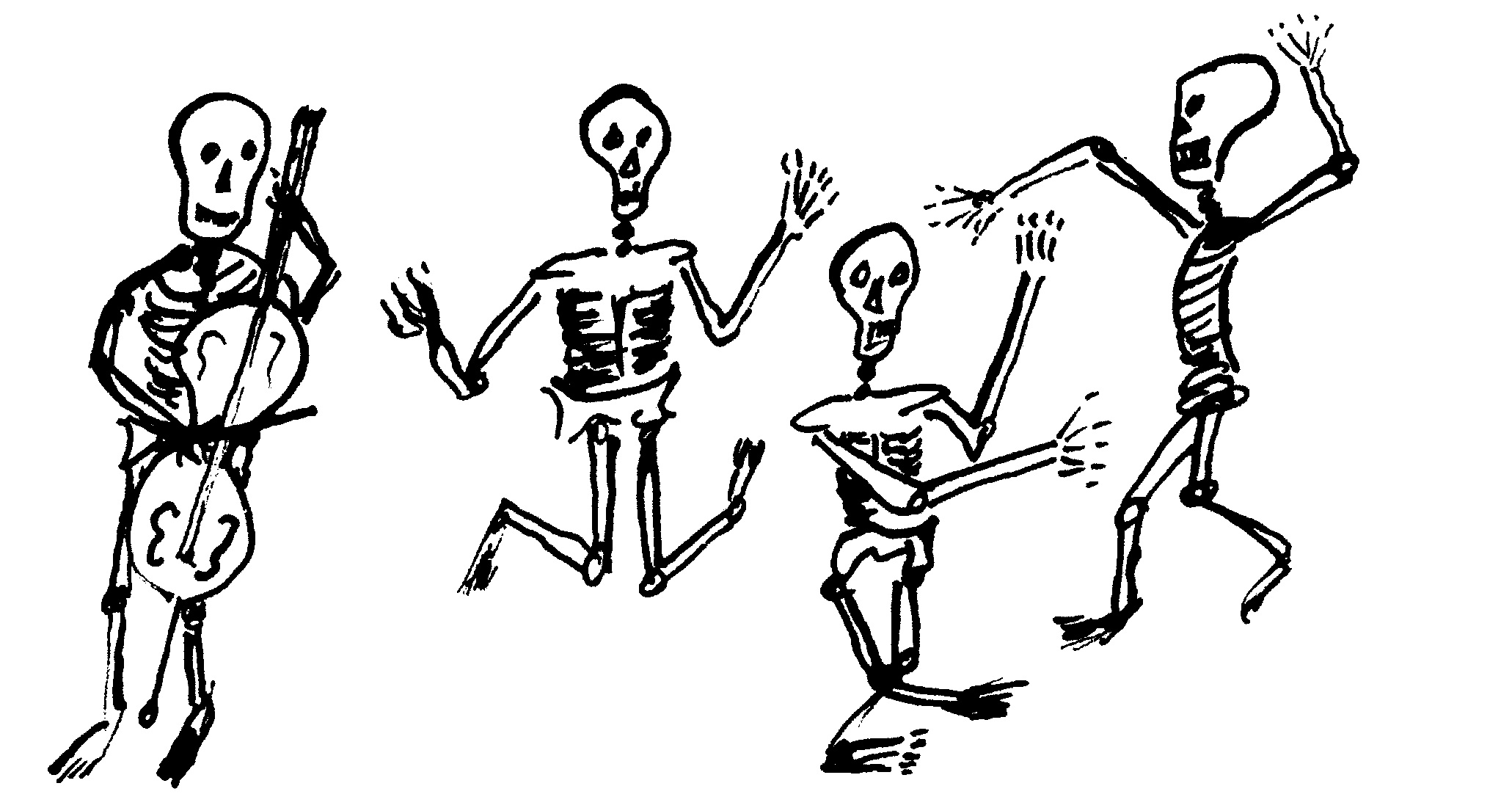
Ink drawing, The Skeleton Dance, by my friend Jim Crump.
He dies,
I die–
Where can we
meet?
–From A Zen Forest
thinking of cold mountain
Posted: February 8, 2011 Filed under: buddhism, poetry, states of mind Leave a commentZen sayings
Posted: February 7, 2011 Filed under: buddhism, photography, poetry, states of mind, writing 2 Comments
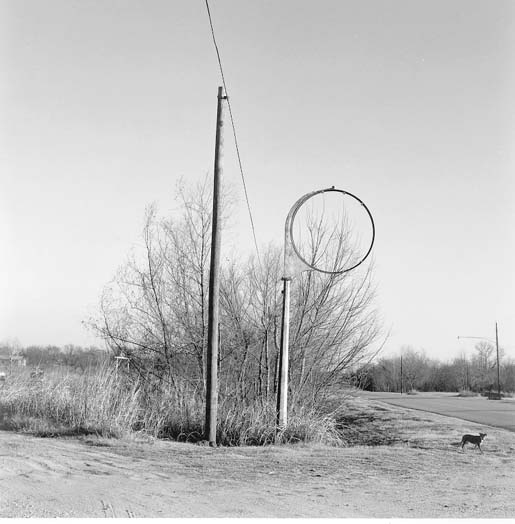
empty circle & dog (photograph Roy Hamric)
Looking
forward only,
Not knowing how
to look back.
– from A Zen Forest
The Etiquette of Freedom
Posted: February 6, 2011 Filed under: articles, books, buddhism, people, reviews, writing Leave a comment This essay originally appeared in The Kyoto Journal, issue No. 76.
The conversation between poets Gary Snyder and Jim Harrison in The Etiquette of Freedom, based on several days spent together while walking over the hills of southern coastal California, is a rare meeting of minds and personalities. A DVD film, The Practice of the Wild, co-produced by Will Hearst and Harrison, accompanies the book, which also contains a generous selection of poems that illustrate Snyder’s ideas. What we have here is a treasure: a rambling conversation between two of America’s most original poets––clear-eyed, unsentimental outsiders, both outdoors men who have spent their life probing the nature of nature.
In Asian terms, Snyder, 80, is the host of the book and film, and Harrison, 73, is the guest. A lifelong fan of Snyder’s work, Harrison assumes a dual role of interviewer—drawing Snyder out, opening up themes, offering him a stage to hold forth, which he does in his usual sharp, light and clear way. We know this encounter is the real thing when Harrison tosses out one of his favorite quotes of D. H. Lawrence that he frequently uses on his own interlocutors: “The only aristocracy is that of consciousness.” It’s easily passed over, but Snyder bites into the moment and their two minds engage:
GS: What do you think he meant by that?
JH: I think he meant that the person who is most conscious lives the most intensely––if “intensity” is the real pecking order, since life is so limited in length, as we are both aware of vividly––
GS: The most vividly. I’m not sure I agree with how he meant that, but that’s a good question.
JH: Why do you disagree?
GS: Oh, because it’s too spectacular, too romantic.
JH: Well, so was he.
GS: Of course. At any rate, you could set that beside an East Asian idea of the aristocracy of consciousness, and a Chinese or Korean idea of that would be much calmer, much cooler. Not like a hard glowing gem-like flame, not like a flaming candle burning out––
JH: That’s what Kobun Chino Sensei said; they criticized his friend Deshimaru because he said, “You must pay attention as if you had a fire burning in your hair.” And Kobun said, “You must pay attention as if you were drawing a glass of water.
GS: Oh, that’s better.
JH: The concept of the divine ordinary.
The title, The Etiquette of Freedom, comes from one of his early seminal essays, at the heart of The Practice of the Wild (1990), which explores his ideas behind the terms Nature, the Wild and Wilderness. In their fullness, the three terms are meant to encompass all aspects of phenomenal life, the whole of creation, a process in which humans are one part (though vastly threatening to the other parts). He wrote: “The lessons we learn from the wild become the etiquette of freedom [for humans].” Approaching Nature from the largest perspective, says Snyder, has sometimes caused him to be misunderstood.
GS: People, including environmentalists, have not taken well to the distinctions I tried to make between Nature, the wild and wilderness. You know, I want to say again, the way I want to use the word “Nature” would mean the whole universe.
JH: Truly.
GS: Yes, like in physics.
JH: Right, exactly.
GS: So not the outdoors.
JH: No. That’s a false dichotomy.
GS: Yes.
JH: –or a dualism.
GS: Yes, Nature is what we’re in.

gary snyder
The term “wild,” as used by Snyder, is a metaphor for the natural processes within Nature when least affected by man’s disproportionately heavy hand (but even our destructive, consumptive role is part of the natural process, as Nature, in the broadest sense, is constantly engaged in a vastly complicated destruction, consumption and renewal). Fully understanding these terms is conjoined by the role of time as measured in hundreds of thousands and millions of years and not at the rate of humankind’s anthropocentric perspective. For more on these terms, see The Practice of the Wild, where he wrote, “Nature is not a place to visit, it is home,” and, in a prophetic stroke: “It is the present time, the 12,000 or so years since the ice age and the 12,000 thousand or so years yet to come, that is our territory. We will be judged or judge ourselves by how we have lived with each other and the world during these two decamillennia.” For more on his ideas on bioregionalism and environmental issues, see Turtle Island(1974), his homage to North America, and his other essay collections and talks: The Real Work (1980),A Place in Space (1995) and Back on the Fire (2007). All of Snyder’s essays are gems. Those on Buddhist themes are filled with poetic prose rising to the level of inspired teishos.
The title, The Etiquette of Freedom, functions as a loaded metaphor, speaking of the importance of living in Nature with a humbleness that reflects humans’ disproportionate role—and responsibility—within the natural processes of creation and life and death. Etiquette means to show respect to a person or occasion. We see this attitude reflected worldwide in ancient cultures when someone asks for understanding before taking a creature’s life or before felling a tree for a home. By exercising an “etiquette” relationship with Nature, we can realign our sense of place and in turn, we experience a greater correctness in a more responsible relationship with Nature. Snyder himself has come to personify a meme which evolved out of the counterculture movment and has been absorbed into mainstream culture: the way to a richer life is to settle in, to reinhabit a rural area, to learn the names of the plants and animals, the geology, the history of the indigenous people, to study the folklore, to engage in civic life, to pay attention to the schools, to deepen one’s sense of self, to live life fully as a thoughtful member of a bioregion in which one strives to play a grateful and productive role. It is a meme for a practical, reality-based approach to life, and one which he played a major role in creating.

Poets Snyder and Harrison with Snyder’s dog Emi
The interplay between the individual and Nature has been Snyder’s subject since his first translations of Cold Mountain (Han-shan) poems as a student at Berkeley. For more than 50 years, he has been the American poet who has most fully embraced the subject of Nature, and the nature of consciousness. In 1955, he left America for Japan to study Zen. His public life began, in a way, as a fictional character in the novel Dharma Bums (1958), in which Jack Kerouac created a charismatic, heroic character named Japhy Ryder (Gary Snyder)—a young, self-assured American poet and outdoors man. In the late-60s, when he returned from Japan to live in America again, he immediately became a central figure in the evolving counterculture. His influence was based on his poetry and his practical ideas of returning to the land, which were embraced as a rallying cry by many young people, and canny elders. His approach was an extension of Emerson’s and Thoreau’s ideas on self-reliance and nature, and Buddhist philosophy. Wary of becoming a counterculture spokesperson, he quickly retreated to live in the isolated Sierra foothills near Nevada City, where he worked on his craft. After Turtle Island, he assumed a role of poet and environmental social critic. In his late period, he taught at the University of California at Davis, while continuing to publish poems and essays. Since then, the mythology surrounding him as a teacher has deepened. Over the coming decades, his work will travel well beyond America’s shores, and one feels the mythology has only just begun.
Snyder’s work has always been aligned with his commitment to Zen. Looking back now, his poetry and essays fan out like one long scroll of his life, a record of what he’s seen and felt and learned. To throw him together here with Jim Harrison’s highly refined Ikkyu-like spirit is a gift—two American poets who have extended the lineage of Emerson and Thoreau (Dogen and Han-shan)—two old men, well-seasoned and free, walking and talking, and turning the wheel.
Review photographs copyrighted San Simeon Films.
a poem by Roxy Gordon
Posted: January 21, 2011 Filed under: people, poetry Leave a commentthe military & mindfulness
Posted: January 17, 2011 Filed under: articles, buddhism, states of mind Leave a commentA New York Times story today looked at the problem of US soldiers processing an overload of data and making split-second decisions which can save lives or mistakenly take lives.
The military is experimenting with training the soldiers in “mindfulness,” and its methods sound like a crude version of Vipasanna meditation techniques. I’m wondering if the military is aware of the parallels. If not, someone needs to clue the psychologists behind the training program in on one of the world’s oldest, proven techniques for increasing mindfulness.
Here’s a clip from the story, which is linked here.
“The military is trying novel approaches to helping soldiers focus. At an Army base on Oahu, Hawaii, researchers are training soldiers’ brains with a program called “mindfulness-based mind fitness training.” It asks soldiers to concentrate on a part of their body, the feeling of a foot on the floor or of sitting on a chair, and then move to another focus, like listening to the hum of the air-conditioner or passing cars.
“The whole question we’re asking is whether we can rewire the functioning of the attention system through mindfulness,” said one of the researchers, Elizabeth A. Stanley, an assistant professor of security studies at Georgetown University. Recently she received financing to bring the training to a Marine base, and preliminary results from a related pilot study she did with Amishi Jha, a neuroscientist at the University of Miami, found that it helped Marines to focus.”
time, space
Posted: January 17, 2011 Filed under: photography, time, space Leave a comment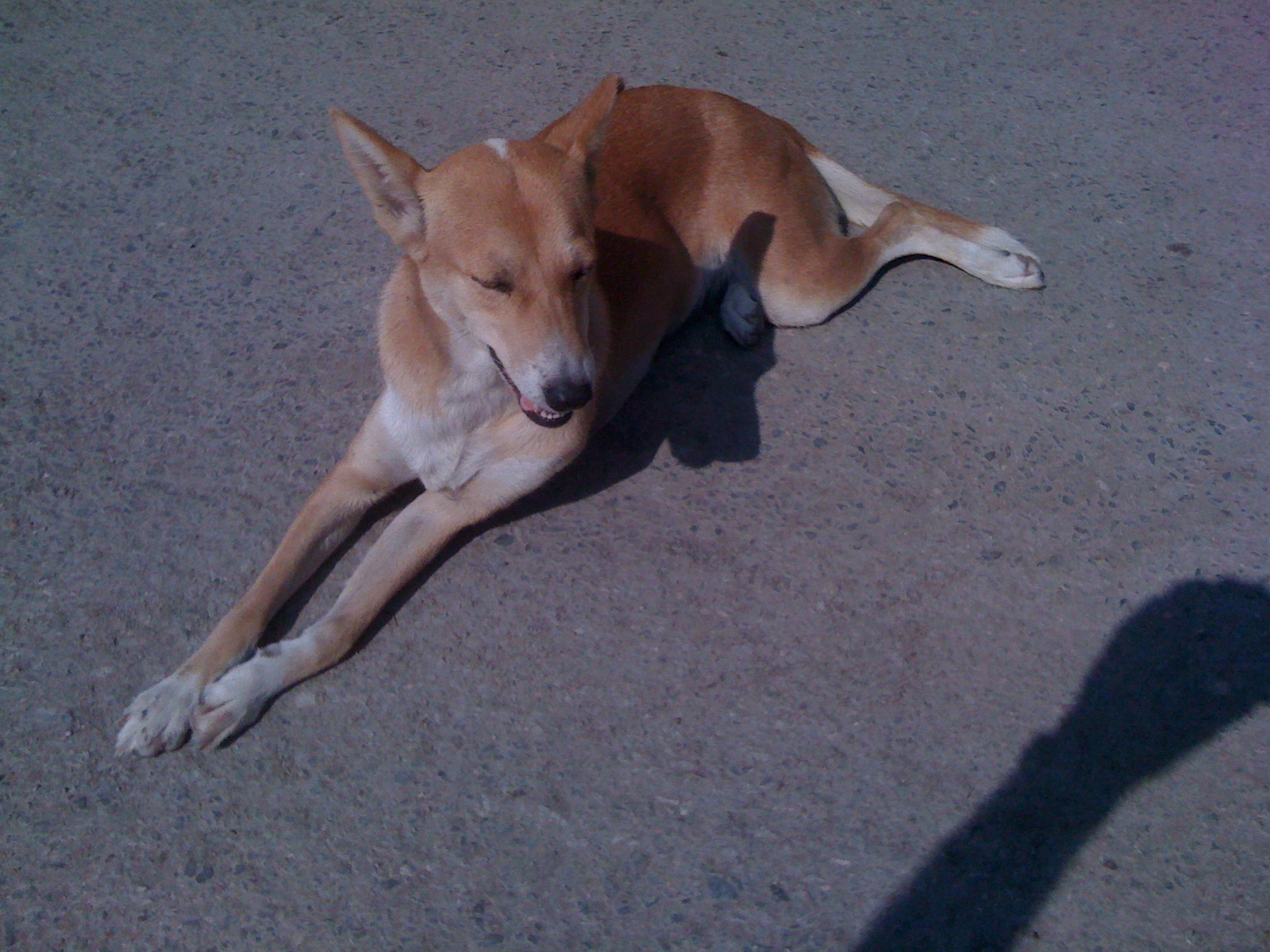
Monday, 10:34 a.m., two shadows and a dog on the road. (Iphone photograph)
 the roy hamric journal