
Yellow River Odyssey Photograph by Red Pine
Posted: February 8, 2014 Filed under: books, buddhism, people, photography Leave a comment
Photography copyright by Bill Porter, aka Red Pine
A photo and caption from Bill Porter’s “Yellow River Odyssey,” now scheduled to be released in May 2014:
“I was on my way from Hong Kong to follow the Yellow River from its mouth to its source and couldn’t resist the temptation to stop in Shanghai for the China Coast Ball. This annual bacchanal was organized by and for the Hong Kong expatriate community, and it was normally held in March at the Belle Vista in Macao. But in 1991 the Belle Vista was being renovated, and the organizers turned to the Peace Hotel in Shanghai as a suitable replacement. The Peace had been boarded up during the Cultural Revolution, and the splendor of its art-deco interior had survived intact.”
Tracking is the future of technology
Posted: February 6, 2014 Filed under: articles, interviews, people, states of mind 2 CommentsThe Edge, an idea-oriented collective of innovators and thinkers, has a new issue here.
It includes a 9,000-word interview with Kevin Kelly, one of the founders of Wired magazine. Kelly ranges across the future of technology, the good and the bad. He says technology is “telling me” it wants to track. I immediately nodded my head, and thought, “We are technology,” and we’re telling ourselves we want to track. Why, for more reasons that we can imagine, and I hope, on balance, it will be a positive phenomenon, and I hope I’m not being characteristically positive here.
Normal computer tracking capabilities (built into the Internet/computer system) and government surveillance are two separate issues, and each will require different answers and regulations to make them work positively within society.
Here’s Kelly on technology and tracking:
“How far will we share, when are we going to stop sharing, and how far are we going to allow ourselves to monitor and surveil each other in kind of a coveillance? I believe that there’s no end to how much we can track each other—how far we’re going to self-track, how much we’re going to allow companies to track us—so I find it really difficult to believe that there’s going to be a limit to this, and to try to imagine this world in which we are being self-tracked and co-tracked and tracked by governments, and yet accepting of that, is really hard to imagine.

Kevin Kelly
“…How does this work? How can we have a world in which we are all watching each other, and everybody feels happy? I don’t see any counter force to the forces of surveillance and self-tracking, so I’m trying to listen to what the technology wants, and the technology is suggesting that it wants to be watched. What the Internet does is track, just like what the Internet does is to copy, and you can’t stop copying. You have to go with the copies flowing, and I think the same thing about this technology. It’s suggesting that it wants to monitor, it wants to track, and that you really can’t stop the tracking. So maybe what we have to do is work with this tracking—try to bring symmetry or have areas where there’s no tracking in a temporary basis. I don’t know, but this is the question I’m asking myself: how are we going to live in a world of ubiquitous tracking?
“I call myself a protopian, not a utopian. I believe in progress in an incremental way where every year it’s better than the year before but not by very much—just a micro amount. I don’t believe in utopia where there’s any kind of a world without problems brought on by technology. Every new technology creates almost as many problems that it solves. For most people that statement would suggest that technology is kind of a wash. It’s kind of neutral, because if you’re creating as many problems as it solves, then it’s a 50/50 wash, but the difference in my protopian view versus, say, a neutral view is that all these new technologies bring new possibilities that did not exist before, including the new possibility of doing harm versus good.
 “One way to think about this is if you imagine the very first tool made, say, a stone hammer. That stone hammer could be used to kill somebody, or it could be used to make a structure, but before that stone hammer became a tool, that possibility of making that choice did not exist. Technology is continually giving us ways to do harm and to do well; it’s amplifying both. It’s amplifying our power to do well and our power to do harm, but the fact that we also have a new choice each time is a new good. That, in itself, is an unalloyed good—the fact that we have another choice and that additional choice tips that balance in one direction towards a net good. So you have the power to do evil expanded. You have the power to do good expanded. You think that’s a wash. In fact, we now have a choice that we did not have before, and that tips it very, very slightly in the category of the sum of good. …”
“Personally, I want to be optimistic, like Kelly, and see tracking, in spite of the current cultural dread, as becoming a force for positive good in culture and society. On balance, I want to believe it will somehow expand our possibilities for change that is good even though we can’t envision that at this moment – how that will take place. To do otherwise, is to fall into the Big Brother trap. It’s not that simple, and we shouldn’t reduce tracking to a dangerous rubric or else we help to create Big Brother rather than to see this as a technological moment which moves us into a new future that carries with it all the possibilities of good and bad, just as technology has done throughout history.
“That said, the tracking issue demands some immediate innovative codifications of principles that offer people choices, some protections, and some control over unbridled tracking. This need, of course, will be on-going in order to keep up with technology.
“The challenge is on the par with the long road of codifying democratic and human rights principles. It will take a lot of seriousness of purpose, work and time.”
Edmund Wilson on America’s Role
Posted: February 3, 2014 Filed under: books, people, writing Leave a commentFrom Edmund Wilson’s A Piece of My Mind (1957):
“One can say that on the one hand, you find in the United States the people who are constantly aware… that, beyond their opportunities for money-making, they have a stake in the success of our system, that they share in the responsibility to carry on its institutions, to find expression for its new point of view, to give it dignity, to make it work; and, on the other hand, the people who are merely concerned with making a living or a fortune, with practicing a profession or mastering some technical skill, as they would in any other country, and who lack or do not possess to the same degree, the sense of America’s role.”
Wilson was – and still is – America’s essential literary and cultural critic. He left a body of work that changed and is still transforming our sense of who we are. For me, he and Emerson are the true America spirit, the American mind. I feel an Edmund Wilson phase of deep rereading coming to the fore. Also, great timing, I just found a copy of Clive James’ first book of collected criticism, The Metropolitan Critic. James has written seminal essays which go to the heart of Wilson’s unique role as a writer-critic. First James, and then back to Wilson for the umpteenth time…
Sight Seeing
Posted: February 2, 2014 Filed under: people, sight seeing 1 Comment
Photograph copyright Robert Crosby
A landscape photograph has an immediacy I never find in a landscape painting. It can sing closer to the heart. This one, by my good friend Robert Crosby, has two sensations: an intimation of despair and a ray of hope. But the blue is the real message. Deep blue dominates all colours for me, even red. It’s such a rich, soothing color – peace. Here it speaks volumes between the foreground and the background. Line and color and inanimate objects and forms, such a mysterious language.
The Rain Tree at the Gymkhana Club
Posted: January 27, 2014 Filed under: articles, books, people, places, writing Leave a comment
The rain tree at the Gymkhana Club in Chiang Mai. Photograph by Bruce Bridges
The Rain Tree at the Gymkhana Club
By Roy Hamric
This essay appeared in the Kyoto Journal, Issue 79, Spring 2014.
Do not require a description of the countries toward which you sail. The description does not describe them to you, and tomorrow you arrive there and know them by inhabiting them. – Emerson, The Over-Soul
Many writers have left exact descriptions of their first taste of Asia. For Joseph Conrad, the East’s charm lived in his heart – in what he called romantic reality. It’s what drove many of his best-known characters, like the young seaman in Lord Jim, who longed to lose himself, to be stripped down to a bare, primitive moment.
Conrad wrote, “This in itself may be a curse, but, when disciplined by a sense of personal responsibility and a recognition of the hard facts of existence shared with the rest of mankind, it becomes but a point of view from which the very shadows of life appear endowed with an internal glow. It only tries to make the best of it, hard as it may be; and in this hardness discovers a certain aspect of beauty.”
To be under the spell of a place, or a state of mind, quickens the blood. But behind the spell lies a deeper mystery imprinted in our subconscious – the desire to answer an unidenifiable call.
In the novel Youth, Conrad described the exact moment when Marlow, his narrator, first sensed the East: “… and suddenly a puff of wind, a puff faint and tepid and laden with strange odors of blossoms, of aromatic wood, comes out of the still night – the sigh of the East on my face.”
Marlow never escaped the spell of that sublime moment – the sense of life flowing from a new direction, a shift of culture from western to eastern. For some of us, it is a seduction of the soul.
Writing as Marlow, Conrad said, “But for me, all of the East is contained in that vision of my youth. It is all in that moment when I opened my young eyes on it…and I saw it looking at me.”
In the short story The Shadow-Line, he described the Bangkok of the 1890s, at the time of his first sighting: “One early morning we steamed up the innumerable bends, passed the shadow of the great gilt pagoda, and reached the outskirts of town. There it was, spread largely on both banks, the oriental capital which had yet suffered no white conqueror. Here and there in the distance, above the crowded mob of low, brown roof ridges, towered great piles of masonry, king’s palaces, temples, gorgeous and dilapidated, crumbling under the vertical sunlight, tremendous, overpowering, almost palpable, which seemed to enter one’s breast with the breath of one’s nostrils and soak into one’s ribs through every pore of one’s skin.”
A very different writer, the cosmopolitan Somerset Maugham, in the early 1920s, toured Burma and Siam. In a nearly forgotten travel book, The Gentleman in the Parlour, he captured a fading moment when Bangkok had yet to blend in with the West:
“The traffic of the river ceased and only now and then did you hear the soft splash of a paddle as someone silently passed on his way home. When I awoke in the night, I felt a faint motion as the houseboat rocked a little and I heard a little gurgle of water, like the ghost of an Eastern music travelling not through space but through time.
“A leisurely tram crowded with passengers passes down the whole length of the street, and the conductor never ceases to blow his horn. Rickshaws go up and down ringing their bells, and motors sounding their claxons. The pavements are crowded and there is a ceaseless clatter of the clogs the people wear. Cloppity-clop they go, and it makes a sound as insistent and monotonous as the sawing of the cicadas in the jungle.”
Alex Waugh left a portrait of expatriate, turn-of-the-century Siam in Hot Countries, published in 1930, nearly three generations removed from today. Describing colonial life and the “natives” in Chiang Mai, he reflected the racist attitudes and language that permeated colonial culture. A well-educated Englishman, he presumed Western superiority, and his attitudes reflected the repression and guilt surrounding sexual mores. He used the expression “gone native” as a rebuke to Westerners who entered the normal life of Asian culture, or who openly took wives or girlfriends and shared their lifestyle. As a journalist who racked up books about exotic countries like they were way stations on a news beat, Waugh described “white life” in old Chiang Mai.
It was especially difficult on Western women, he wrote, and he urged them to stay home rather than endure a life of isolation, boredom and disease. He admitted he’d never personally known of a case of a white man who had “gone native,” but he’d heard rumors and had constant suspicions. The “gone native” phrase was nuanced – most of the time it was a code word for sexual relations or cohabitation.
“In the popular imagination,” he wrote, “the ‘gone native’ myth has become identified with that very different, very real problem of the tropics – the white man and the brown woman.”
It’s easy to pass over 19th-century Western attitudes and the social barriers faced by both Westerners and Asians. But a careful reading makes you cringe. Waugh wrote: “In Bangkok, it would be impossible for a white man to have a Siamese girl living in his bungalow, but on the plantation there is fairly often a Malay girl who disappears discretely when visitors arrive. There the relationship has a certain dignity. There is faithfulness on both sides. Custom creates affection. But in neither case is there any approach to the ‘gone native’ picture. In neither case has the white man done anything that involves loss of caste. He observes the customs of the country.”
In scalding sentences that magnify the distance, he wrote: “All the same, I believe it is extremely rare for there to exist a profound relationship between a white man and a brown woman.” Again, “I have yet to meet the man who will say that he has really loved a coloured woman.”
And, “Love, as we understand it, is foreign to these people.” And, “Between brown and white there can be only a brief and superficial harmony.” And finally, “Between brown and white there can be no relation interesting in itself.”
To get to Chiang Mai, Waugh took the Bangkok passenger train for the 27-hour journey north. If you went by river, it was a five-week journey. Chiang Mai was the administration center of two large timber companies, the Borneo and Bombay Burma. Waugh felt he was going to the end of the road where the “white community” had to unite together against a “common foe.”
“There are not, I fancy, more than thirty white people in the station,” he wrote. “There is the bank manager and the English consul; there are the forest manager, and an occasional assistant who has come in from the jungle for a rest; there is an American mission which is responsible for schools and the hospital and a big sanatorium for lepers.”
The social “white life” of Chiang Mai was centered around the Gymkhana Club, chartered in 1898, which is still in operation today. As I write this, I sit near a majestic rain tree that is older than the club, its huge limbs casting shade over outdoor tables.
“It is a large field set a little way out of town which serves as a polo ground, a golf course and a tennis court,” Waugh wrote. “By five in the evening, most of the white community is there. There is 75 minutes of strenuous exercise, then there is a gathering around a large table on which have been set out drinks, glasses and a little lamp. There are rarely more or rarely less than a dozen people there…the women have slipped their legs into sarongs, sewn up at one end in the shape of bags. Their life is hard and testing. It has many dangers, many difficulties. It is only by mutual tolerance, by interdependence, by loyalty and friendship that it can be made tolerable.”
The rain tree is a stone’s throw from the northern bank of the Mae Ping River as it winds past the city’s old Chinese night market and main tourist hotels. For decades, the club remained a tranquil oasis of white privilege, but after WW II it fell on hard times. By the 1950s, the last of the Western lumber concessions had disappeared. Club membership had dwindled to less than 20, and to avoid bankruptcy the directors voted to offer 12 Thais full membership. By early 2000, the club membership rebounded to around 300 people. Thais numbered about 60 percent and one Westerner served on the board of directors.
The centerpiece of the club is still the venerable rain tree, marking the passage of time. Its shade certainly fell across the figure of the visiting Waugh, whose cultural blinders prevented him from truly knowing Asians. To know the other is as hard as to know one’s self, if not harder.
To live here one would be charged in the quiet, small currency of the conscience. – Graham Greene, describing Vietnam in his essay collection, Reflections.
The three generations between Waugh’s Hot Countries and Greene’s The Quiet American, published in 1955, saw sweeping changes in cultural attitudes. The world grew smaller. In The Quiet American, the correspondent Thomas Fowler, Greene’s alter ego, admits his love and his desire to marry his Vietnamese mistress, Phoung. But his cynicism and sense of superiority still color the relationship. At first, it’s as if he is taking on a beautiful naïf, a woman perfectly designed to be of service to a superior Western man. Later, Fowler learns that the reverse might be closer to the truth.
Phuong is a classic Vietnamese mistress, a heroine who deftly controls and dispenses her emotions and affections between her interests in Fowler and his nemesis, the wide-eyed, naive American, Alden Pyle. She’s capable of breaking the idealistic Pyle’s heart, but she presents little romantic danger to Fowler, who strives to be the dispassionate observer, a stoic who sees emotional attachment as vulnerability. Fowler is a post-colonial man poised at a moment of romantic growth, but just barely. He starts with the typical, Western cultural baggage that is still lugged around today by too many expatriates arriving on Boeing 787s.
Fowler thinks: “It is a cliché to call them children – but there’s one thing which is childish. They love you in return for kindness, security, the presents you give them – they hate you for a blow or an injustice. They don’t know what it’s like – just walking into a room and loving a stranger. For an aging man, it’s very secure. She won’t run away from home so long as the home is happy.”
Later, his cynicism is shaken and his emotions expand when he realizes Phuong “was as scared as the rest of us – she didn’t have the gift of expression, that was all.” Greene gives Fowler an emotional breakthrough when he finally grants Phoung equal emotions – something he should have understood long before, but worth learning at any age.
A Poem for Red Pine
Posted: January 26, 2014 Filed under: people, poetry, writing Leave a commentA Poem for Red Pine
Bill Porter went West, took a new name
and came back from the East to spread the word.
A master of the shadow art,
he trails behind
recasting Chinese ideograms into new lines
for English minds.
He works from a second floor study in Port Townsend,
deciphering black strokes from faraway days with sharp eyes,
diamond mind – a time of flaming hearts:
writers of the Silent Word.
On the wall of his study, a Tibetan tanka.
A small painting of bamboo with a poem by Wang Wei.
Through a window, the Cascade Mountains.
Through another window, the ocean.
Through another window, the branch of a plum tree.
Pine trees and bamboo sway in the morning wind.
Light brightens a new day
as the pine tree’s shadow disappears,
leaving no trace.
Big Bend Burro Lady, Judy Magers
Posted: January 25, 2014 Filed under: people, photography, places, writing 1 Comment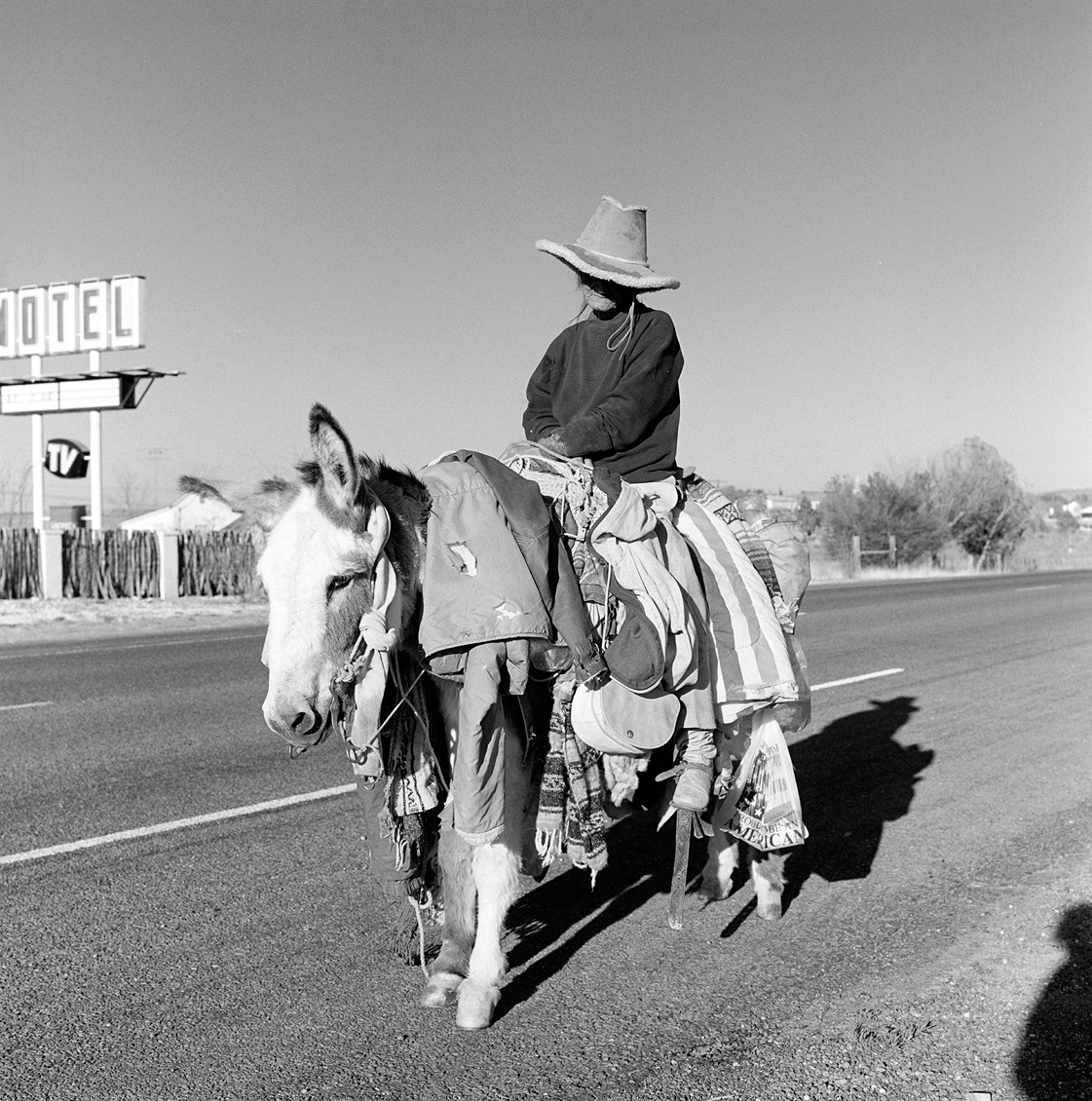
The Burro Lady of Big Bend; photograph copyright James Evans
By Roy Hamric
For decades, most folks in Far West Texas at one time saw Judy Magers on her burro riding along the side of the highway or camping next to the road. This story first appeared in 2008 in the Desert Candle, a cultural journal published in Alpine, Texas. Judy died of a heart attack on January 26, 2007, in Sierra Blanca.
We saw Judy about one mile east of Van Horn on Highway 90. She was sitting on the ground on the side of the road under a small tree and eating food with her fingers. A harsh, cold wind was blowing. Several plastic bags flapped loudly, caught on the barbed wire strands of a fence behind her. Her burro was still saddled, head down, bedecked with the rainbow-colored blankets and brightly colored strings that made it look like a psychedelic, walking Christmas present. The burro carried an assortment of blankets, ropes, bottles and storage bags that represented Judy and her way of life as a vagabond, a mysterious spirit with no home. She lived under the stars.
“Hi, how are you? Can I talk to you?” Laddawan, my Thai wife, asked through the car window. Judy nodded. We got out and Laddawan went over to her and sat down beside her. Laddawan’s puppy followed her and nestled down beside them.
Judy wore three or four coats. She had on white plastic boots with silver spurs. She wore a tight, white plastic skullcap that came down over her ears, making her look like a medieval apparition from a painting by Hieronymus Bosch. The skin on her face was swollen and raw and colored brownish red from the wind and years of living outdoors.
“Do you want some water?” Laddawan asked.
“No, thank you. I have some water.”
“Are you ok? What’s your name?”
“My name’s Judy. You have a beautiful puppy.”
“Yes, he is my baby. His name is Roxy. How old is your donkey?”
“Eight years.”
“Male or female?”
“Male.”
“Can I touch him?”
“Don’t get too close to him, because he might kick.”
“Oh, ok.”
“How old are you?” Laddawan asked.
“How old are you?” Judy asked.
“I’m 35.”
“I’m 29,” Judy said, smiling.
Laddawan laughed. “I’m from Thailand. I’m very interested in you. I like to talk with people – it makes me happy, because sometimes when I am alone I feel sad and homesick.
“You have to buy a radio,” Judy said.
“Do you have a radio?”
“Yes,” she said. “I have a small transistor radio.”
“And you listen to it?”
“Sometimes. I like Mexican music at night.”
“Do you have a problem with animals—tigers, javelina?” Laddawan asked.
“No,” Judy said. “I’ve never had a problem”
“Where are you going?”
“I’m lookin’ for some land to buy,” Judy said. “I hear they have cheap land over around Sanderson.”
“Why do you want land? Just to put some things?”
Judy nodded.
Judy said she roamed the lonely highways as far south as Terlingua near the Mexico border and from Sanderson to Van Horn to Fort Hancock.
“I don’t stop too much,” she said. She said she could average 12 to 15 miles a day, riding or walking alongside her burro.
“Can I take a picture with you?” Laddawan asked.
“You can take a picture of the burro, but I don’t want my picture taken.”
Judy got up and began fiddling with a rope tied to a fence post while I took a picture of her burro.
“If I see you later, can I talk to you again?” Laddawan asked.
“Ok”
Laddawan reached over and tried to shake Judy’s hand, holding two of her fingers.
“Ok, you have a good day,” Laddawan said. “I want to stop and talk to you whenever I see you. It’s nice to meet you.”
“Nice to meet you, too,” Judy said.
Back in the car, we made a U-turn across the highway, and Laddawan waved goodbye.
“I want to be friends with her,” Laddawan said, smiling. “Maybe someday I will live like that – a wandering nun.”

Judy camped on the side of the highway near Van Horn; photograph by Roy Hamric
Elephant Kingdom
Posted: January 19, 2014 Filed under: books, people, places, writing Leave a comment This book was a secret escape into another world, reminding me of the pleasures of childhood reading. It opened up a fascinating realm of nature and animals. I found a battered, spine-broken, worm-eaten edition that had passed through the Penang Library in 1959. It’s a two-track story: first, it’s the story of the Indian working elephant – jungle royalty. Second, it’s a record of a young Englishman’s life, who has been thrown into the job of a “teak wallah” for seven years in the mountainous areas around Chiang Mai in the early 1950s.
Essentially, he’s a clueless but eager, hardy soul who takes over the responsibility of managing a crew of clever and sometimes exasperating Thais and savvy hill tribe workers charged with cutting and hauling out of the deepest jungles of Northern Siam (now known as Thailand) timber that was prized for its strength and beauty. “These elephants possess the virtues of a crawler tractor, crane, bulldozer and tug combined in one package and are endowed with a high degree of intelligence,” wrote H.N. Marshall. In the 1950s, the area around Chiang Mai was still wild and dangerous, especially when sending the cut timber down the small streams into the Mae Ping River where the logs slowly worked their way downriver to the larger Chao Phraya, eventually arriving in Bangkok as long as four or five years later. Huge logjams blocked the river trip along the way, which had to be “un-jammed” by man or elephants in the most dangerous situations imaginable.
Opium crazed workers, pythons in the rafters, hunting game for fresh meat, the lore of treating sick elephants, the devotion of their mahout, berserk elephants on rampages defending their turf, night-stalking tigers, outlaws and bandits, marauding mosquitoes, flies, ants, termites, spiders and centipedes. It was a life and work few people could do. But he found the satisfaction that comes from doing work unimaginably hard, work one thought themselves incapable of doing.
Marshall wrote, in a goodbye tribute, in that effusive English language of his day: “On forested hills, in steamy valleys and swampy lowlands, in extremes of heat, wet and cold, and at all times of day and night, I had come to know the Indian elephants for what they are: the unquestioned Kings and Queens of the jungle.” The daily life he unfolds is warmer, simpler, richer and supremely demanding, a life few people could endure and which he must have carried like a dream through his routine life when he returned home to the easy comforts of England.
Red Pine’s Canny Commentaries on Buddhist Sutras
Posted: January 10, 2014 Filed under: articles, buddhism, people, states of mind, writing Leave a comment
Red Pine hitching a ride in China. Photograph by Ted Burger
Red Pine’s probing and understanding of the major Buddhist sutras: The Heart Sutra, The Platform Sutra of the Sixth Patriarch, The Diamond Sutra and, the latest, The Lankavatara Sutra, in addition to his earlier translation and commentary on The Tao Te Ching continue to deepen. With each translation his commentaries have grown more profound, especially on how all the sutras, taken together, form a whole, offering an approach to the difficult metaphysics that bewitch people looking for the answer to life’s riddles.
Red Pine’s latest commentary on the Lankavatara Sutra is a good example of how he draws all the sutras together. For instance:
“Buddhism is concerned with suffering, which is the inevitable result of desire. But the real issue is the self, which is the cause of the desire, which is the cause of the suffering. In the centuries following the Buddha’s Nirvana, instructions centered around a trio of concepts designed to focus attention in such a way that the nonexistence of the self would become evident and the liberation from suffering would follow. These included the five skandas (form, sensation, perception, memory and consciousness), the twelve ayatanas (six powers and six domains of sensations), and the eighteen dhatus (the ayatanas with the addition of six forms of consciousness). These were three views of the same thing: our mind.
“The were simply different ways of dividing any given moment of awareness into a manageable matrix to demonstrate to anyone willing to wander around these matrices that they contained the universe of our awareness, its inside and its outside, and yet they contained no self. This was their function: to show practitioners that there was no self.
“While these three schemes dealt with the problem of the self, they didn’t help explain how we become attached to a self in the first place, and how we go from attachment to detachment to liberation. Hence, to these were added three more schemes, all of which play a much larger role in the Lankavatara Sutra than the previous trio. The three new schemes are the five dharmas, the three modes of reality, and the eight forms of consciousness.
“The five dharmas divide our world into name, appearance, projection, correction knowledge and suchness. The three modes of reality do the same thing with imagined reality, dependent reality, and perfected reality; and the eight forms of consciousness include the five forms of sensory consciousness, conceptual consciousness, the will or self-consciousness, and an eighth form known as repository consciousness, where the seeds from our previous thoughts, words and deeds are stored and from which they sprout and grow.
“As with earlier trios of concepts, these were designed to account for our awareness without introducing the self. But they had the advantage of also providing a look at how our worlds of self-delusion and self-liberation come about, how enlightenment works, how we go from projection of name and appearance to correct knowledge of suchness, how we go from an imagined reality to a perfected reality, how we transform our eightfold consciousness into Buddhahood.
“….But then the Lankavatara Sutra sets all these schemes aside in the interest of urging us to taste the tea for ourselves….Cup of tea or not, no one said it was going to be easy…”
He goes on to explain how the Lankavatara confounded his understanding for 35 years. Everyone’s approach may differ, but a good step would be to try the sutras in a sequence such as this: the Tao Te Ching, The Heart Sutra, The Platform Sutra, The Diamond Sutra and the Lankavatara Sutra.
Red Pine always offers good advice. His life has been devoted to translating these sutras to deepen his own understanding and wisdom.
Also, as his wisdom – and his humor – ripen, he becomes more humble. The mark of a real teacher
Red Pine’s Yellow River Odyssey
Posted: January 7, 2014 Filed under: articles, buddhism, people 1 Comment
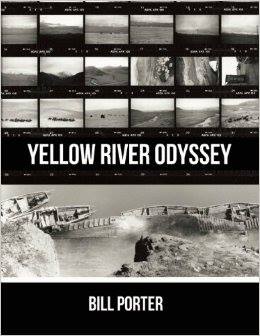
Bill Porter, aka Red Pine, has a new book scheduled to be released in February 2014, titled Yellow River Odyssey. It’s a collection of photographs and recollections of a trip along the river when China was just beginning to open up in small ways. The book is published by a great, small publisher called Chin Music Press based in Seattle. It is a bestseller in China, where it was first published.
I’ve also just come across a fan Facebook page for Porter, which you can see here.
Here’s the Amazon blurb on the book: “Bill Porter follows the Yellow River, the world’s sixth longest river, from its mouth to its source high in the Tibetan Plateau, a journey of more than three thousand miles through nine Chinese provinces. The trip takes the master translator into what was once the cradle of Chinese civilization and to the hometowns and graves of key historical figures such as Confucius, Mencius, Lao-tzu, and Chuang-tzu. Porter’s depth of knowledge of Chinese history and culture is unparalleled. Yellow River Odyssey, already a bestseller in China, reveals a complex, fascinating, contradictory country. Porter masterfully digs beneath China’s present-day materialism and the deep wounds of the Cultural Revolution to get at the roots of Chinese culture.”
 the roy hamric journal