
hunter thompson in Laos
Posted: May 16, 2010 Filed under: people, places, writing 5 Comments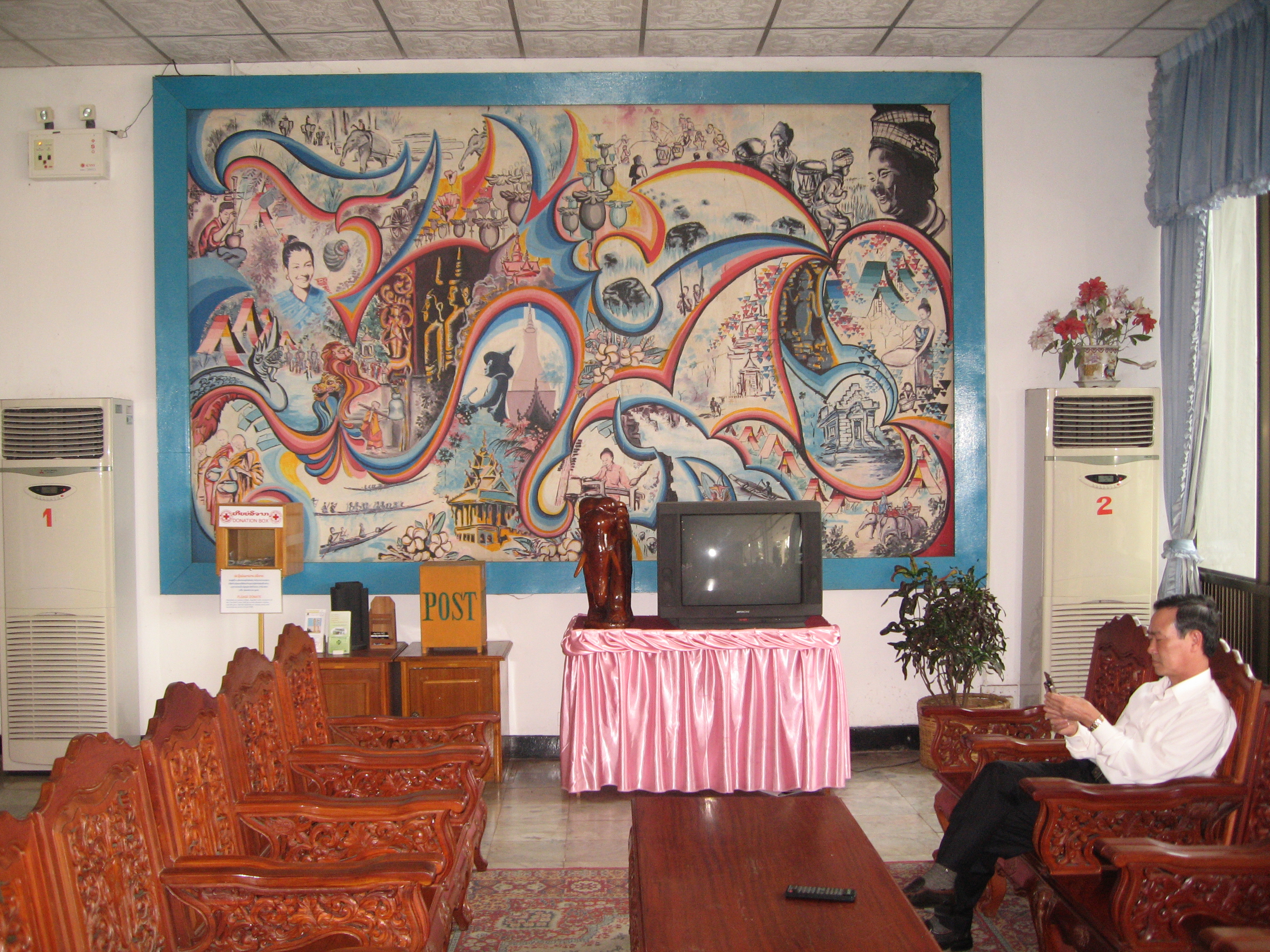
land xang hotel lobby
This is an expanded version of an article that appeared in The Magazine in The Bangkok Post.
hunter thompson in Laos
By Roy Hamric
“Laos is as different from Vietnam as Big Sur is from Long Island”––Hunter S. Thompson
I had a reservation to see if I could locate traces of the ghost of writer Hunter Thompson in Vientiane. It had been about 10 years since I had visited the Laotian capital, a time when most of the downtown streets were still dirt.
The Laos visa process at Friendship Bridge took about five minutes. Emerging from 33 years of Communist rule, Vientiane, the once delicate Laotian capital with about 500,000 people, had the frayed look of an Eastern European city, signaled by the dominance of the imposing government buildings on the city’s main boulevard, Tannon Phon Kheng. The best display of nightlife was still Fa Nyum Road, named for Laos’ first king, a burgeoning strip of restaurants and guesthouses fronting the Mekong River. The city overflowed with backpackers and hardy tourist types.
Following the Communist Pathet Lao takeover in 1975, Laos was a closed society until 1989, when it slowly began accepting Westerners back into the country. The Communist regime proclaimed 1997 the “Year of the Visitor.” The country is still scrambling to accommodate the growing number of tourists, and there’s still only a half dozen or so functioning ATMs. The local media is still heavily censored. Personal mail is still routinely opened and inspected. The sewer system has been under construction for decades.
At nightfall, the riverside filled up with tourists and Laotian couples holding hands––everyone eating, drinking and people-watching along the boulevard with its floating bamboo restaurants and street food vendors. Laotian women, decked out in their elegant long skirts and smooth, coal-black hair, made up for the city’s tapped down, controlled feel. I checked into the Land Xang Hotel, which means Land of a Million Elephants, once the finest in the capital.
I had a reservation for Room 224, where Hunter Thompson said he had stayed for two weeks. He arrived in late April 1975 after spending a few pressure-filled weeks reporting on the final days before the fall of Saigon for Rolling Stone magazine. He left a curious account of his stay at the Lane Xang in an odd, short piece called “Checking into the Lang Xang,” published in Songs of the Doomed, Gonzo Paper III.
When he arrived in Vientiane, Thompson was dejected and angry. The relationship between him and his longtime editor, Jann Wenner, had fallen apart at the worst possible moment. A few weeks earlier, Wenner had pulled out of a book deal with Thompson to cover the 1976 presidential campaign. Then Wenner unexpectedly asked Thompson to cover the fall of Saigon. As he was working on the story, Thompson learned that his group medical insurance provided by Rolling Stone had been withdrawn along with expense money to cover the assignment. His support had evaporated. His relationship with Rolling Stone was never the same following Saigon. Ten years later, his story on the collapse of Saigon finally appeared in Rolling Stone. Classic Thompson, it showed his uncanny ability to put his finger on the heart of a story, even as Saigon was in a frenzied free-fall.
When he finally left Saigon in the final days, he could have sought out Hong Kong, Bangkok or the Philippines, but he chose Vientiane as a place to unwind, to go over his notes and consider his alternatives. He arrived around 2 a.m. during a drenching monsoon rain. He told the Land Xang desk clerk he wanted a king-sized bed, quick access to the swimming pool and a view of the Mekong River that flowed past only a few hundred feet in front of the long, two-story hotel. The hotel has a massive lobby, a cavernous dinning room, a beautiful English-style Billiards Room and an exotic disco with soft-eyed hostesses. The hotel’s Massage and Sauna Center located beside the swimming pool is still noted for the masseuses who provide room service.

room 222 with the 15-foot hallway
After checking myself into the Land Xang there was some confusion about the exact room Thompson stayed in. After inspecting several nearby rooms, I decided that Thompson had gotten his room number wrong, or the room he stayed in had been renumbered. Whatever happened, the room he describes in his story is Room 222, which was still almost exactly as described: “A rambling suite of rooms half hidden under the top flight of a wide white-tiled stair ramp that rose out of the middle of the Land Xang lobby. When I first went into 224 [sic], it took me about two minutes to find the bed; it was around the corner and down a fifteen-foot hallway from the refrigerator and the black-leather topped bar and the ten-foot catfish-skin couch and five matching easy chairs and the hardwood writing desk and the sliding glass doors on the pool-facing balcony outside the living room. At the other end of the hallway, half hidden by the foundation of the central stairway, was another big room with a king-size bed, another screened balcony, another telephone and another air-conditioner, along with a pink-tiled bathroom with two sinks, a toilet and a bidet and deep pink bathtub about nine-feet long.”
At any rate, I quickly settled into Thompson’s strange “half hidden” suite of rooms and that evening I couldn’t stop my mind from imagining Gonzo-like goings on. Of course, the clerks at the Land Xang know nothing of Hunter Thompson or his fame. Many people may think it odd to make anything out of a certain room where someone stayed 33 years ago. My answer is simply that each of us finds personal connections to things that have indefinable meanings, much like Thompson, as a young writer, made a pilgrimage to Ketchum, Idaho, in 1964, to see the place where one of his heroes, Ernest Hemingway, spent his final days before he committed suicide in 1961. When we travel, it’s easy to get lost in the newness of the present and to overlook what happened in places before we arrived.
The Land Xang was perfect for Thompson. Its disco still offers a traditional Asian band with rotating singers and lovely hostesses in spiky, high heels who quickly place their hands on your leg and rest their head on your shoulder. There’s no written account of how Thompson filled his two weeks in Vientiane. The best guess is that it involved burst of manic writing, wiring Western Union dispatches to California, lots of Laotian marijuana, long stretches of sitting at an outdoor restaurant next to the Mekong River, probably some of the local snake moonshine, a few pipes of opium, probably long stretches of pondering the star-filled sky over the flowing Mekong. I’m certain some nights were spent in the dark recesses of The White Rose club, checking out the night life at the one of the most notorious bars in Asia, renowned for its beautiful women and hard-to-distinguish transvestites. Dire tales abounded in the 60s and 70s of soldiers on R&R and visiting government officials who took beautiful ladies out of The White Rose only to discover when sober that the beauties weren’t ladies.

andelman and thompson in Vientiane
At any rate, shortly after arriving, Thompson looked up the New York Times correspondent David Andelman, and they spent some time together going around Vientiane.
“I had been filing quite relentlessly from there for some weeks,” Andelman told me, recalling those days. “I had, of course, heard of him, though I was not aware that he’d been in Vietnam before he arrived in Laos. As I recall, he said that he was finishing up a major Vietnam piece and then intended to turn his attention to Laos. But I’m not sure how intense that attention was. Most of the time, as I recall, he spent trying to score the ‘finest weed ever produced on the planet,’ and he seemed to be quite successful.
“At the time, Vientiane was very much an open city. The bar girls still plied their trade nightly at the White Rose which Peter Kann [a Wall Street Journal reporter] and I closed up some weeks later, the girls going across the river to Thailand the next morning, really marking the end of the Royalist regime in Laos and the arrival in power of the Pathet Lao.
“For a price, and Hunter did seem quite flush at the time, there was very little that was not obtainable. As I recall, Hunter vanished as suddenly and mysteriously as he arrived. I don’t remember seeing any piece that materialized out of his visit to Vientiane. I was aware of his Gonzo reputation, so his search for the perfect weed more amused than surprised me. He seemed so intense about it––more so than any other goal in fact––even though he was soaking in all sorts of other details, scenarios, and dialogue that could have produce a vivid piece if he ever got to the point of writing it, which seemed only a part of his ‘mission’ to Laos. I also recall that at times his circuits seemed pretty fried.”
Thompson had successfully decamped from the manic days of a crumbling Saigon to deceptively tranquil Vientiane. With his acute sense of the possible and probable, he knew the government had only a few days left. In May, 1975, a few weeks after Thompson departed, the government fell to the Pathet Lao and the White Rose closed. The Communists quickly isolated the country from the West and sent tens of thousands of Laotians and ethnic group members to prisons and reeducation camps.
Thompson, in his prime, absorbed Laos’ benighted strangeness and beauty. He glimpsed the final days of Vientaine, before it was smothered by a repressive Communist regime. Thompson despised and raged against dark forces wherever he found them. At the brink of its fall, Laos had so little and lost so much.
In some ways, Thompson’s long strange trip through life was just beginning. His writing captured his times and the imagination of millions of readers. Thirty years later, on Feb. 20, 2005, Thompson, like Hemingway, shot himself in the head in his home, the “fortified compound” he called Owl Farm, in Aspen, Colorado. What reads like a short, personal note written to himself a few days before his death, titled “Football Season is Over,” is now called the “suicide note”: “No More Games. No More Bombs. No More Walking. No More Fun. No More Swimming. 67. That is 17 years past 50. 17 more than I needed or wanted. Boring. I am always bitchy. No Fun — for anybody. 67. You are getting Greedy. Act your old age. Relax—This won’t hurt.”
It’s nice to believe that Room 222 in the Land Xang Hotel in a bygone, sleepy old Vientiane made a positive change in Thompson’s life when he needed it. With the arrival of Pathet Lao cadre, everything changed overnight. But a few things stayed the same. As I ventured out of the Land Xang the next morning, I learned that drugs, as always, were everywhere, in spite of the Communist government or maybe because of it.
The taxi driver turned around, grinning.
“You want ganja?”
“No ganja,” I said. “Too dizzy.”
He nodded, appearing to understand.
“Opium?” he asked.
the photography of thomas merton: seeing through the window
Posted: May 15, 2010 Filed under: articles, buddhism, people, photography 1 CommentThis is an expanded version of an essay that appeared in The Kyoto Journal, issue No. 47 in 2001.
The Photography of Thomas Merton: Seeing Through the Window
By Roy Hamric
Trappist Monk Thomas Merton, in his twenty-seventh year at Gethsemani Monastery, wrote to his friend novelist John Howard Griffin, in 1968, shortly after he received the gift of a camera: “It is fabulous. What a joy of a thing to work with.The camera is the most eager and helpful of all beings, all full of happy suggestions. Reminding me of things I have overlooked and cooperating in the creation of new worlds. So Simply. This is a Zen camera.”

merton with his Canon
And so, Merton’s life as an amateur photographer intensified. One of the most spiritual and literary men of our times, Merton had been taking photographs of his friends and the surroundings at Gethsemani, near Louisville, Kentucky, for several years. He enjoyed using the clear glass of the camera lens and the frame of the viewfinder as tools to help him see and to understand the world. The mirror-like view of the camera, recreating whatever it is pointed at, was perfect for Merton’s practical blend of spirituality.
His spiritual path had evolved over the years, as he began to explore the spiritual connections with Zen, largely through the writings of D.T. Suzuki. He longed to become more deeply involved in the “ordinary.”
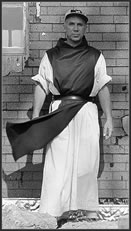
merton in a baseball cap
Many of Merton’s earliest photographs are similar in style to early Chinese painter-calligraphers who tried to capture the direct essence of form. Merton wrote to his friend, John C. H. Wu, the translator of one of the best English versions of the Tao Te Ching, that he was uncomfortable with “mystical writings.” He expressed his desire to go to Asia “to seek at the sources some of the things I see to be so vitally important–the Zen ground of all the dimensions of expression and mystery in the brushwork of Chinese calligraphy- painting, poetry and so forth.”
“On the contrary,” he wrote, “it seems to me that mysticism flourishes most purely right in the middle of the ordinary. And such mysticism, in order to flourish, must be quite prompt to renounce all apparent claim to be mystical at all.”
It is no surprise that a monk who lived a life sequestered from society should be attracted to the still, and silent, photographic image. Within that visual stillness and exchange between the seer and the seen lies a mystery–perhaps some of the spiritual mystery of why one would become a monk in the first place.
During the sixities, as Merton began to explore Asian philosophy, he also began to experiment with calligraphy, creating striking images. In 1958, he wrote in his journal that he had bought a copy of “The Family of Man,” Edward Steichen’s landmark photography book which established the power of photography to evoke universal truths. Merton saw the images as a form of “writing” in which “no explanations are necessary!” “How scandalized some would be if I said that this whole book is to me a picture of Christ, and yet that is the Truth..” This reaction to the visual came in the same entry in his journal in which he recorded what was later to be described as his “Louisville epiphany,” wherein he wrote that he had experienced an overwhelming sense of “oneness” with other people on a street corner.
John Howard Griffin, the author of the civil rights classic Black Like Me, was also an amateur photographer. In 1963, he wanted to build a photographic archive of Merton and his life at Gethsmeni. He wrote to Merton mentioning his desire, and he visited him a short while later. While there, he said, “Tom watched with interest and wanted an explanation of the cameras––a Leica and Alpha.” Merton told Griffin, “I don’t know anything about photography, but it fascinates me.”
Merton had begun his first serious exploration of photography when in January 1962, he visited a Shaker village near the monastery. He found “some marvelous subjects,” he wrote in his journal, and his description of what he saw and photographed signaled that his search for subjects was part of a highly developed visual acuity that unfolded in a charged contemplative state of mind : “Marvelous, silent, vast spaces around the old buildings.” he wrote in his journal. “Cold, pure light, and some grand trees…. How the blank side of a frame house can be so completely beautiful I cannot imagine. A completely miraculous achievement of forms.”
Merton and Griffin started a spiritual-literary friendship during a retreat Griffin made at Gethsemani. Griffin sensed that Merton’s mind innately took to the camera’s frame. He served as a constant source of encouragement to Merton, volunteered to process Merton’s film and became a casual critic of his contact sheets.
They exchanged regular letters touching on Merton’s photography from 1965 through 1968–the year of Merton’s accidental death in Bangkok, following his epiphanic tour of Asia. Merton’s Asian journal of his pilgrimage, and the inclusion of about 30 photographs that he took during the trip, were published as The Asian Journal of Thomas Merton–a work unlike Merton’s other books in its personal intensity. Upon finishing the book, you have a sense that Merton’s life was in a profound stage of evolution.
That revelation, for me, comes through most strongly in the journal entries chronicling the things he photographed during his journey. But his earlier photographs also offer tantalizing clues to Merton’s spiritual journey in his final years.
By 1964, Merton had regular access to a camera and his reading of Zen books became an integral part of his life, no doubt stimulating his interest in the visual experience itself through its emphasis on “attention” and “experiencing the moment.” On September 24, Merton linked Zen and photography in another journal entry: “After dinner I was distracted by the dream camera, and instead of seriously reading the Zen anthology I got from the Louisville Library, kept seeing curious things to shoot, especially a window in the tool room of the woodshed. The whole place is full of fantastic and strange subjects––a mine of Zen photography.”
In the following years, he moved on to better cameras, eventually gaining access to a Rollieflex owned by the monastery. When it malfunctioned in 1968, he immediately wrote to Griffin, who sent him a 35mm Canon FX with 50 mm and 100 mm lenses.
The new camera was the springboard to more sophisticated pictures, and Merton was soon comparing notes with Griffin on the ins-and-outs of photography. He never took any interest in developing his own film or printing his images, instead sending exposed rolls of film to Griffin, who with his son, Gregory, developed the film and sent back contact prints for Merton to select the images he wanted printed. Griffin recalls that he and his son were often frustrated that Merton seemingly skipped over “superlative” images and instead marked others that seemed ordinary to them.
“He went right on marking what he wanted rather than what we thought he should want,” recalled Griffin. “ Then, as he keep taking photographs, more and more often he would send a contact sheet with a frame marked and an excited notation: ‘At last––this is what I have been aiming for.”
Griffin soon began to appreciate Merton’s personal visual quest: “He focused on the images in his contemplation, as they were and not as he wanted them to be. He took his camera on his walks and, with his special way of seeing, photographed what moved or excited him––whatsoever responded to that inner orientation.”
Merton’s interest in painting and photography had taken a decisive turn in early 1965, after he read “The Tao of Painting” by Mai-Mai Sze, a work he called “deep and contemplative.” He began practicing Chinese brushstrokes in a freehand style, one of which he published on the cover of Raids on the Unspeakable. In August of that year, he moved to a cottage hermitage surrounded by woods on the grounds of Gethsemani where he found more solitude and where nature increased his awareness of flora and fauna. Writing in his journal of his early days at the hermitage, he said the hermitage lifestyle challenged him “to see the great seriousness of what I am about to do.”
“Contrary to all that is said about it,” he wrote, “I do not see how the really solitary life can tolerate illusion or self-deception. It seems to me that solitude rips off all the masks and all the disguises. It tolerates no lies. Everything but straight and direct affirmation, or silence, is mocked and judged by the silence of the forest.”
Merton’s natural visual acuteness was intensified during his walks through the fields and woods at his monastery. As a band of deer appeared from out of the woods one day, he watched silently:
“I watched their beautiful running, their grazing,” he wrote in his journal. “Every movement was completely lovely, but there is a kind of gaucheness about them sometimes that makes them even lovelier, like girls. The thing that struck me most–when you look at them directly and in movement–you see what the primitive cave painters saw. Something you never see in a photograph. It is most awe-inspiring. The ‘spirit’ is shown in the running of the deer. The deerness that sums up everything and is sacred and marvelous.”
Merton described such deep perceptions as “contemplative intuition, yet this is perfectly ordinary, everyday seeing–what everybody ought to see all the time.”
“The deer reveals to me something essential, not only in itself, but also in myself,” he wrote. “Something beyond the trivialities of my everyday being, my individual existence. Something profound. The face of that which is both in the deer and in myself.”
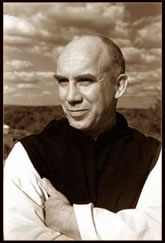
thomas merton
Whenever Griffin visited Merton, the two men often took long walks in the woods and surrounding countryside looking for objects and scenes to photograph. A letter dated Dec. 12, 1966, refers to pictures Merton took of tree roots. “I signed them as you requested, and have sent back the ones you want,” he wrote to Griffin. “They are really splendid. I find myself wondering if I took such pictures.”
His life at Gethsemani was isolated, yet he became friends with another most unusual photographer, Ralph Eugene Meatyard, who had photographed Merton and who lived in Louisville. Meatyard had already achieved great recognition as an exceptionally original and brilliant photographer. He was also interested in Zen, and he took many mysterious, haunting photographs of Merton. They exchanged 16 letters. Meatyard was not, unlike most people, awed by Merton’s reputation, and he seemed to see the man whole: “[I was] photographing a Kierkegaard who was a fan of Mad [magazine]; a Zen adept and hermit who droooled over hospital nurses with a cute behind…a man of accomplished self-descipline who sometimes acted like a 10 year old with an unlimited charge account at a candy store.”
 One of Merton’s most personal photographs from that period is called “The Sky Hook.” He wrote that the picture “is the only known photograph of God.” The picture’s composition is balanced between material and non-material space, cut through the center from the top by a steel hook, curled toward the sky–empty–holding nothing.
In January, 1968, Merton wrote to Griffin, “Unfortunately, the old Rolleiflex is just falling apart…. I guess the old box is shot.I ought to seriously consider your offer. It is justifiable for me to have a camera, since I do occasionally sell a picture and it is not just diddling.” When the new camera arrived, he wrote: “What a thing to have around. I will take reverent care of it.” In the same letter, he made a prophetic statement: “I will take good care to see that it goes straight back to you if anything happens to me.” Nine months later, Merton would die of electrocution in a freak accident in Bangkok.
Merton’s Asian pilgrimage had been an evolving dream, perhaps beginning with his earliest letteers to D. T. Suzuki,whom he corresponded with in the late 1950s. In one of his first letters to Suzuki, he included a picture of himself. “There is no law against my visiting Japan in the form of a picture,” he wrote. A few days before Merton left for Asia in 1968, he had put the final touches on his manuscript for Zen and the Birds of Appetite, which is still an elegant introduciton to Zen and to the similarities and differences between Christianity and Zen, and how the two paths may merge. In the book, Merton quoted Shen Hui: “The true seeing is when there is no seeing.”
Prior to leaving Gethsemani, he wrote in his journal: “I am going home, to the home where I have never been in this body….” He had a stopover in Bangkok for three days before flying to Calcutta and then New Delhi. On Nov. 1, he was in Dharamsala where he met with the Dalai Lama three times. Later, near Darjeeling, he met Chatral Rimpoche, a lama who had meditated extensively for more than 30 years, and who, for Merton, “was the greatest rimpoche I have met so far.”They talked for more than two hours, always coming back to dzogchen (Zen). Upon leaving, they had “a kind of compact that we would both do our best to make it [“complete Buddhahood”] in this life.”
His diary entries during the next days are full of descriptions of the act of seeing new cities, new landscapes and new people. After viewing nearby Mount Kanchenjunga, which seemed to both repel and attract him at the same time, Merton made notes about its powerful force of nature. Kanchenjunga had been constantly surrounded by clouds, revealing itself to him only grudgingly. One night Merton dreamed about the mountain, pure white, and a voice said, “There is another side to the mountain.” He then realized, in the dream, that he was seeing the mountain from the other side and that, : “That is only side worth seeing.”––an image that parallels the concept that the true nature of reality cannot be experienced dualistically, but only through a unitive state of emptiness and limitlessness.
His diary entries during the next days are full of descriptions of the act of seeing new cities, new landscapes and new people. After viewing nearby Mount Kanchenjunga, which seemed to both repel and attract him at the same time, Merton made notes about its powerful force of nature. Kanchenjunga had been constantly surrounded by clouds, revealing itself to him only grudgingly. One night Merton dreamed about the mountain, pure white, and a voice said, “There is another side to the mountain.” He then realized, in the dream, that he was seeing the mountain from the other side and that, : “That is only side worth seeing.”––an image that parallels the concept that the true nature of reality cannot be experienced dualistically, but only through a unitive state of emptiness and limitlessness.
Over the next few days his diary entries are discerning analyses of the processes of discrimination and the subject-object dance of mind. Describing his feelings about his frustrating attempts to photograph the mountain while it was shrouded in clouds, he wrote:
“I took three more photos of the mountain. An act of reconciliation? No. A camera cannot reconcile one with anything. Nor can it see a real mountain. The camera does not know what it takes: It captures the materials with which you reconstruct––not so much what you saw as what you thought you saw.
“Hence, the best photography is aware – mindful, of illusion and the uses of illusion–permitting and encouraging it – especially unconscious (and powerful) illusions that are not normally admitted on the scene.” The last reflection is an affirmation that the photographic process of seeing has the potential–at least for some people –to be a powerful stimulant to the unconscious.
Finally, the clouds lifted from around Kanchenjunga. Merton wrote: “The full beauty of the mountain is not seen until you too consent to the impossible paradox: it is and is not. When nothing more needs to be said, the smoke of ideas clears, the mountain is seen.” *Footnote 1
After completing his visit to Mount Kanchenjunga, Merton returned briefly to Calcutta where a package of his contact prints from Griffin awaited him. “The one of the Dalai Lama is especially good,” Merton wrote. He arrived in Kandy, Ceylon (Sri Lanka), on Dec. 2 and a car took him to Polonnaruwa, the site of an assemblage of large stone Buddhas carved out of a hillside, and “the most impressive things I have seen in Asia.”
Two days later, he wrote in his diary, “Polonnaruwa was such an experience that I could not write hastily of it and cannot write now, or not at all adequately.” During the visit, Merton’s spirit seemed to have opened to the point of bursting forth upon seeing the languid, relaxed forms of the Buddhas in peaceful repose.
“I was knocked over with a rush of relief and thankfulness at the obvious clarity of the figures, out of the habitual, half-tied vision of things, and an inner clearness, clarity, as if exploding from the rocks themselves, became evident and obvious. I don’t know when in my life I have ever had such a sense of beauty and spiritual validity running together in one aesthetic illumination. I mean I know and have seen what I was obscurely looking for. I don’t know what else remains, but I have now seen and have pierced through the surface and have got beyond the shadow and the disguise.”

buddha sculpture in Polonnaruwa
Merton’s widely discussed Polonnaruwa diary entry describes an overwhelming moment loaded with the nuances of Zen experince. In Zen, such moments are sometimes of such depth that they are called kensho experiences, a moment in which one experiences–in Zen terms– the ground of being. Earlier, Merton, in trying to find an equivalent phrase for kensho in Christian terms, in his conclusion to Zen and the Birds of Appetite, suggested “divine grace,” or “perfect clarity.” Zen history is full of stories recording moments when a particular sight of an object strikes a cord in the seer, snapping the ordinary relationship between seer and seen. The physical presence of the large reclining Buddhas seemed to have touched Merton at this deepest level. He wrote in his journal:
“Looking at these figures I was suddenly, almost forcibly, jerked clean out of the habitual, half-tied vision of things, and an inner clearness, clarity, as if exploding from the rocks themselves, became evident and obvious….The things about all this is that there is no puzzle, no problem, and really no “mystery.” All problems are resolved and everything is clear, simply because what matteris is clear. The rock, all matter, all life, is charged with dharmakaya…everything is emptiness and everything is compassion. I don’t know when in my life I have every had such a sense of beauty and spiritual validity running together in one aesthetic illumination.”
This illumination came a week before his death. On Dec., 7, he arrived in Bangkok, where he was scheduled to deliver a paper titled “Marxism and Monastic Perspectives” at a religious conference at the Red Cross Center on the outskirts of town. He stayed at the renowned Oriental Hotel, known for its association with writers traveling through Asia. From his hotel room window, Merton took his last photograph, which looked out through the room’s window onto Thailand’s sacred Chao Prayo River and a section Bangkok lining the other side of the river. Later, he took nine rolls of exposed film to the nearby Borneo Studio on Silom Road. After his death, Griffin wrote to the photographic studio, obtained the rolls of film, and found the window photograph, the last picture on the last role of file exposed. It is a simple, ordinary, yet–for me–haunting image. I can only attempt to touch on the power that resonates around the photophraph by referring to a dream recorded by Merton in Conjectures of a Guilty Bystander, and then to an early essay by one of his early Buddhist mentors, D.T. Suzuki.
Merton described his dream: “I dreamt I was lost in a great city and was walking toward the center without quite knowing where I was going. Suddenly, I came to a dead end, but on a height, looking at a great bay, an arm of the harbor. I saw a whole section of the city spread out before me on the hills covered with a light snow, and realized that, though I had far to go, I knew where I was: because in this city there are two arms of the harbor and they help you to find your way, as you are always encountering them.”
Suzuki also used a window image in a short essay he read on the “Supreme Spiritual Ideal” before the World Congress of Faiths, an assembly of religious leaders, in London in 1936. Suzuki began the essay with a description of his home in Japan and his windows looking out into his garden. He made the point that in Japan when windows are opened, very often “one side of the house is entirely taken away….There is no division between the house and the garden. The garden is a house and the house is a garden; but here [in England] a house is quite separate. A house stands by itself, and so does its occupant. There is nature, here I am; you are you, I am I; so there does not seem to be any connection between those two–– nature, natural surroundings and the occupants of the house.”

thomas merton
Suzuki ended his essay by referring to Chao Chou’s stone bridge [Case No.42 in The Blue Cliff Record] and the awareness of being thankful that all things and beings are passing over the bridge at every moment “from the beginningless past to the endless future.”
On the day Merton died, Dec.10, 1968, he read his conference paper at the Red Cross center and afterwards retired to rest in a cottage on the grounds. His body was found about two hours later. Apparently, after taking a shower he had reached for a large standing fan and was electrocuted. The fan was found lying across his body.
Merton would have relished the poetic irony that can be read into his final photograph, a view of the Chao Phaya River. The photograph closely mirrored his earlier dream image––the “snow” being replaced by a tropical day, a “bay” by a river and the “two arms of the harbor [the relative and the absolute]” by the two banks of the sacred river. It is easy to make too much––or perhaps not enough––from the above description and speculation.
This is only my personal reading of Merton’s spiritual journey during his Asian pilgrimage, and the role of vision in his meditative life. No one will ever know for sure the dimension of his spiritual experience and awakening in Asia, except through his words and photographs. But it is clear that Merton, one of the 20th century’s greatest spiritual souls, had ultimate respect for the beauty and mystery of seeing and experiencing the world as it is, and for the mysterious space that unites the seer and the seen.
But that is not the end of the story. There’s one more photograph, a photograph of Thomas Merton. While Merton was in Darjeeling and experiencing his on-and-off-again affair with Mount Kanghenjunga, he was staying as a guest in a house on a tea plantation. The owner had allowed Thugsey Rinpoche to build a hermitage monastery in the forest near the plantation. The story goes that after Merton’s death, his friend, Harold Talbott, saw the rinpoche, who asked him for a photograph of Merton. Asked why, the rinpoche said Merton had liked the hermitage, and he wanted to put a photograph of Merton on a shrine and say prayers to encourage him to take rebirth as a monk at the hermitage. Time passed. Later, Talbott asked the rinpoche about Merton. “He is here, but I can’t say anything more,” said Thugsey Rinpoche.
Footnote 1: That Merton’s visual intellect was brilliant can be seen in an earlier passage from his Conjectures of a Guilty Bystander: “Nothing resembles substance less than its shadow. To convey the meaning of something substantial you have to use not a shadow but a sign, not the imitation but the image. The image is a new and different reality, and of course it does not convey an impression of some object, but the mind of the subject: and that is something else again.”
gary snyder: Danger on Peaks
Posted: May 13, 2010 Filed under: buddhism, people, poetry, reviews, writing Leave a commentThis review appeared in The Kyoto Journal:
Gary Snyder: Danger on Peaks
By Roy Hamric
“There is a point you can make that anything looked at with love and attention becomes very interesting,” – Gary Snyder. *
Gary Snyder’s Danger On Peaks, his 10th book of poetry, is further proof that since he first published Rip Rap in 1959 we’ve been in the midst of a rare weaving of life and art.
In a few more decades, it will probably be clear that Snyder has claimed the role of world icon of American poetry, bridging East and West, and his life will be a potent force as a model of committment to community and the natural world.
But what will become even clearer is that Snyder’s closest peers are not only Han Shan, Stonehouse, Bassho, Ikkyu and the other red-blooded, Zen poets whose voices Snyder has extended into modern times, but also Thoreau, William Carlos Williams, Wallace Stephens and his close fellow Beat poets.

gary snyder
Snyder’s cultural impact in America and beyond has been two-fold – practically useful and spiritually useful, in the sense of giving coming generations a model of creative responsibility and right thinking. Over time, my feeling is that his poetic and social influence will likely trump even Thoreau’s place as a writer and man of nature. It will, at the least, be seen as a twentieth century extension of Thoreau’s fierce independence of nature. Such is Snyder’s accomplishment since his famous reading at the Six Gallery in San Francisco 50 years ago.
Danger On Peaks is probably the most free and personal of his poetry books so far. It’s not Old Man Snyder’s wisdom finally revealed, but it is wise. In his poetry, he’s never preached. Each poem hoes the Zen line in each line – naming and pointing. Simple, and yet…
Snyder’s poetry, even for America, is rigorous and hardy, a West Coast counterpart to a venerable American-consciousness lineage, inaugurated by Emerson. And yet, Snyder is also a true man of Zen. How the two esthetics mix is up to each reader to decide. But by looking at his poetry and his writing about poetry, we do get a clearer understanding of his art.
For starters, go back to a criticism that Emerson made, measuring the poets of his day. He said poetry should be written so that meaning trumps meter, which is not to say that poetry should be without meter. Real meaning must carry the day. But what is real meaning? Beside Emerson’s esthetic, which he struggled to apply in his own poetry, largely unsuccessfully, let’s place a question Snyder asked in an essay in A Sense of Place: “Is art an imposition of order on chaotic nature, or is art [also read language] a matter of discovering the grain of things, of uncovering the measured chaos that structures the natural world?” Add to that his view that the world is itself an on-going “making poem,” and we’re off into new esthetic territory. Snyder has laid down markers on how and why his poetry works. Naturally, it is closely linked to his spiritual search, which eventually led him, in 1956, to Zen practice in Kyoto. Extended zazen practice makes one extra sensitive to the role of words and language and their effects on mind. From there, it’s a small step to see the practice of poetry as words that find their right place, which approach consciousness, rather than are made by consciousness.
Snyder would, of course, cringe at being called a Zen poet. He is a poet in the fullest sense, writing in an American-Asian poetry lineage of anti-romanticism and modernism –no matter how far back Zen poetry extends in historical time, it is esthetically modern because it doesn’t rely on symbolic, theological or mythological influences.
Before he had met Allen Ginsberg and Jack Kerouac and before he had arrived in Kyoto, Snyder, at age 24, had already seen his course: in a letter to his Buddhist pal PhilipWhalen in1954, fives years before Rip Rap was published, he wrote:
“I come to think more and more, poetry is a process and should be, in a Buddhist sort of way, didactic and sensual.” It all comes down to that: a poetry of attention, almost invisibly instructive, and usually without a pronounced message – a fundamental reliance on words and ordinary reality to carry the “message” rather than tropes or symbols. Let “just that” create the meaning, thank you. The world “making” itself through open mind. The wise and instinctive will see.
While this is an old chestnut in Zen, it was no small feat for an unpublished, young American poet to base his esthetics on – “just that,” freshly seen and vividly laid down.
Snyder has always been wisely reticent in talking about his Zen practice. If we are lucky, though, we someday will get an autobiographical account of his Zen journey, and the people in his life.
In his Paris Review interview in 1992, he speculated a little on the role of zazen in his poetry.
“This taught me something about the nature of thought, and it led me to the conclusion – in spite of some linguists and literary theorists of the French ilk – that language is not where we start thinking. We think before language, and thought images come into language at a certain point. We have fundamental thought processes that are prelinguistic. Some of my poetry reaches back to that.”
Again, in an essay, “Language Goes Two Ways,” in A Place in Space, he talked about, “The way to see with language, to be free with it and to find it a vehicle of self-transcending insight, is to know both mind and language extremely well and to play with their many possibilities without any special attachment. In doing this, a language yields up surprises and angles that amaze us and that can lead back to unmediated, direct experience.” He went on to say, “But, creativity is not a unique, singular, godlike act of ‘making something.’ It is born of being deeply immersed in what is – and then seeing the overlooked connections, tensions, resonances, shadows, reversals, retellings. What comes forth is new.”
The book is composed of six sections. Part one opens with a series of poems built around Snyder’s 1945 ascent of Mt. St. Helens (the year of Hiroshima) and its later eruption in 1980. The book ends in the period of 9/11 and the destruction of the carved Buddhas of Bamiyan Valley by the Taliban in Afghanistan. Between, we get a full range of auto-biographical moments, (truck stops, freeways, community workshops), glimpses of the natural world (mountains, rivers, fields, fauna), home life in the foothills of the San Juan Mountains, epiphanies, memories of earlier life, loves, the rhythm of friendship, his mother, assorted prose and haiku combinations and a final blessing gatha.
Here’s a sample of three short poems of the 97 poems that make up the book – many long, complex and demanding of multiple readings:
Steady, They Say
Clambering up the rocks of a dry wash gully,
Warped sandstone, by the San Juan River,
look north to stony mountains
shifting clouds and sun
– despair at how the human world goes down
Consult my old advisers
“steady,” they say
“today”
Work Day
They want –
Short lengths of 1” schedule 40 PVC
A 10’ chimney sweeping brush
Someone to grind the mower blades
A log chain,
My neighbors’ Spring Work
Chainsaw dust
Clay-clod stuck spade
Apple blossoms and bees
April Calls and Colors
Green steel waste bins
flapping black plastic lids
gobbling flattened cardboard,
far off, a backup beeper.
Like the coyote, the Native American symbol Snyder helped to put back into public consciousness in the early 60s, he has assumed many roles: mountain lookout, sailor, poet, translator, Buddhist, life-long meditator, counter-culture hero, essayist, agitator, government official and academic, while always casting a calm Bodhisattva aura as a worker for a better world.
This book is a hearty gift, another testament of art and faith from a rare talent. The poems show us again that the world of art and artful living is here now before our eyes and ears. Only the bravest poets have the confidence and mastery to rely on the ordinary to achieve the extraordinary. Traditionally, that has been the work of religious teachers.
Finally, here’s Snyder himself, as poet, on the mystery of mind and poetry:
How Poetry Comes to Me
It comes blundering over the
Boulders at night, it stays
Frightened outside the
Range of my campfire
I go to meet it at the
Edge of the light
*Paris Review Interview, 1992.
answering the koan
Posted: May 12, 2010 Filed under: buddhism, people, poetry, states of mind, Uncategorized Leave a commentDavid Rothenberg’s Blue Cliff Record: Zen Echoes tries to cut the koan knot in The Blue Cliff Record. My review appeared in The Kyoto Journal.
the writers club
Posted: May 11, 2010 Filed under: articles, people, places 1 CommentWriters, photographers, artists, and those passing through Chiang Mai, like to drop in to The Writer’s Club to see the local gang.

chiang mai gathering place
A restaurant and bar, it’s run by Bob Tilley, a former correspondent in Germany for the British press. The place serves as a de facto press club for the locals where everyone can see everyone and get a sense of what’s going on in Thailand and the region. I’m posting a pdf story on the club here and will link it to On The Record.
McMurtry on movies, novels
Posted: May 2, 2010 Filed under: articles, people, photography, writing Leave a commentIn writing about movies in his essay collection, Film Flam, Larry McMurtry has much to say about story telling and novels. I’m not ready to leave him yet (see several posts below). In spite of movies’ and novels’ different aesthetics to story telling, what finally moves both audiences the most, he concludes, are a sense of justice and images of human beauty (in form, spirit, compassion, devotion, love etc).
He must be read on this, particularly the penultimate essay, “Movie-Tripping: My Own Rotten Film Festival.”
These excerpts don’t do McMurtry justice, but it moves my interests forward, and this blog’s themes.
One of the reasons, I imagine, why I continue to go to silly films rather than serious films is that the vast majority of serious films, like the vast majority of serious books, are mediocre, and nothing can be more disheartening than mediocre, realistic art.
There may, however, be more interesting reasons than that one. I have come, in my 30s, to realize that for some years now my relationship with Truth has been growing ever more tenuous. All the time that I was maturing, no single virtue, not even loyalty, not even kindness, has been so much extolled to me as honesty; and I assumed that I accepted what I was told and held Truth to be the highest estate. But for fifteen years now the day-to-day work of my life has been the writing of fiction, which means that I have actually been playing a long and rather intricate cat-and-mouse game with Truth. This game has been going on so long that I have cased to know whether I am the Cat and Truth the Mouse, or Truth the Cat and I the Mouse.
What I do know is that for a novelist to suppose that he is wedded to Truth is a flat absurdity. A novelist works with lies. The more constant he is to his craft, the deeper into lies it will lead him. … What if one has finally had enough of all the weighty talk about how elusive reality is, how difficult to know? Happiness must certainly be elusive, but not reality; one of the primary difficulties of adulthood may be how to avoid knowing an unmanageable proportion of what’s true. The anxieties of precise knowledge are not always to be borne, whether that knowledge is of the self or of the world, and it may be that a major task of life is to leave oneself a comfortable and substantive coat of illusion.
The above reminds me of Freud’s comment: “Too much reality is a dangerous thing,” a paraphrase. From here, McMurtry detours into the lessons to be found in so-called “bad” movies, the B or C-grade that are released or might be found as re-runs in seedy theaters in working class neighborhoods where the audiences are light years away from audiences that seek out “art” movies. The former teaches him something about what’s ultimately important in story telling:
I have spent much time amid the audiences of the worst possible films, and I am convinced that most of these viewers would watch no other kind of movie. … The two needs which leave these audiences in open-mouthed response time and again are the need for an image of human beauty, and the need for an enactment of justice…. Poetic justice must be done, and it must be accompanied by the triumph of beauty, or there is no catharsis and no uplift….
I’ve always known secretly that my lies were more interesting and more pleasing and more helpful to people than any truth I knew, but it has taken me years of watching thousands of people from drawing delight from the sheerest fantasy to render me comfortable on that score. …
Even if reality were greatly seen [in a movie] and greatly shown [told] I doubt that it could slake for long their thirst for the fabulous––for the faraway place, where there is heroism, and beauty for it to serve, and where, for once, the impossible can be seen to come true. It may be that bad movies are the last home of the fairy tale, and who can say what will have had to happen to the human psyche before the need for fairy tales is gone?
more mcmurtry
Posted: April 28, 2010 Filed under: articles, people, reviews, writing Leave a commentFinishing Walter Benjamin at the Dairy Queen, Larry McMurtry’s autobiography and musings on story telling, led me to look at his Film Flam again, a collection of trenchant, sometimes vituperative essays, almost all outlandishly funny, on films, Hollywood life and screenwriting. He has much to say about la viva Hollywood. He’s a quirky, prickly writer, quick to dissect motivation, to deflate pomposity, to exact revenge, which gives these essays a white-hot power in the critical, high irony mode of Vidal. Regardless of what he thinks of his books Hud, The Last Picture Show, and later Terms of Endearment and Lonesome Dove, they all made very good movies, a mighty, although secondary, achievement itself. His dour assessment of his early novels, Leaving Cheyenne (Loving Molly), Horseman, Pass By (Hud) and The Last Picture Show, all written before he was 26 and made into movies, underscores the complexity of Bloom’s theory of misreading. The writer is the last person to look to for an accurate judgment of the work. In one essay, he mentions an unfinished, run-away novel about Hollywood. Let’s hope that he gets it under control and publishes it sometime. He knows Hollywood like he knows the West.
joe cummings
Posted: April 27, 2010 Filed under: people, writing Leave a commentMy buddy joe cummings continues to amaze his friends. Regularly, he turns out the most knowledgable books on Thai culture. His latest, Buddhist Temples of Thailand, is a close look at 40 of the best temples with a study of their evolution and role in Thai culture. Most people know Joe as the Lonely Planet Thailand guidebook writer, but that’s way, way too easy. He’s a character out of Conrad, a seeker, who’s running on overdrive. Lately, at night, he’s been exercising the rock guitar side of his character, but the books keep coming. You can also see his writing regularly in the bi-weekly The Magazine in The Bangkok Post where he’s the deputy editor.
mcmurtry’s west
Posted: April 23, 2010 Filed under: people, places, reviews, writing Leave a commentLast night, I finished my third reading of Walter Benjamin at the Dairy Queen, Larry McMurtry’s autobiography/memoir and a serious meditation on story telling. For me, it’s a definitive work on growing up in Texas when the last links to the frontier were dying away. McMurtry’s family included early frontier settlers and his own young life, by today’s standards, was close to a frontier cowboy’s life. He grew up as a working cowboy until he went off to college. The contrast between his cowboy life and achieving the status of being one of the world’s most accomplished readers and bookmen is bracing. His approach to reading was more disciplined than mine, but we share many of the same memories of books and bookstores that entered our lives at close to the same time. We share the belief that if we don’t read at least a few hours every day we are deprived. The number of times that he mentions Hemingway, Mailer and Kerouac is significant. They dominated the scene as we grew up. In Bloom’s phrase, they made a space for themselves at the expense of others, and the space is not shrinking. Reading about another’s life whose interests are close to yours is like reading your own life in a way. It’s hard to think of another writer with whom I share so much. McMurtry has had a sometimes testy, adversarial relationship with Texas writers (he probably doesn’t think so), which took Texas writers by surprise. The state had never had that sort of East Coast rivalry. McMurtry’s good side is the respect he pays to out-of-the-way places and people, his people really. He learns of his Pulitzer Prize when he is speaking at a small college in Uvalde, Texas. He drives to almost the end of the road in Texas, to Pampa, to dedicate a library. He really eats regularly at the Dairy Queen, where he reads his Walter Benjamin. He has one of the biggest used bookstores in America, with 250,000 titles and counting, in his hometown of Archer City, population under 1,000 folks. It pleases me that the library I sold sits mainly on his bookstore’s shelves. One of McMurtry’s books that will live a long time is Walter Benjamin. His other recent nonfiction books, Roads and Books will be followed by one on his women friends, and then, I hope, by a book solely devoted to his reading. Combined, they add up to a rich portrait of who he is, where he’s from, and how the life of the mind blossoms on its own terms.
On the American West, there’s no better guide than McMurtry. Some quotations:
My grandparents were, potent word, pioneers. They came to an unsettled place, a prairie emptiness, a place where no past was––no Anglo-Saxon past, at least, and not even much Native American past. Comanches, Kiowas, Kickapoos, and other tribal nomads had passed over and no doubt occasionally camped on the low hill where my grandparents stopped their wagon and made their home place.
–––
The myth of the American cowboy was born of a brief twenty years’ activity just before railroads criss-crossed the continent north-south and east-west, making slow movement of livestock impractical. The romantic phase of cowboying ended well before my father was born, and yet its legacy of habit, costume, assumption, and to a reduced extent, practice formed the whole world I was born into in 1936.
–––
What rodeos, movies, Western art, and pulp fiction all miss is the overwhelming loneliness of the westering experience. When my uncles (and even my father, for a year or two) were cowboying in the Panhandle they would eagerly ride horseback as much as thirty-five miles to a dance or social, and then ride back and be ready for work at dawn…. Many Westerners were alone so much that loneliness was just in them, to a degree that finally made domestic and social relations difficult, if not secondary.
–––
Cowboys are thought to be fearless, whereas my years as a cowboy were predominately fearful. Nothing that happened to me personally ever fit the archetype. I grew up on a rocky hill with an abundance of rattlesnakes yet never had a close brush with a snake. Stampedes are a staple of Western autobiography, generally made to seem terrifying. And yet I participated merrily in such modest stampedes as came my way, racing happily along beside the cattle, glad for a break in the boredom…
–––
When I consider my books I sometimes feel the same uneasy breeze that my father felt as he contemplated the too meager acres where his own life began and ended. My achievement may not be too different from his; it may consist mainly of the good name I bore and the gifted and responsible son [James McMurtry, the singer] I will pass it on to. I think two or three of my books are good, just as he thought two or three of the many horses that he owned were good… . I would have liked my fiction to have a little more poise, a little more tact––but those are qualities that seem to have found their way into my son’s songs, and that is satisfaction enough.
the junkman
Posted: April 16, 2010 Filed under: articles, buddhism, people, places Leave a commentThe Songkran water festival is over, and street life returns to normal. The neighborhood’s singing junkman peddles by on his tricycle with the first of the morning’s cast-offs culled from his rounds, a Thai flag fluttering in the breeze behind the cart that overflows with oddities, a single plastic leg, a motorcycle wheel, bright scraps of cloth, a few water gun rifles and pistols, some clay pots. He has a handsome movie star Western face, confident, secure. It says, “I’m a loner. I love my life.” He uses his time efficiently, always busy, resourceful. By evening, he’s parked beside Heaven’s Beach, the local Rasta bar, and the cart is a rolling found-art exhibit, its sides covered with his neat, handwritten Thai script quoting Buddhist aphorisms: Silence Speaks Loudly, Think Like a Flower, A Strong Tree has Deep Roots.
 the roy hamric journal
