
Forever Fashion
Posted: August 19, 2015 Filed under: people, photography | Tags: art, fashion, hill tribes, mekong river Leave a comment A profusion of textile art on my friend who lives in the mountains on the Mekong River near Laos.
The Everly Brothers, Chet Atkins, Mark Knopfler, Mark McDonald
Posted: July 6, 2015 Filed under: music, people | Tags: everly brothers, mark knopfler, musicology, why worry 1 Comment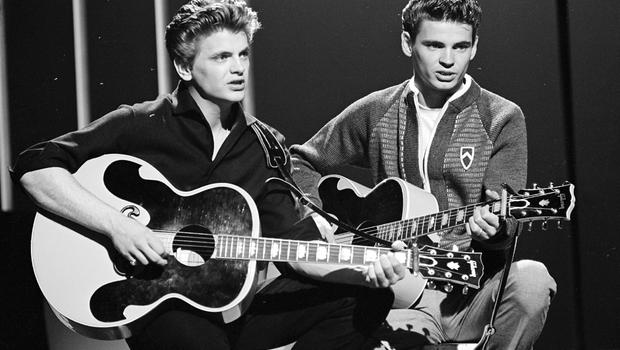 My music friend Peter O’Brien of Britain, who edited Omaha Rainbow for many years, posted this video of Why Worry, written by Mark Knopfler and sung by the Everly Brothers, and it’s too good not to pass along. Click here.
Bedside Books: The Lawless Roads
Posted: May 28, 2015 Filed under: books, people, writing | Tags: chiapas and tabasco states, graham greene, green's most self-revealing book, greene's travels in Mexico Leave a comment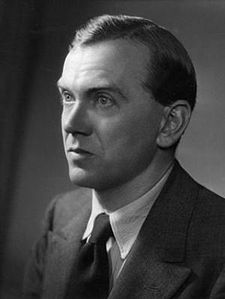 “It is as if everywhere one loses something one had hoped to keep.” “It is awful how things go on when you are not there.” Two sentences, several hundred words apart, on the last two pages of The Lawless Roads by Graham Greene. I read it for the first time 25 years ago. The second reading was a shock, an expansion of my first impression. What I’d read first as an adventurous travel book became a stylistic leap into a more serious immersion in class cruelty and the despair-of-the-world hopelessness that later defined his best novels (Roads was published in 1938). Greene travels through Tabasco and Chiapas, two tropical, backwater Mexican states reeling from a purge of Catholic churches and priests, and he draws on a rich cast of characters that he crosses paths with, many who foreshadow the fictional characters in his best moralistic novels . In those portraits he reveals himself in a way he mostly covers over in his later, more declarative autobiographical books such as A Sort of Life and Reflections. Greene was near the peak of his religious fervour following his conversion to the Catholic Church, and he seems to discover his future moral crossroads and his aesthetic voice in the book. You get Greene as a man in The Lawless Roads – his coldness, distance and cynicism (stoical realism?) encased in a deep religious longing to merge with something that offers salvation – an explanation, a reason – for the moral decay and horrors of humanity found throughout the world. It moves with great force and only in the final few pages did I feel I was, finally, coming up for air at the journey’s end. Greene was a needy young man (see Sherry’s biography), a weak reed who was barely connected to his sense of selfhood. He flirted with the moral and social structure within the Catholic Church, and it captured him in spite of doubts he had from his first encounters. He bought into it with the hope that it would offer him some solid support, but after experiencing the world more broadly and directly (Mexico, Africa) his belief dissolved from a structural/faith connection to a mystical, personal connection. Unlike Greene, I couldn’t accept the story of Christianity as I read and heard it when young, but now, with much deeper reading, I understand the story was crudely simplified to appeal to the broadest numbers of people. The “elect,” as defined by the gnostics, never accepted the New Testament version of Christianity as literal and reinterpreted its dominate themes and symbols. Before and after the New Testament writers, gnostics had their own version of transformative spirituality which followed many Eastern spiritual ideas and techniques. Gnosticism could not survive the rise of the Catholic Church, but many of its texts can be found here. The attraction of Roads is the sustained, long, detailed account of how Greene went through those days that made up the chronology of the trip. It’s a rare, full account of the physicality of travel that couples with a ghastly account of repression and morality turned upside down, a very complicated story when looked at in detail, but one that mirrors the same issues that attracted people to religion and spirituality 2,000 years ago: where is some salvation in this hell on Earth of repression and lack of compassion for the poorest of the poor. Greene found his perfect religon-based story in real life before his eyes, one that might have ensured his own loss of faith eventually. He saw, in real terms, that it is most often the ones with the least who hold most fiercely to faith as a last hope. The whisky priest in his subsequent novel, The Power and The Glory, is about a person much like Greene himself, someone in extremity of belief and faith who wants to be at the center of the religious quest even if he himself doesn’t understand the why or how of it. He was moved by the plight of people who have nothing and yet go on without the benefit of a saving grace. He saw the pattern in many people’s lives everywhere, and he made it one of his great themes. Roads is special because so much converges at this crucial point in Greene’s life.
Revealing Look at Stand-up Comedy in China
Posted: May 23, 2015 Filed under: people, states of mind, writing Leave a comment This essay looks at comedians in China and how the US nurtured Joe Wong, a Chinese comedian who is a big star now in his native land.
Inspired Graphic Art For The True Reader
Posted: May 23, 2015 Filed under: books, people, poetry, states of mind, writing Leave a comment
Capturing sameness in the line.
Here’s the illustration by artist Hannah K. Lee for The New York Times‘ book review of Harold Bloom’s The Daemon Knows (a link can be found below this…). The book and the illustration are infused with capital A art. Read Lee’s illustration with the writers and poets in mind, and you will see what I mean.
Tea With Harold Bloom, & His 45th Book
Posted: May 7, 2015 Filed under: books, people, writing | Tags: harold bloom sums up, harold bloom's 45th book, the critic-sage of America Leave a comment
 Amy Bloom writes: “I scan the latest tower of books in front of me on the dining-room table, not even bothering with the stacks listing toward the far end, where Jeanne’s laptop sits, ready for her correspondence and Harold’s dictation.
“Some of today’s stack: Dialogue on Poetry and Literary Aphorisms, by Friedrich Schlegel (“Very important to me”); Elizabeth Bishop, by Colm Tóibín (“That very well-done novel on Henry James, very good”); The Poetry of Kabbalah, by Peter Cole; Jewish Cryptotheologies of Late Modernity, by Agata Bielik-Robson (“Splendid lady”); Nothing to Declare, by Henri Cole (“Very good. The best poet of his generation”); Shakespeare’s Horses, by Joseph Harrison (“My pupil. Next to Henri Cole.”), and multiple books by authors I expect to see: Hans Jonas, Gershom Scholem, Friedrich Hölderlin.
“Then there is a pile of stuffed animals on the living-room couch that belong not to their grown sons but to Jeanne and Harold. I ask, and he tells me, happily. “Well, there’s Valentina, the ostrich, named after Valentinus, second-century author of The Gospel of Truth; she presides…” For the article, click here.
Schopenhauer On Religion and Morality
Posted: April 12, 2015 Filed under: Buddhism Zen, people, states of mind | Tags: religion, Schopenhauer, Zen metaphysics Leave a comment
Religion: A Dialogue, from the Essays of Arthur Schopenhauer
Demopheles: However that may be, I wanted to remind you that you should look at religion more from the practical than from the theoretical side. Personified metaphysics may be the enemy of religion, but all the same personified morality will be its friend. Perhaps the metaphysical element in all religions is false; but the moral element in all is true. This might perhaps be presumed from the fact that they all disagree in their metaphysics, but are in accord as regards morality.
Philalethes: Which is an illustration of the rule of logic that false premises may give a true conclusion.
For me, this creates a strong basis for Zen metaphysics as an approach to religious/spiritual morality, while leaving the mystery of evil, morality and good unexplained.
Empson: The Heart of Standing
Posted: April 5, 2015 Filed under: books, people, poetry | Tags: the heart of standing, William Empson's declarations Leave a comment
Butterfly Drawing by Jim Crump
The language problem but you have to try.
Some solid ground for lying could she show?
The heart of standing is you cannot fly.
– A stanza from Aubade (1937) by William Empson
Basho & The Old Pond
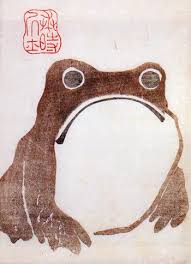
Posted: April 2, 2015 Filed under: buddhism, people, poetry, states of mind | Tags: Basho & The Frog, most famous haiku, The old pond Leave a commentOld pond
Frog jumps
Sound
–Basho
Pete Seeger, Johnny Cash, June Carter
Posted: March 21, 2015 Filed under: music, people | Tags: "How High's The Water, June Carter, Mama?", Seeger Leave a comment
“How High’s The Water, Mama?”
Here is a stunning early video of a Pete Seeger program featuring Johnny Cash and June Carter singing songs back and forth to each other, including “How High’s The Water, Mama?” and other gems. Cash is in his early phase. His voice and control are fresh, natural, and of course uniquely Cash. Cash and Carter come on the program about 8 minutes into the 1-hour show. Listen to all of it…brilliant banjo picking by Seeger and a chilling song about coyotes. The program is here.
 the roy hamric journal