
A war story
Posted: May 25, 2010 Filed under: articles, places, reviews 4 CommentsThis review originally appeared in The Journalism Quarterly.
The Cat From Hue: A Vietnam War Story by John Laurence. New York: PublicAffairs, 2002. 851 pages; $30 hbk.
A little War Goes a Long Way
By Roy Hamric

A later cover
John Laurence was among the best, the brightest, and the most unique of all the American war correspondents who reported from Vietnam. He arrived in Vietnam in 1965, in his early ‘20s, and he went on to work as a correspondent for CBS and ABC News. Laurence looked frail, more like a graduate student than a war correspondent, but few journalists took more risks or covered Vietnam longer–Peter Arnett and Horst Fass come to mind. Very few covered as many of the well-known battles, and–just as important–the deadly, daily skirmishes.
Covering so much combat, Vietnam-style (from the jungles to the Continental Hotel), cost Laurence dearly in emotional turmoil. His personal view of the war paralleled many of the troops’ attitudes. He began with absolutely no doubt about America’s role and ability to win. Later, both he and large numbers of troops felt differently–shifting from winning to just surviving and coming home. Few works of nonfiction (or fiction) have so much human drama, pathos, bravery and professional and human lessons embedded into the story. We also get an invaluable lesson manual on how war correspondents should, and should not, cover war.
GIs were regularly astounded that TV and print correspondents would voluntarily come in to battlefields while troops were taking fire. The reports Laurence and his team (particularly cameraman Keith Kay and soundman Jim Clevenger) did for CBS television were staples of Walter Cronkite’s evening news broadcasts, riveting a national audience that was experiencing its own anguish over the war’s meaning and costs.
Strewn with laurels comparing this memoir to the war correspondence of Stephen Crane and Ernest Hemingway, the book is more artistic and powerful than one would expect. It is likely to become a classic in Vietnam War literature. A seasoned storyteller, Laurence’s story was backed up by hundreds of sound tapes and film reports which he has used to reconstruct vivid prose scenes that carry a descriptive punch that pays homage to what the camera and recorder can capture, and memory and emotions can recreate.
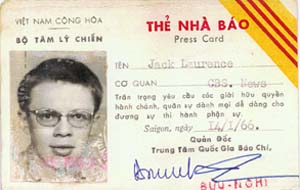 Few memoirs rise to such clarity in conveying the exhilaration, fears and rewards of war reportage, or the uplifting and heartbreaking memories many correspondents carried home, only to deal with privately away from the war. Laurence had his peers’ respect, especially the circle known as the “crazies” as opposed to the “straights.” The decompression base for the “crazies” was British photographer Tim Page’s Saigon apartment, known as “Frankie’s Place.”
The later years of the Vietnam War were equal parts marijuana, rock and roll, irony and cynicism for many in the military and press, along with professionalism, loyalty, devotion and bravery. Laurence’s professional and personal life navigated all those shores.
He includes warm sketches of his fellow colleagues: Page, freelancer Michael Herr, CBS correspondent Hughes Rudd, writer Frances Fitzgerald, a contingent of British journalists, and, especially, Look correspondent Sam Castan (who died in combat), and freelance photographers Dana Stone and Sean Flynn (who were killed in Cambodia). Someone in that crowd, at some point, said, “This is our Paris.” They were right, only it was more dangerous.
Some gleanings from Laurence:
–The full truth of the Vietnam War (or any war) is never reported. Just one area: the carnage regularly inflicted on innocent civilians. In spelling out some reasons, Laurence takes you several notches up on the complexity scale of war coverage.
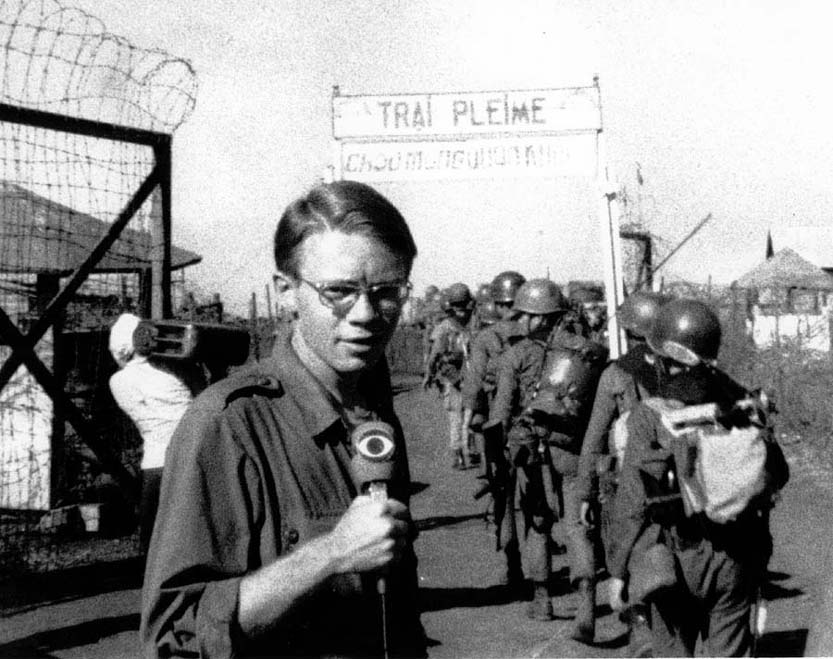
He was young, but older than most of the troops
–“The language of our daily journalism was insufficient,” Laurence says. “For all the facts we poured out of Vietnam, we might better have served the truth by broadcasting some of the letters the GIs wrote to their families.”
–“Of all the media,” he says, “perhaps still photography came closest to showing the truth.The best photographs captured a precise moment, holding it there for inspection, offering each image as a fragmentary symbol of someone’s reality. By the nature of their ambiguity, those pictures gave viewers the privilege of using their imaginations to interpret the reality.”
–Michael Herr’s masterwork “Dispatches” may have benefitted from sound recordings Laurence sent him that were made during a night battle involving a rowdy Army company at “Firebase Jay,” which–symbolically–could stand for “joint,” as in marijuana. To Laurence’s surprise, large numbers of GIs relaxed at night with dope, booze and blaring rock and roll–it was a template for “Apocalypse Now.”
–In times of danger, war correspondents should follow the sergeants–they know what they’re doing. Officers may or may not.
Laurence digs deepest into his three tours in 1965-66, 1967-68 and 1970, but he takes his story up to his 1982 return to Vietnam and the country’s march to renewed prosperity. Students, war colleges, journalists and news organizations’ management can learn immense lessons from Laurence’s story.
If the newest crop of war correspondents read this book, they–and the public–will be well served.
Vietnamese writers
Posted: May 23, 2010 Filed under: places, poetry, reviews Leave a commentThis review originally appeared in The Kyoto Journal.
Manao Journal
TWO RIVERS:
New Vietnamese Writing
from America and Viet Nam
Summer 2002 (vol. 14, no. 1)
186 pages
Two Rivers: Vietnamese writers
By Roy Hamric
Even as more recent wars and conflicts push memories of the Vietnam War farther into the past, the effects, though lessening with time, go on within Vietnam and in the Vietnamese diaspora. “Two Rivers” is an apt title for an issue of Manao, the literary journal published by the University of Hawaii, whose mission is to publish literature from Asia and the Pacific region.
This issue, featuring the work of 23 writers – in poetry, fiction and critical essays – captures the ironies, passions and lifestyles among Vietnamese in the homeland and the United States. Contemporary Vietnamese literature is as varied and complex as the country’s winding history – ranging from classical romantic poems to gritty nonfiction tales of Vietnamese gangs in the industrial suburbs of California.
 The title “Two Rivers” carries multiple symbols: for the past and the present, for the Red River in the north and the Mekong River in the south, and for life today, as lived in Vietnam and in the United States. At its core, literature always carries a political-cultural subtext, and these stories and poems are no exception. Younger Vietnamese today in both countries are less attached to the nostalgia and loss experienced by their parents or grandparents but even so, their lives have been profoundly affected by the war.
Older Vietnamese-Americans were uprooted, fleeing the country in 1973, forcing many intellectuals and educated professionals into new lives, where they worked in menial jobs to survive in a new country. In the late 70s and early 80s, a second wave of “boat people” endured horrific experiences of brutality, rape, starvation, abandonment and long processing in refugee camps. In the late 80s, another wave immigrated, including political prisoners and offspring of American soldiers. Today, there are a little more than one million U.S. Vietnamese, compared to 80 million in Viet Nam, and another one million scattered around the world. The past’s shadow casts a stark dividing line across the work of many of these Vietnamese writers.
The poems of Nguyen Duy, one of Vietnam’s most respected writers, mourn the fading of traditional Vietnamese village culture, the source of so much wisdom and folklore.
 “Viet Nam is, in a way, the name of a poem, not a war,” he writes in an essay, adding that Vietnam, in its rush to forge a more secure future, has itself contributed to cultural erosion while at the same time improving the economy. Traditional family life breaks down , as well as in the new-found homelands in the West, leaving the “deepest imprint on each one of us.”
Lyrical power flows through the work of many of the writers in this collection. The stylistic contrasts are greatest, perhaps, in the poetry of the homeland and the United States. Much of the homeland poetry is imbued with the echoes, imagery, flavor and wisdom-tradition that goes back to the “One Sourced Triple Teaching,” a treatise which united Viet Nam’s Buddhist, Confucian, Taoist, Zen and home-grown wisdom traditions during the Ly Tran dynasties (11th to 15th centuries). Anti-romanticism and a more post-modern tone flavors the US-based poets.
The last stanza from the “Cricket Song” by poet Lam Thi My Da of Hue, who served in a youth brigade engineering unit, reflects elements of the traditional style:
Please just let me be a cricket
Lying down in the green cradle where I began
While the dying day releases a single dewdrop
That trickles into my soul as a kiss, a tear.
 Generally, the poetry and literature of the diaspora is more sardonic and clinically objective. The first stanza of the poem “In the Silicon Valley” by Phan Nhien Hao, who was educated in Saigon and Los Angeles, reflects a more detached, ironic view:
There are climates that can wear out shoes like acid
The view out the window is always cut by rain and sunlight,
And fuzzy calculations on a computer. I live in a valley where people will saw off their own leg to sell to buy a house.
The American poet and translator, Nguyen Ba Chung, in a critical essay surveying the past several decades, notes that overseas Vietnamese have recently acknowledged the blooming of a probing, more critical literature by Viet Nam writers, such as Nguyen Huy Thiep, Bao Ninh, Pham Thi Hoai, Nguyen Duy and Bui Ngoc Tan, dispelling the view held by some that the overseas community was the main hope for an esthetic and critical advance in Vietnamese literature. The younger U.S. generation of writers, such as Barbara Tran, Christian Longworthy, Le Thi Diem Thuy, Mong-Lan, Le Bi, Thuong Quan and Khe Iem, are more focused on writing about their dual-identity lives than the political issues of the past. Both approaches are serving to enrich Vietnamese literature.
Chung points out that the work of both groups, the two rivers, comes together in the overseas Vietnamese journals, such as Hop Luu (Confluence) Van Hoc (Literary Study), Van (Literature) and Tho (Poetry), which publish the work of both homeland and overseas writers plus translations into Vietnamese of essays on Western critical theory, an important source of new ideas for Viet Nam writers.
Manoa editor Frank Stewart and his guest editors, Kevin Bowen and Nguyen Ba Chung, have assembled a rich sample of creative and critical literature that captures the crosscurrents of Vietnamese and Vietnamese-American writers.
The journal itself plays a significant role in putting back together at least some of the pieces of a literary culture that was shattered by decades of war.
Information on Manoa can be found at www.hawaii.edu/mjournal
time, space
Posted: May 21, 2010 Filed under: photography, places, time, space Leave a comment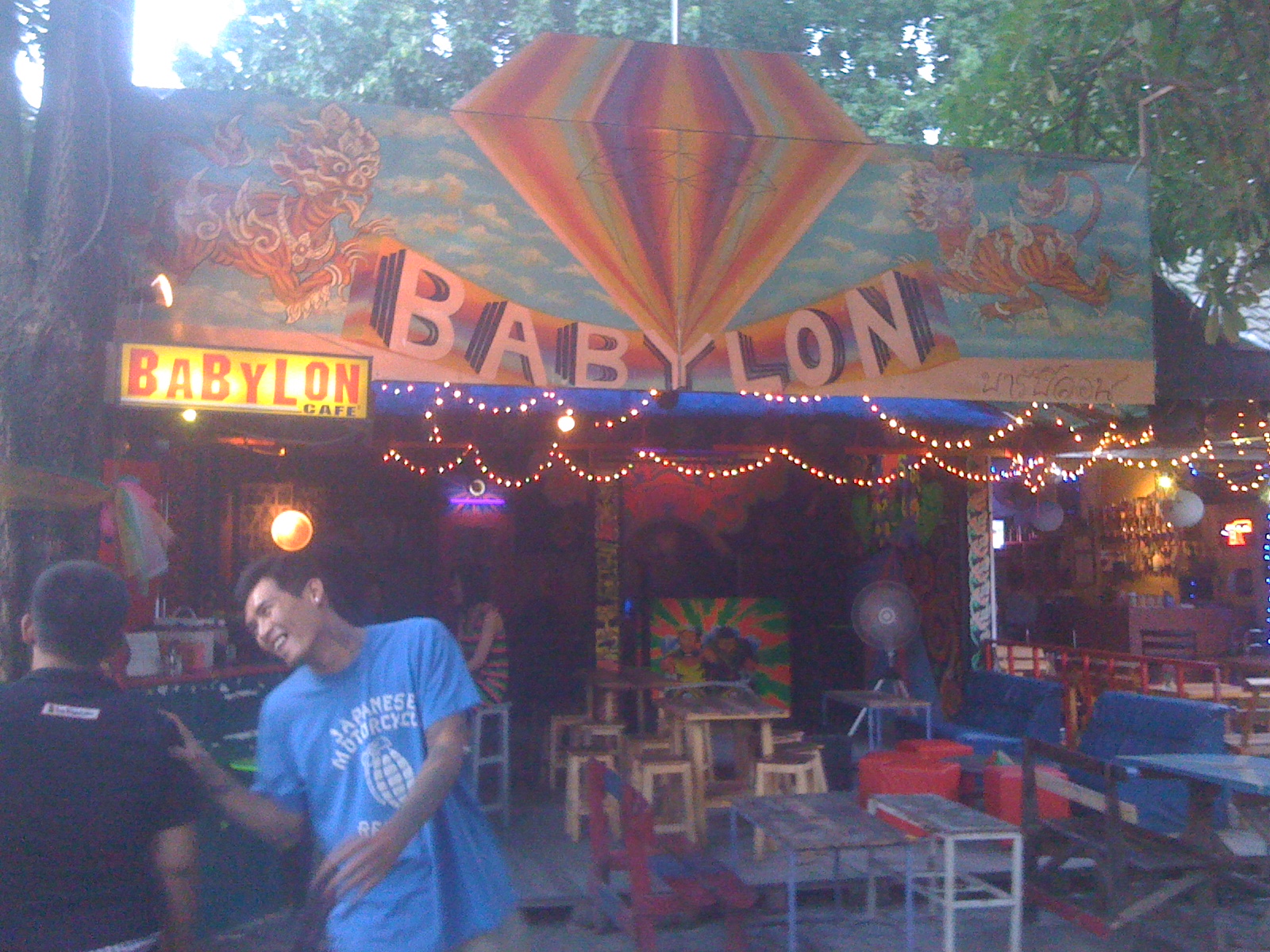
May 20 at 6:42 p.m. at the Babylon Cafe, a popular rasta and rock music venue in Chiang Mai. (Iphone photograph)
the Golden Triangle
Posted: May 20, 2010 Filed under: articles, people, places Leave a commentThis is an expanded version of a story that originally appeared in The Bangkok Post.
The Heart of the Golden Triangle
By Roy Hamric
For decades, Sop Ruak, which means “golden triangle,” a sleepy riverbank town in Northern Thailand, was mostly just a name on the map with very few visitors. The occasional tourist who ventured there found few accommodations or attractions. However, just the name conjures up tales of drug runners and international intrigue behind the lush, green walls that form the nexus where the borders of Thailand, Myanmar and Laos merge. The actual vista is a spectacular swath of riparian jungle with the mighty Mekong River bending eastward in a great flowing mass before disappearing into Laos.
No one should be surprised that during the past decade Sop Ruak, with the sparkle of its name, has attracted a burst of five-star hotels, a hotel-gambling casino complex across the river in Myanmar, and the flowering of dozens of guest houses and outdoor shopping areas selling hill tribe handicrafts and goods from China, Laos and Myanmar. On any day of the week now, lumbering double-deck tour buses bring up to 1,000 or more tourists a day from Asia and the West, most of whom only stay a few hours and depart.
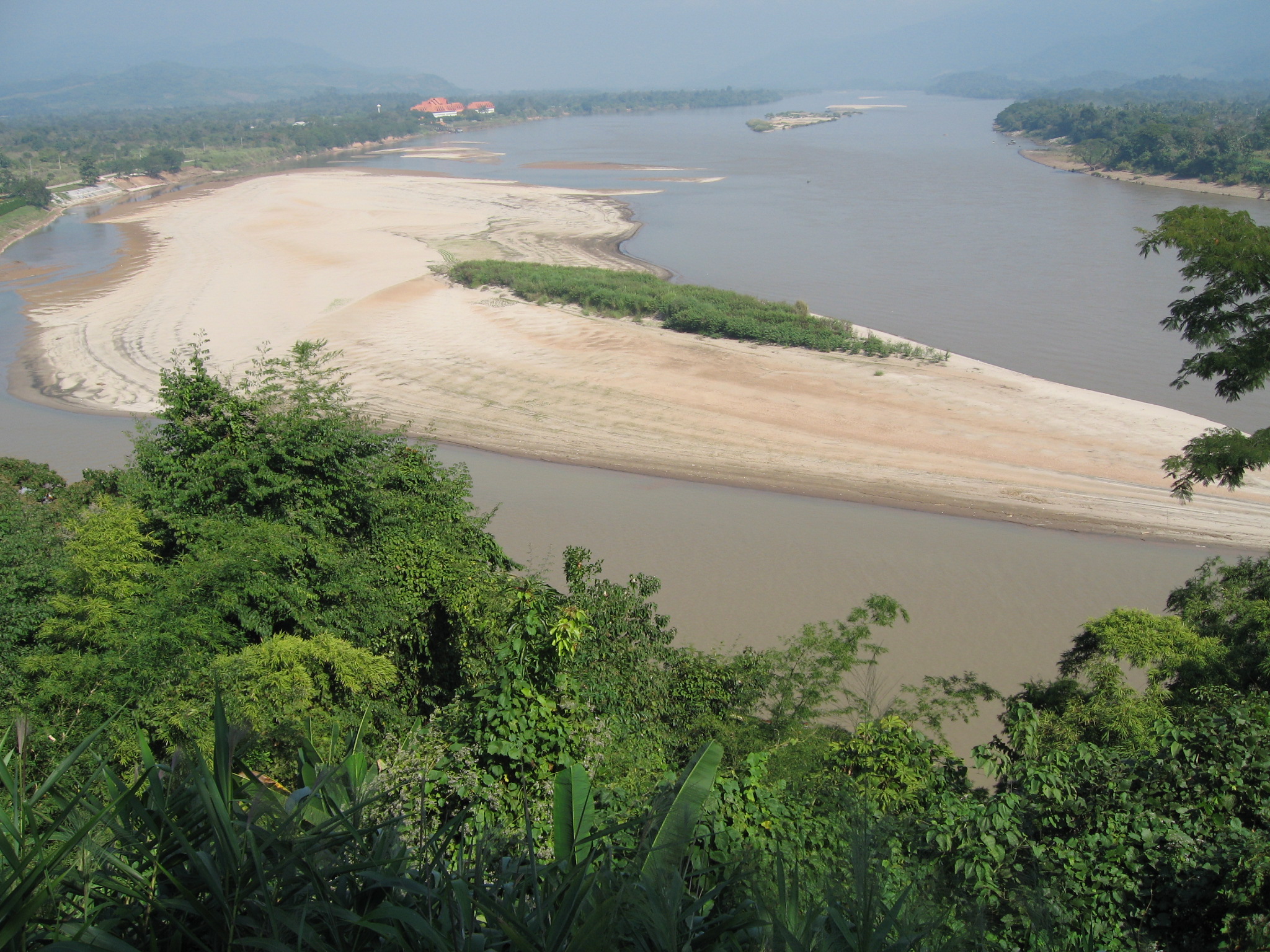
Makong River with Thailand in foreground, Myanmar, left, Laos, right.
By nightfall, the tiny riverside village is quiet again, with a few overnight visitors tucked away in the luxurious hotels outside of town or in the cheaper guesthouses hidden in the town’s backstreets. The village is one of the few tourist sites in Thailand where is no garish nightlife. The only action to be found is in the sound of a radio playing at an outdoor restaurant next to the river or in the lonely silhouette of a Chinese cargo ship plying its way upstream between the shifting sandbars of the Mekong River.
Despite the daily frenzied, packaged tour side of the little town, it’s worth a stopover because of its legitimate––or illegitimate––drug running history, the Akha, Yao and Hmong hill tribes, its unique Mekong River cruises, the casino across the river in Myanmar and as a backwater border point where you can cross over into the interior of Laos.
One of the first things you see in Sop Ruak is a huge golden Buddha rising 40-feet at the stern of an elaborately designed metal boat situated beside the Mekong River. From the deck, you have a sweeping view of the river, the glistening red-roofed casino in Myanmar.
Across the street is The House of Opium, easily one of the most interesting and extensive private collections of opium pipes (sometimes called “smoking guns”), opium measuring weights, scales, lamps, opium bowls and other items associated with “da yen,” Chinese for “the big smoke.”
The museum’s owner, Patcharee Srimatyakul, who was born in the area, started out years ago selling opium paraphernalia in a small shop. With smiling and calculating eyes, she started the museum when she saw that the opium items were becoming hard to find and once-sold, they disappeared forever. An elaborately made ivory or jade opium pipe can sell for $3,000 or more on the collector’s market.
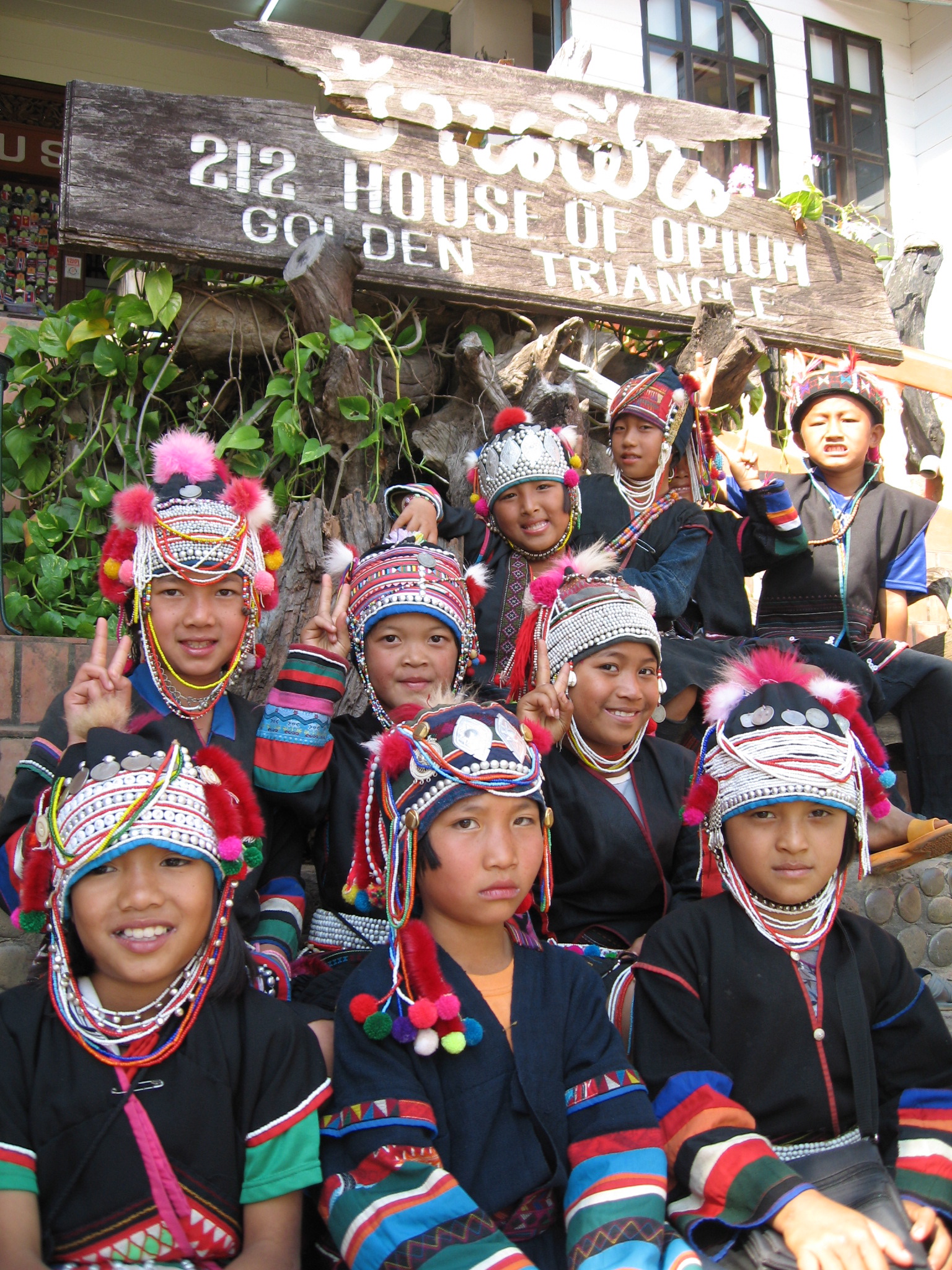
hilltribe girls outside the House of Opium
Mostly, she bought pipes from individuals in Myanmar, Laos and China. Now opium items are very hard to find anywhere. Locally, the main opium users were mountain people, who call opium “black medicine.” Drug lords with private armies were known for particular “brands,” such as Deer Brand, Lion Brand or KKK Brand. Nowadays, while opium is still smuggled through the area in caravans usually entering Laos, the trade is likely to be based on methamphetamine. Opium smuggling in the area is second only to Afghanistan. Thailand has been fairly successful in eliminating most opium growing for export, but opium use is still a regular part of the mountain tribes’ tradition, especially in Myanmar and Laos. To eliminate opium, experts say a product must be found to replace the hill tribes’ cultivation of opium, or Papaver Somniferum because opium cultivation offers poor farmers a significant income. Thailand, China, Myanmar and Laos have all made growing opium illegal, but law enforcement in Myanmar and Laos especially is nearly non-existent. It takes about one acre of cultivated fields to produce around 3,000 opium bulbs, which, after processing by a dealer, could make one kilo of opium. A hill tribe grower might receive around $1,000.
Short walk from the museum is the Imperial Resort, where the hotel’s outdoor restaurant balcony has one of the best views of the actual juncture of the three countries that form the Golden Triangle, especially just before nightfall when the evening light turns pink and gray with rose-colored reflections dancing across the water.
Foreigners must get a Thai permit to cross the river to the casino in Myanmar. The permit office is in nearby Chiang Saen, a lively river port where lines of Chinese cargo ships are docked, ready to be unloaded and re-loaded to return to China. Once back at the triangle, you pass through a Thai immigration checkpoint on the river and board a long-tail passenger boat that ferries visitors to Myanmar. After a quick check of papers by Myanmar authorities, a waiting bus carries visitors one-half mile to the Golden Triangle Paradise Resort, owned by a Thai businessman and his Japanese partners. The casino is one of 34 that encircle Thailand, which bans casinos. The resort offers rooms from $80 to $200. Most visitors stay only during daylight hours, returning to Thailand before the 6 p.m. ferry deadline. The casino and hotel are open 24-hours a day.
On weekends, an average of about 500 people lay down bets on roulette, blackjack, baccarat and draw poker. In a separate room, are rows of automatic gaming machines. Customers place bets ranging from US 0.25 cents to $250. Thai citizens make up the majority of gamblers. The atmosphere is like casinos everywhere except for the Buddhist amulets and lucky charms lined up in front of tense gamblers. An expansive restaurant dishes up Thai, Chinese and Western cuisine and duty-free shops sell jade and gems from China, Myanmar and Thailand, as well as designer items.
Travelers can also book rides on the “scorpion” boats that buzz up and down the Makong River nonstop. The pencil-like, long-tail boats, which carry two to four people, are powered by a car engine decked out with an extended drive shaft with a propeller attached at the end. Cost varies up to about $50, depending on the distance traveled and the number of stops. More adventurous travelers can book a birth on a passenger boat that plies up the Mekong River to Yunnan Province in China, a two-day trip.
Experienced tourists know that to see a place you must get off the main roads, and Sop Ruak is no exception. If you take a drive or walk along the streets leading away from the river, you’ll see small thriving neighborhoods and normal life in Sop Ruak with its schools, hairdressers, small neighborhood restaurants and a placid village lake where teenagers and young couples hang out.
You’ll have a chance to meet people like Anong Sangkawadee, a middle-aged, self-taught wood-carver with a wispy mustache and goatee and a tightly pulled-back pig-tail, who was carving a large wood sculpture in front of his studio.
Taking a break, he said he never cuts down a tree to get wood to work with, instead relying on roots of trees that have been blown down or died. He likes to work with teak or rubber wood.

wood carver in Sop Ruak
“There are a lot of artist in the area,” he said, “but so far we don’t have a local art gallery in Sop Ruak. He started carving wood after a very large, revered tree blew down in the village. “I felt sorry for the tree,” he said. “I told myself I would give the tree life again so people could see it. I want tourist to come and look at it and be happy seeing my work.” The tree, now covered with intricate floral carvings, stands nearly 30-feet tall in an outdoor display area near his workshop.
One of the best places to spend an evening is a five-minute drive downriver alongside the Makong to Chiang Saen, the administrative center of the area and the designated port of entry for international cargo from China or Laos. It’s a bustling market town with lines of vendors beside the riverbank, who sell local hill tribe handicrafts and imported items. Nearby are hill tribe villages that can be visited on private tours or by private car. An interesting relic of the past rests on a hill overlooking the town, the site where the Nationalist Chinese Soldiers Cemetery is located. It’s the final burial place for more than 200 Kuo Ming Tang soldiers (Nationalists Party of Republic of China). The graves are angled on the hill to face in the direction of China.
Chiang Saen has a small foreign expat population, largely citizens of Canada, Germany, Japan, Australia and the U.S. A local realtor, Sugit Tomara, credits the foreign community with the building a popular golf course. Land and home sales in the area have been climbing, but they’re are still low by Western standards. About one acre on the outskirts of the city can cost from $5,000 to $9,000 and could rise to $25,000 or more in town or along a major roadway. A modest Thai-style, two-bedroom home might start around $30,000 and increase in price depending on size and amenities. An acre of land on the Mekong River in or near Sop Ruak could cost as much as $200,000.

dock workers waiting to unload Chinese boats in Chiang Saen
Life in Chiang Saen is destined to get busier with the planned expansion of the Thai river port docking facility, to be located south of the present docking area. The director of the Thai Marine Office, Apisit Kumpiroj, said the expansion will eventually double the cargo volume to nearly 1 million tons annually. Currently, about 27 cargo ships a day are off-loaded at the port, but this will increase to nearly 50. On-loading and off-loading is done the old fashion way, largely by hand. The riverbanks are lined with stevedores who manhandle crates, boxes and other goods. The port takes in about 100 flat-bottom Chinese boats a week. More export goods go to China than are currently imported from China, but that will change soon. Locals see the creation of a regular river passenger service to China as inevitable. Passengers from China book crude accommodations on some cargo boats coming in to Thailand at a rate of about 200 or more each month, while a hundred or so people depart from Thailand. Only the most adventurous Westerners now make the trip on the Chinese cargo boats.
Chiang Saen also has a very worthwhile National Museum that displays pre-historic artifacts, ethnic textiles, hill tribe crafts and traditional musical instruments. Asian art lovers will pause to take in a collection of Taoist ceremonial scrolls called “The Dragon Bridge of the Great Tao,” a series of 17 scrolls arranged in a specific order that depict Taoist gods and spirits, probably painted in the late 19th century.
While Sop Ruak is evolving into a major stop on the tourist trail, and Chiang Saen will only get more crowded with visitors heading to China or Laos, once you step out of the package-tour zone these two Thai river towns, and the surrounding mountain area, offer real pleasures. At night in Chiang Saen when a string of Christmas tree-colored lights pop on at a riverside restaurant and a Chinese cargo ship silently slips by on the river with its solitary white running light scanning left to right in the darkness, you feel for a moment as if a great mystery awaits just around the bend in the river.
time, space
Posted: May 17, 2010 Filed under: places, time, space Leave a comment
May 17 at 1:16 p.m. on Rachawitte Road in Chiang Mai (Iphone photograph)
hunter thompson in Laos
Posted: May 16, 2010 Filed under: people, places, writing 5 Comments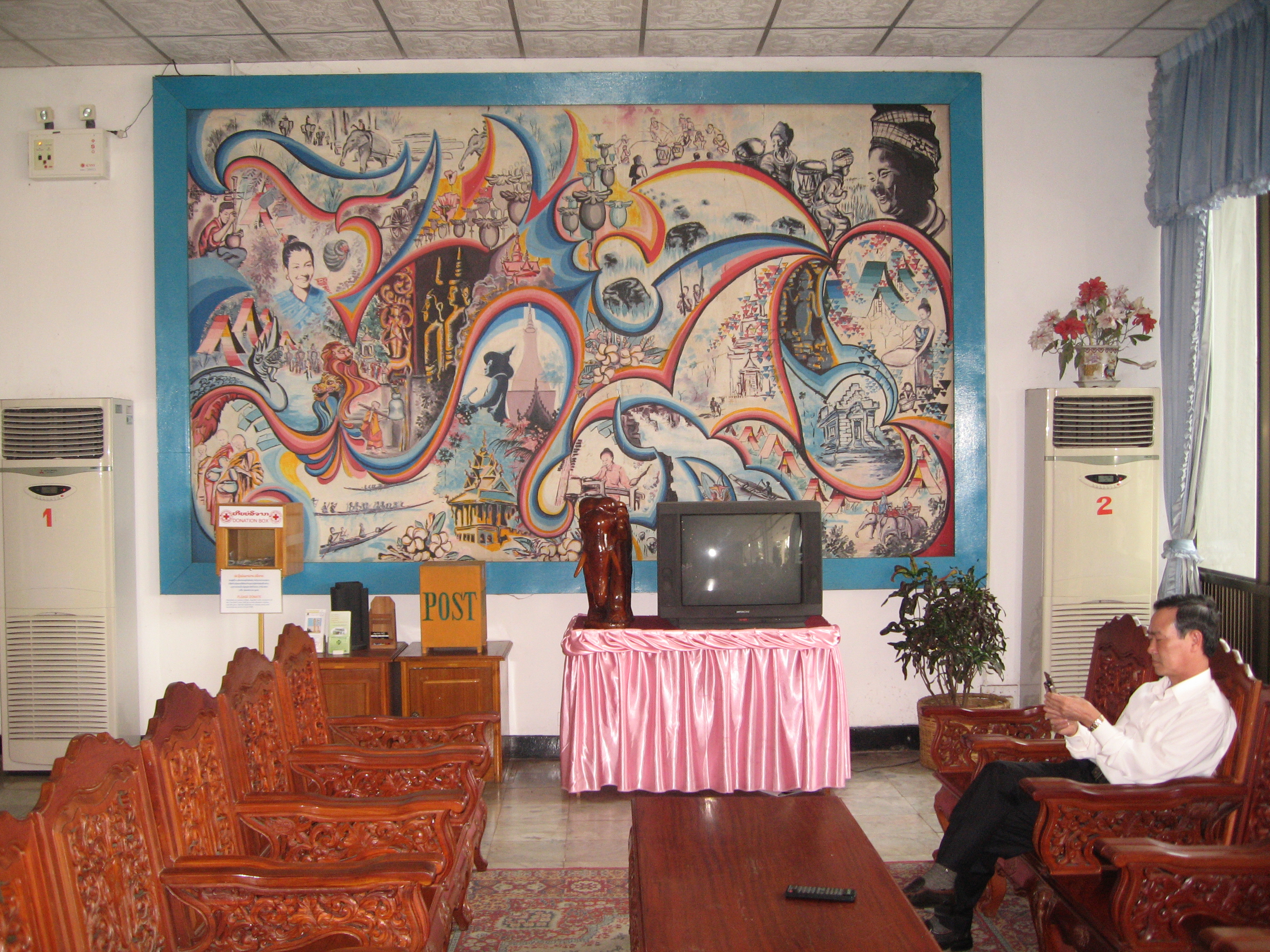
land xang hotel lobby
This is an expanded version of an article that appeared in The Magazine in The Bangkok Post.
hunter thompson in Laos
By Roy Hamric
“Laos is as different from Vietnam as Big Sur is from Long Island”––Hunter S. Thompson
I had a reservation to see if I could locate traces of the ghost of writer Hunter Thompson in Vientiane. It had been about 10 years since I had visited the Laotian capital, a time when most of the downtown streets were still dirt.
The Laos visa process at Friendship Bridge took about five minutes. Emerging from 33 years of Communist rule, Vientiane, the once delicate Laotian capital with about 500,000 people, had the frayed look of an Eastern European city, signaled by the dominance of the imposing government buildings on the city’s main boulevard, Tannon Phon Kheng. The best display of nightlife was still Fa Nyum Road, named for Laos’ first king, a burgeoning strip of restaurants and guesthouses fronting the Mekong River. The city overflowed with backpackers and hardy tourist types.
Following the Communist Pathet Lao takeover in 1975, Laos was a closed society until 1989, when it slowly began accepting Westerners back into the country. The Communist regime proclaimed 1997 the “Year of the Visitor.” The country is still scrambling to accommodate the growing number of tourists, and there’s still only a half dozen or so functioning ATMs. The local media is still heavily censored. Personal mail is still routinely opened and inspected. The sewer system has been under construction for decades.
At nightfall, the riverside filled up with tourists and Laotian couples holding hands––everyone eating, drinking and people-watching along the boulevard with its floating bamboo restaurants and street food vendors. Laotian women, decked out in their elegant long skirts and smooth, coal-black hair, made up for the city’s tapped down, controlled feel. I checked into the Land Xang Hotel, which means Land of a Million Elephants, once the finest in the capital.
I had a reservation for Room 224, where Hunter Thompson said he had stayed for two weeks. He arrived in late April 1975 after spending a few pressure-filled weeks reporting on the final days before the fall of Saigon for Rolling Stone magazine. He left a curious account of his stay at the Lane Xang in an odd, short piece called “Checking into the Lang Xang,” published in Songs of the Doomed, Gonzo Paper III.
When he arrived in Vientiane, Thompson was dejected and angry. The relationship between him and his longtime editor, Jann Wenner, had fallen apart at the worst possible moment. A few weeks earlier, Wenner had pulled out of a book deal with Thompson to cover the 1976 presidential campaign. Then Wenner unexpectedly asked Thompson to cover the fall of Saigon. As he was working on the story, Thompson learned that his group medical insurance provided by Rolling Stone had been withdrawn along with expense money to cover the assignment. His support had evaporated. His relationship with Rolling Stone was never the same following Saigon. Ten years later, his story on the collapse of Saigon finally appeared in Rolling Stone. Classic Thompson, it showed his uncanny ability to put his finger on the heart of a story, even as Saigon was in a frenzied free-fall.
When he finally left Saigon in the final days, he could have sought out Hong Kong, Bangkok or the Philippines, but he chose Vientiane as a place to unwind, to go over his notes and consider his alternatives. He arrived around 2 a.m. during a drenching monsoon rain. He told the Land Xang desk clerk he wanted a king-sized bed, quick access to the swimming pool and a view of the Mekong River that flowed past only a few hundred feet in front of the long, two-story hotel. The hotel has a massive lobby, a cavernous dinning room, a beautiful English-style Billiards Room and an exotic disco with soft-eyed hostesses. The hotel’s Massage and Sauna Center located beside the swimming pool is still noted for the masseuses who provide room service.

room 222 with the 15-foot hallway
After checking myself into the Land Xang there was some confusion about the exact room Thompson stayed in. After inspecting several nearby rooms, I decided that Thompson had gotten his room number wrong, or the room he stayed in had been renumbered. Whatever happened, the room he describes in his story is Room 222, which was still almost exactly as described: “A rambling suite of rooms half hidden under the top flight of a wide white-tiled stair ramp that rose out of the middle of the Land Xang lobby. When I first went into 224 [sic], it took me about two minutes to find the bed; it was around the corner and down a fifteen-foot hallway from the refrigerator and the black-leather topped bar and the ten-foot catfish-skin couch and five matching easy chairs and the hardwood writing desk and the sliding glass doors on the pool-facing balcony outside the living room. At the other end of the hallway, half hidden by the foundation of the central stairway, was another big room with a king-size bed, another screened balcony, another telephone and another air-conditioner, along with a pink-tiled bathroom with two sinks, a toilet and a bidet and deep pink bathtub about nine-feet long.”
At any rate, I quickly settled into Thompson’s strange “half hidden” suite of rooms and that evening I couldn’t stop my mind from imagining Gonzo-like goings on. Of course, the clerks at the Land Xang know nothing of Hunter Thompson or his fame. Many people may think it odd to make anything out of a certain room where someone stayed 33 years ago. My answer is simply that each of us finds personal connections to things that have indefinable meanings, much like Thompson, as a young writer, made a pilgrimage to Ketchum, Idaho, in 1964, to see the place where one of his heroes, Ernest Hemingway, spent his final days before he committed suicide in 1961. When we travel, it’s easy to get lost in the newness of the present and to overlook what happened in places before we arrived.
The Land Xang was perfect for Thompson. Its disco still offers a traditional Asian band with rotating singers and lovely hostesses in spiky, high heels who quickly place their hands on your leg and rest their head on your shoulder. There’s no written account of how Thompson filled his two weeks in Vientiane. The best guess is that it involved burst of manic writing, wiring Western Union dispatches to California, lots of Laotian marijuana, long stretches of sitting at an outdoor restaurant next to the Mekong River, probably some of the local snake moonshine, a few pipes of opium, probably long stretches of pondering the star-filled sky over the flowing Mekong. I’m certain some nights were spent in the dark recesses of The White Rose club, checking out the night life at the one of the most notorious bars in Asia, renowned for its beautiful women and hard-to-distinguish transvestites. Dire tales abounded in the 60s and 70s of soldiers on R&R and visiting government officials who took beautiful ladies out of The White Rose only to discover when sober that the beauties weren’t ladies.

andelman and thompson in Vientiane
At any rate, shortly after arriving, Thompson looked up the New York Times correspondent David Andelman, and they spent some time together going around Vientiane.
“I had been filing quite relentlessly from there for some weeks,” Andelman told me, recalling those days. “I had, of course, heard of him, though I was not aware that he’d been in Vietnam before he arrived in Laos. As I recall, he said that he was finishing up a major Vietnam piece and then intended to turn his attention to Laos. But I’m not sure how intense that attention was. Most of the time, as I recall, he spent trying to score the ‘finest weed ever produced on the planet,’ and he seemed to be quite successful.
“At the time, Vientiane was very much an open city. The bar girls still plied their trade nightly at the White Rose which Peter Kann [a Wall Street Journal reporter] and I closed up some weeks later, the girls going across the river to Thailand the next morning, really marking the end of the Royalist regime in Laos and the arrival in power of the Pathet Lao.
“For a price, and Hunter did seem quite flush at the time, there was very little that was not obtainable. As I recall, Hunter vanished as suddenly and mysteriously as he arrived. I don’t remember seeing any piece that materialized out of his visit to Vientiane. I was aware of his Gonzo reputation, so his search for the perfect weed more amused than surprised me. He seemed so intense about it––more so than any other goal in fact––even though he was soaking in all sorts of other details, scenarios, and dialogue that could have produce a vivid piece if he ever got to the point of writing it, which seemed only a part of his ‘mission’ to Laos. I also recall that at times his circuits seemed pretty fried.”
Thompson had successfully decamped from the manic days of a crumbling Saigon to deceptively tranquil Vientiane. With his acute sense of the possible and probable, he knew the government had only a few days left. In May, 1975, a few weeks after Thompson departed, the government fell to the Pathet Lao and the White Rose closed. The Communists quickly isolated the country from the West and sent tens of thousands of Laotians and ethnic group members to prisons and reeducation camps.
Thompson, in his prime, absorbed Laos’ benighted strangeness and beauty. He glimpsed the final days of Vientaine, before it was smothered by a repressive Communist regime. Thompson despised and raged against dark forces wherever he found them. At the brink of its fall, Laos had so little and lost so much.
In some ways, Thompson’s long strange trip through life was just beginning. His writing captured his times and the imagination of millions of readers. Thirty years later, on Feb. 20, 2005, Thompson, like Hemingway, shot himself in the head in his home, the “fortified compound” he called Owl Farm, in Aspen, Colorado. What reads like a short, personal note written to himself a few days before his death, titled “Football Season is Over,” is now called the “suicide note”: “No More Games. No More Bombs. No More Walking. No More Fun. No More Swimming. 67. That is 17 years past 50. 17 more than I needed or wanted. Boring. I am always bitchy. No Fun — for anybody. 67. You are getting Greedy. Act your old age. Relax—This won’t hurt.”
It’s nice to believe that Room 222 in the Land Xang Hotel in a bygone, sleepy old Vientiane made a positive change in Thompson’s life when he needed it. With the arrival of Pathet Lao cadre, everything changed overnight. But a few things stayed the same. As I ventured out of the Land Xang the next morning, I learned that drugs, as always, were everywhere, in spite of the Communist government or maybe because of it.
The taxi driver turned around, grinning.
“You want ganja?”
“No ganja,” I said. “Too dizzy.”
He nodded, appearing to understand.
“Opium?” he asked.
time, space
Posted: May 15, 2010 Filed under: photography, places, time, space Leave a comment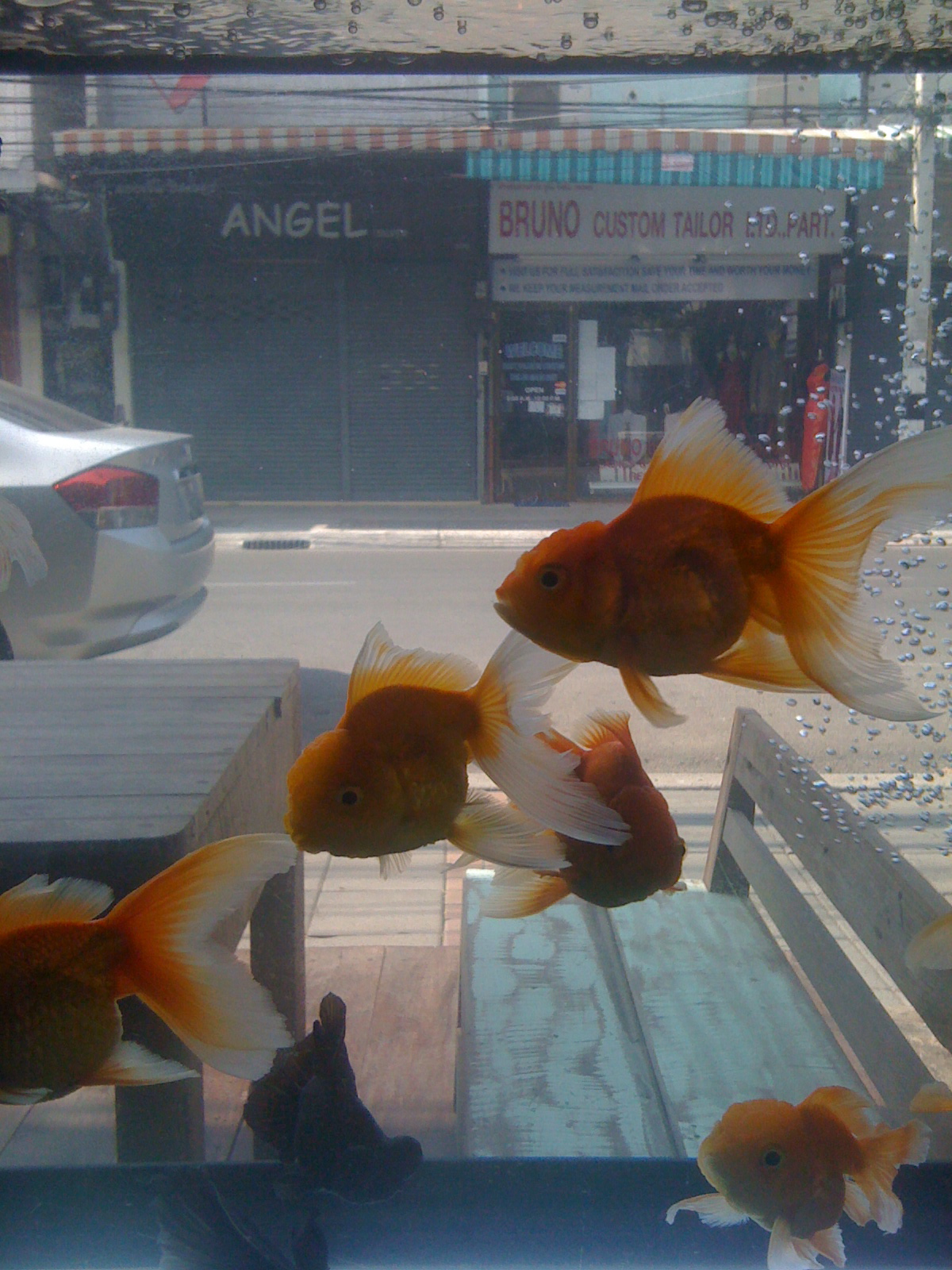
May 15 at 3:08 p.m. on Thae Pae Road in Chiang Mai, Thailand. (Iphone photograph)
time, space
Posted: May 13, 2010 Filed under: photography, places, time, space Leave a comment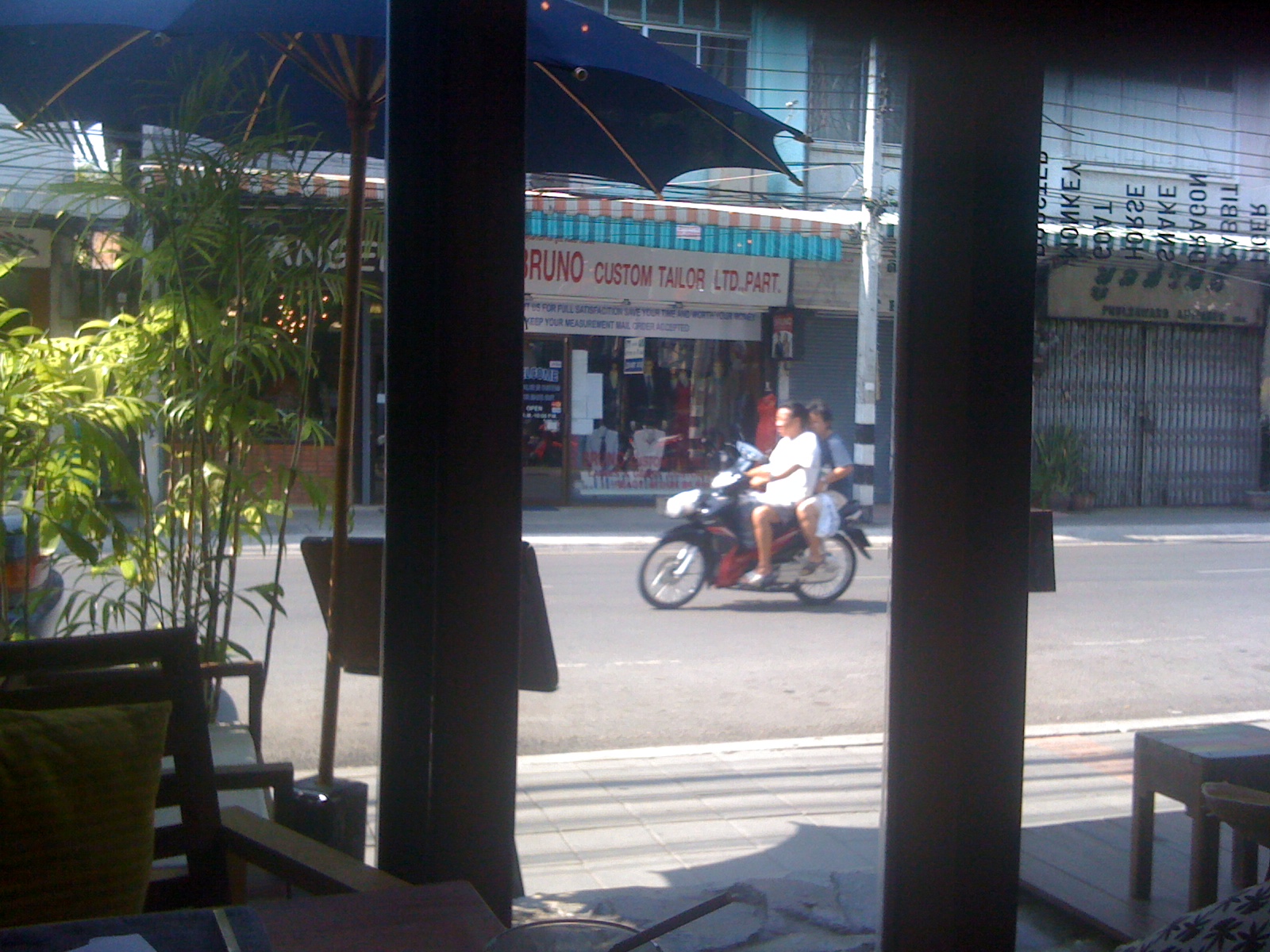
May 13 at 3:14 p.m. in Chiang Mai (Iphone photograph)
I will begin posting moments in time and space. This was one of the main streets in Chiang Mai at 3:14 p.m. on May 13 on a scorching day with almost no one on the streets. It’s been between 104 to 110 degrees for many days (42-44 C…I’m guessing here). I was working on Wi-Fi in a coffee shop with air conditioning.
the writers club
Posted: May 11, 2010 Filed under: articles, people, places 1 CommentWriters, photographers, artists, and those passing through Chiang Mai, like to drop in to The Writer’s Club to see the local gang.

chiang mai gathering place
A restaurant and bar, it’s run by Bob Tilley, a former correspondent in Germany for the British press. The place serves as a de facto press club for the locals where everyone can see everyone and get a sense of what’s going on in Thailand and the region. I’m posting a pdf story on the club here and will link it to On The Record.
bagan, myanmar
Posted: May 9, 2010 Filed under: buddhism, photography, places Leave a comment
Bagan temples are spread out across a vast valley, now largely unpopulated.
I ‘m posting this picture of temples in Bagan, Myanmar, in order to create a blog link to a pdf which will give me a wordpress link and then I can post it under my On the Record stories using the wordpress link. Learning the ins and outs of blogging looked fairly easy, and it’s turning out to be so. Anyway, you can click on the Bagan listing in On the Record to read a story about one of Asia’s most spectacular sites of Buddhist temples, comparable to Angkor Wat. Bagan, unlike Angkor, is in jeopardy.
 the roy hamric journal