
Villa Terlingua in the Big Bend
Posted: February 28, 2018 Filed under: Uncategorized Leave a comment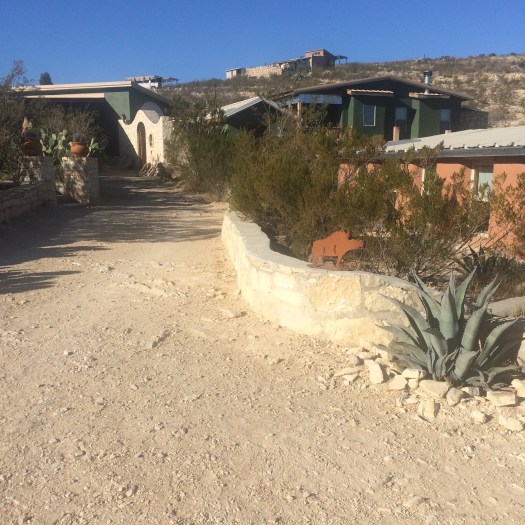
A section of Villa Terlingua in the Terlingua Ghost Town near Big Bend State Park in Far West Texas, owned and operated by Cynta De Navarez.
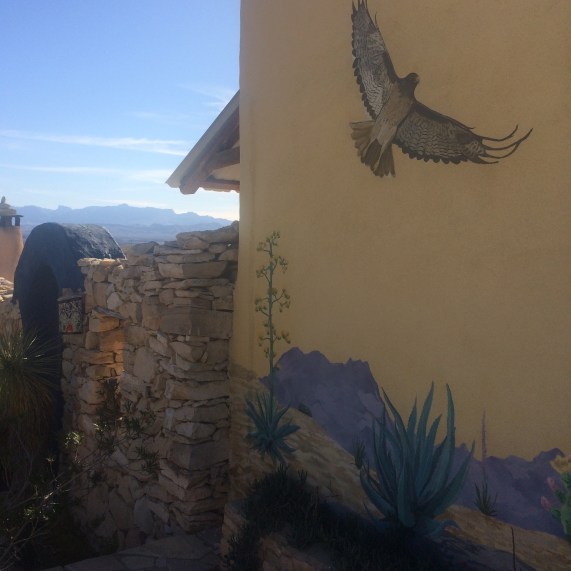
The side of a cabana at Villa Terlingua with the Chisos Mountains in the far distance.
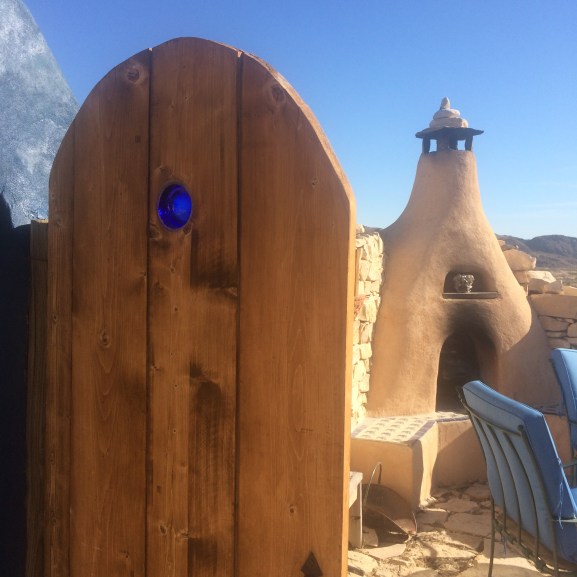
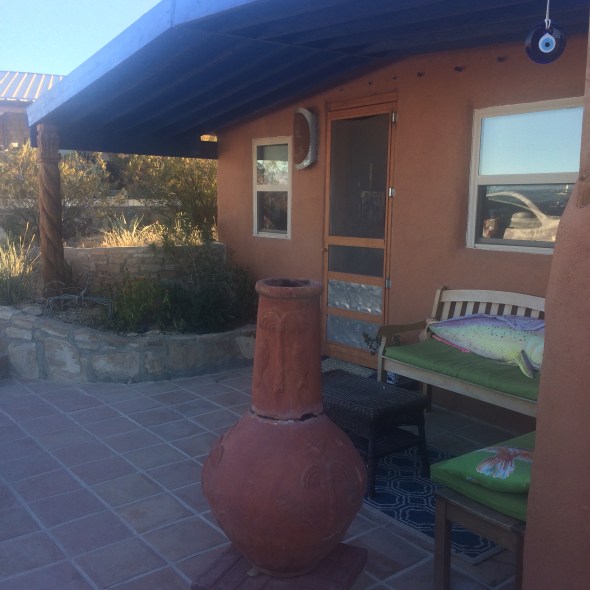
The Blue House cabana at Villa Terlingua in the Ghost Town near Big Bend State Park near the Rio Grande.
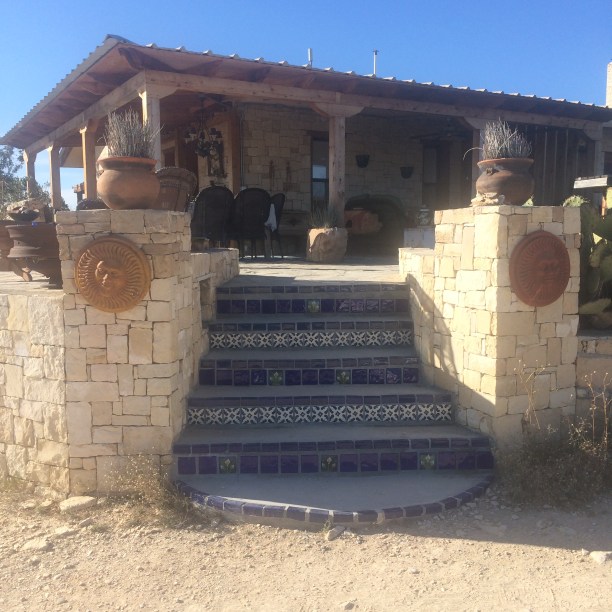
Villa Terlngua’s big house in the Ghost Town of Terlingua near Big Bend State Park in Far West Texas, owned by Cynta De Navarez. The large villa and nearby cabanas are for rent to individuals or groups. See http://www.villaterlingua.com for more information.
The Burro Lady of Big Bend
Posted: February 26, 2018 Filed under: Uncategorized Leave a comment
A painting of the Burro Lady of Big Bend. Judy Magers and her burro roamed hundreds of miles along the highways of West Texas, camping outside beside the highways. She was a mysterious figure to most travelers, but she was beloved and locals kept careful track of her travels. For a story about her, click here. The painting resides in the La Posada Milagro coffee shop in the Terlingua Ghost Town

The La Posada Milagro coffee shop in the Ghost Town, a well-known gathering spot.
February 16, Friday, marks the Year of the Dog
Posted: February 14, 2018 Filed under: Uncategorized Leave a comment
Ranking as the eleventh animal in Chinese zodiac, Dog is the symbol of loyalty and honesty. People born in the Year of the Dog possess the best traits of human nature. They are honest, friendly, faithful, loyal, smart, straightforward, venerable and have a strong sense of responsibility.
What sound is this…
Posted: January 5, 2018 Filed under: Uncategorized Leave a comment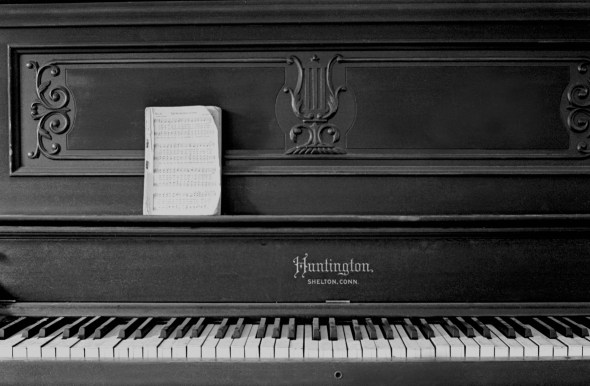
Part of a two-decade documentary project on rural backwoods churches in deep East Texas.
Backwoods Churches Documentary Project
Posted: August 23, 2017 Filed under: photography, religion, states of mind, Uncategorized Leave a comment
A picture from a documentary project I worked on about backwoods churches in the Big Thicket in the 70s and 80s.
Rangoon, Shwedagon Stupa
Posted: August 22, 2017 Filed under: buddhism, places, religion, sight seeing, Uncategorized 1 Comment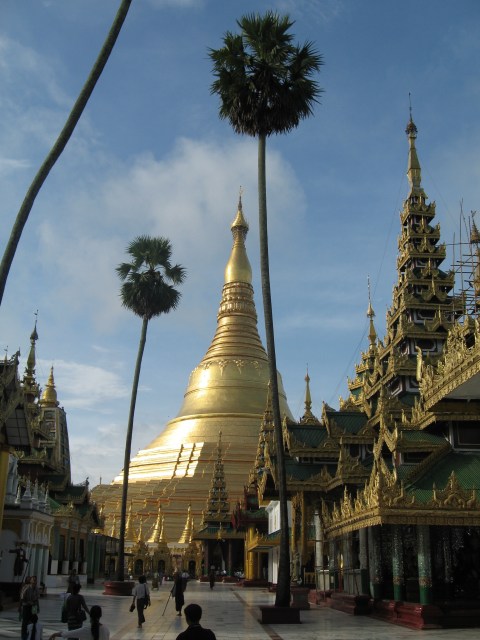
Approaching Shwedagon Stupa (Roy Hamric)
YANGON, Myanmar — A few long, wispy hairs dangled from the chin of the old, brown-robed monk. The skin on his hands was polished like dark parchment. Wearing a brown conical peaked cap, he looked like he was from an earlier age.
Hope for a better life
At mid-afternoon on the day I visited the temple, spiritual reverence filled the air. Streams of pilgrims, both men and women wearing the traditional longyi skirts, supplicated themselves before the golden stupa and the smaller temples and shrines, some of which are believed to house symbolic Nats, or spirits. Families placed mats on the ground and set out steamed chicken, fried bananas and cups of sweet milky brown tea, preparing to spend the day.
The light surrounding the stupa casts a poignant spell. To say the stupa is golden misses it entirely. The air around the stupa is golden. The air seems to sparkle, the brilliance enhanced perhaps by the 1,383 gemstones embedded in the stupa’s surface and especially by the single, radiant 76-carat diamond placed at the top of a diamond-filled orb, which I fancied I could actually see while standing at the exact spot where the old monk had placed me.
“It’s a nice view,” he said, his teeth dark yellow from tea and betel nut. Earlier, the monk had walked me around the temple complex. People paid him reverence and gave him space. Jathei (hermit) monks, a lineage of solitary wanderers, are highly respected for their use of herbs and potions to treat people’s physical and psychological ailments.
Many Jathei monks are homeless, roaming through rural Myanmar. Sometimes they can be spotted at their forest retreats by the small, round huts they build from twigs and large leaves. He said his last retreat was in the forest near Taungbygone, 20 miles north of Mandalay. He’d started walking toward Yangon two months earlier. This would be his last visit to the temple, he said, because he planned to move deeper into the forest.
A few steps removed from the diamond’s sparkle was a shrine to Thanga Min, the king of the Nat spirits. Nat worship is the belief that spirits can exercise a good or evil power over a person or a place, such as homes, trees, hills or lakes. There’s a saying that the Burmese people play it safe: They practice Buddhism for the future life and give gift offerings to Nats for problems in this life. A moment later when I turned back toward the monk, he was gone. I had wanted to ask him more about his life. I searched through the crowd, but he had disappeared.
A country of extremes
From the temple, I hailed a taxi, a 1956 Toyota. I had promised myself a dinner at the Strand Hotel, one of the legendary hotels of the East. The driver, named Htin Swe, was another one of those Myanmar citizens you frequently meet who describe themselves as university students. They are typically in their late 30s or 40s. They explain their studies are incomplete, through no fault of their own. Myanmar universities are usually closed more semesters than they are open, a sign of the fear the ruling military junta has of students and the people. In 1988, the junta, now known as the State Peace and Development Council, gunned down more than 2,000 students, men, women, children and monks during a demonstration in Yangon.
I asked Htin Swe what he studied.
“I am an English major,” he said. “Ahnoma topeeah.”
“Onomatopoeia? ” I said.
“Yes. The Highway Man,” he said. “Fenimore Cooper. American. Shakespeare very different. Robert Frost. Two ways to go.”
Like most of Myanmar’s ordinary citizens, Htin Swe was a poignant mixture of sincerity and arrested development, emblematic of a people and a country with enormous potential that’s been trapped in a time-warp closer to the ’50s than today’s world.
When the concierge swung open the high wooden doors of the Strand Hotel, built in 1901 by two Armenians, the Starkie brothers, I entered a world light years away from everyday Myanmar life. Recently remodeled, the hotel had retained its distinctive colonial-Asian charm and elegance with a shiny, black grand piano dominating the lobby. The natural oak and rattan furniture featured white cushions. In the nearly empty dinning room, leather-bound menus and heavy white parchment paper were stamped with the Burmese lion emblem. Delicate purple flowers sat in crystal vases on each table, and a young woman played a lilting folk melody on a xylophone.
The menu listed barramundi over glass noodles, Myanmar venison, seared Myanmar River prawns in green curry, sesame coated tuna rolls, golden crab cakes, peanut biscuits and more.
Looking through the window at the boulevard that ran parallel to the Irrawaddy River, I saw fenderless trucks sputtering along, belching black smoke, stacked with freshly cut teak trees still oozing oil from their base. Men with bulging calf muscles strained at rickety trishaw pedals, trying to dodge potholes. Students in red skirts and white blouses walked home carrying plastic book satchels.
The stark contrast between the refined Western inner world of the Strand’s elegance and the outside world of daily Yangon street life still seemed very colonial British.
Clearly, Myanmar is a country of extremes — of haves and many have-nots. Average citizens have little money or opportunity and have been repressed for decades. However, the country is slowly opening up to tourists and travel within the country is easier. The feelings you take away from a trip to Myanmar are deep, running an emotional gantlet from awe to sorrow.
As I left the Strand Hotel, I thought of the old monk at the temple. I had tried to take his picture, but he wouldn’t allow it.
“I will remember you,” he said. “You will remember me.”
He was right.
Roy Hamric writes about Southeast Asia for newspapers and magazines.
Denis Johnson, dead at 67
Posted: May 28, 2017 Filed under: Uncategorized Leave a comment
Denis Johnson, my generation’s Graham Greene and Ernest Hemingway, a prolific and beautiful writer who had a key to the confused hearts and minds of people derailed by life and who lived in worlds filled with tragedy and oftentimes transcendent beauty died at his home in California on May 24, 2017. He wrote many books which will stay with you forever. His own life started as a spiritual and mental struggle that was dominated by the fringes of American evangelical religion. He understood its believers’ rock solid spiritual search, their urge for apocalypse, their assurance that we live in a fallen, irreparably damaged world. He left us luminescent novels and nonfiction (See Angels, The Stars at Noon, Tree of Smoke, Jesus’ Son, Seek (nonfiction) . Read any book he wrote as if it’s a holy testament to flawed humanity, a paean to each soul’s blind rush to mortality, a prayer to language to reveal truth, and you will have come a small distance to where his spirit and art lived.
Bedside Books
Posted: January 29, 2017 Filed under: Uncategorized Leave a comment
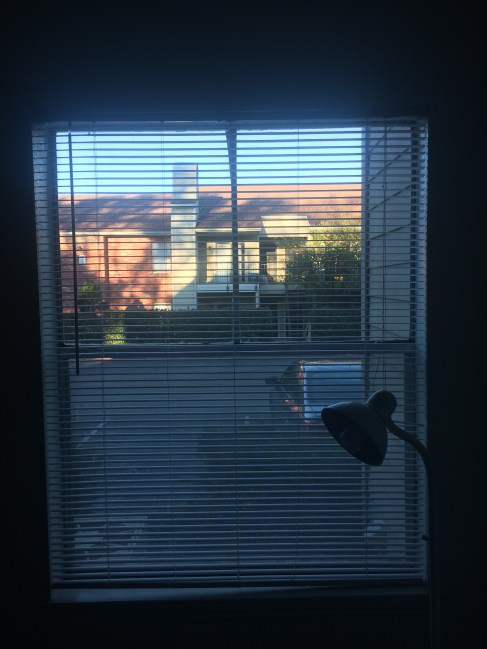
Space & Time, 8:07 a.m., Jan. 29
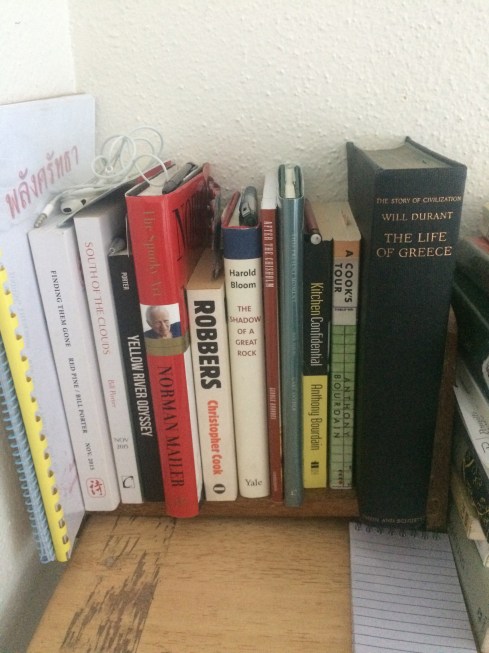
Bedside Books
Year of the Rooster
Posted: December 31, 2016 Filed under: Uncategorized Leave a comment
The Year of the Rooster, Rise and Shine!
Will Durant’s history books
Posted: September 7, 2016 Filed under: Uncategorized Leave a commentI’m nearly finished reading Caesar and Christ, Part III in the estimable Will Durant’s The Story of Civilization. It’s what he termed “synthetic history, which studies all major phases of a people’s life, work and culture in their simultaneous operation.”

“We shall learn more about the nature of man by watching his behavior through sixty centuries than by reading Plato and Aristotle, Spinoza and Kant,” he said. Durant agreed with Nietzsche, “All philosophy has now fallen forfeit to history.”
Durant’s magisterial history (11 volumes) is measured, movingly written and full of distilled wisdom, drawn from the lessons of people’s actions and words, and Durant’s determination to put events in proper context. Above all, he is wise and pragmatic and he sees humankind whole, both the weaknesses and strengths. Written with his wife, Ariel, the books were published between 1935 and 1975, and are an essential read for a seasoned overview of world history.
Here are some gleanings from Caesar and Christ:

“What increases with civilization is not so much immorality of intent as opportunity of expression.”
“The older Romans used temples as their banks, as we use banks as our temples.”
“News reached [a Roman] when it was old, so that his passions could not be stirred everyday by the gathered turmoil of the world.”
“…who could punish robbery among his fellows when half the members of the Senate had joined it violating treaties, robbing allies and despoiling provinces. “He who steals from a citizen,” said Cato, “ends his days in fetters and chains, but he who steals from the community ends them in purple and gold [robes].”
“From the moral standpoint, which is always a window dressing in international politics, …”
“Men begin by seeking happiness and are content at last with peace.”
“…in philosophy all truth is old, and only error is original.”
“Around the immoral hub of any society is a spreading wheel of wholesome life, in which the threads of tradition, the moral imperatives of religion, the economic compulsions of the family, the instinctive love and care of children…suffice to keep us publicly decent and moderately sane.”

