
My aunt’s painting
Posted: July 3, 2016 Filed under: photography, sight seeing, time and space, Uncategorized Leave a comment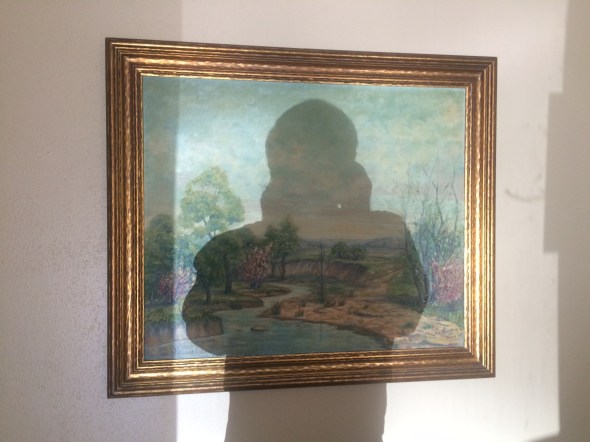
This painting, by Ava Milner Hamm, is one of my earliest memories, a landscape of country that starts west of Fort Worth. The painting was always in the two houses where I grew up. I have lived with it in sight (or memory) for all of my life. It always tells me I’m home.
Whitman’s personal record
Posted: February 4, 2016 Filed under: Uncategorized Leave a comment
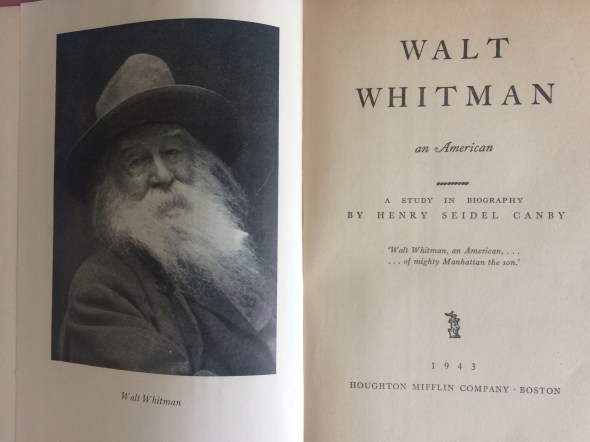
Walt Whitman, An American by Henry Seidel Canby, published in 1943, is an intimate look at the poet’s long struggle to create Leaves of Grass, which Emerson so famously hailed as the rising of a truly new American poet, of a type he had called for in his essays which urged readers to cast off European ways and forge a new consciousness based on the new American land and spirit. Canby is good on Whitman’s early life as a respected journalists and editor of several weeklies in Brooklyn and New York City where he cut a compelling figure among the writers and artists of the times. He was far ahead of his time, with a cunning understanding of publicity, a theatrical presence, and a sophisticated understanding of politics. He was viewed as a sophisticated political journalist who also had a flair for essays and portraits of people and events. All the while, his inner world, his meditative link with the unfolding of his daily experiences, was secretly putting down deep roots which around age 35 burst forth in epiphany-like awakenings, calling out the first poems celebrating himself:
From his notebook:
I am the poet of the body
And I am the poet of the soul…
I am the poet of reality
I say the earth is not an echo…
I am the poet of equality
I dilate you with tremendous breath
He saw himself as nothing less than a divine, incarnate prophet-teacher. He fully assumed the role – braving decades of public outcries of indecency because of his frankness (so tender and mild) when writing about sexual relations between women and men, the actual extent of which are shrouded in personal reticence. His service later in life as a volunteer hospital worker in Washington D.C. during the Civil War years stands out because it called forth and displayed his saint-like character. A touching moment: when Lincoln and Whitman confronted each other on several occasions, there seemed to have been a bow given my both men without an exchange of words.
The record he left of his volunteer service to the injured soldiers, Specimen Days, and his notebooks from that period, are a close second to his final, completed version of Leaves of Grass, which is now our national song of the 19th century America spirit (which, alas, lived and lives only in literature). Wth Emerson, Thoreau, Melville and Whitman we had a calling forth for an America which was never to be and four artful testaments to the causes of that failure: and yet, there is both an America which continues to live up to their ideals and an America which blusters along oblivious to the transcendence they called for to achieve a better human nature during our time on Earth. Even so, it was a bright era for American letters. Looking at Whitman’s life, you can’t help but see the link with Allen Ginsberg, a continuation of Whitman’s spirit and energy who lived in a time when the materialism and cynicism, foreseen by the 19th century writers, was firmly entrenched. It dominated Ginsberg’s time, but he did, indeed, Howl against it. Ginsberg’s public acceptance had obvious parallels to Whitman’s. A public misapprehension of his poetic style and widespread establishment shock at his unabashed homosexuality and willingness to assume a political role (something Whitman never did). And here we are, in hope, awaiting the emergence of another quartet of writers who will raise the banner in this century.
Wittgenstein Trying to Touch It
Posted: June 15, 2015 Filed under: Uncategorized Leave a comment
Painting on wood by Jack, the departed owner of the former Heaven’s Beach Bar.
3.3421 A particular method of symbolizing may be unimportant, but it
is always important that this is a possible method of symbolizing.
And this happens as a rule in philosophy: The single thing
proves over and over again to be unimportant, but the possibility
of every single thing reveals something about the nature of
the world. – From the Tractatus
Language Disguises Thought: Koan For The Day
Posted: May 24, 2015 Filed under: Uncategorized Leave a comment
Wittgenstein plays the banjo.
4.002 Language disguises the thought; so that from the external form of the clothes one cannot infer the form of the thought they clothe, because the external form of the clothes is constructed with quite another object than to let the form of the body be recognised – Ludwig Wittgenstein from the Tractatus
Ralph Waldo Emerson On Sentences, Time, Words
Posted: May 3, 2015 Filed under: Uncategorized | Tags: r.w.emerson on language Leave a comment – “This thought being spoken in a sentence becomes by
mere detachment falsely emphatic.”
– “An American complained that he didn’t have enough
time, and was told by the Indian chief Red Jacket, ‘Well,
I suppose you have all there is.'”
– “Every sentence has some falsehood of exaggeration because the infinite diffuseness refuses to be epigrammatized – the world to be shut in a word.”
Cherry Blossoms
Posted: April 29, 2015 Filed under: Uncategorized | Tags: sakura Leave a comment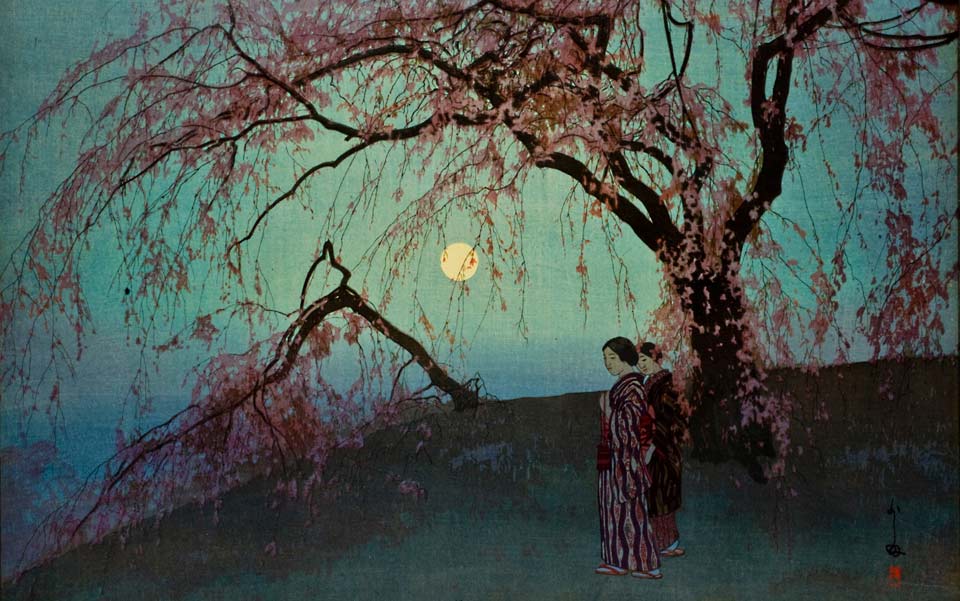
Detail from Kumoi Cherry Trees (Kumoi sakura) by Yoshida Hiroshi, 1926.
Haiku By Issa
Posted: April 16, 2015 Filed under: Uncategorized | Tags: Haiku poetry, Issa, spiders Leave a comment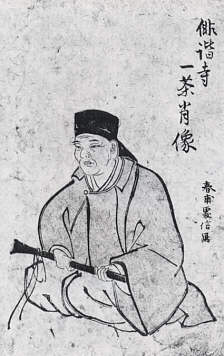
Don’t worry, spiders,
I keep house
casually.
– Issa
Clive James: New Poetry Book & Life Update
Posted: March 29, 2015 Filed under: Uncategorized Leave a commentWith the release of Sentenced to Life, a new poetry book by Clive James, there’s been a burst of publicity, in summa mode, recounting his career, particularly his brilliant essays and later poetry.
 I’m an avid reader of all his books. Two recent articles offer a good perspective on his current state of health and his life. He suffers from an assortment of chronic ailments, and many premature articles have all but announced his impending death. Thankfully, his recent books show he’s still creating art, and he has other books in the works. His lifestyle appears to be not all that dire.
See this article for a revealing recap of his past four years, and this article, for a view of James by his daughter, who lives nearby James’s own home in Cambridge. His estranged wife also lives nearby, and it appears that she and her daughter are giving James good support, despite his self-proclaimed breach of faith with his wife.
Many of the poems in his new book go to the heart of the pain he publicly caused his wife and daughter, and his great remorse. His incisive friend, the playwright Tom Stoppard, offers a fulsome dissection of James’s compelling voice as a writer and a critical assessment of his later poetry. James is one of the premier essayists of our time, and a recent collection Cultural Amnesia, should be required reading by aspiring journalists, critics and anyone interested in the 20th century.
To hear James read his poem Early to Bed, go here. He also reads his poem Japanese Maple in the first profile article. Don’t miss it…
Don’t Cry For Me, Billy
Posted: November 21, 2014 Filed under: Uncategorized | Tags: cliff potts, eliot kastner, harry dean stanton, indepdendent Western movie Leave a comment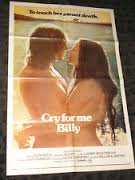
Cliff Potts plays opposite his wife in the film. She runs around naked in most of the movie when not covered by a blanket or his shirt.
This is an independent Western shot in the early 70s with two worthy performances by Cliff Potts, who is terrifically good in this movie but whose career never reached the heights he seemed capable of, and Harry Dean Stanton. It was produced by Elliot Kastner, who did some interesting independent films. He produced Tom McGuane’s modern revisionist Western, Rancho Deluxe, and the hilarious classic, Missouri Breaks (great dialogue).
The story is stark, the dialogue is scarce, but good, and the villains are a troop of US Army cavalry who hunt down an Indian girl and rape her. Earlier, Potts’ character befriends the girl and they fell in love. After witnessing the rape, he sets out to revenge her death. He’s a convincing gunslinger who meets the fate of a lot of gunslingers: he’s shot in the back. Harry Dean appears in key scenes at the beginning and end. Good performances by James Gannon (who stared in several Sam Shepard plays) and others. It was a time when a lot of talent was underused in Hollywood, and this film shows what can be done on a small budget when in the hands of good filmmakers.
Some critics faulted the filmmakers for not having a “payoff” for viewers at the end. The girl is raped, dies, and the hero is shot dead. That’s real storytelling. The film fails because you want a happy ending? Spare me…
James Evans Sees His Masterpiece
Posted: October 1, 2014 Filed under: Uncategorized Leave a comment
A Javelina at Night Photograph copyright James Evans
James Evans has completed a series of photographs, called the Ranch Project, that are a testament to his beloved Big Bend area of desert and mountains in far West Texas. Working from his home in Marathon, a small crossroads town, Evans has risen to a new level of personal vision, revealing his inner eye and heart through his photographs of the land and the animals who live there. It is a vision of the natural world in dream-like images of the beauty and mystery that surrounds us and yet remains untouchable. To see a story about the project, go here. To see his website and hundreds of his photographs, go here.

