
Clive James’ Recent Poems
Posted: September 30, 2014 Filed under: Uncategorized Leave a comment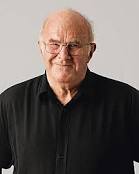 I’m always touched by Clive James’ essays, and his many books and poems. He’s a writer to read for a broad perspective on our world. Recently, his illness has forced him to concentrate more on his poetry. His latest work is a summing up, marked by thoughts of deep regret and death. The regret is the most tragic kind, involving affairs of the heart and the ending of close relationships. This is the last stanza of a recent, long poem, Rounded With A Sleep, which you can read here.
“All day tomorrow I have tests and scans/ And everything that happens will be real. / My blood might say I should make no more plans, / And when it does so, that will be the deal. / But until then I love to speak with you / Each day we meet. / Sometimes we even touch / Across the sad gulf that I brought us to. / Just for a time, so little means so much: / More than I’m worth, I know, as I know how / My death is something I must live with now.”
Anthony Bourdain: Good Interview On The World and Reality
Posted: August 7, 2014 Filed under: interviews, people, states of mind, Uncategorized Leave a comment Anthony Bourdain has helped put much needed reality into the world of television, with his shows No Reservations and Parts Unknown, while his books deliver good writing and interesting takes on life. Here’s a good interview with him on Blogs of War. Check it out here.
A quote from the interview:
“My crew has NEVER been treated so well – by total strangers everywhere. We had heard that Persians are nice. But nicEST? Didn’t see that coming. It’s very confusing. Total strangers thrilled to encounter Americans, just underneath the inevitable “Death To America” mural. The gulf between perception and reality, between government policy and what you see on the street and encounter in people’s homes, in restaurants – everywhere – it’s just incredible. There’s no way to be prepared for it.”
New Harrison essay
Posted: December 2, 2012 Filed under: Uncategorized Leave a commentJim Harrison has a new novella, The River Swimmer, to be released in January, while at the same time he is experiencing a series of health issues that he writes about extensively in this essay in Brick magazine.
Difficult poetry
Posted: February 6, 2012 Filed under: Uncategorized Leave a commentSo-called difficult poetry has become my touchstone lately; poetry by William Empson, who seems a bit akin to Wittgenstein because of his elliptical nature; Wallace Stevens, who many people say is difficult but who seems very open to me; and Philip Larkin, for his lack of brio and his entrapment of the mundane in elegant verse. Larkin’s acceptance by the British people says a lot about the poetry of ideas, such as Stevens’, versus Larkin’s withering honesty about the grinding futility of most people’s lives, that inevitable sense of flatness that replaces the glow of the future, faith, hope and belief while people slide into old age and death. Larkin and Stevens are opposites (except in craft). Larkin leaves you with only a stripped-down self, while Stevens leaves you inside a romance, though it must be self-sustaining. For the difference, see below Larkin and Stevens….
Here is early Larkin from his youth, in The North Ship:
XXVI
This is the first thing
I have understood:
Time is the echo of an axe
Within a wood
Also, see the Stevens excerpt below this….
James Franco on directing Blood Meridian
Posted: April 19, 2011 Filed under: Uncategorized 1 Comment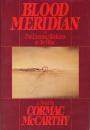
First edition dust jacket
Here’s an excerpt from an entertainment Website on Franco talking about getting the job to direct Blood Meridian. He’s also got a project underway to direct Faulkner’s As I Lay Dying.
“As for Blood Meridian, which has its own remarkable and distinctive prose style and includes scenes of nightmarish violence which should prove tough to translate to screen, Franco said he got the gig by shooting a test sequence from the book, with all the trappings (among them Luke Perry). Mark Pellegrino (a.k.a. Jacob from Lost) played the Judge — one of the most horrific villains ever to grace a work of American fiction — and the sequence also starred the likes of Scott Glenn, Luke Perry, and Franco’s brother Dave, also an actor.
“Franco said: ‘We made that as a way to convince Scott Rudin to give us the rights. It was like, why should he give it to me when Ridley Scott didn’t make it? So I called him up and said, “I’m planning on doing this. You don’t have to give me any money, I can finance this shoot. Would you just wait? Don’t do anything with it until I show this to you.” And I showed it to him and he loved it.'”
To see the entire article, click here. For the 1992 interview with Cormac McCarthy in The New York Times, click here.
the Edge
Posted: April 16, 2011 Filed under: Uncategorized Leave a comment
Could you explain the Third Culture?

Brockman, Warhol & Dylan, circa late 60s
In 1959 CP Snow noted in his book The Two Cultures that, during the 30s, literary intellectuals took to referring to themselves as “the intellectuals”, as though there were no others. This new definition excluded scientists such as the astronomer Edwin Hubble, the mathematician John von Neumann, and the physicists Albert Einstein and Niels Bohr. In the second edition, Snow added a new essay, optimistically suggesting that a “third culture” would emerge and close the communications gap between the literary intellectuals and the scientists. Although I borrow Snow’s phrase, it does not describe the third culture that he predicted. Literary intellectuals are not communicating with scientists. Scientists are communicating directly with the general public, and in doing so they are taking the place of the traditional intellectual in rendering visible the deeper meanings of our lives, redefining who and what we are.
Which new writers, scientists and artists should we be following at the moment?
Research psychologist Daniel Kahneman, who won a Nobel Prize for the creation of behavioural economics, is one. Jeff Bezos, Larry Page, Sergey Brin, Dean Kamen, Nathan Myhrvold, Jimmy Wales and Salar Kamangar all came to an Edge seminar to hear him lecture. Kahneman is not exactly a household name — yet among many of the leading thinkers in psychology, he ranks at the top of the field.
What is it that gets you interested in a person or their work?
I am interested in people who can take the materials of the culture in the arts, literature and science and put them together in their own way. We live in a mass-produced culture where many people, even many established cultural arbiters, limit themselves to secondhand ideas. Show me people who create their own reality, who don’t accept an ersatz, appropriated reality. Show me the empiricists (and not just in the sciences) who are out there doing it, rather than talking about and analysing the people who are doing it.
How do you find these people?
It’s all based on word of mouth and reputation. Edge, contrary to how it may appear, is not exclusive. Elitist, yes, but in the good sense of an open elite, based on meritocracy. The way someone is added to the Edge list is when I receive a word from a Steven Pinker, a Brian Eno, a Martin Rees, an Ian McEwan or a Richard Dawkins, telling me to do so. It’s as simple as that and I don’t recall ever saying no in such circumstances.
States of mind: Joseph Conrad
Posted: April 11, 2011 Filed under: Uncategorized Leave a comment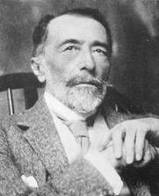
“When once the truth is grasped that one’s own personality is only a ridiculous and aimless masquerade of something hopelessly unknown the attainment of serenity is not very far off.”––Joseph Conrad, letter to Edward Garrett
100 Best Novels: Really ?
Posted: January 14, 2011 Filed under: Uncategorized Leave a commentHere’s the Modern Library Association list of 100 best novels. You have to chuckle at how this list would change if given to you, or to him or to her, or to me.
100. Booth Tarkington, The Magnificent Ambersons
99. J.P. Donleavy, The Ginger Man
98. James M. Cain, The Postman Always Rings Twice
97. Paul Bowles, The Sheltering Sky
96. William Styron, Sophie’s Choice
95. Iris Murdoch, Under the Net
94. Jean Rhys, Wide Sargasso Sea
93. John Fowles, The Magus
92. William Kennedy, Ironweed
91. Erskine Caldwell, Tobacco Road
90. Salman Rushdie, Midnight’s Children
89. Henry Green, Loving
88. Jack London, The Call of the Wild
87. Arnold Bennett, The Old Wives’ Tale
86. E.L. Doctorow, Ragtime
85. Joseph Conrad, Lord Jim
84. Elizabeth Bowen, The Death of the Heart
83. V.S. Naipaul, A Bend in the River
82. Wallace Stegner, Angle of Repose
81. Saul Bellow, The Adventures of Augie March
80. Evelyn Waugh, Brideshead Revisited
79. E.M. Forster, A Room with a View
78. Rudyard Kipling, Kim
77. James Joyce, Finnegans Wake
76. Muriel Spark, The Prime of Miss Jean Brodie
75. Evelyn Waugh, Scoop
74. Ernest Hemingway, A Farewell to Arms
73. Nathaniel West, The Day of the Locust
72. V.S. Naipaul, A House for Mr. Biswas
71. Richard Hughes, A High Wind in Jamaica
70. Lawrence Durrell, The Alexandra Quartet (Four books: Justine, Balthazar, Mountolive, Clea)
69. Edith Wharton, The House of Mirth
68. Sinclair Lewis, Main Street
67. Joseph Conrad, Heart of Darkness
66. W. Somerset Maugham, Of Human Bondage
65. Anthony Burgess, A Clockwork Orange
64. J.D. Salinger, A Catcher in the Rye
63. John Cheever, The Wapshot Chronicle
62. James Jones, From Here to Eternity
61. Wilia Cather, Death Comes for the Archbishop
60. Walker Percy, The Moviegoer
59. Max Beerbohm, Zulieka Dobson
58. Edith Wharton, The Age of Innocence
57. Ford Maddox Ford, Parade’s End (Four books: Some Do Not…, No More Parades, A Man Could Stand Up…, and Last Post)
56. Dashiell Hammett, The Maltese Falcon
55. Jack Kerouac, On the Road
54. William Faulkner, Light in August
53. Vladimir Nabokov, Pale Fire
52. Phillip Roth, Portnoy’s Complaint
51. Norman Mailer, The Naked and the Dead
50. Henry Miller, Tropic of Cancer
49. D.H. Lawrence, Women in Love
48. D.H. Lawrence, The Rainbow
47. Joseph Conrad, Nostromo
46. Joseph Conrad, The Secret Agent
45. Ernest Hemingway, The Sun Also Rises
44. Aldous Huxley, Point Counter Point
43. Anthony Powell, A Dance to the Music of Time (12 novels: A Question of Upbringing., A Buyer’s Market, The Acceptance World, At Lady Molly’s, Casanova’s Chinese Restaurant, The Kindly Ones, The Valley of Bones, The Soldier’s Art, The Military Philosophers, Books Do Furnish a Room, Temporary Kings, and Hearing Secret Harmonies)
42. James Dickey, Deliverance
41. William Golding, Lord of the Flies
40. Graham Greene, The Heart of the Matter
39. James Baldwin, Go Tell It On the Mountain
38. E.M. Forster, Howards End
37. Thornton Wilder, The Bridge of San Luis Rey
36. Robert Penn Warren, All the King’s Men
35. William Faulkner, As I Lay Dying
34. Evelyn Waugh, A Handful of Dust
33. Theodore Dreiser, Sister Carrie
32. Henry James, The Golden Bowl
31. George Orwell, Animal Farm
30. Ford Maddox Ford, The Good Soldier
29. James T. Farrell, Studs Lonigan (Three books: Young Lonigan, The Young Manhood of Studs Lonigan, and Judgment Day)
28. F. Scott Fitzgerald, Tender is the Night
27. Henry James, The Ambassadors
26. Henry James, The Wings of the Dove
25. E.M. Forster, A Passage to India
24. Sherwood Anderson, Winesburg, Ohio
23. John Dos Passos, USA Trilogy (Three books: The 42nd Parallel, 1919, and The Big Money)
22. John O’Hara, Appointment in Samarra
21. Saul Bellow, Henderson the Rain King
20. Richard Wright, Native Son
19. Ralph Ellison, Invisible Man
18. Kurt Vonnegut, Slaughterhouse-Five
17. Carson McCullers, The Heart is a Lonely Hunter
16. Theodore Dreiser, An American Tragedy
15. Virginia Woolf, To the Lighthouse
14. Robert Graves, I, Claudius
13. George Orwell, 1984
12. Samuel Butler, The Way of All Flesh
11. Malcolm Lowry, Under the Volcano
10. John Steinbeck, The Grapes of Wrath
9. D.H. Lawrence, Sons and Lovers
8. Arthur Koestler, Darkness at Noon
7. Joseph Heller, Catch-22
6. William Faulkner, The Sound and the Fury
5. Aldous Huxley, Brave New World
4. Vladimir Nabokov, Lolita
3. James Joyce, A Portrait of the Artist as a Young Man
2. F. Scott Fitzgerald, The Great Gatsby
1. James Joyce, Ulysses
Alex Kerr interview
Posted: January 14, 2011 Filed under: interviews, people, places, Uncategorized, writing 1 Comment
 Alex Kerr is a writer-educator who is well known for several books about Japan, including Lost Japan and Dogs and Demons, and his most recent book on Thailand, Bangkok Found, where he has lived since 1997. Noted as a perceptive cultural critic of Asian arts, he heads Origin, an educational program that offers special classes on the fine arts of Japan and Thailand. His books on Japan have had a cultural impact in the area of the arts and environment. Currently, he’s working on Kyoto Found, which looks at the city’s unique cultural heritage.
For a short Q&A interview about Bangkok Found click here.
Frank Kermode dies
Posted: August 21, 2010 Filed under: books, people, Uncategorized, writing Leave a comment He died this week at age 90. He published more than 50 books on literature and other matters, 10 of them in the last 10 years. His writing reflected a judicial, gentle nature. His close reading of a work is beyond compare.
Each book is down to earth, written for readers, glowing brilliantly in thought and style. In the mold of Harold Bloom and Edmund Wilson, he was unswayed by fashionable academic trends.
A quote from one of the obituaries: “John Updike said that Kermode’s conclusions seem ‘inarguable – indeed just what we would have argued, had we troubled to know all that, or goaded ourselves to read this closely,’ while Philip Roth admitted that although he dislikes reading reviews, ‘if Frank Kermode reviewed my book I would read it.'” Whatever you see with his name on it, pick it up. For a list of his books, click here.


