
McMurtry on movies, novels
Posted: May 2, 2010 Filed under: articles, people, photography, writing Leave a commentIn writing about movies in his essay collection, Film Flam, Larry McMurtry has much to say about story telling and novels. I’m not ready to leave him yet (see several posts below). In spite of movies’ and novels’ different aesthetics to story telling, what finally moves both audiences the most, he concludes, are a sense of justice and images of human beauty (in form, spirit, compassion, devotion, love etc).
He must be read on this, particularly the penultimate essay, “Movie-Tripping: My Own Rotten Film Festival.”
These excerpts don’t do McMurtry justice, but it moves my interests forward, and this blog’s themes.
One of the reasons, I imagine, why I continue to go to silly films rather than serious films is that the vast majority of serious films, like the vast majority of serious books, are mediocre, and nothing can be more disheartening than mediocre, realistic art.
There may, however, be more interesting reasons than that one. I have come, in my 30s, to realize that for some years now my relationship with Truth has been growing ever more tenuous. All the time that I was maturing, no single virtue, not even loyalty, not even kindness, has been so much extolled to me as honesty; and I assumed that I accepted what I was told and held Truth to be the highest estate. But for fifteen years now the day-to-day work of my life has been the writing of fiction, which means that I have actually been playing a long and rather intricate cat-and-mouse game with Truth. This game has been going on so long that I have cased to know whether I am the Cat and Truth the Mouse, or Truth the Cat and I the Mouse.
What I do know is that for a novelist to suppose that he is wedded to Truth is a flat absurdity. A novelist works with lies. The more constant he is to his craft, the deeper into lies it will lead him. … What if one has finally had enough of all the weighty talk about how elusive reality is, how difficult to know? Happiness must certainly be elusive, but not reality; one of the primary difficulties of adulthood may be how to avoid knowing an unmanageable proportion of what’s true. The anxieties of precise knowledge are not always to be borne, whether that knowledge is of the self or of the world, and it may be that a major task of life is to leave oneself a comfortable and substantive coat of illusion.
The above reminds me of Freud’s comment: “Too much reality is a dangerous thing,” a paraphrase. From here, McMurtry detours into the lessons to be found in so-called “bad” movies, the B or C-grade that are released or might be found as re-runs in seedy theaters in working class neighborhoods where the audiences are light years away from audiences that seek out “art” movies. The former teaches him something about what’s ultimately important in story telling:
I have spent much time amid the audiences of the worst possible films, and I am convinced that most of these viewers would watch no other kind of movie. … The two needs which leave these audiences in open-mouthed response time and again are the need for an image of human beauty, and the need for an enactment of justice…. Poetic justice must be done, and it must be accompanied by the triumph of beauty, or there is no catharsis and no uplift….
I’ve always known secretly that my lies were more interesting and more pleasing and more helpful to people than any truth I knew, but it has taken me years of watching thousands of people from drawing delight from the sheerest fantasy to render me comfortable on that score. …
Even if reality were greatly seen [in a movie] and greatly shown [told] I doubt that it could slake for long their thirst for the fabulous––for the faraway place, where there is heroism, and beauty for it to serve, and where, for once, the impossible can be seen to come true. It may be that bad movies are the last home of the fairy tale, and who can say what will have had to happen to the human psyche before the need for fairy tales is gone?
more mcmurtry
Posted: April 28, 2010 Filed under: articles, people, reviews, writing Leave a commentFinishing Walter Benjamin at the Dairy Queen, Larry McMurtry’s autobiography and musings on story telling, led me to look at his Film Flam again, a collection of trenchant, sometimes vituperative essays, almost all outlandishly funny, on films, Hollywood life and screenwriting. He has much to say about la viva Hollywood. He’s a quirky, prickly writer, quick to dissect motivation, to deflate pomposity, to exact revenge, which gives these essays a white-hot power in the critical, high irony mode of Vidal. Regardless of what he thinks of his books Hud, The Last Picture Show, and later Terms of Endearment and Lonesome Dove, they all made very good movies, a mighty, although secondary, achievement itself. His dour assessment of his early novels, Leaving Cheyenne (Loving Molly), Horseman, Pass By (Hud) and The Last Picture Show, all written before he was 26 and made into movies, underscores the complexity of Bloom’s theory of misreading. The writer is the last person to look to for an accurate judgment of the work. In one essay, he mentions an unfinished, run-away novel about Hollywood. Let’s hope that he gets it under control and publishes it sometime. He knows Hollywood like he knows the West.
joe cummings
Posted: April 27, 2010 Filed under: people, writing Leave a commentMy buddy joe cummings continues to amaze his friends. Regularly, he turns out the most knowledgable books on Thai culture. His latest, Buddhist Temples of Thailand, is a close look at 40 of the best temples with a study of their evolution and role in Thai culture. Most people know Joe as the Lonely Planet Thailand guidebook writer, but that’s way, way too easy. He’s a character out of Conrad, a seeker, who’s running on overdrive. Lately, at night, he’s been exercising the rock guitar side of his character, but the books keep coming. You can also see his writing regularly in the bi-weekly The Magazine in The Bangkok Post where he’s the deputy editor.
sumano’s poem
Posted: April 26, 2010 Filed under: buddhism, poetry, states of mind, writing Leave a commentSumano, an American Buddhist monk, has lived in a cave in the Khao Yai mountains east of Bangkok for nearly 20 years. Of his four or five books, the best known is Questions from the City, Answers from the Forest (which should be reprinted). He just published his translation of three dharma talks by Achan Tate, one of the great teachers from the Thudong (Wandering Monk) lineage of northeast Thailand. This is Sumano’s poem, used as a foreword in the Tate book. To see his website, click here.
The Way Things Are
If you realize that all things change, there is nothing you will try to hold on to.
If you aren’t afraid of dying, there is nothing you can’t achieve.
If you want to shrink something, you must first allow it to expand.
If you want to get rid of something, you must first allow it to flourish.
If you want to take something, you must first allow it to be given.
This is called the subtle perception of the way things are. The soft overcomes the hard. The slow overcomes the fast.
Let your workings remain a mystery; Just show people the results.
True words aren’t eloquent; Eloquent words aren’t true.
Wise men don’t need to prove their point; If you look to others for fulfillment, you will never truly be fulfilled.
If your happiness depends on money, you will never be happy with yourself.
Be content with what you have; Rejoice in the way things are.
When you realize there is nothing lacking, the whole world belongs to you.
mcmurtry’s west
Posted: April 23, 2010 Filed under: people, places, reviews, writing Leave a commentLast night, I finished my third reading of Walter Benjamin at the Dairy Queen, Larry McMurtry’s autobiography/memoir and a serious meditation on story telling. For me, it’s a definitive work on growing up in Texas when the last links to the frontier were dying away. McMurtry’s family included early frontier settlers and his own young life, by today’s standards, was close to a frontier cowboy’s life. He grew up as a working cowboy until he went off to college. The contrast between his cowboy life and achieving the status of being one of the world’s most accomplished readers and bookmen is bracing. His approach to reading was more disciplined than mine, but we share many of the same memories of books and bookstores that entered our lives at close to the same time. We share the belief that if we don’t read at least a few hours every day we are deprived. The number of times that he mentions Hemingway, Mailer and Kerouac is significant. They dominated the scene as we grew up. In Bloom’s phrase, they made a space for themselves at the expense of others, and the space is not shrinking. Reading about another’s life whose interests are close to yours is like reading your own life in a way. It’s hard to think of another writer with whom I share so much. McMurtry has had a sometimes testy, adversarial relationship with Texas writers (he probably doesn’t think so), which took Texas writers by surprise. The state had never had that sort of East Coast rivalry. McMurtry’s good side is the respect he pays to out-of-the-way places and people, his people really. He learns of his Pulitzer Prize when he is speaking at a small college in Uvalde, Texas. He drives to almost the end of the road in Texas, to Pampa, to dedicate a library. He really eats regularly at the Dairy Queen, where he reads his Walter Benjamin. He has one of the biggest used bookstores in America, with 250,000 titles and counting, in his hometown of Archer City, population under 1,000 folks. It pleases me that the library I sold sits mainly on his bookstore’s shelves. One of McMurtry’s books that will live a long time is Walter Benjamin. His other recent nonfiction books, Roads and Books will be followed by one on his women friends, and then, I hope, by a book solely devoted to his reading. Combined, they add up to a rich portrait of who he is, where he’s from, and how the life of the mind blossoms on its own terms.
On the American West, there’s no better guide than McMurtry. Some quotations:
My grandparents were, potent word, pioneers. They came to an unsettled place, a prairie emptiness, a place where no past was––no Anglo-Saxon past, at least, and not even much Native American past. Comanches, Kiowas, Kickapoos, and other tribal nomads had passed over and no doubt occasionally camped on the low hill where my grandparents stopped their wagon and made their home place.
–––
The myth of the American cowboy was born of a brief twenty years’ activity just before railroads criss-crossed the continent north-south and east-west, making slow movement of livestock impractical. The romantic phase of cowboying ended well before my father was born, and yet its legacy of habit, costume, assumption, and to a reduced extent, practice formed the whole world I was born into in 1936.
–––
What rodeos, movies, Western art, and pulp fiction all miss is the overwhelming loneliness of the westering experience. When my uncles (and even my father, for a year or two) were cowboying in the Panhandle they would eagerly ride horseback as much as thirty-five miles to a dance or social, and then ride back and be ready for work at dawn…. Many Westerners were alone so much that loneliness was just in them, to a degree that finally made domestic and social relations difficult, if not secondary.
–––
Cowboys are thought to be fearless, whereas my years as a cowboy were predominately fearful. Nothing that happened to me personally ever fit the archetype. I grew up on a rocky hill with an abundance of rattlesnakes yet never had a close brush with a snake. Stampedes are a staple of Western autobiography, generally made to seem terrifying. And yet I participated merrily in such modest stampedes as came my way, racing happily along beside the cattle, glad for a break in the boredom…
–––
When I consider my books I sometimes feel the same uneasy breeze that my father felt as he contemplated the too meager acres where his own life began and ended. My achievement may not be too different from his; it may consist mainly of the good name I bore and the gifted and responsible son [James McMurtry, the singer] I will pass it on to. I think two or three of my books are good, just as he thought two or three of the many horses that he owned were good… . I would have liked my fiction to have a little more poise, a little more tact––but those are qualities that seem to have found their way into my son’s songs, and that is satisfaction enough.
hunter thompson in laos
Posted: April 11, 2010 Filed under: people, places, writing | Tags: articles, reviews Leave a comment
the lan xang hotel lobby in Vientiane. the hotel is unchanged basically from when it was built by the Soviet government. it sports a cavernous restaurant and a night club with a live band and rotating singers. Vientiane is a wonderful city, not least because it rests on the banks of the Makong River.
Assuming stories you’ve written will stay active online is always a costly mistake, particularly with newspapers. This strange little story about Hunter Thompson’s (click on the above underlined and it should open PDF files) stay at the Lan Xang Hotel in Vientiane about the time Saigon fell led to a recent post on a Laotian chat group called Samakomlao. A poster named “Communist man” wrote: “Roy Hamric is mad man, now he is in the mad house in Xieng Mai [Chiang Mai].” I don’t know where the Laotians found the article, but it stirred a lively pro and con over whether I had defamed the country by suggesting that illegal drugs could be found in Vientiane today. Of course they can, but you’d have to be truly mad to pursue that line of inquiry very far, since you never know when the Communist government could make use of a few foreigners arrested for using illegal drugs. Avoid them at all cost, I’d say, the risk is too high. But in Hunter’s days it wasn’t so, and I’m sure he found drugs of all kinds everywhere in Vientiane. Also, below I’ve posted a picture of him and David Andelman, who was then a The New York Times correspondent covering the final days. David sent me some memories of their time together. I think one of the things to remember about Hunter, as a person, is something Jerry Hopkins said in an interview I did with him (he lives with his wife in a rice farming community in northeast Thailand). The author of the Jim Morrison biography and a Rolling Stone Magazine alum, he said, “He had a voice like Fred MacMurray’s. My God, I thought, no wonder straights like to talk to him.” MacMurray’s voice had a deep, avuncular tone, a quintessential good-guy quality. If you listen to earlier audio tapes of Thompson’s voice, before his health declined, it’s not the voice of a hipster or madman. Maybe that’s why Bill Murray’s portrayal has a true ring to it.

David Andelman, NYTimes, and Thompson in Vientiane
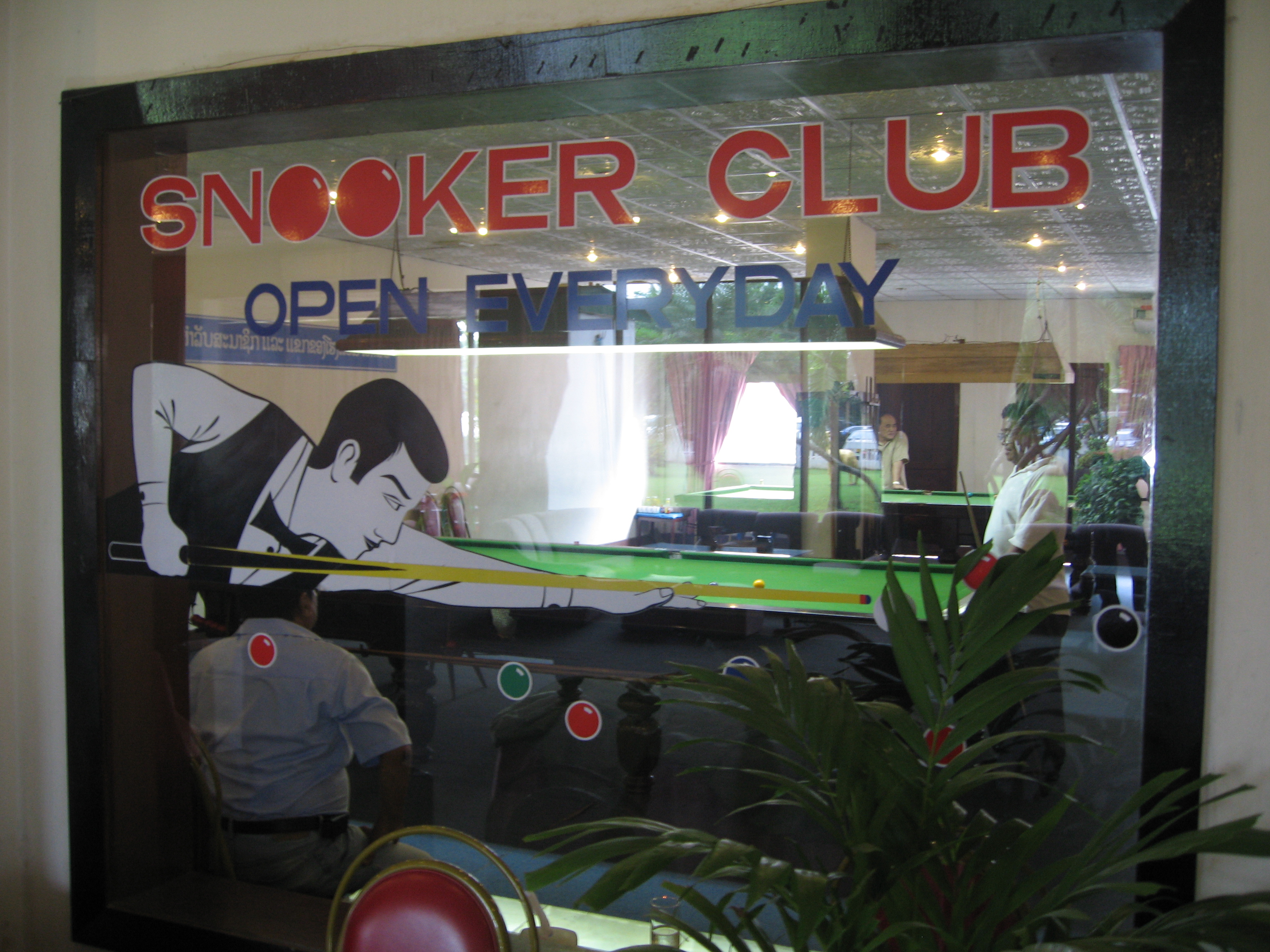
the lan xang hotel has the best billiards tables in Laos.
jim harrison interview
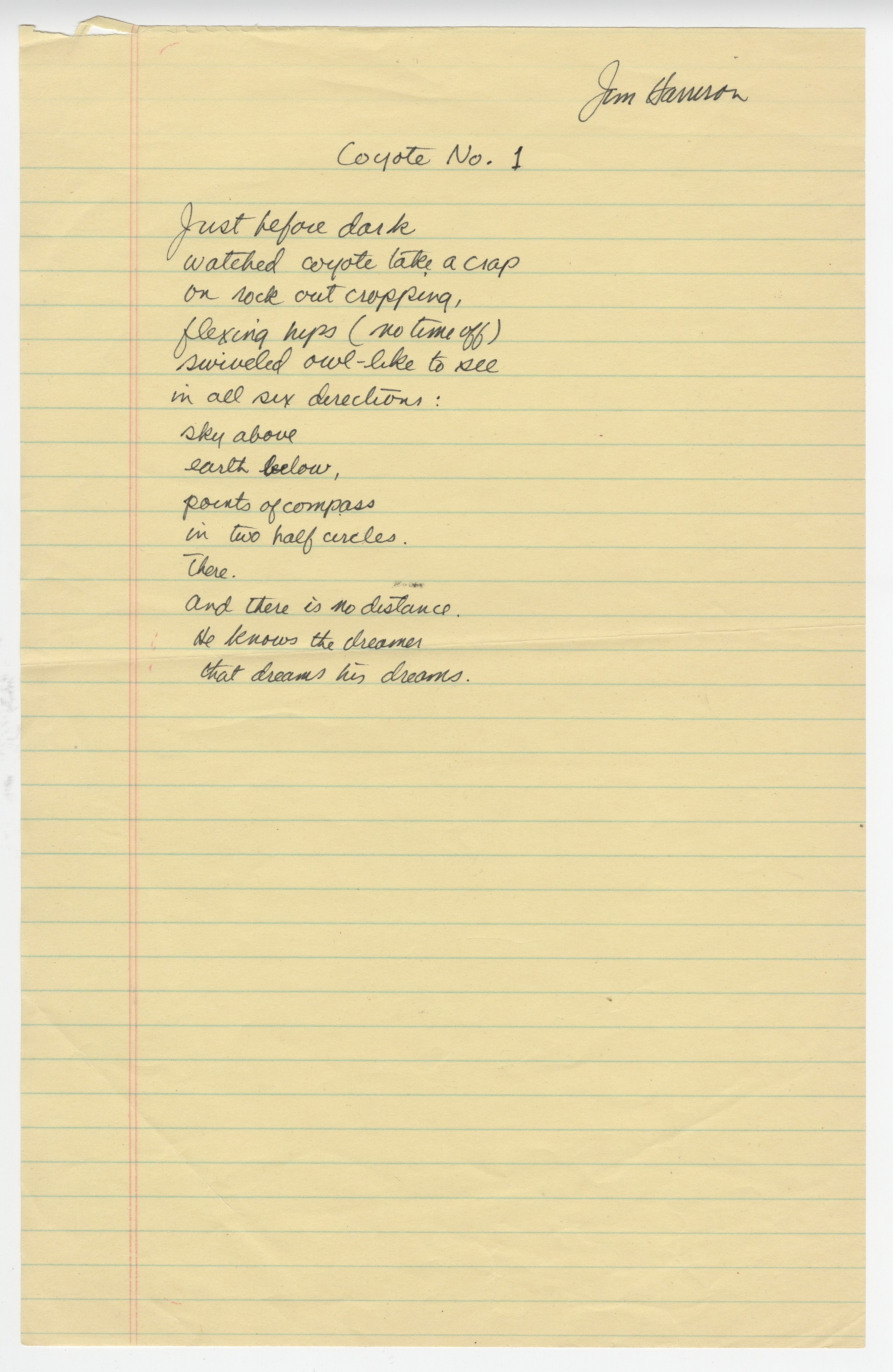
Posted: April 9, 2010 Filed under: interviews, people, poetry, writing | Tags: interviews, poetry, writing Leave a commentI’ve read novelist and poet Jim Harrison’s work since he first started publishing. Jim is simply indispensible to a certain kind of male reader. Women look at him with interest and amusement, I think, something that he’s not entirely against. Recently, I did an interview with him on the Asian connection to his poetry. The interview was published in The Kyoto Journal. The interview isn’t online, but you can click on a pdf version in On the Record (to the right of this post). Also, here’s a manuscript page he sent, but the image wasn’t used so I’m posting it also. Click on the page to enlarge it.
beginning
Posted: April 9, 2010 Filed under: people, writing | Tags: in the beginning, m. john harrison, the word, Wittgenstein Leave a commentIn the beginning was the word. Someone actually wrote that down or said it for the first time somewhere sometime, and it’s a powerful perception still defying understanding, expressed most rigorously by LW when he said something to the effect, “Language confuses meaning,” as if, on the other hand, meaning doesn’t confuse language. At any rate, we’re here as we are, no doubt, partly as a result of words, spoken and unsaid, and we’re now forever awash, swamped, drowned, awed by them all, but still dry inside where from it all arises and passes away. This will do fine as my first post.
But for this…I want to say that M. John Harrison is responsible, unknowingly, for me starting this internet journal. I saw a review he published, I think, in The Guardian, or somewhere like that. Its urgency rattled me so I looked him up, found his brilliant blog, and henceforth birthed this journal. Thanks, Mike.
 the roy hamric journal