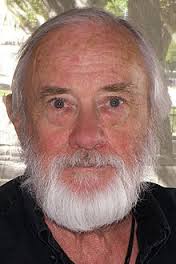
Gary Snyder Talks About Kerouac
Posted: March 12, 2015 Filed under: articles, books, buddhism, people, writing | Tags: gary snyder, jack kerouac, snyder's days with Kerouac, the dharma bums in real life 7 CommentsHere’s a tender recollection of Jack Kerouac by Gary Snyder. It’s included in The Allen Ginsberg Project website, here, along with a video of the interview. The date and source of the interview was not given:

Kerouac in 1960.
“I only knew Jack (Kerouac) personally, in an intimate way, for those few months from the Fall of (19)55 to May of 1956 when I set sail for Japan. I never saw him again, and it was like a brief camp-out together when we shared that cabin in Marin County through the Spring of that year, practiced meditation together, talked Buddhists texts, wrote poetry and drank a lot of Tokaj – and then I left. At that time, all that Jack and I were doing together were practicing mountains, practicing wood-cutting, practicing flowers and birds and practicing Buddhist studies.
Interviewer: Does The Dharma Bums…Is that a really accurate story or is a lot of it made up?
GS: Some of it’s a novel, some of it reflects things that happened, but even the reflection is novel too, like (William) Burroughs would say.
Interviewer: Did you know he was going to write a book about you?
GS: Yeah, he told me, towards the end. He said, “I’m going to write a book about you, Gary, you’re going to be really famous!” – “Really?”
Interviewer: Do you think he had a sense of himself as being a major novelist. I mean as like a..
GS: Yes. I do, at that time even.
Interviewer: In what sense..?
GS: The clear sense of his skill, his power, his vocation, and his energy, and that there was something that he was going to be saying
Interviewer: In a way, there’s a funny kind of worship, you know, of what you represented.
GS: Well, he does that in the novel. He plays that in some of the other novels too, where he makes his first person singular into kind of a naive character that elicits information from people by pretending not to know (and he didn’t do that much with me in person, although, it’s true, he was real naive about some things.
Interviewer: What was.. what was..
GS: He didn’t really know what was involved in going back-packing and hiking and climbing. It was all new to him, but he was a quick learner. And he didn’t know much about nature, or that you could know about nature really, in its specific way. And so, spending some time on the Spring bird migrations and the many species that were coming through Marin County that year – five hundred a year come through Marin County on a Pacific fly-way – so we were checking off species as they came through that little shack and Jack really appreciated all that information.
…Like we were cutting some eucalyptus and splitting eucalyptus for fire-wood the stove and he was like a kid – learning how to start a chain-saw, how to handle a maul – same way as when we went back-packing. Oh, I was going to say, we did another trip too (besides to the High Sierra). We did a.. two-night maybe? camping trip, hiking right from Homestead Valley over Mount Tam. and camping out on the drainages on the north side of Mount Tamalpais..local places..and swinging around and coming back…
Interviewer: Was Kerouac really as frightened… there’s a thing where he..
GS: (shaking his head): Mm-mm
Interviewer: Oh, interesting.
GS: Well, that’s part of his story-telling.
Interviewer: Because he says, “I was a coward” – He says “I was the Buddha known as the coward. At least I have joy”, or something like that [editorial note – Kerouac’s actual line –“I realized I have no guts anyway, which I’ve long known. But I have joy.”]
GS: He likes to play with that. He’s an athlete.
Interviewer: Did you think of him as an intellectual?
GS: No. But well-read, to make the distinction. A very well-read person and a very sharp person with a critical acuity when he wished to employ it, but not like a practicing intellectual, which is a style, (that) is all it is…
GS: The Buddhist metaphor?
Interviewer: Yes
GS: Suffering, impermanence, the First Noble Truth – everything is impermanent and we must find our joy and our freedom in suffering – finally. He swung around through that, to the Buddhist understanding of that – and it’s all through his writing – and then settled back into, maybe, the more familiar comfort of Catholic metaphors…
Now you asked me “Did he seem very American?” and I said “Yes”, and you said “Why?”, and I was ruminating on how to answer that. He was in his physical health and strength, in his unconscious grace, in his child-like-ness, (which was real a lot of the time), in his openness to experiencing new things and learning new things, his paradoxical joy in a kind of freshness in the world (paradoxical, because at the same time he was aware of suffering and impermanence), and maybe all of that is sort of American – And a total absence in Jack of anything elite, or yuppie, or academic, or intellectual, or any of that posturing at all that we associate with learned people, middle-class white people. He was more like your aunt, you know, sitting at a table in the kitchen, or your grandma, sitting at a table in the kitchen, speaking in common-sense truths about orderliness and kindness, basic instructions, and so, very much like my old aunt from Texas, and easy to be with.

Kerouac’s desk in Florida in the house where he wrote The Dharma Bums, the story of his time with Snyder.
Haiku By Issa, (1763–1827)
Posted: February 27, 2015 Filed under: buddhism, people, poetry, writing | Tags: Haiku poetry, Japanese poet Issa Leave a comment
Natural Circles, iPhone photograph by Roy Hamric
Mosquito at my ear –
does it think
I’m deaf?
James Fenton’s Paean to Mexico
Posted: February 26, 2015 Filed under: articles, books, people, poetry, writing | Tags: James fenton on writing, james fenton's paean to Mexico Leave a comment
Christopher Hitchens, James Fenton, Martin Amis, Paris 1979
Here is a beautiful prose poem by James Fenton on Mexico that celebrates attention to place, while also offering a primer on how to ignite creativity – always a solitary exercise. A friend reminds me of the story of Fenton riding on the top of a North Vietnamese army tank that breached the gates of the Presidential Palace during the fall of Saigon in 1975. Has any great poet had such a send-off story to mark the eve of their career? His experience in Vietnam and Cambodia from summer 1973 form sections of All the Wrong Places (1988), a collection of essays.
Lary Wallace’s Take On Stoicism
Posted: February 15, 2015 Filed under: articles, buddhism, states of mind, writing | Tags: stoicism and Buddhism, Stoicism begrudged place in philosophy Leave a comment
Epictetus
My friend Lary Wallace tackles why stoicism is largely misunderstood and not viewed as an early, elegant philosophy, a view I’ve come to share and ponder. The whereof probably stems from the early coupling of stoicism with Sparta and the fearsome emergence of the single-minded, nearly unconquerable Greeks of that era, who encouraged endurance in the face of physical hardship. Endurance translates to a honing of the will, or a view of the mind, of what Wallace calls “indifference.” That’s a really tricky term with shades akin to the Buddhist idea of “letting go,” a way to encourage non-attachment – again a tricky term.
When we’re in this area of Truths, deep understanding, words blur and it brings us to a place where truths slide around and through each other, a philosophical fusion. Anyway, Lary is, as usual, on target in his essay, which can be found here in Aeon, a new online cultural journal that’s one of the best serious websites going now. Look at it…
David Carr: RIP
Posted: February 13, 2015 Filed under: articles, books, people, writing | Tags: david carr was no Brian Williams Leave a comment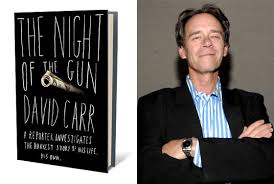

David Carr, 58, died on the job at The New York Times on Thursday. He was one of the great ones: no pretence, accurate, compassionate, humble. He knew his job as a journalist was not to be part of the story, but to serve the story through facts, from which a truth might be born in and of itself, or as part of a larger story pieced together from multiple sources. I haven’t read his autobiography, The Night of the Gun, which chronicled his drug addiction during the 1980s, but I’m sure it’s him, and it’s good. Here’s a link to media bistro with Carr talking about his first big break in journalism. Also see the other videos featuring Carr at this site.
Atticus Lish’s Novel
Posted: January 19, 2015 Filed under: articles, interviews, people, writing Leave a comment By all accounts, Atticus Lish, the son of the editor Gordon Lish, has written a great American novel, in the fullest sense of American. Preparations For The Next Life… I haven’t read it yet, but I can’t resist helping to spread the word on this one. Here’s the New York Review of Books review, and several interviews with Lish on his background and how the book came together. Interview here, here and here.
Here’s the opening paragraph of the NYRB review by Cathleen Schine:
“Preparation for the Next Life, by Atticus Lish, is an astounding first novel about a world so large there is, sometimes, nowhere to go; a world so small the people in it, sometimes, get lost. The book has the boundless, epic exhilaration you expect to find only in a writer as mighty as, say, Walt Whitman. It is a love story, a war story, a tale of New York City in which familiar streets become exotic, mysterious, portentous, foul, magnificent. Some of it reads like poetry. All of it moves with a breathless momentum.”
Robert Stone Dies; Our Moral Existentialist
Posted: January 11, 2015 Filed under: books, fiction, people, writing | Tags: robert stone: our Graham Greene Leave a comment To: The Committee of Responsibility
The first sentences in Dog Soldiers:
“There was only one bench in the shade and Converse went for it, although it was already occupied. He inspected the surface for unpleasant substances, found none, and sat down. Beside him he placed the oversize briefcase he’d been carrying; it’s handle shone with the sweat of his palm. He sat facing Tu Do Street, resting one hand across the case and raising the other to check the progress of his fever. It was Converse’s nature to worry about his health.”
Robert Stone, the award-winning novelist known for “A Flag for Sunrise” and “Dog Soldiers,” has died. He was 77. Stone’s literary agent said Stone died Saturday at his home in Key West, Florida. The cause was chronic obstructive pulmonary disease.
The Bitter Southerner: Great Website
Posted: January 2, 2015 Filed under: music, photography, places, writing 1 Comment
There are many good online websites, but The Bitter Southerner is a big cut above all the rest. The site has a literary slant and down-home naturalness with a big tip of the hat to the cultural past and the cutting edge present. It pays tribute to the legacy, creativity and energy of the southern US. For the site, go here.
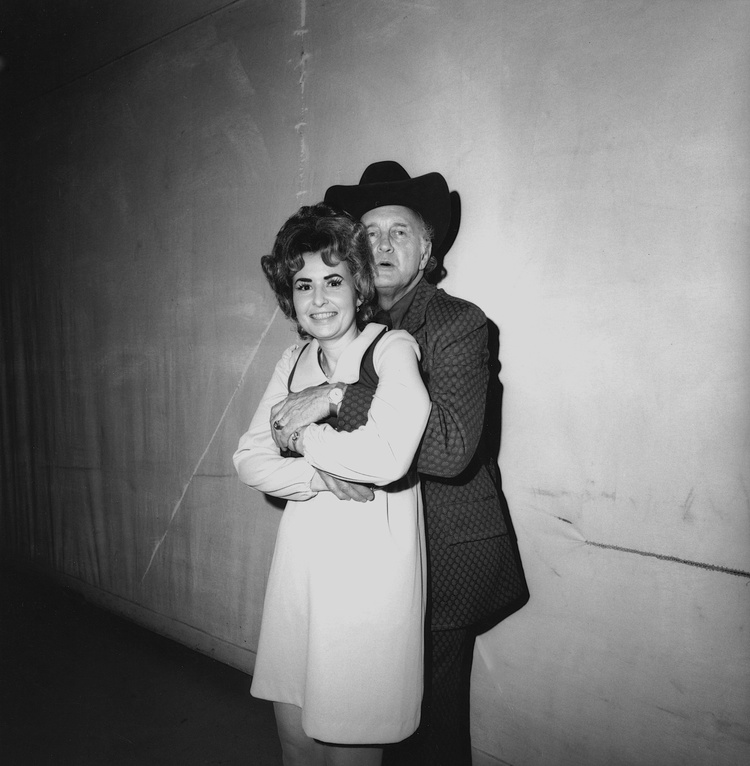
To go right to some good stories go here. Here’s a taste from a current photography essay: Bluegrass legend Bill Monroe and a fan backstage.
Wittgenstein’s riddle of life
Posted: December 23, 2014 Filed under: articles, books, people, states of mind, writing | Tags: natural science, the Tao of Wittgenstein, wittgenstein as poet, wittgenstein's silence Leave a comment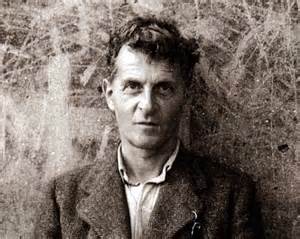
The magnificent ending of Ludwig Wittgenstein’s Tractatus Logico Philosophicus:
…The solution of the riddle of life in space
and time lies outside space and time.
(It is not problems of natural science which have to be
solved.)
6.432 How the world is, is completely indifferent for what is higher.
God does not reveal himself in the world.
6.4321 The facts all belong only to the task and not to its performance.
6.44 Not how the world is, is the mystical, but that it is.
6.45 The contemplation of the world sub specie aeterni is its contemplation
as a limited whole.
The feeling of the world as a limited whole is the mystical
feeling.
6.5 For an answer which cannot be expressed the question too cannot
be expressed.
The riddle does not exist.
If a question can be put at all, then it can also be answered.
6.51 Scepticism is not irrefutable, but palpably senseless, if it would
doubt where a question cannot be asked.
For doubt can only exist where there is a question; a question
only where there is an answer, and this only where something
can be said.
6.52 We feel that even if all possible scientific questions are answered,
the problems of life have still not been touched at all. Of course
there is then no question left, and just this is the answer.
6.521 The solution of the problem of life is seen in the vanishing of
this problem.
(Is not this the reason why men to whom after long doubting the sense
of life became clear, could not then say wherein this sense consisted?)
6.522 There is indeed the inexpressible. This shows itself; it is the
mystical.
6.53 The right method of philosophy would be this. To say nothing
except what can be said, i.e. the propositions of natural science,
i.e. something that has nothing to do with philosophy: and then
always, when someone else wished to say something metaphysical,
to demonstrate to him that he had given no meaning to
certain signs in his propositions. This method would be unsatisfying
to the other—he would not have the feeling that we
were teaching him philosophy—but it would be the only strictly
correct method.
6.54 My propositions are elucidatory in this way: he who understands
me finally recognizes them as senseless, when he has climbed out
through them, on them, over them. (He must so to speak throw
away the ladder, after he has climbed up on it.)
He must surmount these propositions; then he sees the world
rightly.
7 Whereof one cannot speak, thereof one must be silent.
More Dreams
Posted: December 17, 2014 Filed under: buddhism, states of mind, writing | Tags: subconscious, zen dreams Leave a comment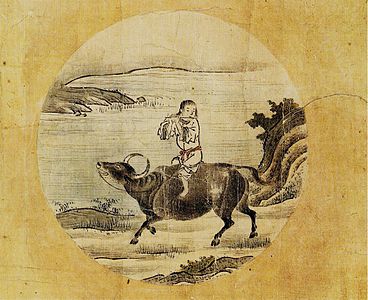
Water Buffalo
March 23, 1989
Poet Bob Trammel, his girlfriend, Allison, and I are in a house that extends over a riverbank on a swiftly flowing river. Through a window, I see a larger-than-life water buffalo swimming against the current toward the house. My first thought is that the buffalo is so big it will crash into the house and sweep it into the river. I watch in amazement as the water buffalo clambers up the almost vertical riverbank, defying gravity. Before I can tell Trammel what’s happening, the buffalo is walking on the roof of the house. Each step is loud, and I think it’s trying to crush the house. I ask Bob if he knows what’s happening. He seems unconcerned, and I think: He doesn’t hear me or the buffalo – I may be dreaming.
I look out the window again, and more water buffalo are swimming toward the house. I must confront the largest buffalo. She exudes great power, but I feel I can tame her. I jump into the river, swim over, and scramble onto her back. Then she turns and begins swimming to the other side of the river. On the riverbank, she turns into a normal, calm water buffalo, and I slide off onto the ground.
 the roy hamric journal