
A River Runs Through It: The ending
Posted: March 23, 2014 Filed under: books, fiction, writing 1 Comment The ending, and especially the last two paragraphs, of Norman Maclean’s masterful A River Runs Through It echo the Bible and the true American idiom:
“Now nearly all those I loved and did not understand when I was young are dead, but I still reach out to them.
“Of course, now I am too old to be much of a fisherman, and now of course I usually fish the big waters alone, although some friends think I shouldn’t. Like many fly fisherman in western Montana, where the summer days are almost Arctic in length, I often do not start fishing until the cool of the evening. Then in the Arctic half-light of the canyon, all existence fades to a being with my soul and memories and the sounds of the Big Blackfoot River and a four-count rhythm and the hope that a fish will rise.
“Eventually, all things merge into one, and a river runs through it. The river was cut by the world’s great flood and runs over rocks from the basement of time. On some of the rocks are timeless raindrops. Under the rocks are the words, and some of the words are theirs.
I am haunted by waters.”
—A River Runs Through It
Emerson’s scandalous ideas
Posted: March 14, 2014 Filed under: people, photography, poetry, states of mind, writing Leave a comment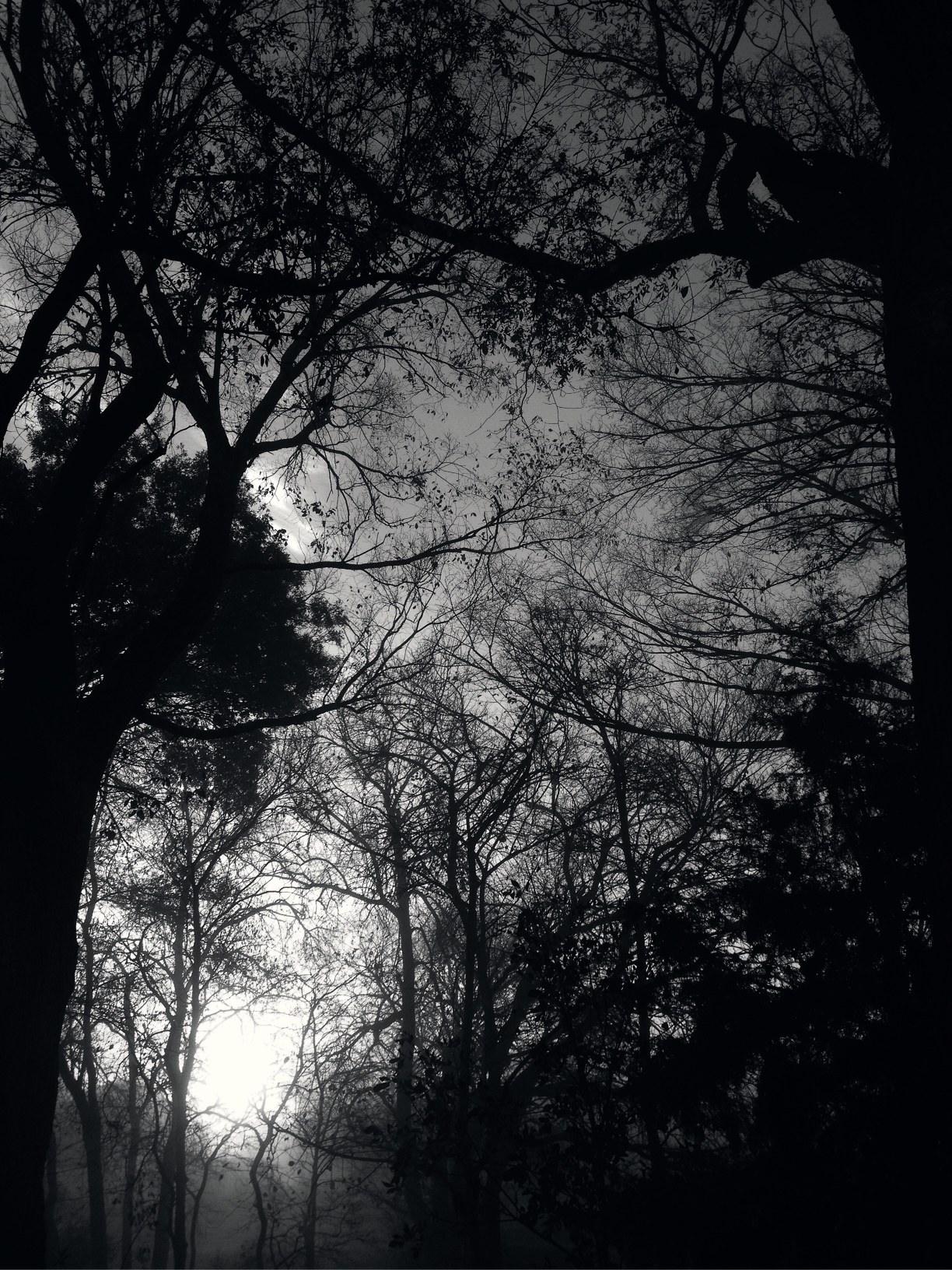
In The Woods; a photograph by Robert Crosby
Whoso walketh in solitude,
And inhabiteth the wood,
Choosing light, wave, rock, and bird,
Before the money-loving herd,
Into that forester shall pass
From these companions power and grace.
Emerson– Woodnotes II
Modern transcendental idealism, Emersonianism, for instance, also seems to let God evaporate into abstract Ideality. Not a deity in concreto, not a superhuman person, but the immanent divinity in things, the essentially spiritual structure of the universe, is the object of the transcendentalist cult. In that address to the graduating class at Divinity College in 1838 which made Emerson famous, the frank expression of this worship of mere abstract laws was what made the scandal of the performance. – William James, The Variety of Religious Experience
Lawrence Durrell, from the Alexandria Quartet
Posted: March 13, 2014 Filed under: books, people, writing Leave a comment“For us artists there waits the joyous compromise through art with all that wounded or defeated us in daily life; in this way, not to evade destiny, as the ordinary people try to do, but to fulfil it in its true potential – the imagination.” – From The Alexandria Quartet, by Lawrence Durrell, 1912- 1990

Durrell lived on the top floor of this house in Alexandria. While there, he wrote Prospero’s Cell.
Philip Roth Praises US Crop of Novelists
Posted: March 3, 2014 Filed under: books, fiction, interviews, people, writing Leave a comment
Philip Roth may be enjoying his days more now, since it’s going on five years since he said he had decided to still his pen as a novelist. But that doesn’t mean he’s not still making literature, this time in the form of a literary interview conducted by a Swedish journalist, which has just appeared in The New York Times Book Review.
The interview sheds light on his own work and his methods, and also the current golden age of American novels. He spins off a list of American novelists, a paean to the uniqueness of American literature that captures as it does the modern and the universal world, writ large through America’s novelists’ eyes. Even in the face of America’s overpowering popular culture, he says, literature lives:
“What has the aesthetic of popular culture to do with formidable postwar writers of such enormous variety as Saul Bellow, Ralph Ellison, William Styron, Don DeLillo, E. L. Doctorow, James Baldwin, Wallace Stegner, Thomas Pynchon, Robert Penn Warren, John Updike, John Cheever, Bernard Malamud, Robert Stone, Evan Connell, Louis Auchincloss, Walker Percy, Cormac McCarthy, Russell Banks, William Kennedy, John Barth, Louis Begley, William Gaddis, Norman Rush, John Edgar Wideman, David Plante, Richard Ford, William Gass, Joseph Heller, Raymond Carver, Edmund White, Oscar Hijuelos, Peter Matthiessen, Paul Theroux, John Irving, Norman Mailer, Reynolds Price, James Salter, Denis Johnson, J. F. Powers, Paul Auster, William Vollmann, Alison Lurie, Flannery O’Connor, Paula Fox, Marilynne Robinson, Joyce Carol Oates, Joan Didion, Hortense Calisher, Jane Smiley, Anne Tyler, Jamaica Kincaid, Cynthia Ozick, Ann Beattie, Grace Paley, Lorrie Moore, Mary Gordon, Louise Erdrich, Toni Morrison, Eudora Welty (and I have by no means exhausted the list) or with serious younger writers as wonderfully gifted as Michael Chabon, Junot Díaz, Nicole Krauss, Maile Meloy, Jonathan Lethem, Nathan Englander, Claire Messud, Jeffrey Eugenides, Jonathan Franzen, Jonathan Safran Foer (to name but a handful)?”
William Gass: On Being Blue
Posted: February 19, 2014 Filed under: articles, books, people, states of mind, writing Leave a commentThe estimable The New York Review of Books has reissued William Gass’s On Being Blue, a philosophical romp through moods, colours and much more. Gass is a writer who, one hundred years from now, may emerge as one of the few contemporary writers whose work will enter the American canon. Here’s the NYRB description:
“On Being Blue is about everything blue—sex and sleaze and sadness, among other things—and about everything else. It brings us the world in a word as only William H. Gass, among contemporary American writers, can do.
Gass writes:
“Of the colors, blue and green have the greatest emotional range. Sad reds and melancholy yellows are difficult to turn up. Among the ancient elements, blue occurs everywhere: in ice and water, in the flame as purely as in the flower, overhead and inside caves, covering fruit and oozing out of clay. Although green enlivens the earth and mixes in the ocean, and we find it, copperish, in fire; green air, green skies, are rare. Gray and brown are widely distributed, but there are no joyful swatches of either, or any of exuberant black, sullen pink, or acquiescent orange. Blue is therefore most suitable as the color of interior life. Whether slick light sharp high bright thin quick sour new and cool or low deep sweet dark soft slow smooth heavy old and warm: blue moves easily among them all, and all profoundly qualify our states of feeling.”

Edmund Wilson on America’s Role
Posted: February 3, 2014 Filed under: books, people, writing Leave a commentFrom Edmund Wilson’s A Piece of My Mind (1957):
“One can say that on the one hand, you find in the United States the people who are constantly aware… that, beyond their opportunities for money-making, they have a stake in the success of our system, that they share in the responsibility to carry on its institutions, to find expression for its new point of view, to give it dignity, to make it work; and, on the other hand, the people who are merely concerned with making a living or a fortune, with practicing a profession or mastering some technical skill, as they would in any other country, and who lack or do not possess to the same degree, the sense of America’s role.”
Wilson was – and still is – America’s essential literary and cultural critic. He left a body of work that changed and is still transforming our sense of who we are. For me, he and Emerson are the true America spirit, the American mind. I feel an Edmund Wilson phase of deep rereading coming to the fore. Also, great timing, I just found a copy of Clive James’ first book of collected criticism, The Metropolitan Critic. James has written seminal essays which go to the heart of Wilson’s unique role as a writer-critic. First James, and then back to Wilson for the umpteenth time…
The Rain Tree at the Gymkhana Club
Posted: January 27, 2014 Filed under: articles, books, people, places, writing Leave a comment
The rain tree at the Gymkhana Club in Chiang Mai. Photograph by Bruce Bridges
The Rain Tree at the Gymkhana Club
By Roy Hamric
This essay appeared in the Kyoto Journal, Issue 79, Spring 2014.
Do not require a description of the countries toward which you sail. The description does not describe them to you, and tomorrow you arrive there and know them by inhabiting them. – Emerson, The Over-Soul
Many writers have left exact descriptions of their first taste of Asia. For Joseph Conrad, the East’s charm lived in his heart – in what he called romantic reality. It’s what drove many of his best-known characters, like the young seaman in Lord Jim, who longed to lose himself, to be stripped down to a bare, primitive moment.
Conrad wrote, “This in itself may be a curse, but, when disciplined by a sense of personal responsibility and a recognition of the hard facts of existence shared with the rest of mankind, it becomes but a point of view from which the very shadows of life appear endowed with an internal glow. It only tries to make the best of it, hard as it may be; and in this hardness discovers a certain aspect of beauty.”
To be under the spell of a place, or a state of mind, quickens the blood. But behind the spell lies a deeper mystery imprinted in our subconscious – the desire to answer an unidenifiable call.
In the novel Youth, Conrad described the exact moment when Marlow, his narrator, first sensed the East: “… and suddenly a puff of wind, a puff faint and tepid and laden with strange odors of blossoms, of aromatic wood, comes out of the still night – the sigh of the East on my face.”
Marlow never escaped the spell of that sublime moment – the sense of life flowing from a new direction, a shift of culture from western to eastern. For some of us, it is a seduction of the soul.
Writing as Marlow, Conrad said, “But for me, all of the East is contained in that vision of my youth. It is all in that moment when I opened my young eyes on it…and I saw it looking at me.”
In the short story The Shadow-Line, he described the Bangkok of the 1890s, at the time of his first sighting: “One early morning we steamed up the innumerable bends, passed the shadow of the great gilt pagoda, and reached the outskirts of town. There it was, spread largely on both banks, the oriental capital which had yet suffered no white conqueror. Here and there in the distance, above the crowded mob of low, brown roof ridges, towered great piles of masonry, king’s palaces, temples, gorgeous and dilapidated, crumbling under the vertical sunlight, tremendous, overpowering, almost palpable, which seemed to enter one’s breast with the breath of one’s nostrils and soak into one’s ribs through every pore of one’s skin.”
A very different writer, the cosmopolitan Somerset Maugham, in the early 1920s, toured Burma and Siam. In a nearly forgotten travel book, The Gentleman in the Parlour, he captured a fading moment when Bangkok had yet to blend in with the West:
“The traffic of the river ceased and only now and then did you hear the soft splash of a paddle as someone silently passed on his way home. When I awoke in the night, I felt a faint motion as the houseboat rocked a little and I heard a little gurgle of water, like the ghost of an Eastern music travelling not through space but through time.
“A leisurely tram crowded with passengers passes down the whole length of the street, and the conductor never ceases to blow his horn. Rickshaws go up and down ringing their bells, and motors sounding their claxons. The pavements are crowded and there is a ceaseless clatter of the clogs the people wear. Cloppity-clop they go, and it makes a sound as insistent and monotonous as the sawing of the cicadas in the jungle.”
Alex Waugh left a portrait of expatriate, turn-of-the-century Siam in Hot Countries, published in 1930, nearly three generations removed from today. Describing colonial life and the “natives” in Chiang Mai, he reflected the racist attitudes and language that permeated colonial culture. A well-educated Englishman, he presumed Western superiority, and his attitudes reflected the repression and guilt surrounding sexual mores. He used the expression “gone native” as a rebuke to Westerners who entered the normal life of Asian culture, or who openly took wives or girlfriends and shared their lifestyle. As a journalist who racked up books about exotic countries like they were way stations on a news beat, Waugh described “white life” in old Chiang Mai.
It was especially difficult on Western women, he wrote, and he urged them to stay home rather than endure a life of isolation, boredom and disease. He admitted he’d never personally known of a case of a white man who had “gone native,” but he’d heard rumors and had constant suspicions. The “gone native” phrase was nuanced – most of the time it was a code word for sexual relations or cohabitation.
“In the popular imagination,” he wrote, “the ‘gone native’ myth has become identified with that very different, very real problem of the tropics – the white man and the brown woman.”
It’s easy to pass over 19th-century Western attitudes and the social barriers faced by both Westerners and Asians. But a careful reading makes you cringe. Waugh wrote: “In Bangkok, it would be impossible for a white man to have a Siamese girl living in his bungalow, but on the plantation there is fairly often a Malay girl who disappears discretely when visitors arrive. There the relationship has a certain dignity. There is faithfulness on both sides. Custom creates affection. But in neither case is there any approach to the ‘gone native’ picture. In neither case has the white man done anything that involves loss of caste. He observes the customs of the country.”
In scalding sentences that magnify the distance, he wrote: “All the same, I believe it is extremely rare for there to exist a profound relationship between a white man and a brown woman.” Again, “I have yet to meet the man who will say that he has really loved a coloured woman.”
And, “Love, as we understand it, is foreign to these people.” And, “Between brown and white there can be only a brief and superficial harmony.” And finally, “Between brown and white there can be no relation interesting in itself.”
To get to Chiang Mai, Waugh took the Bangkok passenger train for the 27-hour journey north. If you went by river, it was a five-week journey. Chiang Mai was the administration center of two large timber companies, the Borneo and Bombay Burma. Waugh felt he was going to the end of the road where the “white community” had to unite together against a “common foe.”
“There are not, I fancy, more than thirty white people in the station,” he wrote. “There is the bank manager and the English consul; there are the forest manager, and an occasional assistant who has come in from the jungle for a rest; there is an American mission which is responsible for schools and the hospital and a big sanatorium for lepers.”
The social “white life” of Chiang Mai was centered around the Gymkhana Club, chartered in 1898, which is still in operation today. As I write this, I sit near a majestic rain tree that is older than the club, its huge limbs casting shade over outdoor tables.
“It is a large field set a little way out of town which serves as a polo ground, a golf course and a tennis court,” Waugh wrote. “By five in the evening, most of the white community is there. There is 75 minutes of strenuous exercise, then there is a gathering around a large table on which have been set out drinks, glasses and a little lamp. There are rarely more or rarely less than a dozen people there…the women have slipped their legs into sarongs, sewn up at one end in the shape of bags. Their life is hard and testing. It has many dangers, many difficulties. It is only by mutual tolerance, by interdependence, by loyalty and friendship that it can be made tolerable.”
The rain tree is a stone’s throw from the northern bank of the Mae Ping River as it winds past the city’s old Chinese night market and main tourist hotels. For decades, the club remained a tranquil oasis of white privilege, but after WW II it fell on hard times. By the 1950s, the last of the Western lumber concessions had disappeared. Club membership had dwindled to less than 20, and to avoid bankruptcy the directors voted to offer 12 Thais full membership. By early 2000, the club membership rebounded to around 300 people. Thais numbered about 60 percent and one Westerner served on the board of directors.
The centerpiece of the club is still the venerable rain tree, marking the passage of time. Its shade certainly fell across the figure of the visiting Waugh, whose cultural blinders prevented him from truly knowing Asians. To know the other is as hard as to know one’s self, if not harder.
To live here one would be charged in the quiet, small currency of the conscience. – Graham Greene, describing Vietnam in his essay collection, Reflections.
The three generations between Waugh’s Hot Countries and Greene’s The Quiet American, published in 1955, saw sweeping changes in cultural attitudes. The world grew smaller. In The Quiet American, the correspondent Thomas Fowler, Greene’s alter ego, admits his love and his desire to marry his Vietnamese mistress, Phoung. But his cynicism and sense of superiority still color the relationship. At first, it’s as if he is taking on a beautiful naïf, a woman perfectly designed to be of service to a superior Western man. Later, Fowler learns that the reverse might be closer to the truth.
Phuong is a classic Vietnamese mistress, a heroine who deftly controls and dispenses her emotions and affections between her interests in Fowler and his nemesis, the wide-eyed, naive American, Alden Pyle. She’s capable of breaking the idealistic Pyle’s heart, but she presents little romantic danger to Fowler, who strives to be the dispassionate observer, a stoic who sees emotional attachment as vulnerability. Fowler is a post-colonial man poised at a moment of romantic growth, but just barely. He starts with the typical, Western cultural baggage that is still lugged around today by too many expatriates arriving on Boeing 787s.
Fowler thinks: “It is a cliché to call them children – but there’s one thing which is childish. They love you in return for kindness, security, the presents you give them – they hate you for a blow or an injustice. They don’t know what it’s like – just walking into a room and loving a stranger. For an aging man, it’s very secure. She won’t run away from home so long as the home is happy.”
Later, his cynicism is shaken and his emotions expand when he realizes Phuong “was as scared as the rest of us – she didn’t have the gift of expression, that was all.” Greene gives Fowler an emotional breakthrough when he finally grants Phoung equal emotions – something he should have understood long before, but worth learning at any age.
A Poem for Red Pine
Posted: January 26, 2014 Filed under: people, poetry, writing Leave a commentA Poem for Red Pine
Bill Porter went West, took a new name
and came back from the East to spread the word.
A master of the shadow art,
he trails behind
recasting Chinese ideograms into new lines
for English minds.
He works from a second floor study in Port Townsend,
deciphering black strokes from faraway days with sharp eyes,
diamond mind – a time of flaming hearts:
writers of the Silent Word.
On the wall of his study, a Tibetan tanka.
A small painting of bamboo with a poem by Wang Wei.
Through a window, the Cascade Mountains.
Through another window, the ocean.
Through another window, the branch of a plum tree.
Pine trees and bamboo sway in the morning wind.
Light brightens a new day
as the pine tree’s shadow disappears,
leaving no trace.
Big Bend Burro Lady, Judy Magers
Posted: January 25, 2014 Filed under: people, photography, places, writing 1 Comment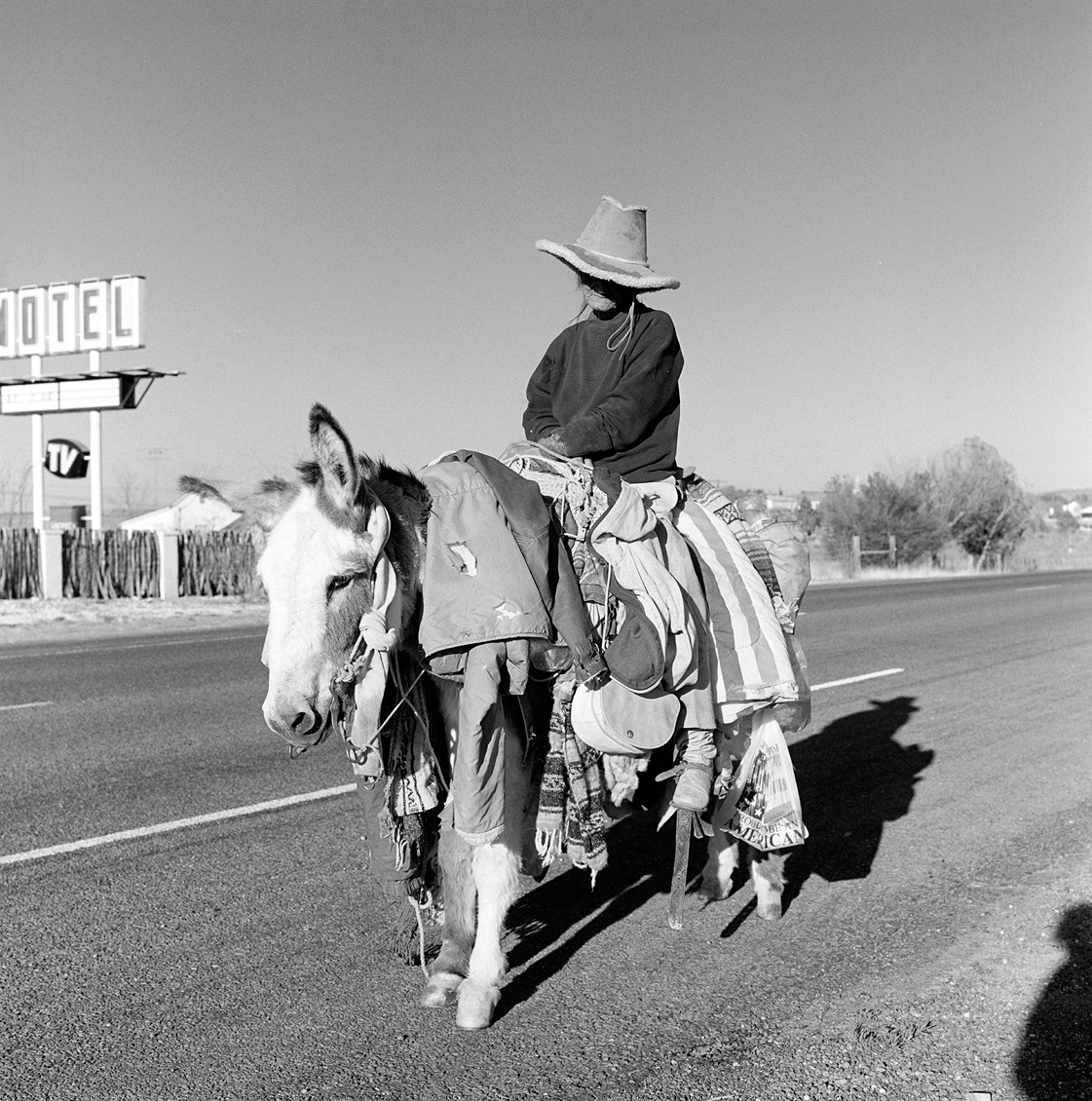
The Burro Lady of Big Bend; photograph copyright James Evans
By Roy Hamric
For decades, most folks in Far West Texas at one time saw Judy Magers on her burro riding along the side of the highway or camping next to the road. This story first appeared in 2008 in the Desert Candle, a cultural journal published in Alpine, Texas. Judy died of a heart attack on January 26, 2007, in Sierra Blanca.
We saw Judy about one mile east of Van Horn on Highway 90. She was sitting on the ground on the side of the road under a small tree and eating food with her fingers. A harsh, cold wind was blowing. Several plastic bags flapped loudly, caught on the barbed wire strands of a fence behind her. Her burro was still saddled, head down, bedecked with the rainbow-colored blankets and brightly colored strings that made it look like a psychedelic, walking Christmas present. The burro carried an assortment of blankets, ropes, bottles and storage bags that represented Judy and her way of life as a vagabond, a mysterious spirit with no home. She lived under the stars.
“Hi, how are you? Can I talk to you?” Laddawan, my Thai wife, asked through the car window. Judy nodded. We got out and Laddawan went over to her and sat down beside her. Laddawan’s puppy followed her and nestled down beside them.
Judy wore three or four coats. She had on white plastic boots with silver spurs. She wore a tight, white plastic skullcap that came down over her ears, making her look like a medieval apparition from a painting by Hieronymus Bosch. The skin on her face was swollen and raw and colored brownish red from the wind and years of living outdoors.
“Do you want some water?” Laddawan asked.
“No, thank you. I have some water.”
“Are you ok? What’s your name?”
“My name’s Judy. You have a beautiful puppy.”
“Yes, he is my baby. His name is Roxy. How old is your donkey?”
“Eight years.”
“Male or female?”
“Male.”
“Can I touch him?”
“Don’t get too close to him, because he might kick.”
“Oh, ok.”
“How old are you?” Laddawan asked.
“How old are you?” Judy asked.
“I’m 35.”
“I’m 29,” Judy said, smiling.
Laddawan laughed. “I’m from Thailand. I’m very interested in you. I like to talk with people – it makes me happy, because sometimes when I am alone I feel sad and homesick.
“You have to buy a radio,” Judy said.
“Do you have a radio?”
“Yes,” she said. “I have a small transistor radio.”
“And you listen to it?”
“Sometimes. I like Mexican music at night.”
“Do you have a problem with animals—tigers, javelina?” Laddawan asked.
“No,” Judy said. “I’ve never had a problem”
“Where are you going?”
“I’m lookin’ for some land to buy,” Judy said. “I hear they have cheap land over around Sanderson.”
“Why do you want land? Just to put some things?”
Judy nodded.
Judy said she roamed the lonely highways as far south as Terlingua near the Mexico border and from Sanderson to Van Horn to Fort Hancock.
“I don’t stop too much,” she said. She said she could average 12 to 15 miles a day, riding or walking alongside her burro.
“Can I take a picture with you?” Laddawan asked.
“You can take a picture of the burro, but I don’t want my picture taken.”
Judy got up and began fiddling with a rope tied to a fence post while I took a picture of her burro.
“If I see you later, can I talk to you again?” Laddawan asked.
“Ok”
Laddawan reached over and tried to shake Judy’s hand, holding two of her fingers.
“Ok, you have a good day,” Laddawan said. “I want to stop and talk to you whenever I see you. It’s nice to meet you.”
“Nice to meet you, too,” Judy said.
Back in the car, we made a U-turn across the highway, and Laddawan waved goodbye.
“I want to be friends with her,” Laddawan said, smiling. “Maybe someday I will live like that – a wandering nun.”

Judy camped on the side of the highway near Van Horn; photograph by Roy Hamric
Elephant Kingdom
Posted: January 19, 2014 Filed under: books, people, places, writing Leave a comment This book was a secret escape into another world, reminding me of the pleasures of childhood reading. It opened up a fascinating realm of nature and animals. I found a battered, spine-broken, worm-eaten edition that had passed through the Penang Library in 1959. It’s a two-track story: first, it’s the story of the Indian working elephant – jungle royalty. Second, it’s a record of a young Englishman’s life, who has been thrown into the job of a “teak wallah” for seven years in the mountainous areas around Chiang Mai in the early 1950s.
Essentially, he’s a clueless but eager, hardy soul who takes over the responsibility of managing a crew of clever and sometimes exasperating Thais and savvy hill tribe workers charged with cutting and hauling out of the deepest jungles of Northern Siam (now known as Thailand) timber that was prized for its strength and beauty. “These elephants possess the virtues of a crawler tractor, crane, bulldozer and tug combined in one package and are endowed with a high degree of intelligence,” wrote H.N. Marshall. In the 1950s, the area around Chiang Mai was still wild and dangerous, especially when sending the cut timber down the small streams into the Mae Ping River where the logs slowly worked their way downriver to the larger Chao Phraya, eventually arriving in Bangkok as long as four or five years later. Huge logjams blocked the river trip along the way, which had to be “un-jammed” by man or elephants in the most dangerous situations imaginable.
Opium crazed workers, pythons in the rafters, hunting game for fresh meat, the lore of treating sick elephants, the devotion of their mahout, berserk elephants on rampages defending their turf, night-stalking tigers, outlaws and bandits, marauding mosquitoes, flies, ants, termites, spiders and centipedes. It was a life and work few people could do. But he found the satisfaction that comes from doing work unimaginably hard, work one thought themselves incapable of doing.
Marshall wrote, in a goodbye tribute, in that effusive English language of his day: “On forested hills, in steamy valleys and swampy lowlands, in extremes of heat, wet and cold, and at all times of day and night, I had come to know the Indian elephants for what they are: the unquestioned Kings and Queens of the jungle.” The daily life he unfolds is warmer, simpler, richer and supremely demanding, a life few people could endure and which he must have carried like a dream through his routine life when he returned home to the easy comforts of England.
 the roy hamric journal