
Time & Space
Posted: January 13, 2014 Filed under: books, places, time, space, writing 1 Comment
Monday, 11 a.m., January 13, 2014
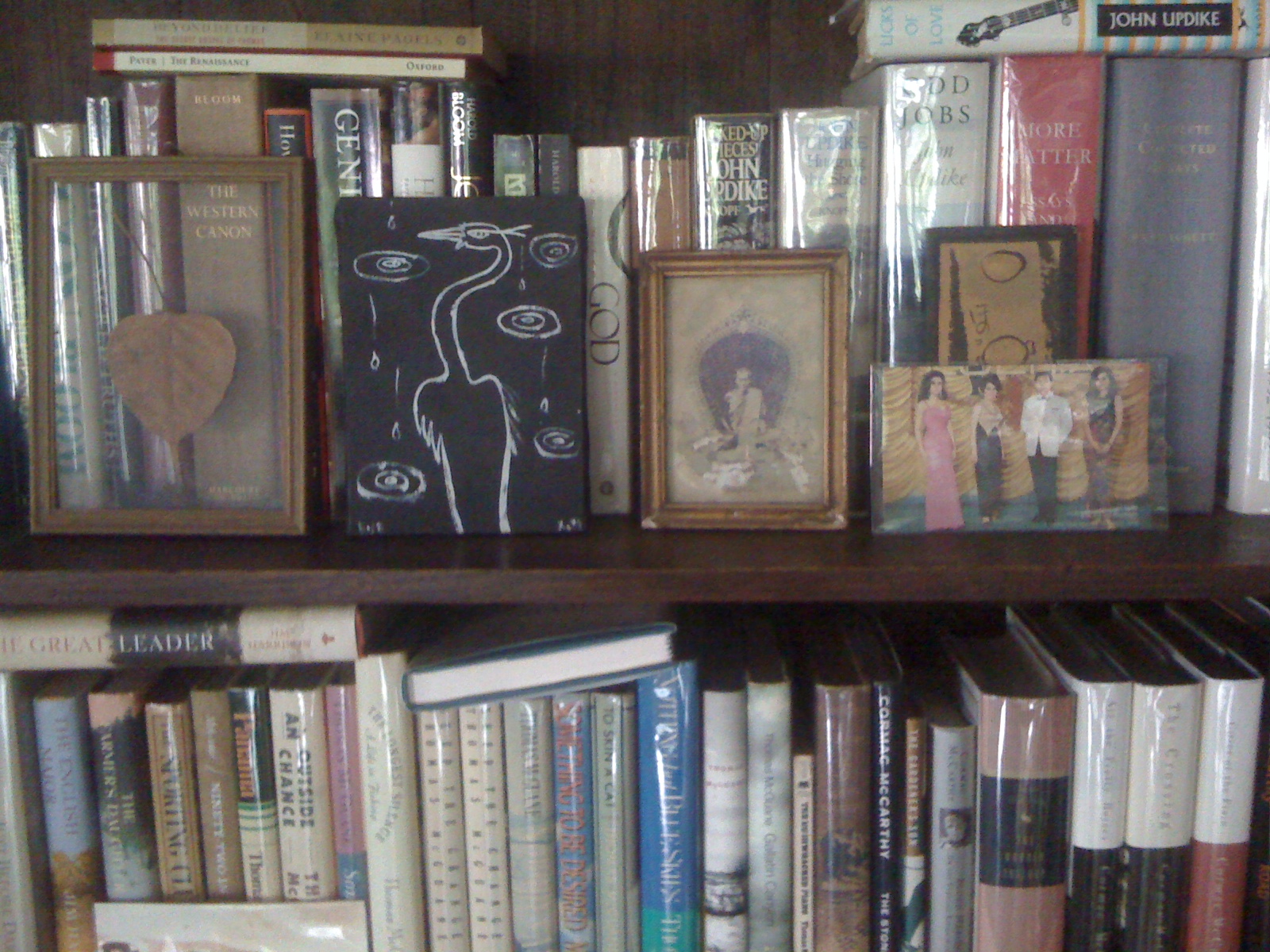
I sometimes call it an office, but it’s not that in any traditional sense. It’s a room lined with bookcases wherever a window isn’t located. Various small pictures rest on the bookcase shelves. Old postcards – one a picture of three women singers at the Lolita Club in Bangkok in the 1950s. Two small, framed, antique pictures of famous monks. A framed heart-shaped leaf from a Bodhi tree. A 6-foot, teak desk sits under four windows. The floor is teak. A sliding door opens onto a long porch, always offering shade. On the desk is a notebook computer, various black, gray, white and brown rocks worn smooth from years in local streams. A bronze turtle, a wooden frog, two small ivory horses. Two ivory-inlaid, small circular boxes from China. Two small, wooden elephants, two statues of the Buddha from China. Framed pictures on the wall include a Tibetan symbol for Om, a color photo of a sunset over the Rio Grande in the Big Bend, a picture of three wood ibises about to land on a river in East Texas, a small oil painting of a heron by Texas artist Frank Tolbert, Chinese calligraphy for the word Mu, a picture of Han Shan and Pick-up, a picture of Jiun’s calligraphy for the word Buddha. The books were mostly shipped here from the US, or were bought at local used bookstores. Most are old friends that have stood the test of time. This space helps to keep me alive, to keep me me, in the sense of being drawn into this mystery. My life.
Red Pine’s Canny Commentaries on Buddhist Sutras
Posted: January 10, 2014 Filed under: articles, buddhism, people, states of mind, writing Leave a comment
Red Pine hitching a ride in China. Photograph by Ted Burger
Red Pine’s probing and understanding of the major Buddhist sutras: The Heart Sutra, The Platform Sutra of the Sixth Patriarch, The Diamond Sutra and, the latest, The Lankavatara Sutra, in addition to his earlier translation and commentary on The Tao Te Ching continue to deepen. With each translation his commentaries have grown more profound, especially on how all the sutras, taken together, form a whole, offering an approach to the difficult metaphysics that bewitch people looking for the answer to life’s riddles.
Red Pine’s latest commentary on the Lankavatara Sutra is a good example of how he draws all the sutras together. For instance:
“Buddhism is concerned with suffering, which is the inevitable result of desire. But the real issue is the self, which is the cause of the desire, which is the cause of the suffering. In the centuries following the Buddha’s Nirvana, instructions centered around a trio of concepts designed to focus attention in such a way that the nonexistence of the self would become evident and the liberation from suffering would follow. These included the five skandas (form, sensation, perception, memory and consciousness), the twelve ayatanas (six powers and six domains of sensations), and the eighteen dhatus (the ayatanas with the addition of six forms of consciousness). These were three views of the same thing: our mind.
“The were simply different ways of dividing any given moment of awareness into a manageable matrix to demonstrate to anyone willing to wander around these matrices that they contained the universe of our awareness, its inside and its outside, and yet they contained no self. This was their function: to show practitioners that there was no self.
“While these three schemes dealt with the problem of the self, they didn’t help explain how we become attached to a self in the first place, and how we go from attachment to detachment to liberation. Hence, to these were added three more schemes, all of which play a much larger role in the Lankavatara Sutra than the previous trio. The three new schemes are the five dharmas, the three modes of reality, and the eight forms of consciousness.
“The five dharmas divide our world into name, appearance, projection, correction knowledge and suchness. The three modes of reality do the same thing with imagined reality, dependent reality, and perfected reality; and the eight forms of consciousness include the five forms of sensory consciousness, conceptual consciousness, the will or self-consciousness, and an eighth form known as repository consciousness, where the seeds from our previous thoughts, words and deeds are stored and from which they sprout and grow.
“As with earlier trios of concepts, these were designed to account for our awareness without introducing the self. But they had the advantage of also providing a look at how our worlds of self-delusion and self-liberation come about, how enlightenment works, how we go from projection of name and appearance to correct knowledge of suchness, how we go from an imagined reality to a perfected reality, how we transform our eightfold consciousness into Buddhahood.
“….But then the Lankavatara Sutra sets all these schemes aside in the interest of urging us to taste the tea for ourselves….Cup of tea or not, no one said it was going to be easy…”
He goes on to explain how the Lankavatara confounded his understanding for 35 years. Everyone’s approach may differ, but a good step would be to try the sutras in a sequence such as this: the Tao Te Ching, The Heart Sutra, The Platform Sutra, The Diamond Sutra and the Lankavatara Sutra.
Red Pine always offers good advice. His life has been devoted to translating these sutras to deepen his own understanding and wisdom.
Also, as his wisdom – and his humor – ripen, he becomes more humble. The mark of a real teacher
Sight Seeing
Posted: January 9, 2014 Filed under: places, sight seeing, writing Leave a comment
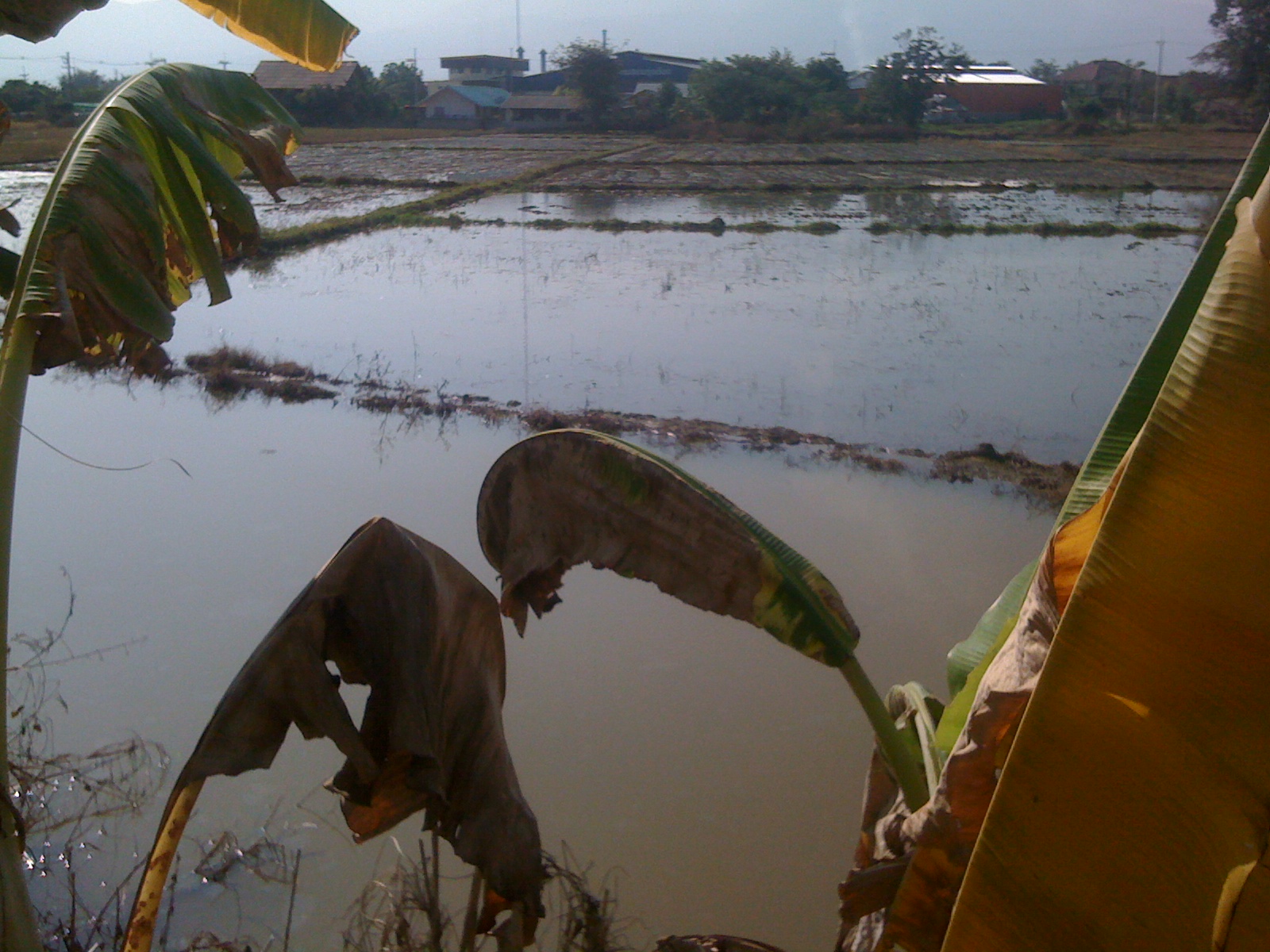
After weeks of cold nights and mild days, the air was dry this morning. The sun is warming the land. The light is bright, crisp, but it still holds a yellow tint as it rises into the dark blue sky. It can’t be Spring, but it feels like it. The neighborhood farmers wade calf-deep in the rice paddies. The separation dikes are rebuilt, water is draining into the square, sere paddies, some still showing the stubs of rice stalks burnt black after the last harvest. The light on the still water casts silver streaks across the surface. The yellow legs of white egrets, for a moment, hang back straight as they rise airborne, their wings moving slowly, wand-like over the Earth.
A tribute from the natural world. Last night, Katy the Cat caught a large mouse. Some remains, a head, hind legs and a few entrails, were left uneaten. She placed them near the water bowl in my office.
Where’s Roxy Gordon?
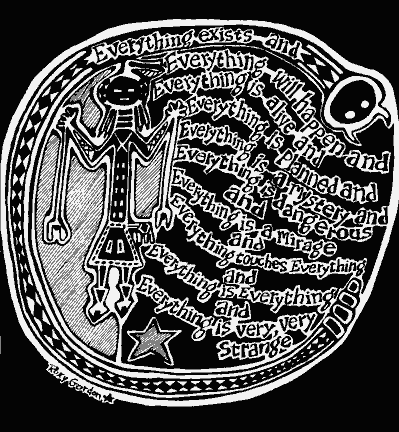
Posted: January 5, 2014 Filed under: articles, buddhism, people, poetry, writing 2 Comments I looked for Roxy Gordon’s website today, and couldn’t find it. I’ve written his wife, Judy, for more information. I still can’t write about Roxy, who’s dead and buried outside of Talpa, Texas, near his “house up” home/campsite in West Texas. It’s one of those small, flat-top hills with the mesquite-desert spaces in between. Roxy was a writer-artist-musician-poet. Even more important, he had what Indians call medicine. People in Asia would say he was a man of The Way. He knew some things.
Here’s a link to Smaller Circles, his poem/talking word song (also the title for a book of poetry).
Here’s a poem/talking word song Indians.
Here’s a story written upon his death by a Dallas friend.
 Roxy Gordon, Dallas, circa 1980s
Travel book still in rewriting
Posted: May 8, 2013 Filed under: books, fiction, writing Leave a comment
I haven’t returned to posting anything lately because I’m still rewriting my travel book, after helpful advice from several friends. However, to break the grind of copyediting, rewriting and adding new material, I’ve been reading again and before long I’ll catch up on my Bedside Books post.
Lately, between daily bouts with the travel book, I’ve read There and Then by James Salter, a classy travel book by a beautiful writer who I hadn’t read before. I was attracted to his writing by a review of All That Is, his latest novel. I ordered his autobiography, Burning the Days, which I’m reading now.
In the unread stack of books are Love Songs from the Grave, the ninth in Colin Cotterill’s Dr. Siri crime series set in Laos, and The Great Leader by Jim Harrison.
New Woody Guthrie novel
Posted: February 5, 2013 Filed under: books, people, places, writing Leave a comment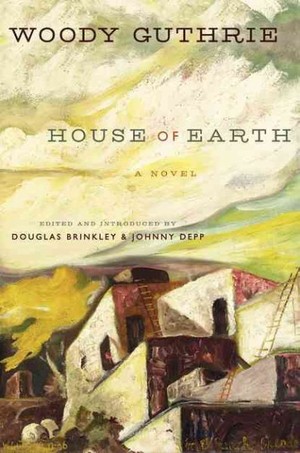 A new Woody Guthrie novel, set in Pampa, Texas, has been uncovered and will be published by actor Johnny Depp’s new imprint, which he says will be devoted to worthy, hard-to-publish works. You can find good reviews and information on the book at the following sites:
http://www.npr.org/2013/02/05/170496691/woodie-guthries-house-of-earth-calls-this-land-home
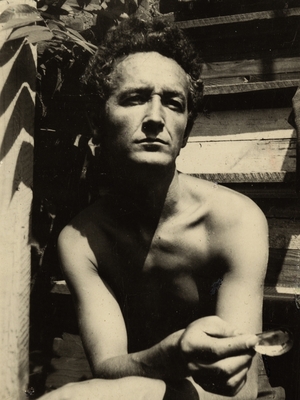 Ttitled House of Earth, the novel takes a close up look at a couple engaged in a serious, sexual love affair who spend a lot of time arguing and making love. A theme is the main character’s belief in adobe construction methods as a way for the poor to have decent, quality homes.
Depp would make a good Woody in a movie (surely he’s working on that), and we need stories like Woody’s to be told. He spent a year or so in the Big Bend area of Texas and decades later produced a good novel set there based on some of his experiences, The Seeds of Man. This synopsis is an excerpt from moneyblows.blogspotcom:
Woody Guthrie’s Seeds of Man was inspired by a 1931 trip the author remembered…. or mis-remembered… in 1947-8. The novel wasn’t published until 1976.
By evidence of this rambling tome, Woody Guthrie wrote more about his 1931 trip to Big Bend, than about any other single topic. Although, that may be unfairly comparing songs to prose.
A visitor to the mysterious border wilderness known as Big Bend, where Seeds of Man is set, will not quickly grasp how formative was Guthrie’s own visit. He was an impressionable young man in 1931 whose travels thus far had been limited to Oklahoma and Texas. Woodrow Wilson Guthrie took his family gift of music and optimism farther than any Guthrie had before. It some ways, it could be said this magical trip started it all.
In 1941 he was part of the propaganda effort for the Coulee and Bonneville dams on the Columbia River. 26 ballads in 30 days, he had so much creativity coming out of him. His autobiographical novel Bound for Glory came in 1943. As he began to feel the curse of Huntington’s Disease in the late 1940’s, he typed like a madman on a novel he originally titled Study Butte,calling it “An Experience Lived and Dreamed,” the chronicle of a search to look for his family’s lost silver claim in the Christmas Mountains.
Study Butte is the name of a crossroads settlement in the Big Bend, near Terlingua, a stone’s throw from Mexico, which had an active mercury mine. It was very wild country at the time of Woody’s visit. Guthrie’s vision of America was inspired, and his themes were the same ones that get so little traction today, in spite of the bankers and big shots running roughshod over the governing system the same way today as they did during the Depression and the Dustbowl days.
Bedside books
Posted: November 11, 2012 Filed under: books, fiction, people, writing Leave a comment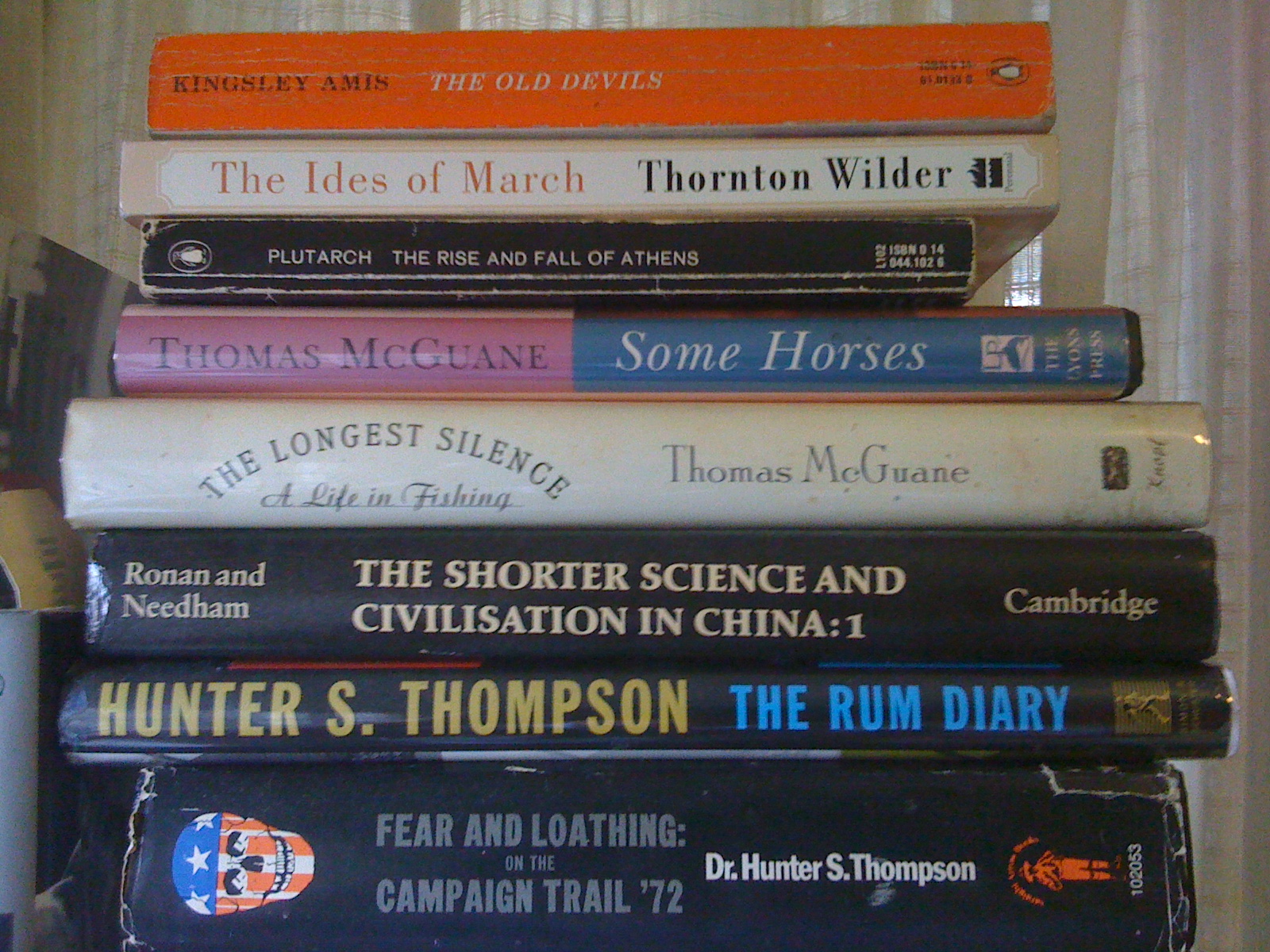
The Shorter Science and Civilization of China: 1 by Ronan and Needham: This is the condensed version of Needham’s classic history of China, starting at the beginning and focusing on the foundations of China’s developing religions.
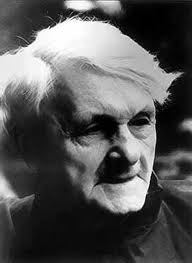
Joseph Needham
Needham is a story in himself. Wikipedia says: “Under the Royal Society‘s direction, Needham was the director of the Sino-British Science Co-operation Office in Chongqing from 1942 to 1946. During this time he made several long journeys through war-torn China and many smaller ones, visiting scientific and educational establishments and obtaining for them much needed supplies. His longest trip ended in far west in Xinjiang at the caves in Dunhuang at the end of the Great Wall where the first printed copy of the Diamond Sutra was found. The other long trip reached Fuzhou on the east coast, returning across the Xiang River just two days before the Japanese blew up the bridge at Hengyang and cut off that part of China. In 1944 he visited Yunnan in an attempt to reach the Burmese border. Everywhere he went he purchased and was given old historical and scientific books, which he shipped back to England through diplomatic channels and were to form the foundation of his later research. He got to know Zhou Enlai and met numerous Chinese scholars, including the painter Wu Zuoren, and the meteorologist Zhu Kezhen who later sent crates of books to him in Cambridge, including the 2,000 volumes of the Gujin Tushu Jicheng encyclopedia, a comprehensive record of China’s past.” The personal side: he remained married to his wife but had a Chinese “second wife” who lived on the same road in Cambridge as his wife for decades, with her knowledge, and whom he married after the death of his wife.
The Ides of March by Thornton Wilder: I’m now a dedicated Thornton Wilder fan. This historical novel is an imaginative recreation of the period before Caesar’s assassination told through the eyes of Caesar, his rivals, Cleopatra, Catullus, Cicero, conniving aristocratic women, famous actresses, Anthony and others. Wilder was a lifelong student of Classical Rome, and he inhabits the voices of his characters, weaving their stories, letters, diary entries and experiences together to recreate the life of Rome as effectively as we’re ever likely to experience it. I ordered his two other novels of the period, The Cabbala, and The Woman of Andros, plus his selected letters. A nice side story: Wilder spent a year and half in Douglas, Arizona, living anonymously, savoring the life of the local people, especially the nightlife and bar crowd that would cross the border to Agua Prieta at closing hour to continue the fun. It was a roisterous version of Our Town.

Douglas, Arizona, circa the period of Wilder’s sojourn
The Rum Diary by Hunter Thompson: His first novel, written at age 22, but delayed publication until not long before his suicide, is a revealing look at the well-spring of his talent. The novel is a solid piece of work and depending on the extent of later revision, a mystery as to why it wasn’t published earlier. Had it been published earlier, it might have done what he predicted at the time in a letter to a friend: it would, “in a twisted way,” do for the Caribbean what The Sun Also Rises did for Europe. Paul Kemp, age 35, is a vagabond journalist looking for a place to settle in, who sees the odd assortment of journalist has beens at the Puerto Rican newspaper that’s hired him sight unseen as what he secretly feared: a near crazy house mirroring the pretense, posing and fakery in the island’s culture at large. But, he can do his own good work anywhere, and he finds the odd misfits help keep his interests alive. A love triangle is handled realistically. The writing shows off his exuberant, tabloid-comic book adjectives, and his later trademark joy in exaggeration, satire and humor leavened by sharply outlined characters and scenes with a relentless pace.
The Longest Silence by Thomas McGuane: This is vintage McGuane essays on fishing, while framing his well-known descriptive talents. His personal and family life slowly unfold as the essays pile up, revealing a man at a slight remove from his children, who see his obsessions to know and to master his various interests with risible disinterest. If McGuane has a religion, it’s fishing and horses. He invests his fishing quest (South America, Iceland, Ireland, Canada, Mexico, Michigan, Montana and other locales) with all the hyper-sensory mystery surrounding Nature and the self, especially the mandatory attainment of accepting the outcome – win, lose or draw. It’s fishing as a source of the sublime, the unexpected, the inability to know anything concrete or take away anything that gives anyone an edge during the next roll of the dice. Nothing to take away to use again, except the relish to continue the quest and savor the experience. That’s a lot.
Some Horses by Thomas McGuane: I followed up with more essays by McGuane on his other passion: horses and competitive quarter horse roping. He says some years he won more prize money at roping competitions than he earned through his novels. His essay on Buster Welch, a West Texas quarter horse trainer, is worth the price of admission. The kernel of McGuane’s talent has always rested on his untouchable American traits.
The Old Devils by Kingsley Amis: This is the best description of old age I’ve ever read. It could as well be called The Old Friends. Really brilliant. It’s the first novel I’ve read by Martin Amis’s father. Wonderful dialogue and roguishness, with women characters fully the equal of his men characters. In fact, compared to the women, the men remain rather vague, except for Alun Weaver, an ex-TV celebrity who’s retired and become a professional Welshman eager to rejoin a group of old chums soaked in afternoon cocktails and sodden binges. His wife, Rhiannon, is the strongest – and most mysterious – character in the book. Death hangs over it all. Kingsley understands how to let the mask of humor slip to reveal desperate pathos, but life goes on thanks to the guise of British manners. The book celebrates the wear and the endurance that long friendships demand, and as death encircles everyone, why a momentary solace counts for all.
More dream poetry
Posted: October 27, 2012 Filed under: articles, books, people, poetry, writing Leave a commentAfter posting my dream poem (below this post), I was reading in Edmund Wilson’s The Shores of Light and enjoying immensely his hard edged judgements and wise takes on the likes of Hemingway, Thornton Wilder, Gertrude Stein, H.L. Mencken, Sherwood Anderson, W. H. Auden, Elinor Wylie, Edna S. Vincent Mallay, E.E. Cummings, Henry Miller, D.H. Lawrence and other writers of that era when American letters were finding a new footing. Wilson, besides his literary critcism, was a prolific writer on cultural life for The New Republic, and he captured the fleeting fervor surrounding communism and its prominence in American life during that era, which now seems the musings of a different civilization entirely.
Anyway, in the book I was surprised to see an essay on Dream Poetry.
Wilson wrote about dreams that produced poetry, citing examples, the most prominent of course was Coleridge’s Kubla Khan, which is said to have come to him in an opium-induced dream state. Most dream poetry is not high art, of course, and is in fact touched by an other wordly whimsy.
Wilson recorded one of his dream poems:
The human heart if full of leaks;
The human head is full of vapors.
The crows disband: the mandrake shrieks;
The scandal was in all the papers.
And this from an anonymous poet:
It’s white to be snow,
It’s cold to be ice,
It’s windy to blow,
And it’s nice to be nice.
And one by E.M. Forster:
I will put down Hastings, you shall see
Companion to India as a boat gnawed.
Forster’s is closer to most dream poetry, I think, in which the dreamer feels that the “as a boat gnawed” is touched by genius, only to awaken, recall the words, and shake his head in wonderment.
I wish Wittgenstein would have taken an interest in this phenomenon of language produced in a dream, rather than action stories, states of feelings, fantasies, etc.
For Charles Dukes
Posted: October 9, 2012 Filed under: people, poetry, states of mind, writing Leave a commentRiding the Wind
In my dream
you gave me your
Book of Poems
and said,
“Read this one:”
The wind was Love
and what the was was
was was.
Finding Now
Posted: August 27, 2012 Filed under: buddhism, places, poetry, time, space, writing 3 CommentsFinding Now
Well, yes – exactly – that is the problem.
All travelers experience it
at each step on the Way. Is it
here, there, up, down,
backwards, forwards, all around,
or somewhere else? How are we to know,
if it doesn’t tell us so?
We all have our maps, but they are the
artifacts rubbing our noses in it.
My worn map I drew myself. I traced
a line from Birchman Street in Fort Worth
through dark caves as a Boy Scout, to Saigon
(and flowing dresses) to Ubon and
Thailand’s temples to Third Street in Denton –
a college town – to Dallas (there’s the dead president)
to Arlington to Thailand again and Laddawan – to Denton
(the college town again) to Waco – a crazy town –
to Alpine and the airy Big Bend where I met and lost
so many friends, to here and now in Chiang Mai.
Ok, just breathe deep and let go.
That’s as close as I can get to it.
 the roy hamric journal