
Larry McMurtry’s Booked Up bookstore
Posted: May 26, 2012 Filed under: books, people, writing 2 Comments
The novelist and bookman, Larry McMurtry, opened Booked Up, a bookstore in his West Texas boyhood home of Archer City, Texas, many years ago. The bookstore is one of the finest and largest used bookstores in the world. Word has circulated that he will liquidate most of the stock and keep only his main store which is located near his home a few blocks away, where he has a personal library of around 30,000 books. Estimates of the number of his books in all his stores, which were abandoned buildings in the town, range from 300,000 to 400,000 books. The dispersion of his well-bought books will be a great loss to readers.
Clive James on William Empson
Posted: May 26, 2012 Filed under: people, poetry, states of mind, writing Leave a commentHere is a short remembrance by Clive James on William Empson that was posted on Poetry.
Bedside Books
Posted: May 1, 2012 Filed under: books, people, writing Leave a comment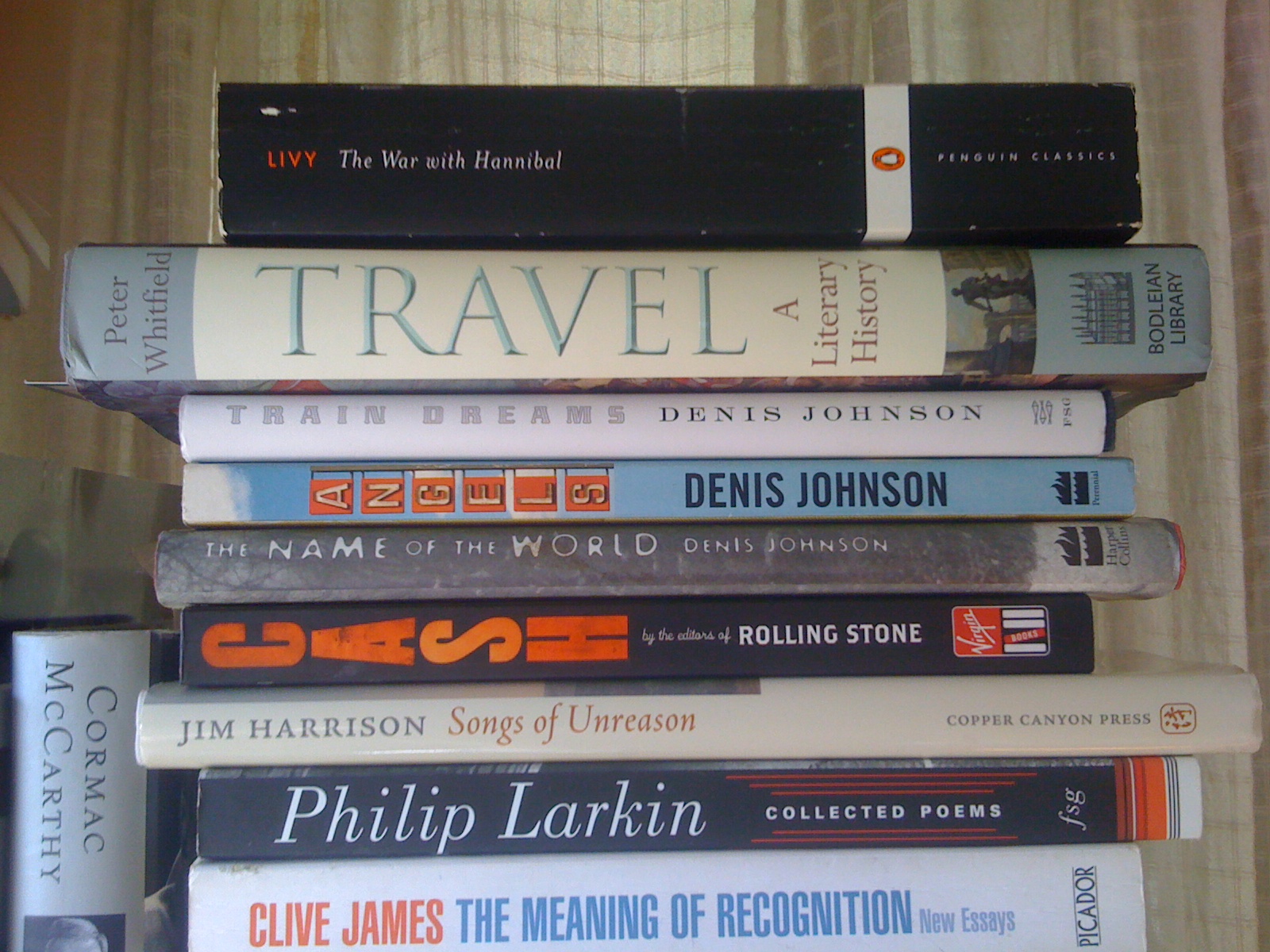
The War with Hannibal by Livy: This was a great read distinguished by a consistent narrative drama chronicling Hannibal’s failed (barely) attempt to conquer the Roman empire. Hannibal was something of a military genius, certainly a relentlessly ambitious general, who led a largely mercenary army that spoke many different languages through decades of war with Rome. His elephants. His crossing of the Alps. He tested the Romans’ endurance, and they proved themselves absolutely resolute, even when he was knocking on their doorstep. He called forth a number of brilliant Roman generals, ending with Scipio who took the reins in the bleakest of times. He was still in his early 20s when he took command, after the death in battle of his father at the hands of Hannibal’s army. I don’t want to stop reading about the Romans, but I’ve nearly exhausted the stock in the local used bookstores so now I’ll have to make a list of the Penguin edition Roman history classics that I haven’t read and order them.
Travel: A Literary History by Peter Whitfield: This is required reading for anyone who loves real travel literature. It’s a comprehensive look at what we must call travel writing, but the story is always so much more in the hands of the masters. This survey goes back to the story of the Jewish people’s journey through the desert, and evolves through the centuries as travel stories change with the texture of the times, ranging from pilgrimage, exploration, conquest, adventure, science and the “search for the self.” Whitfield, a sharp intellect, is more than capable of expanding our mind about the role of the writer who sets out to record a journey, and what such books say about both the writer and the culture that produces them. As Robert Louis Stevenson said, “There is no foreign land; it is the traveler only who is foreign.” There are generous quotations from the earliest to the latest writers who take on the stories of their travels. Paul Theroux is immensely appreciated by Whitfield, as are Thoreau, Gary Snyder and Jack Kerouac. His assurance makes Whitfield brave enough to draw in such American writers who are not in the traditional travel-writing genre: the last three, of course, touch on the nature of inner journeys or attention to a place. It takes someone with his literary abilities, learning, and reading to do this type of history justice, and he does.
Train Dreams by Denis Johnson: I mentioned a review of this book in a post a month or so ago. This novella is what it’s cracked up to be: a perfect, short narrative that draws you into a simple man’s life as the U.S. western frontier is closing. The mesmerizing and poetic language is haunting, a quality that Johnson has in aces. It’s very hard for me to make comparisons with Johnson, which is a sign of uniqueness. Something of Hemingway’s pristine sharpness, especially in the art of staying on the story’s pitch so that it never wavers. Something of Faulkner’s way with common folk, but the expansiveness of Johnson’s talent allows him to treat all people with precision. His unique gift centers on people in search of a spiritual awakening. In the story of Grainier this never surfaces. Grainier is too simple to even address those types of questions in his mind: but he’s there as a full human being, and the death of his wife and young daughter send him into remorse and haunting dreams, which he survives. A seldom seen acquaintance calls him a hermit of the mountains and deep forest, which shocks him. A simple soul beautifully captured in a story that stops more or less in his mid-thirties, yet he goes on to live another thirty some years before his death in the mid-60s. I hope the telling of the second half of his life will be given to us later. It deserves to be placed beside Jim Harrison’s Legends of the Fall. Two short masterpieces capturing the American West.
Cash by The Editors of Rolling Stone: Johnny Cash, like all great artists, seemed to be playing out his life and his art all at the same time, shake and mix. He did it with his song lyrics and his voice, and it’s pretty clear he’s not going to go away, and he will emerge as one of the great singer-storytellers of our time, along with Dylan. They both share many traits, and they recognized their religious kinship and folk-country roots. The fact that the last three of Cash’s recordings were among the best he ever did is amazing, and a hats off to producer Rick Ruben of heavy metal fame who understood Johnny Cash and allowed and challenged him to do those last CDs that covered some great Americana songs and also some of the wilder, modern singer-artists like Kurt Cobain, et al. Cash’s version of Hurt is going down in the Great All-Time Book of Songs. And this book is one of those great reads, a blend of hagiography, utterly appropriate in this case, and quick-take journalism of sundry days in Cash’s life as viewed by a vagabond writer on an assignment. Cash was an open guy, at home in his skin, and he had an ability to see himself and wasn’t afraid to use his bad side to make good art. His story was played out to a large extent on the stage of life for all to see, or at least enough of it for us also to learn something about the art of myth-making. But Cash shines through for who he was, even acknowledging the myth-making. Managing the elements of an artist’s life isn’t a simple matter of myth-making. The elements have to be there. The outlaw spirit. A truth-teller. A willing disciple of the dark forces. A good, tender heart. The spirit of an artist. The touch of a poet. Cash had it all, and he turned it into a redemption story, a man expressing his deepest soul in song. Dylan writes about Cash in Chronicles, his brilliant autobiography: After praising “I Walk the Line” and the early Sun Records artists, he says: “Johnny Cash’s records were the same, but they weren’t what you expected. Johnny didn’t have a piercing yell, but 10,000 years of culture fell from him. He could have been a cave dweller. He sounds like he’s at the edge of the fire, or in the deep snow or in a ghostly forest, the coolness of conscious, obvious strength, full tilt and vibrant with danger…Johnny’s voice was so big, it made the world grow small.”
Bill
Posted: April 12, 2012 Filed under: poetry, writing Leave a commentI knew a cowboy in Texas named Bill.
I guess I wanted him as a Father.
But he was a loner. He wouldn’t drive
till after midnight. He liked empty roads.
This cowboy made moonshine
in the woods, kept a spiral notebook
in his khaki shirt pocket, read science fiction.
He said
We’re reachin’ out from inside. We know there
ain’t no real heaven. But maybe
that’s still where we’ll all end up––out there.
How we’ll be…
He wanted to know where West was
or he got nervous. He couldn’t handle
compliments or prosperity.
He liked without better.
This cowboy was brave,
and knew not to show it.
But this cowboy wanted
reassurance too. He didn’t
want it from people.
He wanted it from the sky.
Minding My Time
Posted: April 11, 2012 Filed under: poetry, states of mind, writing Leave a commentMinding My Time
Awash in mind time.
Mind’s always mattering:
sensations, feelings
always forming.
Words always mattering
in Universe of Matter––
That’s all
(not really for Roy & Laddawan
and the Thai band playing
Eric Clapton).
Not to mind called self
that’s just the go-between
for no-body.
Big Self is every thing.
Knows like the bone in your
eye every thing’s just co-
existing meaning matter
of meaning-ness.
Right now
at 1:18 a.m.
as a tiny candle lantern rises
golden in the night sky
like a star.
Name it
Posted: April 8, 2012 Filed under: poetry, states of mind, writing 2 CommentsI call it A Rock in the Cosmos,
a rock on the ground with no name.
But let’s be real. It is a rock,
not a rock-on-the-ground metaphor,
not a descriptive target: a white, porous
igneous outcast atop a scaly wind-blown
nob here in the cowboy Big Bend
in mysterious Springtime. It
stimulates. Does it recognize
something of its firey history
or the bottom of the swaying Sea,
or a bit of a bright Star – its ancestry?
No matter, of itself it is enough.
Ok, let’s be real, it is a rock
on the ground in the Cosmos.
It is white, porous, igneous.
The rock can never know
the rising Sun, the waning Moon,
the ten thousand waves, but there
is this rock in my mind, too,
not on the ground, and this
mysterious non-stop, air-like chorus
accompanying all this and more.
An Ernest Valentine wish
Posted: February 24, 2012 Filed under: books, people, writing Leave a commentA real Valentine sentiment

Bedside Books
Posted: February 15, 2012 Filed under: books, people, writing Leave a comment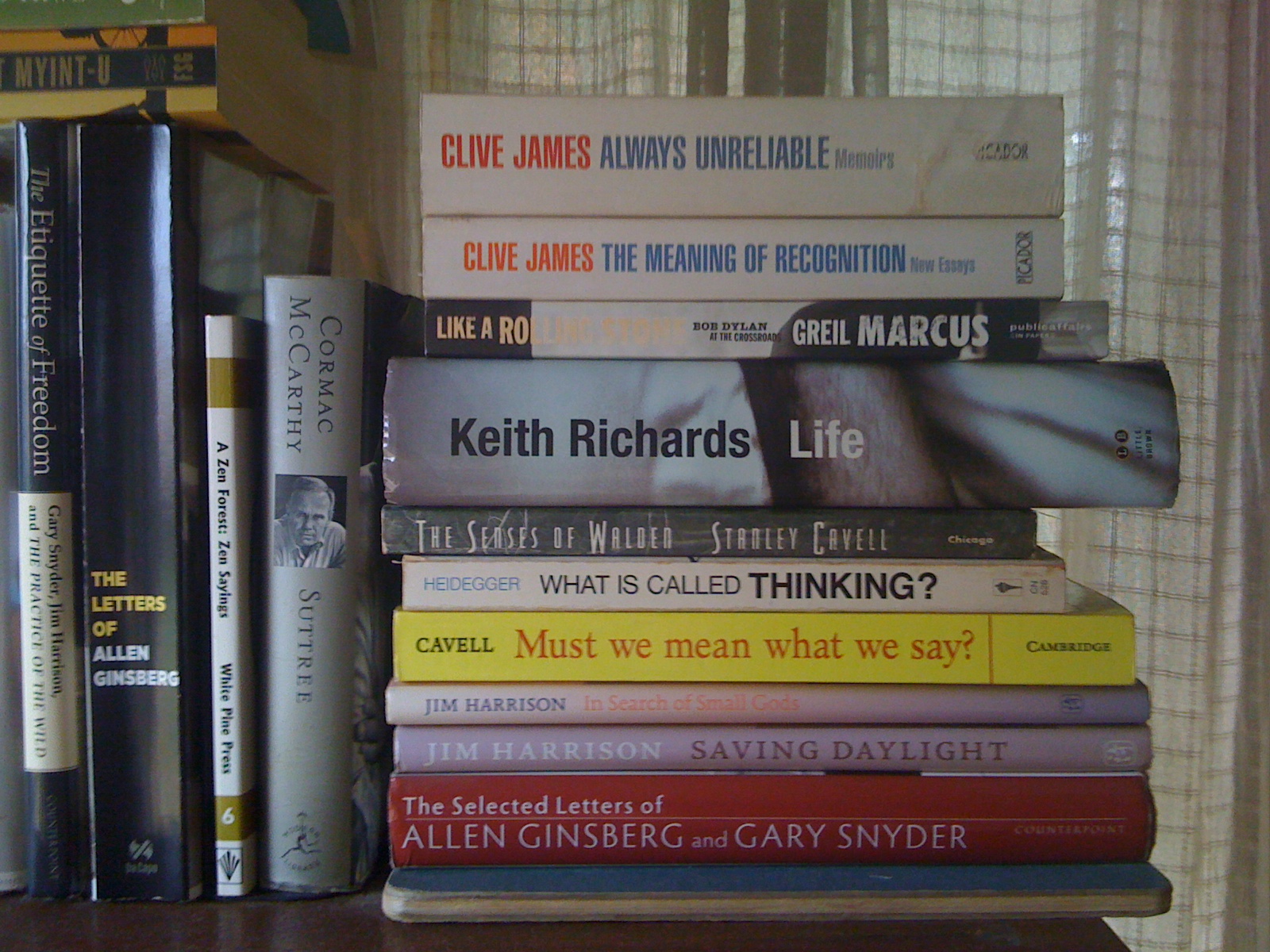 Rome and Italy by Livy: I’m still immersed in Imperial Rome, and now reading the historian Livy for the first time. This volume must be the definitive picture of Roman campaigns and battles, which were nearly ceaseless during the period covered here from 386 B.C. to 293 B.C., requiring Rome to police and maintain its power by defeating upstart states and tribes who resisted the Roman way. The Roman elite, of course, were all military men, that being the only pathway to the highest offices. The battles were hand-fought with spears, javelins and swords by armies ranging from around 5,000 to 30,000 men. This was man-to-man contact. You wonder if the same could happen today? To be safe, I would have to answer yes, simply because 2,800 years isn’t very long. Why should human nature and capabilities change? Battles involved the death of tens of thousands of soldiers and the same sometimes in civilians living in the towns that supplied the enemy soldiers.
Like a Rolling Stone by Greil Marcus: Here’s a nice change of pace. Marcus, who has an extraordinary way of writing deep, majestic prose that enshrines the nature and power of music, has written a hagiography of the making of the Dylan classic “Like a Rolling Stone.” Recorded unpretentiously on June 16, 1965, after a couple of days of getting the music down, it was something new. As always, the new takes time to decipher. It changed the way songs were written, virtually wiping out the traditional sweet Pop sound and replacing it, at least in the hands of the ambitious songwriters, with a powerful allusive poetry, a fractured lyrical impressionism that sprang from the Beat poetry of the day. Few could actually achieve that, of course, but they recognized the territory that Dylan had staked out. Marcus makes you appreciate the studio musicians who wrapped Dylan’s words in sounds that are apparently near impossible to match in live performance because of the extreme jazz-like improvisations that combined to become the perfect accompaniment to his soaring accusatory wailing. This book is especially good for non-musical people like me who love to listen but don’t understand music itself. I respond, wishing I knew how musicians do it. Dylan’s words inspired the musicians and their music inspired Dylan’s delivery. Dylan remains the fey, enigmatic ringmaster, the troubadour leading the flock anxious to be in his moment.
Life by Keith Richards: Here you go. You want something on the dark side? Then don’t read Richards’ excellent book. It’s far too funny and perceptive. Think a rock and roll Marx brother and you’re close. A rock and roll surrealistic Little Boy Blue who wants to be bad, and actually almost gets there, at least bad to himself. For the folks around him, at least in his version, he’s more like a caring scoutmaster, always ready to lead the way and help. I believe him. The early, childhood section is really fine, and the young Richards had a lot of class. Poor childhood, the best kind with interesting people, but he heard what lives inside rock and roll music and the Blues. He heard where it comes from, which is different from knowing where it comes from. He knows how to love women who want to take care of him; he likes a good chat with whoever’s around. He’s one lucky guy to be alive after all the drugs, and that’s one of the things that never gets explained. Why did he do all the drugs? I wonder if he could have answered that, but didn’t? At any rate, he survived, and he’s enjoying his life now, and he and Mick created songs that will always be up there with Dylan and the Beatles. On the tough side. Try Some Girls and “Far Away Eyes” for starters.
Always Unreliable and The Meaning of Recognition by Clive James: I keep saying Clive James is one of the top three essayists of our time, and I mean it. Very unique, a mind one loves to follow, sliding all around from very serious – read relevant – to very funny. The first book is a collection of three of his autobiographies, taking him from childhood in Australia to his conquering of Britain’s world of letters and television, a double that no one has ever achieved in the U.S. the way he has in his career. The autobiography is a slick bit of magic. It’s really a novel of the people and places in his life written in a way that creates a gentle, sympathetic romantic truth with him at center stage. The Australian growing up and Oxford sections are alive with shimmering stories, portraits and wisdom. The other two? Gore Vidal and John Updike. What I like immensely about James is that, unlike Vidal and Updike who are “high” essayist, James is a work-a-day journalist in the great tradition, who switch hits between low and high with verve, brio, deep, dead-eye seriousness and sheer joy of living, of life. That said, his “high” style could not be higher. He’s given me some real wisdom in the areas of European history, Russia, Communism, literary criticism and poetry. Like a lot of smart, literary Brits, he loves America and allows me to see it fresh.
Bedside Books
Posted: October 9, 2011 Filed under: books, people, reviews, writing Leave a comment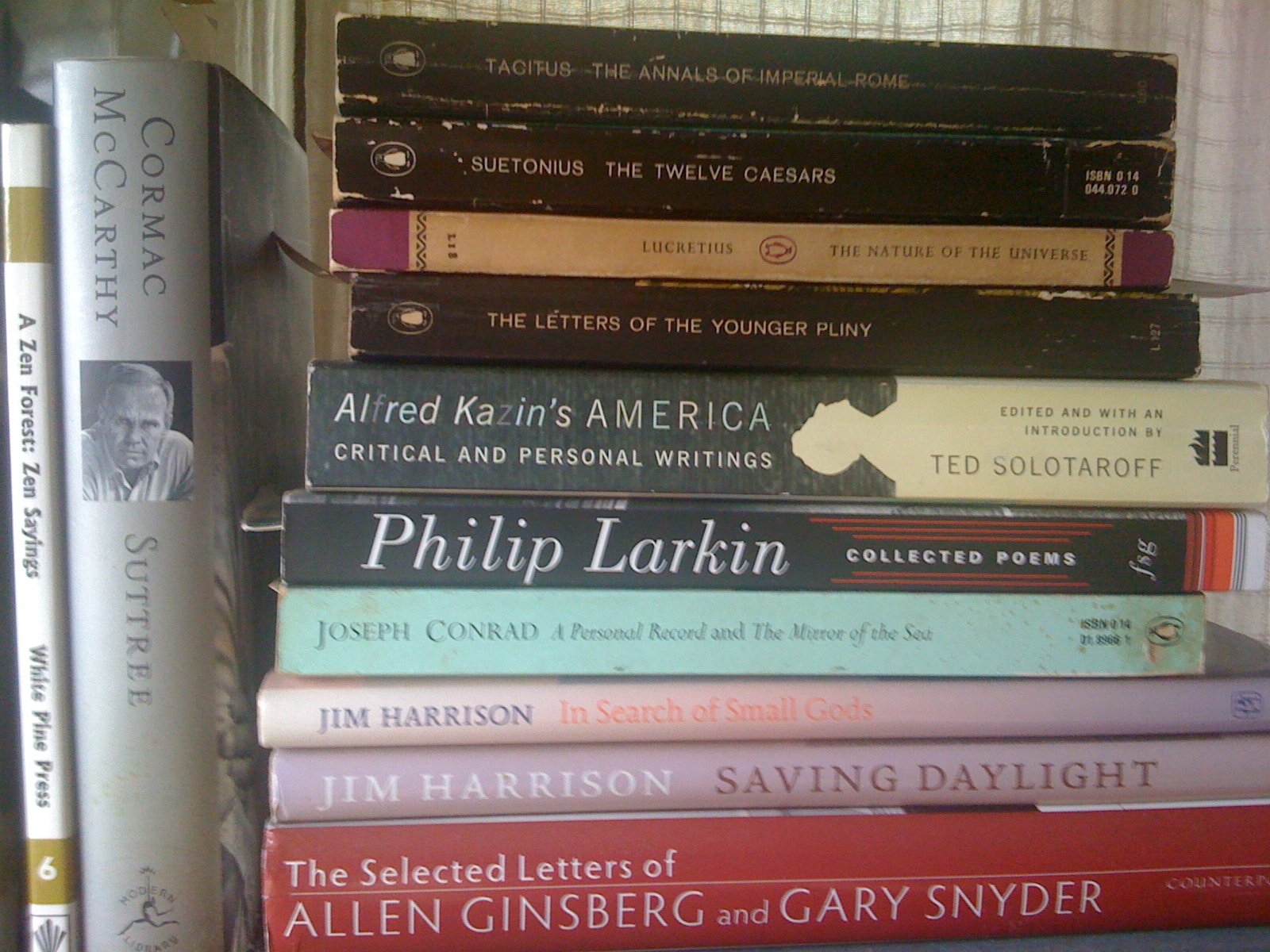 The Annals of Imperial Rome by Tacitus: What a bracing wake-up call. I would have forever been prepared for the ways of the world had I read Tacitus, Suetonius and Pliny when young. The perfect time would have been while I was a lowly volunteer in the Army, and prior to the mesmerizing days of the Kennedys and the Civil Rights Movement. Unfortunately, I was taken in by the American myth, and the Romans are the perfect antidote to keep one balanced and aware that the struggle against tyranny, dictators, totalitarianism, corruption and human duplicity, and, yes, evil, is part and parcel of humankind. Clive James’ Cultural Amnesia says the same thing, using the example of World War II and Communism. At any rate: a word to the would-be wise. Read Tacitus and Suetonius.
The Twelve Caesars by Suetonius: The Emperors of Rome show the whole range of human proclivities from monstrously evil to sublimely enlightened. Depravity and democratic principles existed simultaneously in the same city and state, and yet the structure of the government itself and the influence it wielded across its Empire had a lasting effect in jump-starting the spread of civilization. If only all the great libraries could have been saved.
The Letters of the Younger Pliny: Pliny offers a window into the mind and culture of relative normalcy in imperial Rome. A lawyer and literary man, he shows the workings of power, influence, a passion for justice, administrative efficiency, wit and friendship. The voice is wrapped in reason and civility and shows that power needn’t be self-serving, vengeful or disrespectful. His letters demonstrate the power of the individual who can personalize their professional and daily life in words, therein creating a record of their time rivaling any historical narrative. Without such writing we are forced to rely on a storybook reading of history. As Emerson said, “All history is autobiography,” because he saw it as the best history.
Alfred Kazin’s America: (an anthology) by Ted Solotaroff. One of the critics-as-artist, Kazin’s views on Twentieth Century American literature are part and parcel of the dream of American uniqueness and “democratic contentiousness,” and I’m still a sucker for this view, a blend of realism and romance. He does it well, and the man can put together streams of sentences that coalesce like honey around clear thought. Read him with Edmund Wilson and you’re well prepared to know wherein to read deeply and fully in American letters, from Jefferson to Mailer.
Oval Dreams on the Dirt Track
Posted: September 22, 2011 Filed under: articles, writing 1 CommentThe drivers who race on Texas’ oval dirt tracks don’t get the glory or the purses of Le Mans but that’s not what it’s about. It’s about winning.
By Roy Hamric
(This article was first published in the Houston Chronicle’s Texas Magazine in 2002.)
Henry Witt Jr. is holding court in the pit area for drivers and crew at Heart o’ Texas Speedway in Elm Mott, north of Waco. The evening Texas sun floats orange on the horizon. Witt’s yellow and red open-wheel race car, No. 701, basks in a mellow Technicolor glow. The pit area is a heady brew of dust motes, down-home jokes and barbs, maneuvered avoidances, carefully voiced respect and an occasional fistfight.
But the fights have to be done just right. If a race promoter sees a fight, a driver can be stripped of his points, barred from racing for 30 days and fined $1,000. “It’s usually the unprofessional suckers who fight,” Witt says. “Usually, I don’t like it.” Over his 22-year career, he has had four or five fistfights – one last year. “If they have time to think, most people cool down after a race,” he says. “I try to be cool.”
Witt won the title of IMCA modified national champion for 2000, and he’s in the hunt to repeat this year. The International Motor Contest Association, or IMCA, has about 150 sanctioned dirt tracks around the country that offer weekly “affordable racing,” with a race class for everyone who wants to compete, from kids with a few thousand dollars to high rollers. Organized in 1915, IMCA represents the lowest level of nationally sanctioned racing and has the most member drivers. Drivers race for points and purses of a few hundred dollars. At year’s end, local champions are determined by total points earned at the same sanctioned track in a season; regional and national champions are determined by the best 30 finishes at sanctioned tracks in their regions.
With an estimated 2,000 dirt-track drivers and 19 IMCA-sanctioned tracks, Texas has more tracks than any other state in the nation.
Witt sometimes races three or four times a week, averaging around 90 races a year. For a purse of just a few hundred bucks, he and 15 to 20 other drivers hurl their juiced-up, finely tuned cars around an oval dirt track for 20 laps, collectively roaring like a NASA engine test. Fans ask him why he does it. He wishes he had a good answer. He knows his stock response isn’t good enough. “I just like winning,” he says sheepishly.
If you win often enough, as Witt does, the small purses can add up. And there are endorsements and free contributions in the form of car parts from various companies. But Witt doesn’t race for money or merchandise, although they don’t hurt.
In dirt-track racing, he’s discovered what it’s like to be inside a manmade tornado, a sonic fury racing around and around in a tight, roaring circle. When he rides through the whirling chaos unscathed – it takes only a few minutes to race 20 laps – and shuts off the engine to sounds of “Way to go, Henry, thataway, Henry,” and starry-eyed kids rush to his side and an amplified voice says, “The No. 1 winner,” it’s a feeling beyond words, something he can’t find in hobbies like poker or golf.
Most dirt-track drivers look fairly average outside their cars. But looks deceive. You’re either very physical or you don’t race on dirt. It takes sensitive hands, sensitive eyes and a steady stomach. You have to synchronize mind and body in inches-apart racing at nearly 100 mph on a short, banked oval track. Given the right education and some computer skills, some of these guys might qualify to become jet fighter pilots.
At 42, Witt is still very physical. He lives in Waco, where he owns an auto glass business, works his 800-acre farm, raises four children with his wife, Kayren- and races every chance he gets. He exudes youthful charm. His trim, full-shouldered body moves with the catlike smoothness of a linebacker. His deep tan comes from outdoor work. He’s friendly, and he likes to encourage good young drivers. But better than that, he likes to beat them all – young and old.
In his mind, he’s already running his private movie of tonight’s race. The stars will be Chris and Chase Glick of Buffalo, Texas, two hot young drivers; veteran driver Keith Green, 47, of Waco; and Witt. Green, a near neighbor of Witt’s, is the Waco track’s No. 1 modified point leader this season. Green won the NASCAR-Winston Sunbelt Region title in ’97, and he’s raced with legends like A.J. Foyt.
During this year’s IMCA racing season, Witt and his crew drove to distant tracks in Louisiana, Oklahoma and New Mexico to race as many nights as they could. Their goal is to win No. 1 in as many races as possible. Whoever has the most No. 1 wins in a season is national champion. Witt and his crew are like gunfighters, pulling into distant towns with the goal of leaving No. 1. Nothing else will do. If No. 1 looks beyond Witt’s grasp, he will pull out of a race and wait for the next one. By withdrawing and not finishing in the top four positions, he’s assured a higher starting position for the next race. It’s a tactic used by a few select drivers across the nation – all trying to be the national winner. Second-, third- and fourth-place finishes don’t mean anything to Witt. He wants The Big One.
With 30 IMCA modified wins this year, Witt is ranked second nationally. He has a shot at the national No. 1 modified title, but he needs a string of back-to-back wins in the next three weeks. It’s not uncommon for him to enter four races in four cities in four days.
“What you have here,” Witt says, “is some of the most competitive people in the world. Winning isn’t everything, but second place is nothing – nobody ever asks, `Who placed second?’
“But if you win too much on one track, they’re going to hate you, and they’ll `claim’ you.”
A claim refers to an IMCA rule that allows a driver who places second, third or fourth to “claim” a winner’s engine. If a winner is claimed, he must give up his engine block in return for a $525 payment. The rule helps keep drivers from putting too much money into modifying their engines, thus keeping races competitive.
It also keeps costs down for most racers. The economics of “affordable racing” attract drivers ranging from those who might spend $1,000 a season to those who spend more than $100,000, including the cost of free merchandise. Most tracks offer a broad range of racing in one night. At the Waco track, competition classes include sprint, modified, hot stock, street stock, pure stock (all IMCA-sanctioned), cruisers and mini-stock (drivers 12-16 years old).
Witt has been claimed four times this year. “When they claim us, we’re ready the next night,” he says. “We always have one engine in reserve ready to go.”
His longtime, devoted mechanic, Glenn Wilson, nods his head. “One time we changed an engine in 28 minutes,” he says.
IMCA modified race cars start out as simple frames. Racers add support bars to protect the driver, special suspension and shocks, minimal sheet-body covering and open racing wheels. Most of the engines cost around $2,500 – and up.
Witt’s No. 701 has a JR Motor Sports “400 Claimer” engine (a 406-cubic-inch Chevy block with a flat tappet cam). It has a Gaerte 750 cfm four-barrel carburetor, an Ernie slide transmission (low, high and reverse), General Motors brakes and 5-by-16-inch coiled racing springs.
“I ain’t never claimed, myself,” Witt says. “Kind of an honor deal. You got a guy making $400 a week, and to put a guy like that out of business – that’s bad.”
Witt and Wilson take a break to walk through the pit area and look at some of the competition. Witt chuckles at the crews frantically changing engine parts. “You win by working on your car during the week,” he says, “not by working on it at the race.”
When they return to their own car, a few fans are staring at the left rear wheel of No. 701, which looks flat, although it’s not – quite. “You know you got a flat tire?” one man asks.
“You got a bicycle pump?” Witt snaps back. “Naw,” he goes on, “we always let the air out of the left rear so it don’t grow, keeps it shrunk – makes it smaller, gives you more roll and bite on the turns.”
As other drivers walk past his crew area, Witt quietly offers a running commentary on the talent. “Guy right there will push you on the turns,” he says. “Guy right there, he’ll spin out by the fourth lap. Guy right there, he might slam you.”
Slamming is a common occurrence in modified racing. Some drivers use it as a tactic to bump past cars. It keeps IMCA racing on the wild side, and often it causes festering grudges, if not outright fistfights. “You slam a guy, most of ’em will slam you back,” Witt says. “It’s an unwritten rule – you spin a guy out, they spin you back. I don’t drive dirty myself. Maybe I should, but I don’t. Sometimes a young kid will spin you and not mean it. You go over and have a friendly talk. But an older driver . . . you get ’em back.”
IMCA racing, while wilder than high-speed NASCAR competition, has slower speeds and fewer serious crashes and injuries than you would expect. Speeds hit 85-100 mph on the quarter mile, and the action on the turns is fiercely competitive. Witt flips his car about once a year. “I flipped in Odessa,” he says. “Car hit me, and I spun like a top.”
The drivers begin moving to their starting positions. Wilson, whose day job is being Waco’s assistant fire chief, makes a last-minute measurement of the distance between Witt’s chassis and the dirt. He wants the car to be exactly 6 3/4 inches above the ground on the right side and 6 1/4 inches above on the left. He adjusts a large bolt, pulling the body weight off the right side of the chassis.
Witt slips his helmet on. “Now I’ve just got to watch the X’s and O’s,” he says, referring to slams and spins.
Witt starts in the seventh position. Green is 17th. By the ninth lap, Witt has passed inside to take the lead. The earlier leader, trying to adjust, has spun out. Green moves from 17th to second, right behind Witt. Green was “lovin’ on ’em,” Witt says after the race, meaning his car was rubbing and bumping its way through. A yellow caution flag comes up on the 16th lap, putting Witt and Green bumper to bumper, one and two, with a near-even start for the remaining four laps. When racing resumes, Green’s car dives to the bottom of the first turn and bumps the lap car. Witt pulls ahead three car lengths, and barring car failure, he won’t be passed.
Within minutes Witt is standing in the winner’s circle, clutching the No. 1 trophy and a microphone, surrounded by kids who run out of the stands to share the brief moment that Witt lives for – feeling what the word “winning” can’t really describe.
The purse is $450. A photographer snaps the official photograph, and a voice announces the next race. Both Witt and Green enter the crew area happy. Green, with a second-place finish, is still ahead in local track points. Witt has his track win, boosting his national point wins to 31, only two behind the national leader, Jonathan Thompson of Superior, Neb.
On the next Friday, big trucks pull into the Heart o’ Texas crew area as the sun pauses above the tree line on the flat western horizon. There are a few tractor-trailer rigs capable of carrying two race cars and a rolling mechanic’s garage, but most modified race cars arrive on flatbed trailers pulled by big pickups.
Country girls with Farah Fawcett hairdos and tight Wrangler jeans prance about. Some seem pumped up and wild-eyed, ready for their 10 minutes on the Jerry Springer show. Many of their teenage male counterparts sport mullet haircuts.
In the far corner of the pit area, Charles Robinson of Waco, a rookie driver, works at setting up car No. 7, his cruiser-class ’76 Chevy Monte Carlo. On the side of the car is his handpainted logo, cribbed from Elvis: “Taking Care of Business.” A small figure of the King is lodged next to the passenger’s window. About nine months ago, Robinson’s car had rested, and rusted away, in a farm field. Robinson gave the owner $100 and, surprisingly, drove the car out of the field. Three months later, after spending $300 on safety bars and $2,500 on engine repairs and tires, he was a race driver. Three months later he had his first track win. Tonight is his 96th race.
He remembers the first race. “It was awesome,” he says. “Terrifying. This is the most exciting hobby I’ve every had, and I’ve had ’em all. Now I can’t get racing out of my blood.”
He points to the rippled indentations that pockmark the roof of his car. “Those dents on the top I made myself, jumpin’ up and down on the top of the car after my first win.”
Unlike the modified class, the cruiser class is pure stock car racing, with cars right off the street, a popular way for drivers to break in. It’s “bumping and grinding” racing, but most of the knocks are unintentional.
Tonight will not go well for Robinson. After a good start, he will pull out of the race with a flat tire.
Over in his crew area, Witt mulls his odds for the remaining two weeks of the season. With his 31 national points, he is still two points behind the national leader. Witt plans to race five more times.
“I got a shot at it,” he says, but he doesn’t sound happy. “In Texas, there’s maybe seven drivers who could win on any night. But there’s always some guy who comes out of nowhere and can beat you. Maybe they’ve never won a race, but on that night they’re unbeatable. Anybody can have their night and nobody can beat them.”
Before the qualifying heat, which determines the starting order of the racers, Witt worries that the dirt is too wet and sticky. A thunderstorm had passed through the day before, and water stands in low spots on the track. He and Wilson had talked on the phone all week, finally deciding to switch to a heavier 25-pound spring on the right rear and to install new brakes. Wilson had told Witt, “I got all week to think about what to do. You got one turn.”
Freddy Bottoms, one of Witt’s volunteer crew of four to five members, has sprayed the car with “mud-off,” a liquid that prevents mud from sticking to the frame and body and adding weight and air drag.
Witt looks tired. His week has been routine. He worked at his glass business. He worked on his farm and looked after his cattle. “It’s always a hustle-bustle deal,” he says. But there’s one piece of time in his hurried life when time seems to slow: “When you’re leadin’ the race, it seems like time is going really, really slow,” he says.
A full yellow moon is rising, looking like somebody punched a hole in an ink-blue curtain. As starting time nears, Witt’s crew attaches 40 pounds of lead bars to the back of the chassis to push the frame down. Chris Glick’s car roars up and stops next to Witt.
“Wait up on me, kid!” Witt shouts.
“Come and get it,” Glick says.
Witt glides to the passenger window, leans in and smiles. “Now, don’t get your pretty car banged up,” he says.
“I know, I hate that,” Chris says, and they both beam.
At the last minute, Witt’s crew makes adjustments to the “bleeder” attached to each tire, a device that lets air out as a tire heats up, keeping the air pressure constant. The bleeders are set very low, at 6 pounds for the left rear and 10 pounds for the right rear, and 10 pounds for the left front and 12 pounds for the right front.
Witt slips into his fireproof, red racing suit and gloves. He wears Simpson “Power Shoe” fireproof boots with soft rubber soles, and a neck brace under his helmet. As he settles behind the steering wheel, he attaches two shoulder straps designed to keep the driver’s arms inside the car and to prevent his body from being tossed out during a wreck. It’s time to roll.
By the second lap of the race, Keith Green has pulled from 12th to sixth. Witt is fourth. Two cars crash on the fifth lap. When racing restarts, Witt is second and Green fourth. At the start of lap 18, Green and Witt restart at numbers one and two with two laps to go. Green shoots ahead. Witt moves up to within three car lengths of Green on the 19th lap, but Green holds and crosses the finish line three lengths ahead.
In the crew area, Witt is unhappy. He stands slope-shouldered. The new brakes grabbed, and he couldn’t drive smoothly on the turns, he says. “You can’t win ’em all, but you can want to, and it hurts to lose when I could’ve won. Ah, well, we’ll get ’em tomorrow.”
Green is happy. With one week left in the season, he knows he’s got the local track’s modified title in his pocket right now. “I just had to get through there,” he says. “It was a tricky track tonight – one of the hardest. When I got the lead, I told myself don’t make a mistake. The competition was there, but whoever got through Turn 4 best had the advantage.”
A friend walks up, shakes Green’s hand and says, “Good drivin’, old man.” “I survived it,” Green says, smiling.
Within minutes, Witt’s 350-horsepower, twin-wheeled pickup is hauling out his 30-foot trailer with car No. 701 inside, engine still hot. As he rolls past car No. 52, Green and his crew are still celebrating.
On the last Friday night of the racing season, Witt has the No. 2 national ranking in IMCA modified competition wrapped up. He also won his fifth South Central regional championship. But he was too far behind to catch the national leader for first place. “I ain’t real proud of that,” he says, “but it’s still pretty good.”
The No. 2 position ensures he’ll receive an $8,700 national purse and maybe $30,000 in endorsements or merchandise certificates. Although Witt is already thinking about next year, he’s not quite through with this one. He’ll race this month at non-IMCA races where bigger purses are offered, ranging from $5,000 to $25,000. Then he’ll take December off. In January he’ll start preparing No. 701 for the next IMCA season.
He and his crew have run in more than 90 races during the season and won 32, a 3-to-1 average. (During his 2000 national championship year, he won 47 races, or almost one win for every loss – a sweet ratio.) He’s also pulled in around $100,000 in material contributions from auto-related companies and pocketed about $35,000 in winnings.
In the crew area, mechanic Wilson works at setting up No. 701. The banter flows.
“Track don’t look as sloppy tonight,” Witt allows.
“Yeah, maybe it will hang,” says Wilson.
The past week Wilson had changed the shocks and the springs and adjusted the panhard bar, which controls how the rear weight of the car is placed. He also changed the engine, estimating it was about the 20th engine change of the season. “We spend maybe 60 to 80 hours a week working on it.”
His hands constantly work over the parts. He adjusts the chassis based on Witt’s running description of how the car feels. Wilson says his work really is about mathematics and physics. “All the angles of the bars in the chassis need to come together like they’re supposed to, to get optimum traction,” he says. It’s also about the condition of the dirt – information the driver supplies.
“Henry has to tell me what the car feels like,” he says. “I got to get it from Henry.”
Witt and Wilson both look tired. They’ve driven about 60,000 miles to tracks this season. The daily grind is both exciting and exhausting. “But we’re jealous of what we got, and we don’t want to give it up,” Wilson says. “We’ve spent many a dang hour getting where we are.”
Witt nods. “Winning’s a big part of it, but it’s also some of the other drivers. It’s the fellowship, the cuttin’ up. But other nights you go home and you got people mad at you if there was bumpin’ and rubbin’.”
Both worry about being “claimed” on their engine. “We’d give up the motor for a win, but not for a second, third or fourth place,” Witt says. When the checkered flag falls on the last modified race of the season at Heart o’ Texas Speedway, the race ends, in its way, a picture perfect for almost everyone. Keith Green wins the race flat out and becomes track-modified champion. Chase Glick finishes at No. 2, ending the season in eighth place in the competition for national rookie of the year.
Witt never worked his way up from his fifth starting position. On lap 7, his car started shooting sprays of white sparks from the inside right rear brake, not three feet from the 32-gallon tank of methanol racing fuel.
The race had eight yellow flags and numerous wrecks. Witt drove through the wrecks unscathed. But on lap 12 he drove No. 701 over the high bank into his crew area. He switched off the ignition. The piston roar faded into an eerie stillness. He felt a trickle of small consolations. He had lost, but he had avoided an engine claim. The sparking brake hadn’t caused a fire. Most important, “anybody” didn’t win. First and second place went to skilled dirt drivers.
Witt ends the season national No. 2 in the modified class, three wins behind the champion. He knows nobody ever asks, “Did you win No. 2?” But there is next season. Witt is eager for it. He plans to race around that earth-scented oval in hot pursuit of that feeling he can’t describe.
“You find out you’re good at something and you like it,” he says. “It makes it kinda hard to quit.”
 the roy hamric journal