
Lonn Taylor’s Colbert Report Appearance
Posted: September 25, 2014 Filed under: articles, people, writing Leave a comment On Sept. 11, the great Lonn Taylor, my friend from Fort Davis, Texas, was on The Colbert Report talking about the 200th anniversary of The Star-Spangled Banner. He had a great time… Here’s his weekly newspaper column recounting his experience. He had never heard of Steve Colbert before he was contacted by the show’s producer.
September 25, 2014
The Rambling Boy Column
By LONN TAYLOR
Andy Warhol (or perhaps Marshall McLuhan; there is disagreement about who originated the phrase) said, “In the future, everyone will be famous for fifteen minutes.”
On September 11 I was famous for six and a half minutes, so I still have eight and a half-minutes coming to me. That night 1.2 million people watched me explain to Stephen Colbert why Francis Scott Key was on a sloop in the Patapsco River watching the British fleet bombard Fort McHenry 200 years ago and how he happened the next morning to jot down a poem that became our national anthem, “The Star-Spangled Banner.” I had written a book on the subject in 2000, and someone connected with the Colbert Report had found the book and invited me to appear on the show to help commemorate the bicentennial of our national anthem.
The call with the invitation came in late May. I have to confess that at the time I had never heard of Stephen Colbert or the Colbert Report. We do not have a television set and I really only watch television on election night and during the Miss America contest. Fortunately, my wife, Dedie, took the call and briefed me before I called back, so I did not sound like a total idiot to the producer I talked with.
Over the next three months I watched a lot of clips of the Colbert Report. The more I watched the more nervous I became. Colbert seemed irreverent, frenetic, and acerbic, someone who asked questions and didn’t listen to the answers but simply tried to score off his guests. I decided that it was going to be like being interviewed by Vance Knowles in his Jackie Pepper persona. By the time Dedie and I left for New York I was a nervous wreck. About a week before we departed Emily Lazar, the executive producer of the show, called me and spent half an hour rehearsing me on the phone, reading me a series of questions that she said were similar to those that Colbert would ask. She advised me to have three or four things in my head that I could talk about if the interview seemed to drag. I got on the plane running these little speeches through my head.
All of my fretting proved to be for naught. The show, which runs at 11:30 P.M. in New York, is taped before a live audience between 7:30 and 8:30 P.M. A limousine picked us up at our hotel at 6:30 and took us to the studio, where a young woman met us at the curb and showed us to a private green room with my name on the door. The room was furnished with sofas and plates of fruit and cheese were on a table. Henry Kissinger had occupied the room the previous evening and I signed the guest book just below his name.
Colbert came in just as we got settled and introduced himself. He explained that he was going to interview me in character, and that his character was that of a dumb right-wing idiot and that I should not take offense at anything he said. He was not intimidating at all; in fact was a most gracious host. After he left Emily Lazar came in and said they had now refined the script and she could run through the questions Colbert was likely to ask, although she also said that it was impossible to predict what he might do on camera. We went through another series of questions and she left the typed script with me. I was made up, a microphone was attached to my lapel, and I was led through a maze of cables and cameras to the set and seated at the interview table. The camera swung around, the lights came on, Colbert jumped up from his desk, introduced me, strode over to the table, shook hands, and we started talking. Six and a half minutes later it was over, and I realized that he had asked none of the questions that were in the script, had made no insulting remarks, and had not interrupted me once. I also realized that I had just had a wonderful time.
The television audience did not see the best part of the show. During the warm-up period, when Colbert was exchanging remarks with the studio audience, a young man wearing a Northwestern University t-shirt stood up and said that he was a student at Northwestern and that the Northwestern Dance Marathon, the annual student charity event, was coming up. He knew that Colbert was a Northwestern alumnus and he wondered if Colbert could work a mention of the dance marathon into tonight’s show?
Colbert thought a minute and said, “We’ll do something better than that. Come down front after the show.” When the taping was over Colbert called the young man down to the stage and explained that they were going to slow dance together, and that when they started the camera would be on the student’s face but as they turned it would reveal that he was dancing with Colbert. Colbert took the young man in his arms and they danced several steps and turned, and Colbert looked into the camera and said “Northwestern University . . . Dance Marathon,” providing Northwestern with an invaluable film clip to use in promoting the marathon.
With 1.2 million people watching I was sure that I would be stopped on the sidewalk the next day by people wanting autographs. It took 2 ½ days for it to happen, and it wasn’t an autograph. Dedie and I were waiting for a table for Sunday lunch at the Café Luxembourg on 70th Street when a young man leaving the restaurant stopped and said, “Aren’t you the historian I saw on the Colbert Report Thursday night?” I allowed that I was and he said, “Wow. You were really interesting. We’re studying Francis Scott Key in our Bible study class.” I’m still trying to figure that out.
I want to thank all of my friends who sent e-mails saying that they had enjoyed the show, and especially all of those folks who went to the Crowley Theater to watch it at the ungodly hour of 10:30 P.M. The fact that I knew that you were watching kept me from being completely tongue-tied.
Lonn Taylor is a historian and writer who lives in Fort Davis. He can be reached at taylorw@fortdavis.net. Email Taylor to be placed on the column’s mailing list.
Men With Style
Posted: September 22, 2014 Filed under: photography | Tags: recalling Leave a comment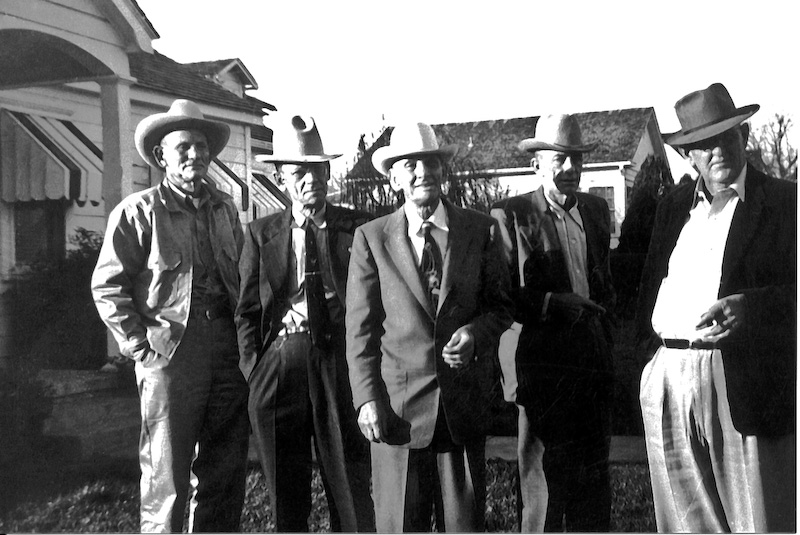
Big Daddy, on the far right, my grandfather.
Leonard Cohen’s Great New Songs
Posted: September 20, 2014 Filed under: music, people | Tags: poetry, writing Leave a comment “I cried for you this morning /And I’ll cry for you again/ But I’m not in charge of sorrow / So please don’t ask me when / I know the burden’s heavy / As you bear it through the night / Some people say it’s empty / But that doesn’t mean it’s light.” Lyrics from a poem/song from his new album, Popular Problems.
The Star-Spangled Banner Marks 200th Anniversay
Posted: September 15, 2014 Filed under: poetry Leave a comment BY FRANCIS SCOTT KEY O! say can you see, by the dawn’s early light, What so proudly we hail’d at the twilight’s last gleaming, Whose broad stripes and bright stars through the perilous fight, O’er the ramparts we watch’d, were so gallantly streaming? And the rockets’ red glare, the bombs bursting in air, Gave proof through the night that our flag was still there — O! say, does that star-spangled banner yet wave O’er the land of the free, and the home of the brave? This is the famous first stanza of the four-stanza song/poem by Francis Scott Key.
For Ikkyu
Posted: September 7, 2014 Filed under: buddhism, people, poetry, states of mind, writing Leave a comment
Spoon strikes cup,
Sound made flesh
Each time the door opens
Something is given and given up
Upon waking: The corpse dances
In the empty casket
Rock on the ground
Moon in the cosmos –
Breathe this.
Leonard Cohen’s Poem: It Was Almost Like The Blues
Posted: September 3, 2014 Filed under: people, poetry Leave a commentI saw some people starving. There was murder, there was rape. Their villages were burning. They were trying to escape. I couldn’t meet their glances. I was staring at my shoes. It was acid, it was tragic. It was almost like the blues.
I have to die a little between each murderous thought. And when I’m finished thinking I have to die a lot. There’s torture and there’s killing. There’s all my bad reviews. The war, the children missing. Lord, it’s almost like the blues.
I let my heart get frozen to keep away the rot. My father said I’m chosen. My mother said I’m not. I listened to their story of the Gypsies and the Jews. It was good, it wasn’t boring. It was almost like the blues
There is no G-d in heaven. And there is no Hell below. So says the great professor of all there is to know. But I’ve had the invitation that a sinner can’t refuse. And it’s almost like salvation. It’s almost like the blues.
See below to hear Cohen perform the poem/song in concert.
Ernest Hemingway: Revealing, New Edition of The Sun Also Rises
Posted: August 31, 2014 Filed under: people, writing Leave a comment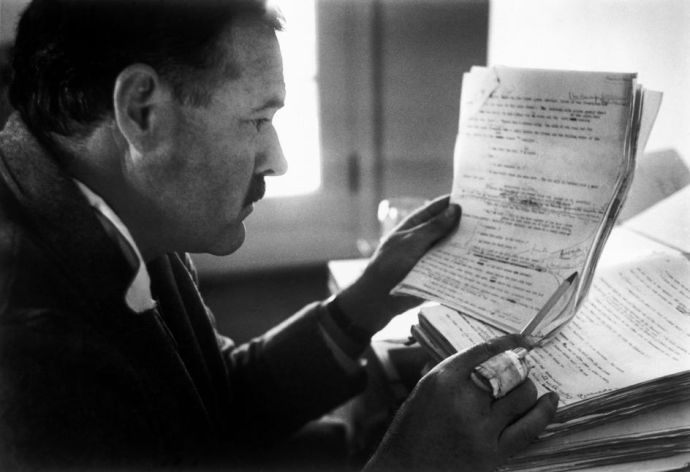
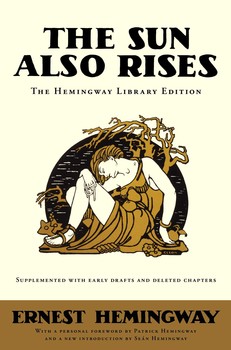
Simon & Schuster has published a new edition of Hemingway’s first novel, which includes generous portions of early drafts, deleted passages, and self-musings about the role of the author’s voice in a novel. Here’s an article from The New Yorker looking at how the editing process, with crucial suggestions from Scott Fitzgerald, saved the book’s structure and offered warnings about inserting Hemingway’s authorial presence directly into the story.
Tomdispatch: The Website We All Need
Posted: August 27, 2014 Filed under: states of mind Leave a comment
Here’s the website that I’ve been looking for…it draws events together in articles that outline (the most we can hope for) how our intwined world has lurched into a frightening brew of churning events that largely eludes comprehension.
Leonard Cohen: Still Writing and Rolling
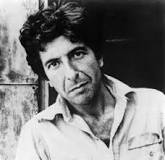
Posted: August 25, 2014 Filed under: music, people, poetry Leave a comment The poet Leonard Cohen, one of the originals who came out of the ’60s, is still writing and performing at 80 years old. A poem/song from his new album is linked here.
The Ghost of Poetry
Posted: August 25, 2014 Filed under: people, poetry 2 CommentsIn 1968, Roger Waters of the rock band Pink Floyd borrowed lines from the poetry of Li Ho as lyrics for the song “Set the Controls for the Heart of the Sun” from the band’s second album A Saucerful of Secrets. Li Ho died at 26. His mother said, “This boy will spit out his heart.” One of the “crazy poets” of the T’ang era, his poetry avoided the traditional Chinese metaphors, opting for lines which jumped from his tongue. More of his poems are here. For a good article on T’ang poetry, Li Ho, and others, see Eliot Weinberger’s article here.
The Southern hills, how mournful!
A ghostly rain sprinkles the empty grass.
In Ch’ang-an, on an autumn midnight,
How many men grow old before the wind?
Dim, dim, the path in the twilight,
Branches curl on the black oaks by the road.
The trees cast upright shadows and the moon at the zenith
Covers the hills with a white dawn.
Darkened torches welcome a new kinsman:
In the most secret tomb these fireflies swarm.

