
the junkman
Posted: April 16, 2010 Filed under: articles, buddhism, people, places Leave a commentThe Songkran water festival is over, and street life returns to normal. The neighborhood’s singing junkman peddles by on his tricycle with the first of the morning’s cast-offs culled from his rounds, a Thai flag fluttering in the breeze behind the cart that overflows with oddities, a single plastic leg, a motorcycle wheel, bright scraps of cloth, a few water gun rifles and pistols, some clay pots. He has a handsome movie star Western face, confident, secure. It says, “I’m a loner. I love my life.” He uses his time efficiently, always busy, resourceful. By evening, he’s parked beside Heaven’s Beach, the local Rasta bar, and the cart is a rolling found-art exhibit, its sides covered with his neat, handwritten Thai script quoting Buddhist aphorisms: Silence Speaks Loudly, Think Like a Flower, A Strong Tree has Deep Roots.
songkran
Posted: April 15, 2010 Filed under: people, places Leave a commentThais have a three-day festival called Songkran. Everybody throws water on everybody. We’re washing away our sins and getting ready to plant seeds before the next rains. It comes on what is annually the hottest days of the year. Tomorrow will be 104 degrees, which feels like the sun has dropped down to 12 feet above your head. The streets along the moat around the old city are jammed with pickup trucks filled with people in the back throwing water and people lined along the sidewalks throwing water. Water guns shaped like exotic space weapons give everyone equal power. The devious use ice-cold water which briefly paralyzes the unsuspecting victim. Women and young girls’ bodies are soaked, their clothing pressed tightly against their breasts. Young men are in full macho mode. Naturally, some people drink too much, motorcycles flip on the slick pavement, fender-benders plonk right and left, an angry temper flares, but really it’s a million smiles flashing, especially from the wide-eyed young watching their elders play like children. It’s a public ritual of rejuvenation and unfortunately, I can’t imagine it happening like this in the United States. Europe, maybe in France. England, never. Italy, maybe. Style note: Western cowboy hats are in.
red pine
Posted: April 13, 2010 Filed under: buddhism, people, poetry Leave a commentRed Pine’s “Dancing with the Dead” on translation
My “Dancing with Words” profile of Red Pine/Bill Porter in The Kyoto Journal
Here’s a clip below from Bill Porter, who uses the name Red Pine for his clear-headed translations of Buddhist poetry and philosophy:
Dancing with the Dead: The Art of Translation
Every time I translate a book of poems, I learn a new way of dancing. The people with whom I dance, though, are the dead, not the recently departed, but people who have been dead a long time. A thousand years or so seems about right. And the music has to be Chinese. It’s the only music I’ve learned to dance to. I’m not sure what led me to this conclusion, that translation is like dancing. Buddhist meditation. Language theory. Cognitive psychology. Drugs. Sex. Rock and Roll. My ruminations on the subject go back more than twenty-five years to when I was first living in Taiwan. One day I was browsing through the pirated editions at Caves Bookstore in Taipei, and I picked up a copy of Alan Ginsberg’s Howl. It was like trying to make sense of hieroglyphics. I put it back down and looked for something else. Then a friend loaned me a video of Ginsberg reading Howl. What a difference. In Ginsberg’s voice, I heard the energy and rhythm, the sound and the silence, the vision, the poetry. The same thing happened when I read some of Gary Snyder’s poems then heard him read. The words on a page, I concluded, are not the poem. They are the recipe, not the meal, steps drawn on a dance floor, not the dance.
This ties in nicely with the post below of D.T. Suzuki’s note fragment on poetry and religion. We’ve stepped into the infinite here, a place beyond our battered world. See the underlined link above for Red Pine’s full article in Cipher Journal.
d. t. suzuki on poetry
Posted: April 12, 2010 Filed under: buddhism, people, poetry, states of mind Leave a commentReading last night, I found this scribbled note fragment by D. T. Suzuki reprinted in The Eastern Buddhist, Vol. 33, No 2, 2001. I don’t think it’s found in any of his many books:
Poetry is more real than what is generally regarded as reality.
Religion is poetry.
The Infinite is absolutely real.
What is called reality is finite and not at all real. Impermanent, transient, subject to mutability.
I want to parse this a bit: it seems to fly in the face of Zen’s granting “suchness” or “isness” the dominant role in understanding “reality.” Also, the not relying on “words and letters.” In other words, the perception of the object rather than the perception of the subjective. That’s pretty standard Zen metaphysics.
This is the sort of thing that used to play with my mind, but now I couldn’t agree with Emerson more: “Consistency is for people with small minds,” a rough paraphrase. The fragment passes my feeling test.
hunter thompson in laos
Posted: April 11, 2010 Filed under: people, places, writing | Tags: articles, reviews Leave a comment
the lan xang hotel lobby in Vientiane. the hotel is unchanged basically from when it was built by the Soviet government. it sports a cavernous restaurant and a night club with a live band and rotating singers. Vientiane is a wonderful city, not least because it rests on the banks of the Makong River.
Assuming stories you’ve written will stay active online is always a costly mistake, particularly with newspapers. This strange little story about Hunter Thompson’s (click on the above underlined and it should open PDF files) stay at the Lan Xang Hotel in Vientiane about the time Saigon fell led to a recent post on a Laotian chat group called Samakomlao. A poster named “Communist man” wrote: “Roy Hamric is mad man, now he is in the mad house in Xieng Mai [Chiang Mai].” I don’t know where the Laotians found the article, but it stirred a lively pro and con over whether I had defamed the country by suggesting that illegal drugs could be found in Vientiane today. Of course they can, but you’d have to be truly mad to pursue that line of inquiry very far, since you never know when the Communist government could make use of a few foreigners arrested for using illegal drugs. Avoid them at all cost, I’d say, the risk is too high. But in Hunter’s days it wasn’t so, and I’m sure he found drugs of all kinds everywhere in Vientiane. Also, below I’ve posted a picture of him and David Andelman, who was then a The New York Times correspondent covering the final days. David sent me some memories of their time together. I think one of the things to remember about Hunter, as a person, is something Jerry Hopkins said in an interview I did with him (he lives with his wife in a rice farming community in northeast Thailand). The author of the Jim Morrison biography and a Rolling Stone Magazine alum, he said, “He had a voice like Fred MacMurray’s. My God, I thought, no wonder straights like to talk to him.” MacMurray’s voice had a deep, avuncular tone, a quintessential good-guy quality. If you listen to earlier audio tapes of Thompson’s voice, before his health declined, it’s not the voice of a hipster or madman. Maybe that’s why Bill Murray’s portrayal has a true ring to it.

David Andelman, NYTimes, and Thompson in Vientiane

the lan xang hotel has the best billiards tables in Laos.
jungle heat
Posted: April 10, 2010 Filed under: Uncategorized | Tags: places, recalling Leave a commentRuu doo rawn: the hot season in Thailand. The news was bad today, demonstrations in Bangkok with 15 people killed. Darkness offers us a few hours of coolness and the dogs quiet down after the temple bells stop, happy to get some rest. Not so with the people trying to get a fair share of the system. This is a hard land. With the first rays of the sun, the heat starts to rise up from the ground. The sun is relentless this year, and the farmers in the valleys and on the mountain slopes are burning the sere winter grass and shrubs now, sending up clouds of smoke that blends in with more smoke and haze streaming eastward from India, Bangladesh, and Burma, crossing over us here nestled beside the Ping River below Doi Sutep, then drifting onward over Laos and Vietnam, crossing the China Sea, and then up the coast of industrial China. This season the sun brought back a childhood memory of black and white movies and newsreels of soldiers in khaki shorts, shirtless, bone thin, wearing canvas campaign hats, whipping streams of sweat from their face. Sitting in the dark theater, I could feel the sun on that day, the same sun and heat that burns down now. World War II in Southeast Asia was as much a war against the sun and insects as against the enemy. It turned soldiers into killing animals, angry to be in the blazing tropics exposed to the elements. Now everyone walks quickly to the nearest shade beside a building, under a tree or inside a food stall or cafe, searching for a sliver or swath of shade to buffer the sun’s blast on your skin. I remember the biting snow-covered mornings in Alpine in the Big Bend. Each year there, in the Chuhuahuan Desert, we had snow, and then in summer, the bleach-dried cactus and the rocky hard-baked desert ground where the heat rose up through the soles of your boots.
Fifty years ago, most rural Thais were born into a peasantry. They are a hard, tough people who have seen the world grow modern and who have lived under the sun close to the soil, struggling to raise families. They know this heat, this sun.
jim harrison interview
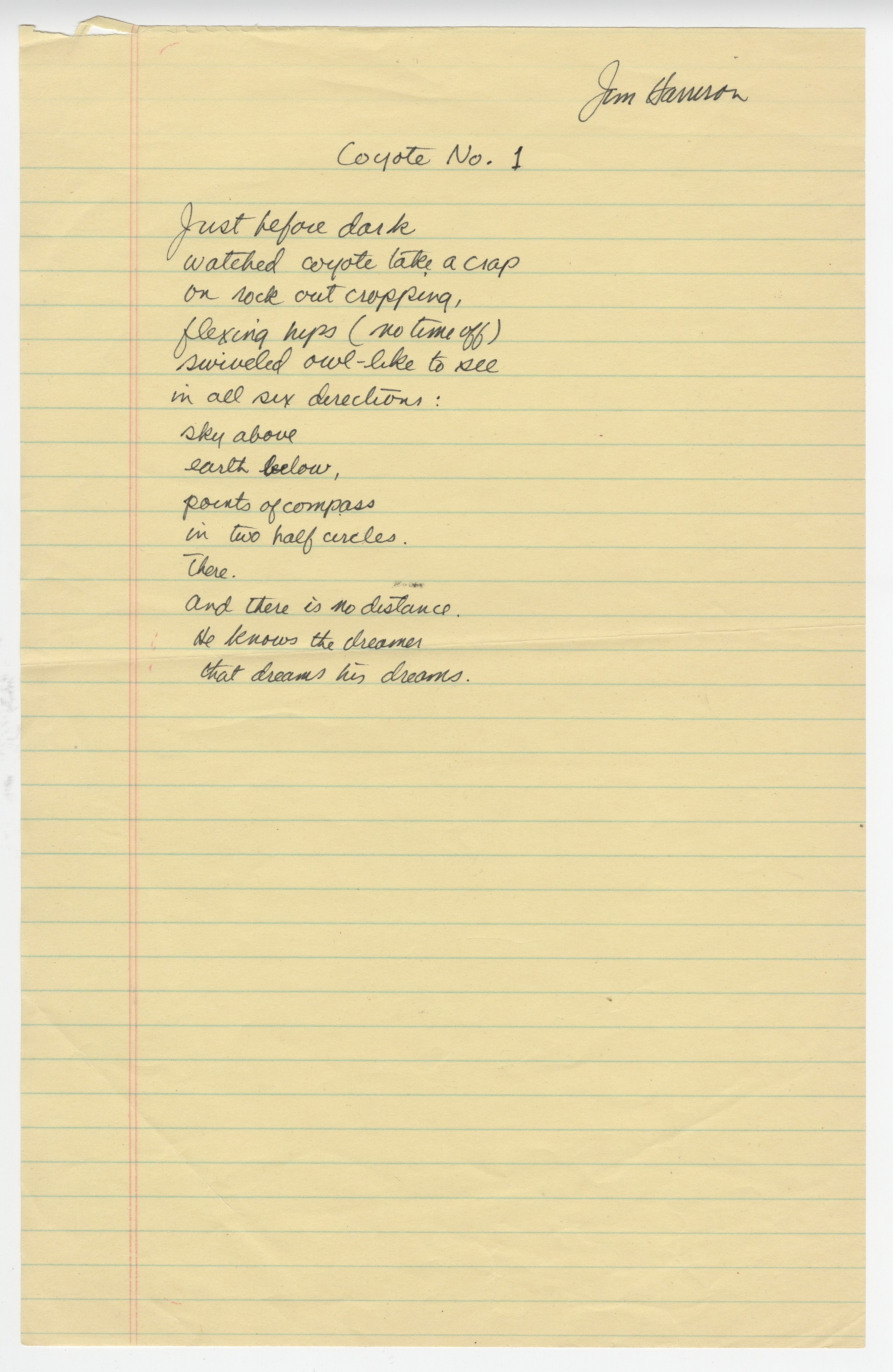
Posted: April 9, 2010 Filed under: interviews, people, poetry, writing | Tags: interviews, poetry, writing Leave a commentI’ve read novelist and poet Jim Harrison’s work since he first started publishing. Jim is simply indispensible to a certain kind of male reader. Women look at him with interest and amusement, I think, something that he’s not entirely against. Recently, I did an interview with him on the Asian connection to his poetry. The interview was published in The Kyoto Journal. The interview isn’t online, but you can click on a pdf version in On the Record (to the right of this post). Also, here’s a manuscript page he sent, but the image wasn’t used so I’m posting it also. Click on the page to enlarge it.
beginning
Posted: April 9, 2010 Filed under: people, writing | Tags: in the beginning, m. john harrison, the word, Wittgenstein Leave a commentIn the beginning was the word. Someone actually wrote that down or said it for the first time somewhere sometime, and it’s a powerful perception still defying understanding, expressed most rigorously by LW when he said something to the effect, “Language confuses meaning,” as if, on the other hand, meaning doesn’t confuse language. At any rate, we’re here as we are, no doubt, partly as a result of words, spoken and unsaid, and we’re now forever awash, swamped, drowned, awed by them all, but still dry inside where from it all arises and passes away. This will do fine as my first post.
But for this…I want to say that M. John Harrison is responsible, unknowingly, for me starting this internet journal. I saw a review he published, I think, in The Guardian, or somewhere like that. Its urgency rattled me so I looked him up, found his brilliant blog, and henceforth birthed this journal. Thanks, Mike.
 the roy hamric journal
