
Matthiessen On Writing, Zen
Posted: May 17, 2014 Filed under: articles, buddhism, people, writing Leave a comment
Peter Matthiessen is one of the rare greats, a man who took both spirituality and writing seriously. He never soft pedalled his Zen training and practice, and he wrote about it in his two perhaps most famous, or widely read, books: The Nine-Headed Dragon River, about a pilgrimage to Japan with his Zen teacher, and The Snow Leopard, about a trip to Nepal. This is from an NPR radio interview in 1989:
TERRY GROSS, HOST:
This is FRESH AIR. The publication of Peter Matthiessen’s final novel “In Paradise” is coinciding with his obituary. He died in April [2014] at the age of 86. We’re going to listen back to an excerpt of my interview with him. Matthiessen was a naturalist, as well as writer, and his fiction and nonfiction books were often inspired by his travels to remote regions, including mountains and rainforests. His books include “The Snow Leopard,” “Men’s Lives,” “At Play in the Field of the Lords” and “Far Tortuga.”
Along with George Plimpton he was a founder of the literary magazine The Paris Review, but it wasn’t until a few years ago that a documentary film revealed he was working for the CIA at the time and he used the Paris Review as his cover. I spoke with Matthiessen in 1989, before that revelation, and asked about a subject that was central to his life and his writing, Zen Buddhism.
He was initially reluctant to write about Zen. I asked him why.
PETER MATTHIESSEN: Well, I think it almost – in the nature of Zen, to speak about it is already kind of missing the point because Zen, the whole teaching depends on the immediacy and the spontaneity of this present moment. And the minute you talk about it, you’re introducing ideas and concepts that get in the way of seeing directly, which is the whole basis of the training.
And then to see behind it another way of looking at reality, which is what happens through meditation practice and really enhances one’s life. So there’s a built-in contradiction in writing about it. On the other hand, even the meditation is a tool, and the writing is a tool, and it helps people, prepares the ground for this sort of insight and training.
GROSS: Did you seek out Buddhism, or did you happen into it?
MATTHIESSEN: No, I didn’t seek it out, nor did I happen into it. I was – during the ’60s, very early on, my then wife, who since died, we were very interested in finding a teacher of some kind, and we couldn’t – there weren’t really any around in the early ’60s. And we got into experiments with LSD, and we did a lot of LSD during the ’60s not as a recreation but as a way of seeing something else, seeing things another way.
And that kind of wore out for her pretty early. I went on with it a bit longer. And she went over to Japanese tea ceremony and then from there, through friends, to a Zen teacher who was then working in New York City. And, I, a year or two later did the same thing and found that it was far more effective and far closer to what we originally had in mind than the drug use was.
GROSS: Had you ever asked any of your teachers what they thought about taking LSD?
MATTHIESSEN: I don’t think – I think they feel that any chemical is a screen that gets in the way, and I think that’s true. I think these drugs, if properly used, and if you knew what you were getting, which you don’t anymore – in the old days of LSD it was quite different because Sandoz Chemicals in Switzerland was making it, and you knew exactly what the dose was, and they knew exactly what the amount was.
But a Zen teacher, or any spiritual teacher, would be against it simply because you’re seeing things purely. There always is that, finally that chemical screen, even if you are having an extraordinary vision of existence.
GROSS: One of the founders of the school of Buddhism that you practice, Soto, had said that the way to be truly universal is to be particular, moment by moment, detail by detail. And I wonder if you see that as really applying to writing, as well, that to be universal you really have to focus on detail.
MATTHIESSEN: I think so. I think all really good writing is attention to detail. It’s that one detail, that one scrap of dialogue, one color or smell that brings the whole scene to life. You can’t throw in everything. You’d be just writing all day long over one small scene. So you have to find that one thing that the reader can build up from.
For example, William Faulkner, he was extraordinarily skillful. He would pick out one, or at most two, physical characteristics of somebody and then just repeat them over and over again, and the reader gradually builds up a whole character around that one physical detail because the detail is so well-chosen that it serves you in this way you can do it.
GROSS: I want to ask you something else about Zen, and this is from something that you said in your Zen journals book, “Nine-Headed Dragon River.” You were explaining that you were studying to be a Zen monk, studying in the States, and you had passed 13 of 14 checkpoints. You failed the last, which was about the vital expression of the inexpressible. And you said you were only able to come up with a weak intellectual answer.
I found that a fascinating thing to stumble on for a writer, and I was wondering if you’d tell us a little bit about what this means.
MATTHIESSEN: That’s in Koan training, which is part of formal training for the priesthood and so forth. In Soto Zen and also in Rinzai Zen, any kind of Zen, and that’s a very famous Koan, that, the sound of one hand, usually it’s called the sound of one hand clapping, but it’s actually the sound of one hand, what is the sound of one hand?
This is a Koan that stops you dead like an iron wall. I mean, where can you go with that logically? It just makes your whole logical apparatus collapse. And that’s the point of it, that you would see it all from a different way. And nonetheless, you could arrive at a kind of an answer, which would be adequate, a presentation which would be adequate, without quite understanding the subtleties and what’s behind it.
So there are 14 checkpoints of that Koan, and you have to pass all 14 of them, and they’re kind of increasing in difficulty and subtlety and so forth. So finally an intellectual answer is not nearly good enough. You have to manifest that Koan and present it, and this is part of the training.
GROSS: Well, let me ask you again how that connects with your writing. Has that training in not using the intellectual to explain or to understand helped you in your writing?
MATTHIESSEN: I wrote a novel called “Far Tortuga,” which is my own favorite of my books, and one reason it is is because I tried to replace, similarly in metaphor, an image with just these very simple descriptions of the thing itself, of, for example, the feelers of a cockroach coming out from underneath a galley cabin on a ship deck or the water vibrating in the rim of an oil drum on the deck because of the diesel motor, just these things, just to see over the line of birds migrating along the horizon, just if the reader could see those and see the immense mystery and hugeness of existence shimmering behind those very, very concrete details.
GROSS: Peter Matthiessen, recorded in 1989. He died Saturday at the age of 86.
(Transcript provided by NPR, Copyright NPR.)
Joshu’s Dog in East Texas
Posted: April 10, 2014 Filed under: buddhism, places, sight seeing 2 Comments Photograph copyright Roy Hamric
Does a dog have Buddha nature?
This is a matter of life and death.
If you say yes or no,
You lose your mind and body!
– Mumon
Peter Matthiessen’s New Novel
Posted: April 3, 2014 Filed under: books, buddhism, people Leave a comment
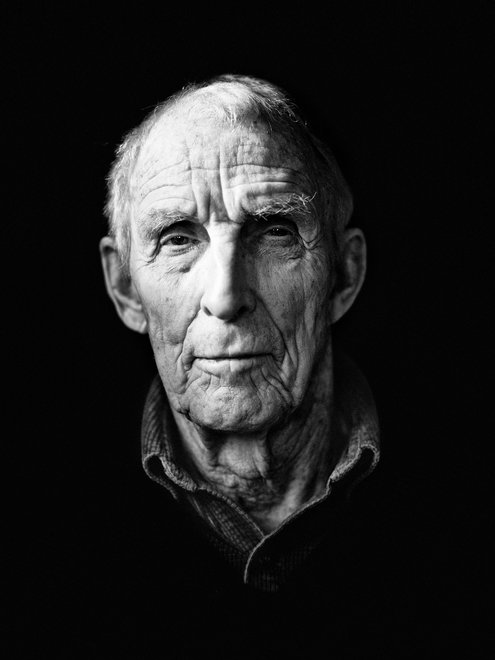
In Paradise, the name of Peter Matthiessen’s new novel, will be released soon, and it could be the last book in his one-of-a-kind outpouring of fiction and nonfiction. A beautiful tribute to him in The New York Times magazine can be found here.
Photograph copyright Damon Winter/The New York Times
Red Pine Has Two New Books Coming Out
Posted: April 2, 2014 Filed under: books, buddhism, people, poetry Leave a comment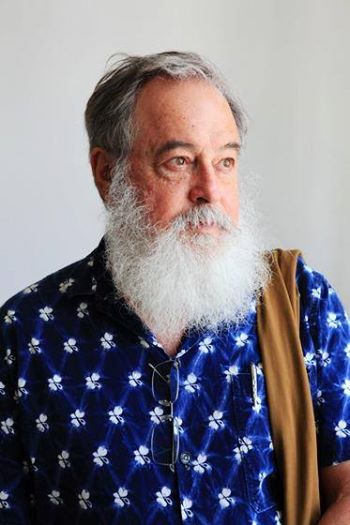
Red Pine has two new books coming out in the next couple of years, in addition to Yellow River Odyssey which will be released sometime this summer. The first is based on the poems of Stonehouse, and the second, Finding Them Gone, is the story of his pilgrimage to the graves of Chinese poets. Both will be published by Copper Canyon Press.
Jack Kerouac, Happy Birthay!
Posted: March 12, 2014 Filed under: buddhism, people Leave a comment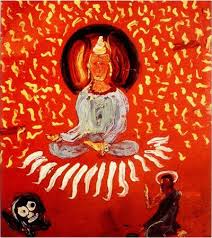
a painting of Buddha by Jack kerouac
Another Yellow River Odyssey Photograph by Red Pine
Posted: March 5, 2014 Filed under: books, buddhism, people, photography Leave a comment
Here’s one more picture from Bill Porter’s new book, Yellow River Odyssey, which should be released soon by Chin Music Press, a small publisher of elegant books based in Washington state. The caption reads: “After another hour among the dunes, we headed back to Shapotou, where I cooled my heels in the Yellow River mud and talked with several men who were inflating goat skins and lashing them to wooden frames to use as rafts. Sheepskins, they said, were useless. Goatskins were the only the skins that held air long enough, and they had to be coated on their insides with sesame oil to keep them from cracking and to maintain their flexibility.”
Sight Seeing
Posted: February 25, 2014 Filed under: buddhism, photography, sight seeing, time, space Leave a comment
Monday, 5:55 p.m., February 24, 2014; IPhone photograph
Ash-sprinkled head,
soil-smeared face.
– From A Zen Forest, Sayings of the Masters
Why Bodhidharma Came to China
Posted: February 13, 2014 Filed under: buddhism, photography, sight seeing, states of mind Leave a comment
The Setting Sun, copyright Robert Crosby
I’ll explain in detail
why Bodhidharma
came to China:
Listen to the evening
bell’s sound. Watch
the setting sun.
– From A Zen Forest: Zen
Sayings.
Yellow River Odyssey Photograph by Red Pine
Posted: February 8, 2014 Filed under: books, buddhism, people, photography Leave a comment
Photography copyright by Bill Porter, aka Red Pine
A photo and caption from Bill Porter’s “Yellow River Odyssey,” now scheduled to be released in May 2014:
“I was on my way from Hong Kong to follow the Yellow River from its mouth to its source and couldn’t resist the temptation to stop in Shanghai for the China Coast Ball. This annual bacchanal was organized by and for the Hong Kong expatriate community, and it was normally held in March at the Belle Vista in Macao. But in 1991 the Belle Vista was being renovated, and the organizers turned to the Peace Hotel in Shanghai as a suitable replacement. The Peace had been boarded up during the Cultural Revolution, and the splendor of its art-deco interior had survived intact.”
Red Pine’s Canny Commentaries on Buddhist Sutras
Posted: January 10, 2014 Filed under: articles, buddhism, people, states of mind, writing Leave a comment
Red Pine hitching a ride in China. Photograph by Ted Burger
Red Pine’s probing and understanding of the major Buddhist sutras: The Heart Sutra, The Platform Sutra of the Sixth Patriarch, The Diamond Sutra and, the latest, The Lankavatara Sutra, in addition to his earlier translation and commentary on The Tao Te Ching continue to deepen. With each translation his commentaries have grown more profound, especially on how all the sutras, taken together, form a whole, offering an approach to the difficult metaphysics that bewitch people looking for the answer to life’s riddles.
Red Pine’s latest commentary on the Lankavatara Sutra is a good example of how he draws all the sutras together. For instance:
“Buddhism is concerned with suffering, which is the inevitable result of desire. But the real issue is the self, which is the cause of the desire, which is the cause of the suffering. In the centuries following the Buddha’s Nirvana, instructions centered around a trio of concepts designed to focus attention in such a way that the nonexistence of the self would become evident and the liberation from suffering would follow. These included the five skandas (form, sensation, perception, memory and consciousness), the twelve ayatanas (six powers and six domains of sensations), and the eighteen dhatus (the ayatanas with the addition of six forms of consciousness). These were three views of the same thing: our mind.
“The were simply different ways of dividing any given moment of awareness into a manageable matrix to demonstrate to anyone willing to wander around these matrices that they contained the universe of our awareness, its inside and its outside, and yet they contained no self. This was their function: to show practitioners that there was no self.
“While these three schemes dealt with the problem of the self, they didn’t help explain how we become attached to a self in the first place, and how we go from attachment to detachment to liberation. Hence, to these were added three more schemes, all of which play a much larger role in the Lankavatara Sutra than the previous trio. The three new schemes are the five dharmas, the three modes of reality, and the eight forms of consciousness.
“The five dharmas divide our world into name, appearance, projection, correction knowledge and suchness. The three modes of reality do the same thing with imagined reality, dependent reality, and perfected reality; and the eight forms of consciousness include the five forms of sensory consciousness, conceptual consciousness, the will or self-consciousness, and an eighth form known as repository consciousness, where the seeds from our previous thoughts, words and deeds are stored and from which they sprout and grow.
“As with earlier trios of concepts, these were designed to account for our awareness without introducing the self. But they had the advantage of also providing a look at how our worlds of self-delusion and self-liberation come about, how enlightenment works, how we go from projection of name and appearance to correct knowledge of suchness, how we go from an imagined reality to a perfected reality, how we transform our eightfold consciousness into Buddhahood.
“….But then the Lankavatara Sutra sets all these schemes aside in the interest of urging us to taste the tea for ourselves….Cup of tea or not, no one said it was going to be easy…”
He goes on to explain how the Lankavatara confounded his understanding for 35 years. Everyone’s approach may differ, but a good step would be to try the sutras in a sequence such as this: the Tao Te Ching, The Heart Sutra, The Platform Sutra, The Diamond Sutra and the Lankavatara Sutra.
Red Pine always offers good advice. His life has been devoted to translating these sutras to deepen his own understanding and wisdom.
Also, as his wisdom – and his humor – ripen, he becomes more humble. The mark of a real teacher
 the roy hamric journal