Posted: March 28, 2014 | Author: roy hamric | Filed under: people, places, reviews, writing |
An earlier version of this review originally appeared in The Bangkok Post on January 29, 2008.
By Roy Hamric
 Not many novels are set in Laos these days, but Colin Cotterill is fast changing that with his series of crime novels set in the former Southeast Asian kingdom. The first novel begins just after Laos fell to the Pathet Lao Communists in 1975.
The unlikely hero, Dr. Siri Paiboon, is a sharp-witted, 72-year-old former jungle surgeon and Communist Party member. He’s surrounded by a cast of loveable characters. He wants to be left alone in his old age, but, to his chagrin, he’s appointed the national coroner of Laos – which really means he’s the only coroner in Laos. A unique twist is Siri’s ability to commune with powerful spirits who dwell in Laos, one of whom has entered his body.
The novels’ tone – read colourful, warm and smart – hit a home run with The New York Times’ reviewer, who called his first book “a perfect balance between the modern mysteries of forensic science and the ancient mysteries of the spirit world”; The Washington Post reviewer said it was “an impressive guide to a little known culture”; Entertainment Weekly cooed “magically sublime, tragically funny”; and Kirkus Reviews called the series, “an embarrassment of riches.”
For Cotterill, who lives in a small village south of Bangkok on the coast of Thailand, it’s been a rollercoaster ride, with each novel followed by glowing reviews – a writer’s dream come true. His gift as a novelist is that he makes it all look so easy. The fluid prose, the intricate plotting, the exotic Laotian setting and the earthy, wry, characters are all far superior to the average crime novel – or almost any novel for that matter.
Before his Siri novels, he apprenticed himself by writing two novels that were published only in Thailand. They were flops, in terms of attracting readers. Evil in the Land Without (2001) and Pool and Its Role in Asian Communism (2002) earned “a total of about $500 in royalties,” he said. Little did he know that international success was waiting just around the corner.
To find an agent for the first Laotian novel, “The Coroner’s Lunch,” he sent a short letter and a few pages of the first chapter to 120 US agents. He got several nibbles. Then an email appeared from a New York agent who asked to see the manuscript. He wrote back, “I can sell this for you.” Suddenly, it felt like fate had adopted him. Before long, he had a contract with Soho Press for a series. “I think getting published is a quirk of fate – getting to the right person at the right time,” he said, in his typical, self-effacing way.
Other novels in the series include Thirty-three Teeth, Disco for the Departed, Anarchy and Old Dogs, Curse of the Pogo Stick (“That’s my Hmong book.”), Slash and Burn and The Woman Who Wouldn’t Die.
Born in Wimbledon on the outskirts of London, he arrived in Southeast Asia in the early 1980s and started a series of NGO jobs, at one point working with refugees from Burma, Laos and Vietnam. He met a circle of Laotian ex-royalist and refugees who had vivid stories about the Communists, the fate of ordinary Laotians, the ethnic groups and the mass education and propaganda campaigns.
In 1990, Cotterill joined a Unesco project, working with the Laotian government to train English teachers at a college in Pakse, where he lived for two years. “It’s different to live in Laos and know what’s really happening,” he said. He learned, for instance, that one group of Laotians who wanted to study English used an East German language textbook, requiring them to first learn German to learn how to speak English. His notebooks filled up with stories, anecdotes and character details. But then he tripped up badly, ending up on the wrong side of a dispute with the military over who should be allowed to take English training classes.
“I went out of the country, then found out the government wouldn’t let me back in,” he said. “I didn’t really know who to blame. It took me a little while to get over it.” Starting in 1994, he began revisiting the country. “Every time I went, I thought, ‘I’m going to write about this.'”
In the late autumn of each year, he goes to Koh Samui to write a first draft of a new Siri novel in about four weeks. “I don’t like to know where the story is really going,” he said. “I know some of the things that occurred during the year I’m going to write about, so I get a few ideas and then just put Siri into a situation and ask, ‘How do we get out of this?'”
The spirit world plays a key role in each novel. Spirits are engaged in a sort of Manachean battle, inflicting their power for good or bad on lowly humans.
Within Cotterill’s exotic, mysterious world looms every-present bureaucracy, Communism, corpses and death. For Siri, death is but the beginning of the story. He uses his brain like a scalpel to cut through the mysteries of strangulation, stabbings, shootings, drownings, poisonings—and possessions.
On the serious side, one feels the crushing weight Communism has had on one of the most gentle, sublime cultures in the world. Siri is determined – what else is there to do? – to undermine the Communist ideologues whose mission is to discourage free-thinking and individual initiative––the exact traits possessed by Siri’s flesh-and-blood gang.
Another pleasure is Cotterill’s ability with dialogue. Many readers have commented that it’s the first time they feel as if they are hearing the way Asians really talk and think. “I had to defend the way my characters talk,” said Cotterill, who speaks Thai and Laotian. “If I have a character call someone a ‘bubblehead,’ well, there’s no exact Laotian equivalent for that English expression, but there are many similar Laotian expressions, so I feel I’m actually giving a closer approximation of the way my characters really talk.”
Cotterill has drawn cartoons and illustrations since he was a child, and he still enjoys working as an illustrator and cartoonist. He published a cartoon book, “Ethel and Joan Go to Phuket,” in Thai, and his unique website features his drawing.
“I write very visually,” he said. “I’m walking through the scenes with the characters. I’m seeing the characters, the weather, the land. I think I write more as an artist than as a writer.”
Two unpublished non-Siri novels sit on his desk; One is set in New York and Vietnam in 1952; the other is a contemporary thriller set in Chiang Mai involving the search for a 13th-century buried treasure.
Posted: March 14, 2014 | Author: roy hamric | Filed under: people, photography, poetry, states of mind, writing |

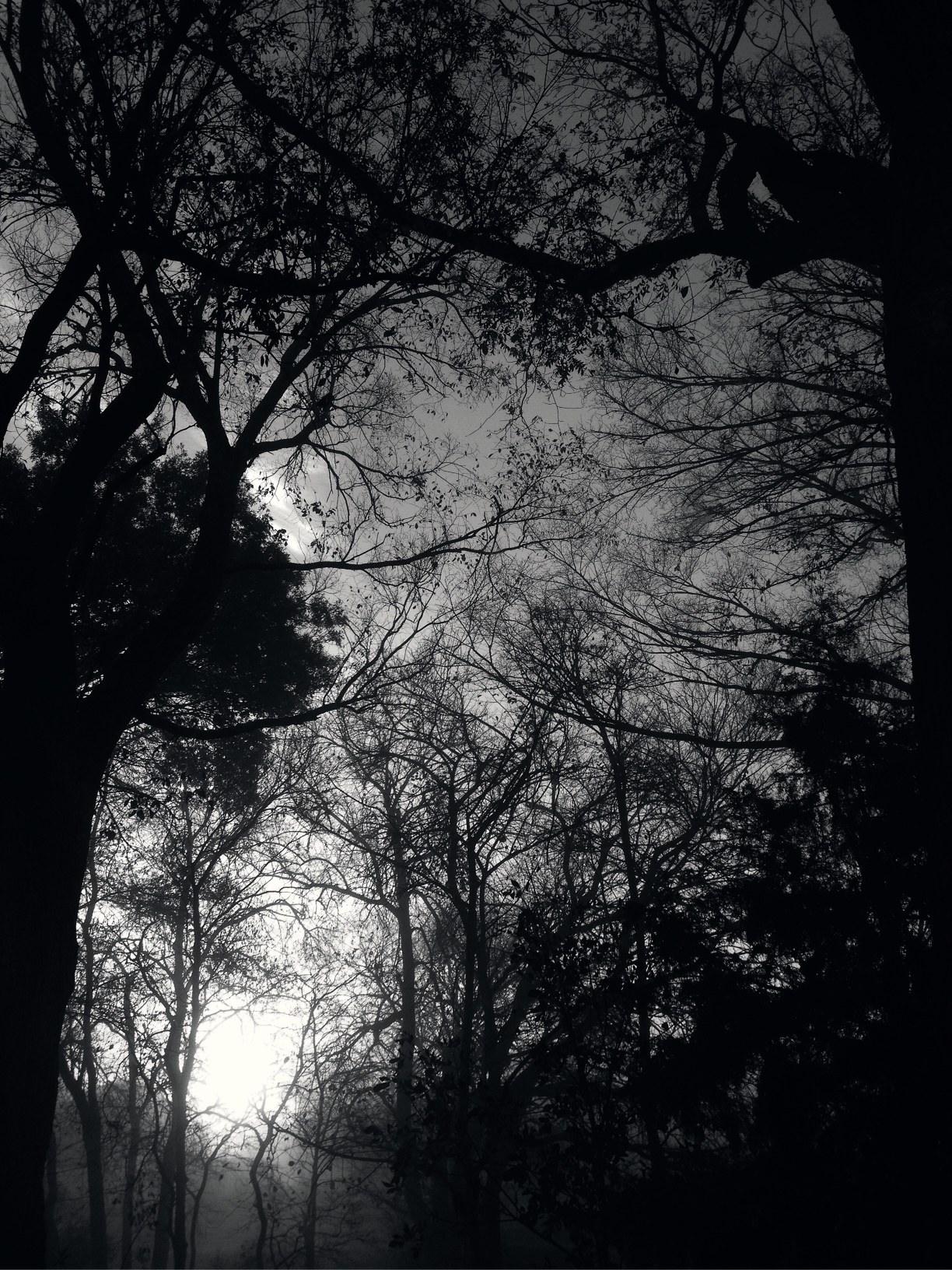
In The Woods; a photograph by Robert Crosby
Whoso walketh in solitude,
And inhabiteth the wood,
Choosing light, wave, rock, and bird,
Before the money-loving herd,
Into that forester shall pass
From these companions power and grace.
Emerson– Woodnotes II
Modern transcendental idealism, Emersonianism, for instance, also seems to let God evaporate into abstract Ideality. Not a deity in concreto, not a superhuman person, but the immanent divinity in things, the essentially spiritual structure of the universe, is the object of the transcendentalist cult. In that address to the graduating class at Divinity College in 1838 which made Emerson famous, the frank expression of this worship of mere abstract laws was what made the scandal of the performance. – William James, The Variety of Religious Experience
Posted: March 13, 2014 | Author: roy hamric | Filed under: books, people, writing |
“For us artists there waits the joyous compromise through art with all that wounded or defeated us in daily life; in this way, not to evade destiny, as the ordinary people try to do, but to fulfil it in its true potential – the imagination.” – From The Alexandria Quartet, by Lawrence Durrell, 1912- 1990
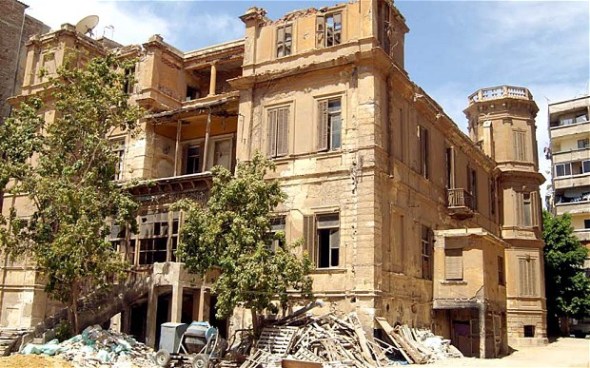
Durrell lived on the top floor of this house in Alexandria. While there, he wrote Prospero’s Cell.
Posted: March 12, 2014 | Author: roy hamric | Filed under: buddhism, people |
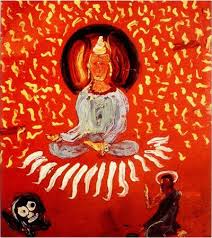
a painting of Buddha by Jack kerouac
Posted: March 12, 2014 | Author: roy hamric | Filed under: people, photography |

Photograph by Robert Crosby
“Gods cool in turn,
by the sun long outlasted.”
– William Empson (1906-1984),
British critic, poet.
– A line from the poem To An Old Lady
See my link to William Empson writing about Chinese poetry here.
Posted: March 5, 2014 | Author: roy hamric | Filed under: books, buddhism, people, photography |

Here’s one more picture from Bill Porter’s new book, Yellow River Odyssey, which should be released soon by Chin Music Press, a small publisher of elegant books based in Washington state. The caption reads: “After another hour among the dunes, we headed back to Shapotou, where I cooled my heels in the Yellow River mud and talked with several men who were inflating goat skins and lashing them to wooden frames to use as rafts. Sheepskins, they said, were useless. Goatskins were the only the skins that held air long enough, and they had to be coated on their insides with sesame oil to keep them from cracking and to maintain their flexibility.”
Posted: March 4, 2014 | Author: roy hamric | Filed under: books, people, places |
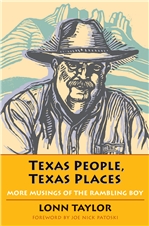
Lonn Taylor, my friend who lives in Fort Davis, Texas, has a new book of essays, Texas People, Texas Places: More Musings of the Rambling Boy. It follows up My Texas: Musings of the Rambling Boy, which was published in January 2012, and he continues his stories and essays illuminating the best of Texas geography, history, and personalities. See my essay on Lonn’s earlier book here. Lonn is revered in the Big Bend area of Texas, where he has a weekly radio show on Marfa’s public radio station KRTS, which is the place to go to hear a wide range of music from classical to Texas roots music.
Posted: March 3, 2014 | Author: roy hamric | Filed under: books, fiction, interviews, people, writing |

Philip Roth may be enjoying his days more now, since it’s going on five years since he said he had decided to still his pen as a novelist. But that doesn’t mean he’s not still making literature, this time in the form of a literary interview conducted by a Swedish journalist, which has just appeared in The New York Times Book Review.
The interview sheds light on his own work and his methods, and also the current golden age of American novels. He spins off a list of American novelists, a paean to the uniqueness of American literature that captures as it does the modern and the universal world, writ large through America’s novelists’ eyes. Even in the face of America’s overpowering popular culture, he says, literature lives:
“What has the aesthetic of popular culture to do with formidable postwar writers of such enormous variety as Saul Bellow, Ralph Ellison, William Styron, Don DeLillo, E. L. Doctorow, James Baldwin, Wallace Stegner, Thomas Pynchon, Robert Penn Warren, John Updike, John Cheever, Bernard Malamud, Robert Stone, Evan Connell, Louis Auchincloss, Walker Percy, Cormac McCarthy, Russell Banks, William Kennedy, John Barth, Louis Begley, William Gaddis, Norman Rush, John Edgar Wideman, David Plante, Richard Ford, William Gass, Joseph Heller, Raymond Carver, Edmund White, Oscar Hijuelos, Peter Matthiessen, Paul Theroux, John Irving, Norman Mailer, Reynolds Price, James Salter, Denis Johnson, J. F. Powers, Paul Auster, William Vollmann, Alison Lurie, Flannery O’Connor, Paula Fox, Marilynne Robinson, Joyce Carol Oates, Joan Didion, Hortense Calisher, Jane Smiley, Anne Tyler, Jamaica Kincaid, Cynthia Ozick, Ann Beattie, Grace Paley, Lorrie Moore, Mary Gordon, Louise Erdrich, Toni Morrison, Eudora Welty (and I have by no means exhausted the list) or with serious younger writers as wonderfully gifted as Michael Chabon, Junot Díaz, Nicole Krauss, Maile Meloy, Jonathan Lethem, Nathan Englander, Claire Messud, Jeffrey Eugenides, Jonathan Franzen, Jonathan Safran Foer (to name but a handful)?”
Posted: February 24, 2014 | Author: roy hamric | Filed under: articles, people, photography |
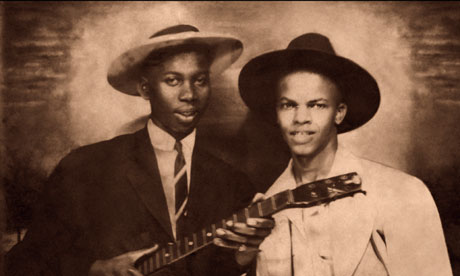
The man on the left has been identified as Robert Johnson, the legendary blues singer and guitarist.
Only two verified photographs of Johnson (1911-1938) existed until now. Eric Clapton once said Johnson was “the most important blues musician who ever lived.” A third, newly cleaned-up and authenticated image has been released by the Johnson estate showing him standing next to musician Johnny Shines.
Work on the photograph began in 2007, when Lois Gibson, who works with the Houston police department, analysed the features of the long-fingered figure holding the guitar. Gibson, who found the identity of the sailor kissing the nurse in the Life magazine photo of Times Square on VJ day during the second World War, said forensic techniques showed a match between this photograph and Johnson’s image in two other photographs, which were previously thought to be all the photographs of Johnson that existed.
Posted: February 19, 2014 | Author: roy hamric | Filed under: articles, books, people, states of mind, writing |
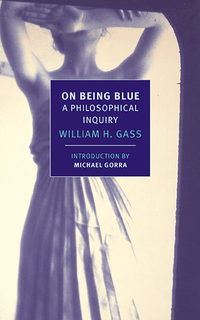
The estimable The New York Review of Books has reissued William Gass’s On Being Blue, a philosophical romp through moods, colours and much more. Gass is a writer who, one hundred years from now, may emerge as one of the few contemporary writers whose work will enter the American canon. Here’s the NYRB description:
“On Being Blue is about everything blue—sex and sleaze and sadness, among other things—and about everything else. It brings us the world in a word as only William H. Gass, among contemporary American writers, can do.
Gass writes:
“Of the colors, blue and green have the greatest emotional range. Sad reds and melancholy yellows are difficult to turn up. Among the ancient elements, blue occurs everywhere: in ice and water, in the flame as purely as in the flower, overhead and inside caves, covering fruit and oozing out of clay. Although green enlivens the earth and mixes in the ocean, and we find it, copperish, in fire; green air, green skies, are rare. Gray and brown are widely distributed, but there are no joyful swatches of either, or any of exuberant black, sullen pink, or acquiescent orange. Blue is therefore most suitable as the color of interior life. Whether slick light sharp high bright thin quick sour new and cool or low deep sweet dark soft slow smooth heavy old and warm: blue moves easily among them all, and all profoundly qualify our states of feeling.”








 the roy hamric journal