
Thai music: Joe Cummings
Posted: June 17, 2010 Filed under: articles, interviews, people 1 CommentJoe Cummings is one of the best people to talk to about anything Thai. After more than two decades roaming Thailand and Southeast Asia, he sees the scene, high and low, in great detail. In an earlier life, he created the running series of Lonely Planet Thailand guide books. I asked him to talk about the Thai music scene, especially rural music.
Roy Hamric: When farangs first come to Thailand, they eventually hear about look thung music. What is it exactly?
Joe Cummings: The name literally translates as “children of the fields,” but means, in essence, farmers. In many ways, it’s the Thai equivalent of country & western in America in its stories and tightly structured formulae. But just as country western has been moving towards rock and roll, look thung is moving that way from traditional forms. If you’re in a taxi in Bangkok most likely you’ll be listening to look thung. It’s the same kind of lyrics: lost your job, your truck broke down, your wife left you. There are two basic styles, the original suphanburi style, with lyrics in standard Thai, and an Ubon style sung in Issan (northeastern) dialect. Thailand’s most famous look thung singer, Pumpuang Duangjan, rated a royally sponsored cremation when she died in 1992.
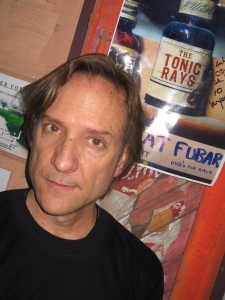
joe cummings
Chai Muang Sing and Siriporn Amphaipong have been the most beloved look thung superstars for several years, with lesser lights coming and going. Other stars include former soap opera star Got Chakraband and Monsit Khamsoi, whose trademark silky vocal style has proved enormously popular.
Look thung has lately been adopted and adapted by long-haired Thai bands such as Carabao, the most popular pop group in Thai history, complete with electric guitars and lots of rock posturing. It’s sort of like redneck rock.
Look thung is popularly heard in the Thai café, which is anything but a coffeeshop in the Western sense, but rather a dark nightclub where a succession of scantily clad female singers take the stage to perform watered-down versions of look thung hits. There are some more grand venues for the music, however, such as the legendary Café Rama 9 in Bangkok.
Q. Some people claim Maw Lam trumps Look Thung for authenticity, originality and a look into the Thai soul.
Arguably the most authentically native strain of Thai music is maw lam which developed in northeastern Thailand and Laos around 100 years ago. Fans in the northeast breath, live and die for this music. The main instrument is still the khaen, a traditional Lao-Thai pan pipe. It has a very dynamic beat, usually a quick 3/8 tempo with a strong bass line reminiscent of Jimi Hendrix’s Third Stone from the Sun. The lyrics are more hard core than in look thung, with more politics, more sex and more violence. It’s almost like Mississippi Delta blues with its rougher language and songs about murder and suicide. Jintara Poonlap and Chalermphol Malaikham continue to reign as queen and king of maw lam.
When you see an authentic maw lam performance live in the northeast (as opposed to on TV in Bangkok), you’ll see how intense the bands can get, with lots of sweat and veins popping out on the forehead. The players really get into it.
It’s most commonly performed at festivals and temple fairs. One of the best festivals for maw lam is the Dok Khoon Siang Khaen Flower Festival in Khon Kaen, also Phi Ta Khon festival in Dan Sai, Loei.
Q. Some groups must have updated both Look Thung and Maw Lam?
Just as Bob Dylan took folk, blues and rock and wove them together with a political outlook in his early to mid-1960s songs, the Thai band Caravan grafted Thai rural folk melodies onto Dylan- and Springsteen-influenced song structures to create a genre of protest-oriented songs called phleng pheua cheewit (Songs for Life), beginning in the late 1970s.
Caravan and their music were banned from public performances throughout the Thai military dictatorship of the 70s and 80s. As Thai politics stablized in the late 80s, the genre was picked up by other groups and commercialized. Much as the sounds of politically oriented Buffalo Springfield were later co-opted by Poco and The Eagles in the USA, Caravan’s musical creation was taken to market by Carabao.
You won’t find much live maw lam in Bangkok or in many clubs even in Issan. Songs For Life can be heard in smaller bars typically decorated with water buffalo skulls and buffalo-cart wheels. Chiang Mai has one of the better venues for Songs For Life (although not exclusively), a bar called Sudsanan.
Q. The Pai music scene is attracting a lot of interest musically, right?
For such a small town, Pai (Mae Hong Son Province) does have an amazing music scene. Be-Bop Bar, which has been around since the late 90s, attracts musicians and bands from all over Thailand, and some from other countries as well. The place is packed with live music lovers every night, and the roster of bands change nightly. Aside from Caravan and Carabao, both of whom have performed there, Be-Bop has recently hosted Mason Ruffner (former guitarist for Bob Dylan), Aussie bluesman Mojo Webb, and New Orleans-style pianist Mitch Woods. The owner, Sucharat Panpai, is an excellent blues and jazz guitarist himself, and he plays there regularly with his own band.
Parking Pai, a branch of Bangkok’s Parking Toys, offers a variety of live music, usually local or Chiang Mai acts playing international and Thai music, sometimes something a little different, including indie bands from Bangkok. Edible Jazz does live jazz and blues in a rustic bambbo-and-wood setting.
Q. What about contemporary Thai music?
Most popular on Thai radio is T-Pop, meaning Thai pop, a borrowing from Japan’s J-Pop. I don’t find it very original-sounding, with its general emphasis on Western 80s New Wave production style, with heavily processed guitars and keyboard washes and lyrics about teen love. The language features a lot of faux naïve lyrics, again influenced by J-Pop.
Singers who are look khreung – half-Thai, half-farang– and sport Western names are particularly popular. For example, Tata Young, Nicole Theriault and the original look khreung heartthrob, Thongchai “Bird” MacIntyre.
Thai mainstream rock is more unique. Although obviously influenced by Western bands like Guns and Roses, Thai rockers have a way of taking the genre and giving it a Thai twist. Just where you might end the chord progression in a typical Western rock song, they’ll tag on a little something, often taking a minor key song back into its relative major. Loso is still the biggest traditional Thai rock band.
In the 1990s an alternative pop scene known as klawng sehrii or “free drum” in Thail, also phleng ta\^i din, “underground music”––grew in Bangkok. Hip-hop/ska artist Joey Boy not only explored new musical frontiers but released lyrics that the Department of Culture banned. Thaitanium have taken over that territory and are currently the number-one hip-hop act in Thailand. Ska seems more popular than ever. Of course the veterans on the scene are T-Bone, who groove equally well in Thai and English. They’re internationally recognized, even scored a small stage at Glastonbury a few years ago. But there are a whole bunch of new ska bands that take it much closer to the roots of the genre.
Modern Dog, a Britpop-inspired band of four Chulalongkorn University graduates, brought independent Thai music into the mainstream, and their success prompted an explosion of similar bands and indie recording labels. Among the most significant indie rock acts in Thailand, from my perspective, were Day Tripper, Silly Fools and Futon. I think Silly Fools still plays but the other two groups are gone. Gene Kasadit from Futon now does his own thing, more outrageous than ever, while other members of Futon have formed Goo, who put on a seriously kickass rock show.
There’s a new generation of indie bands who are really state of the art for Thailand, often composing songs in English or in both English and Thai. Among these, my present favourites include Zero Hero, Abuse The Youth, Revenge of the Cybermen, Class A Cigarettes.
Q. When you visit Bangkok, where do you go to hear good music?
The situation has gotten pretty dire over the last couple of years. A few special venues like Rain Dogs, The Tube and Lullaby have disappeared. Saxophone, at the Victory Circle, is an old holdover from the 80s that’s still good for blues, funk and fusion, with occasional acts from overseas like Eddie Baytos and Mason Ruffner. Ad Here the 13th, on Samsen Road near Soi 1, is a personal fave. I love the house blues band, led by owner Pong. Common Ground on Samsen Rd occasionally has a good lineup of indie bands, as does Bangkok Rocks on Sukhumvit Soi 19. Club Culture recently re-located to a spot near the Democracy Monument but has gone mostly DJ, with the occasional live show. DJ culture has just about taken over the city. Parking Toys off Kaset Nawamin Rd has a nightly line-up of bands playing rock, latin and funk, occasionally something more modern. Stu-Fe, near the Nam Kluay Thai intersection of Rama 4, is run by a musicians collective called Monotone, and on the weekends the jams can be pretty good. I’ve become a big fan of Belgian accordionist Matthieu Ha, who has played there. Overtone Music Cave, in the RCA area, has a state-of-the-art sound system and will become a popular spot for fusion and prog rock. I’m living in Bangkok now, but sometimes I have to fly to Chiang Mai to hear good live music at Guitarman.
Q. And what about classical Thai music?
Classical Thai music, known as peepat (the name of the ensemble itself), is based on styles of music imported from the Cambodian royal court during the Ayuthaya era, so it can be argued that it’s not particularly Thai. It’s also not very popular and is for the most part reserved for ceremonial performances, tourist dinner shows and occasional Thai cinema.
Classical Thai music received a huge boost in 2004 when the film Hom Rong (The Overture) was released. Based on the life story of Thai maestro Luang Pradit Phairoh (1881-1954), the film chronicles an era when Thai political leaders were trying to suppress traditional Thai music in favour of Western classical music in order to prove to would-be colonisers that Thais were “civilized.” In the first few months after the film’s opening, new students were practically standing in line to learn ranaat ehk (classical wooden xylophone) at Bangkok music schools.
Q. It seems your music life is picking up and your travel writing life is slowing down. Talk about the music…
I actually started playing in rock bands when I was 15, and by the time I was 20, I was touring with a band called The Fog that opened for the likes of Blue Oyster Cult, Uriah Heep and Edgar Winter’s White Trash. I came to Thailand shortly after that period and have been jamming around Bangkok since dinosaurs roamed Sukhumvit Road.
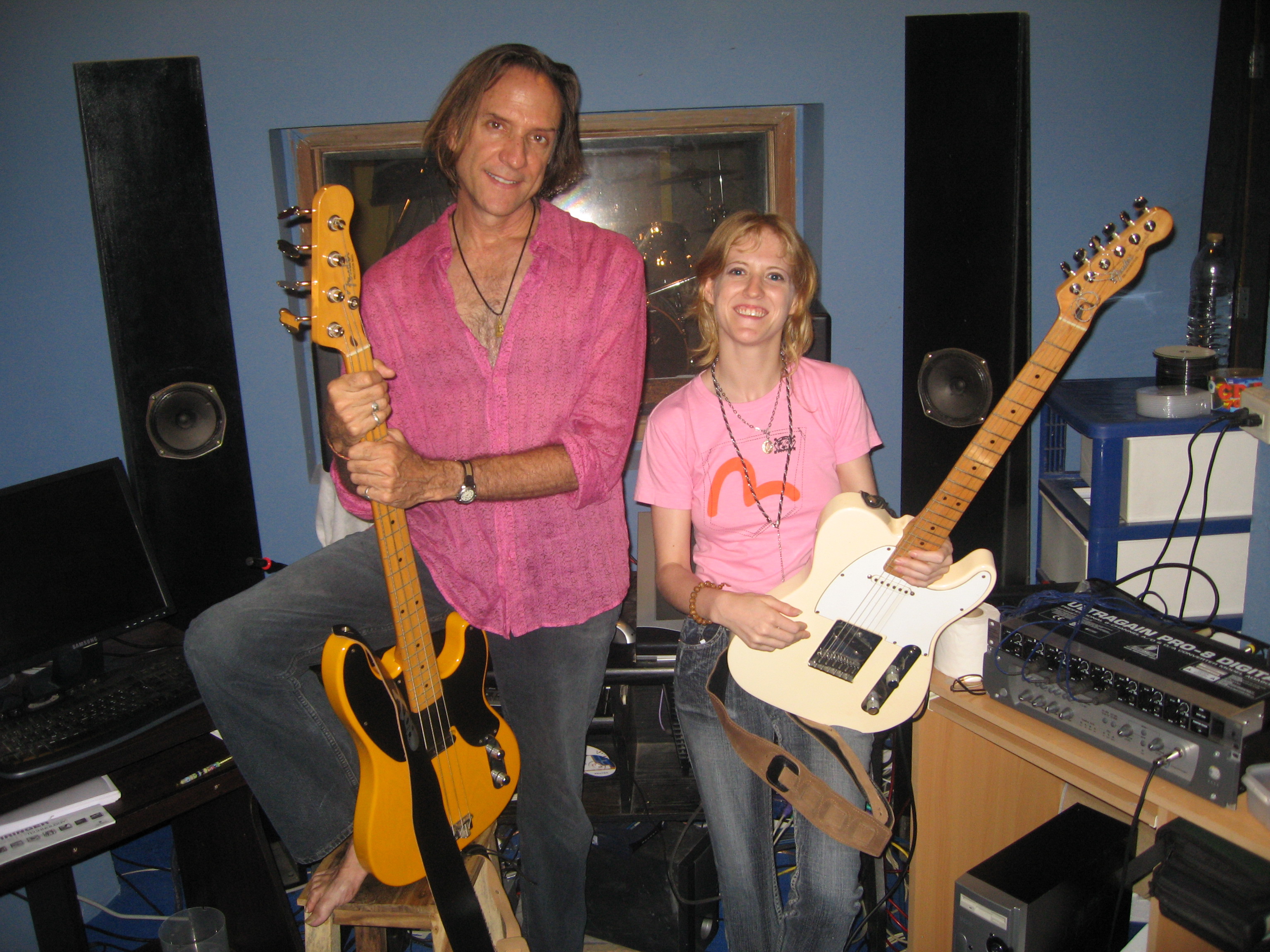
joe cummings and marie dance in a Chiang Mai recording studio
A few years ago I met Marie Dance, a talented singer-songwriter-guitarist from England. We played together a few times with a band called The Jackalans, based in Pai, and as we got more serious about writing and performing originals, we changed the name to The Tonic Rays. We recorded one album, which miraculously made the Billboard Critics Top 10 Albums of 2008, courtesy of rock critic Chuck Eddy. You can download the tunes at Amazon, Rhapsody, iTunes, and CDBaby. You can also hear a few tracks at www.myspace.com/tonicrays. We were based in Chiang Mai and played a lot there (at Babylon, Drunken Flower and Guitarman) and in Pai (Be-Bop and now-defunct Phu Pai), but we also played in Bangkok, Pattaya and Ko Phi Phi. Marie is out of the picture for now, but I may start another band soon. I’ve been jamming with Cannonball here in Bangkok and also in Saigon last year at a music fest. Mason Ruffner is coming back to Thailand in August, and so I’ll join him for a spell. I was in Berlin recently and really stoked by the scene there.
Q. So is Joe Cummings still in the travel writing business?
I guess you could say I have a dual life. My day job now is writing about art, culture, architecture and people for The Magazine of The Bangkok Post. Also, on my own I do mostly large format books like Lanna Renaisance, Chiang Mai Style and Buddhist Temples of Thailand, rather than guidebooks. At night, I still play music. Sometimes it feels like there’s two of me in one tired body!
Q. Now we fade to silence.
Drum roll…
searching for Orwell
Posted: June 17, 2010 Filed under: articles, people, reviews Leave a commentThis is a revised version of a review published in The Kyoto Journal prior to the 2010 national election which led to the creation of a parliament and the opening up of Burma to democracy.
Secret Histories: Finding George Orwell in a Burmese Teashop by Emma Larkin
“Who controls the past controls the future: who controls the present controls the past.”––Nineteen Eighty-Four
By Roy Hamric
Early into Emma Larkin’s extended stay in Burma while she was gathering material for Secret Histories, she visited a Burmese scholar and brought up George Orwell’s name.
“You mean the prophet!” the man exclaimed.
In Burma today, rechristened Myanmar in 1989 by a military junta that has methodically repressed the country and turned it into a pariah state, there is a joke that Orwell wrote not just one book about the country, Burmese Days, but two more: Animal Farm, the tale of a socialist revolution in which pigs overthrow human farmers and set about to destroy the farm, and Nineteen Eighty-Four, the story of a heartless dystopia. The trilogy depicts a before-and-after picture of Burma-Myanmar.
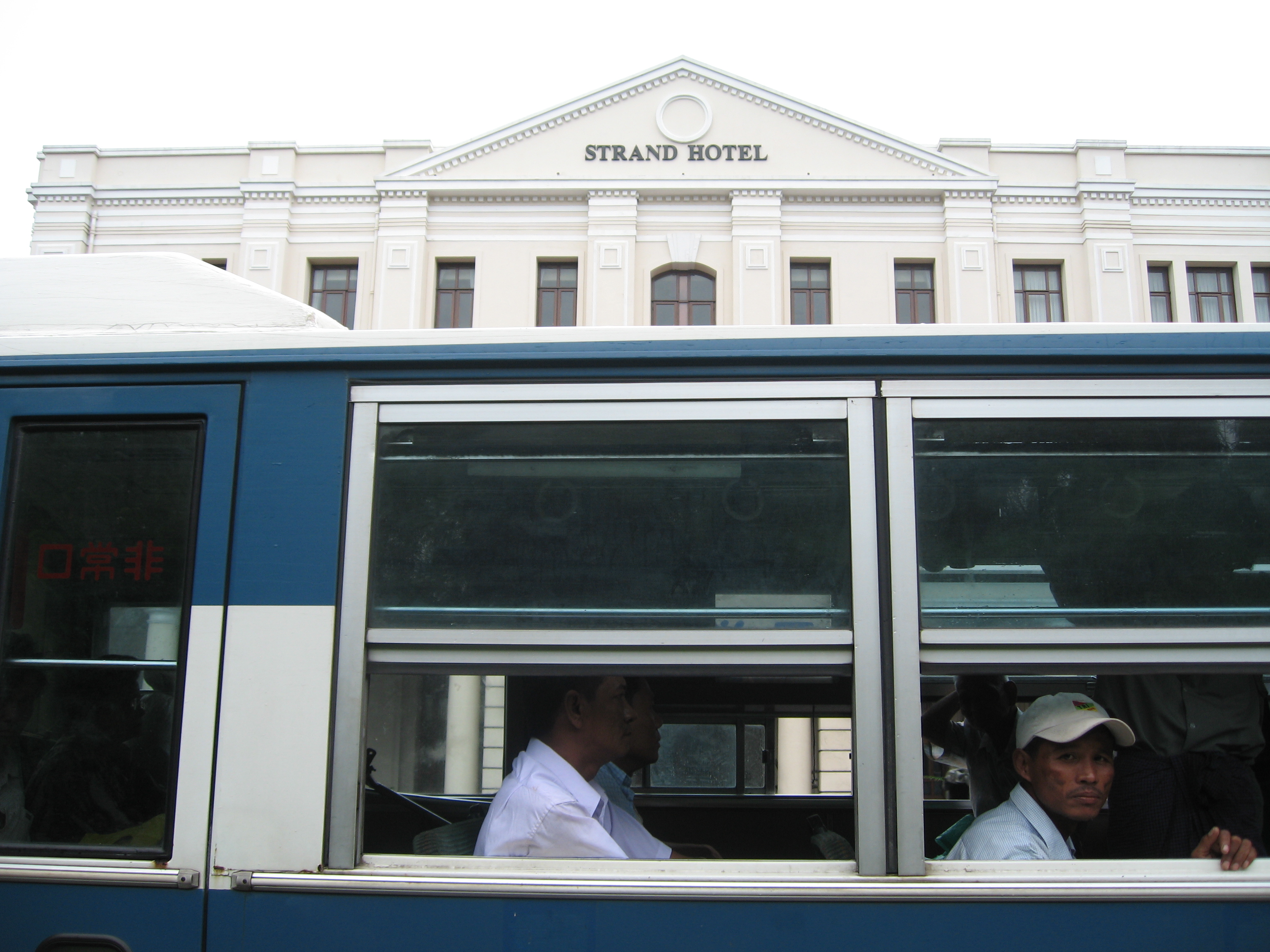
Emma Larkin is the pseudonym of an American journalist, born in Asia, who has spent long stretches of time living in Burma, a rarity for Western writers these days. Her book has added luster now because Burma is has undergone profound changes since the 2010 elections, in which the junta handed over power to a parliament and began a rapid move to establish a democracy, a normal civil society and open up its closed culture to foreign investment and businesses.
Larkin’s book is now a time capsule on what Burma was like under a bloody totalitarian military regime, which massacred many students and other in demonstrations over a two decade period. She wisely steered clear of the tourist trail, preferring quiet visits with ordinary Burmese in the former capital of Rangoon or in towns and villages in the north and south. The result is unsurprisingly a book that feels Orwellian, a sad testament to the fact that Burma hasn’t progressed much in nearly 90 years, when Orwell was serving unhappily as a policeman for the British crown, in the waning days of its Asian empire. The Burmese eventually threw the British out, but what they got in return has been a dismal chronicle of brutal, incompetent, repressive military dictatorships which have driven the country into the ground.
Reading about life in Burma in the hands of Larkin is a pleasure on many levels. She writes a gentle prose which, largely free of polemical arguments, lets the Burmese people speak for themselves. For those who are unaware of Burma’s recent history, the book is a primer on the woeful battering suffered by its citizens at the hands of cold, ruthless military regimes that first took power in the 1950s, and is known most recently for the 1988 massacre of an estimated 3,000 people–– students, monks, citizens and children––who took to the streets to protest nearly three decades of military rule and neglect. Burma, during the time of Larkin’s book, was the same Burma of long ago. It had undergone little change. The infrastructure is still in shambles, electricity was non-existent or rationed, the press was censored, individual initiative was discouraged, political speech was repressed and pro-democracy activists were routinely rounded up and sentenced to prison on draconian charges grounded on state control. Commodities were scarce, but mostly just non-existent. Jobs were scarcer. Reliable information couldn’t be found. An ever-present fear of informers hovered over all conversations, especially with foreigners, and the fear was captured in the expression pasien yo, literally “the handle of the ax”––signifying the tool used to chop down a tree is made from the wood of the tree itself. The people are kept in line through fear of their fellow citizens.
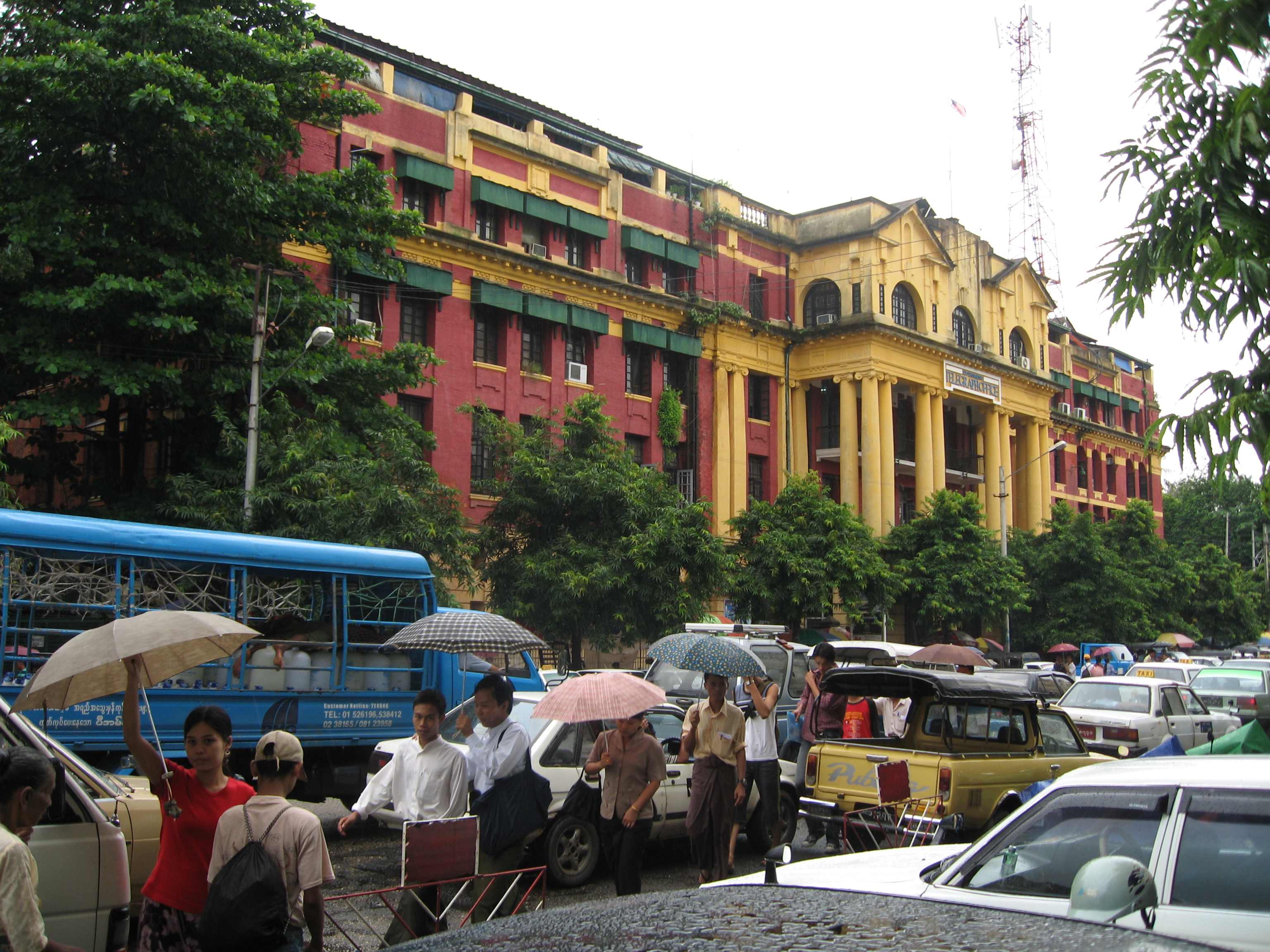
On another level, the book is a detective story, as Larkin searches out the places where Orwell, as a young man, lived and worked. She visits all the towns where he was posted as an officer in the Imperial police force, starting in 1922: Mandalay in the country’s center; Myaungmya and Twante, in the Delta swamplands; the capital of Rangoon (now called Yangon by the junta); Moulmein, on the eastern peninsular; and Katha, in the foothills of northern Burma, which became the fictional setting for Burmese Days.
In her travels, she finds that many of the dwellings and buildings where Orwell lived and worked are still in use or now lie abandoned to dust and weeds. In each town, the people who befriend Larkin are etched in vivid portraits.
Lastly, the book is a chilling picture of what life is like on the Animal Farm in post-Nineteen Eighty-Four. Inertia, gloom, paranoia and absurdity color the days. The country stagnates, a tangible entropy unwinds downward, progress is systematically retarded: ancient taxis, held together with wire and prayers, rattle around potholes, all print and broadcast media are policed, information from the outside world is sketchy, tourists must register passports at hotels and guesthouses and state their next destination (duly recorded by the desk clerk). The Burmese themselves must inform the local authorities if anyone––Burmese or foreigner––stays overnight in their home. In such an environment, the people are expert at reading and decipher rumors, for they are often the most reliable clues to important events the government tries to suppress. Leaders of opposition groups, all brave souls, are routinely spied on, intimidated or jailed, and on and on. In one town, Larkin was required to visit nine governmental agencies to inform them that she had arrived in the town. In spite of the obstacles, the Burmese people somehow struggled on, carving out pockets of happiness in simple pleasures.

Larkin’s sympathies for the Burmese people stand out, but she offers little hope for a better life anytime soon, and recent events confirm her pessimism. China, Russia and South Africa’s recent vetoes of the U.S. and British resolutions to place Burma’s human rights record on the U.N Security Council agenda confirms that brutal regimes have friends in the world. Asean, the organization of Southeast Asian nations, had a dismal record on Burma, defending its timid stance under its “softly, softly” rubric of Asian values and non-interference in a brother state’s internal affairs.
Meanwhile, millions of Burmese were displaced over five decades by a cold-blooded military machine, whose soldiers routinely rape women and burn villages and homes of ethnic citizens, causing them to flee to the safety of the jungle and border areas.
Burma under the bloody military regime was almost beyond belief, but then again, no. In colonial Burma, George Orwell first glimpsed the dark shadows where greed, lies and governmental repression can lead. Larkin takes us farther down that totalitarian road and deep into Burma’s darkness under the military regimes which turned Orwell’s prophetic nightmare into a frightening, daily reality.
Global Portraits 2
Posted: June 15, 2010 Filed under: fiction, people, writing Leave a commentNo. 2 in a series of short fiction sketches that say something about the cultural mix that’s going on in Asia. To see all the fiction pieces, go to “Categories” and click on the “fiction” link.
2
The guy has a chicken neck, soft rolls of fat under his chin, wispy white hair. He’s like a boy in front of the most beautiful girl in the village. His eyes never leave me. He says go out, go to room. I think: Go out with this old animal again? I tell myself––Pai, if pay enough, go. I test his money. A little bar-fly girl in a black and white school uniform walks by in her white sneakers, bouncing up and down, like this, to Proud Mary.
“I see that little girl likes you,” I say, using my best smile. “I help you. You want her? Only $60.”
He said the name of Jesus, the God. “No, honey. I like you. Don’t you want to go with me?” he says.
“I want to go,” I say, “but I have to ask for a lot of money. I have to pay rent. I have two children.”
“I seen the scar,” he says.
My head was a broken plate from tequila the night before. All the dancers went to Mr. Spicy’s after work. Men went crazy buying us drinks. We had a lot of fun. Now I feel like somebody kick me in the head. He says again, “Don’t you like me, darlin’? I need another tequila.”
“Me, too,” I say. I start to feel better because that was my 74th drink this month. I made 65 drinks before the twelfth day. Now the mamasan knows I work hard to make money. $1 a drink for me. $3 for the bar. Then the old animal who is covered in tatoos says he needs another tequila to make his carrot grow. When I don’t understand, I smile and laugh. “Me too,” I said. One more dollar. He smiles and nods. Momasan walks around the dance floor, “Tomorrow, everything 50 percent off,” she says. “Not me,” says Blue.
The old animal says it’s time to put up or shut up. I know shut up means to keep quiet. Finally, he says, “Well? Let’s go, honey…”
I say, “You give me $100, Ok? We go now.” That’s how I got $30 to send to my mom yesterday. My mom’s in jail in Burma. Two more years. I want her with me. I need her close. I’m a baby too, really. I want to cry all the time.
Tomorrow night Blue and I go to the temple for Macha Bucha––about the Buddha talks to people. I will pray to take care of my mom and to live to be old with my children.
The next night all the temples in the town filled with people. The moon rose big and red like millions of nights before on this night in May. Pai and her two children prayed for her mother, and she prayed to be a good mother and to have a good heart.
chiang mai sketch
Posted: June 13, 2010 Filed under: people, places, writing | Tags: chiang mai sketches Leave a commentThis is an excerpt from my unpublished travel book. I’ll be posting some sketches that capture a little of the cultural mix tha t’s going on in Asia. To see more, go to “On the Record” and click on the sketches links.
1.
“That summer I went back to Vietnam, that was a strange one. Speed and cocaine was everywhere, my kids were goin’ crazy and somebody with BB guns shot the eyes out of two cows in my pasture. I finally found my youngest son in a county-line motel room filled with dirty clothes and eight other run-away kids. He was 17 then, going out with girls 23 years old. I mean beautiful girls, the prettiest in the county. My oldest son was let out of jail early ’cause he was a ‘model prisoner.’ Hell, how proud was that supposed to make me?
“Then I started getting calls on the answering machine, ‘We’re going to kill your family.’ ‘Your time’s up, hombre, say adios.’ My wife, who’d just turned Pentecostal, had done said goodbye to me. Really she didn’t say anything––she was just gone. Even took the curtains and the lawn chairs. The youngest boy, the gigolo, he finally took a high school test and placed in the Top 5 percent in the country––the Top 5. He’s smart, but stubborn. Now he’s the youngest electrician in Junction, Colorado. Joined the Pentecostals. Goes regular. Got some credit cards. Sends me a little money sometimes, but he never writes.
“I got arthritis, a big belly. It’s hard to walk. My mother’s lingering. Yesterday, my sister says, ‘I want those blue Limoge bowls.’ I said, ‘Hell, your mother’s not dead. What are you talking about?’ Then I got to thinking, and told her, ‘Ok, tell mother to get some of those stickers. Put names on the bottom of things. Then there won’t be no fighting when she goes.’ Truth was, I wanted Dad’s trunk with the old uniforms in it. He worked for the Texaco gas station when people at those stations wore real uniforms, hats, special belts, and all.
“My mother, she made me proud yesterday. She said, ‘You got good boys now.’ My oldest boy, he’s in China now. Married a Chinese gal, real cute, in San Diego after the Navy. Her father is something in their government. The boy don’t work. Says they’re tearing down all the old things in Beijing. He says they got a lot of that to knock down.
“It’s the same everywhere, I guess. Except we got a black man president now. It’s about time, I say. After I came back from Vietnam and the Airborne, I seen the world clear. I seen it for real. It’s what it is. A blessing in the center of sorrow. I dispatched the two cows, dressed them out, filled the freezer, had meat for a year, and I said to myself, it’s time to go to Vietnam. I nearly died over there two times. Once with the Airborne on Nui Cuong Mountain. Then again last year on that same mountain. “I told myself I was going to climb to the top of that mountain again, to see it all again, and I did, but it didn’t mean anything. I didn’t recognize anything. It looked like no one had ever been there. Getting back down, it nearly killed me. It turned dark, and I was on the ground – couldn’t walk. Thought I was dying. My guide, who was a good kid – I seen that when he first started to cut trail going up the mountain – he said, ‘Look at the stars, mister. They’re beautiful.’ I thought, ‘Son, I’m dying here right now.’
“Then I see the damn stars – they were beautiful. It felt like they had come down and were touching me. I said, get your ass up, you’re not dying here. The boy, he about carried me down the mountain. I think he understood what it was all about.” copyright@roy hamric
sight seeing
Posted: June 11, 2010 Filed under: people, photography, sight seeing Leave a comment
I like the distortion and colors in this self-portrait reflection on an aluminum water container on the roof of a building. (Iphone photograph)
Lines of thought
Posted: June 7, 2010 Filed under: books, people, states of mind, writing Leave a commentGleanings from reading Pater, Kerouac and Emerson:
“We have an interval, and then our place knows us no more. Some spend this interval in listlessness, some in high passions, the wisest, at least among ‘the children of this world,’ in art and song. For our one chance lies in expanding that interval, in getting as many pulsations as possible into the given time.
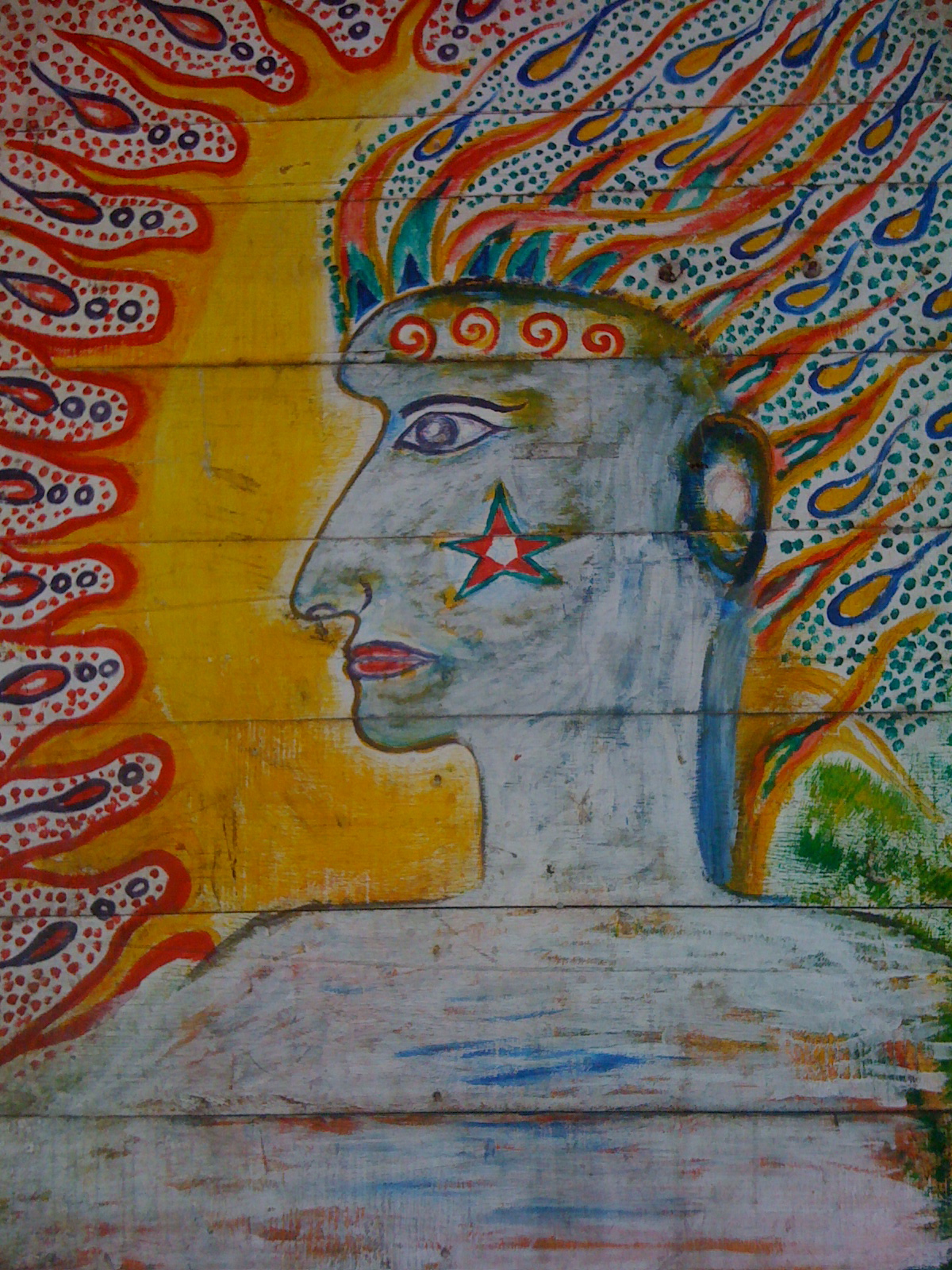
burning man, painting in Cafe del Sol, Chiang Mai
“….Great passions may give us this quickened sense of life, ecstasy and sorrow of love, the various forms of enthusiastic activity, disinterested or otherwise, which come naturally to many of us. Only be sure it is passion––that it yields you this fruit of a quickened, multiplied consciousness. Of this wisdom, the poetic passion, the desire for beauty, the love of art for art’s sake, has most; for art comes to you professing frankly to give nothing but the highest quality to your moments as they pass, and simply for those moments’ sake.”––Walter Pater, The Renaissance
“Believe in the holy contour of life.”––Belief & Technique of Modern Prose, Jack Kerouac
Emerson, in his Journal: “The days come and go like muffled and gray figures sent from a distant party, but they say nothing and if we do not use the gifts they bring, they carry them silently away.”
why Stanley Cavell?
Posted: June 5, 2010 Filed under: articles, books, people, states of mind 1 CommentI was first attracted to Stanley Cavell’s study of Thoreau, The Senses of Walden, and his deep probing of Emerson’s ideas in essays throughout his many books. All his books circle around American thought, American originality, while pulling in Wittgenstein, Kirkegarde, J.L. Austin, Heidegger, and others, with a commitment to use ordinary language and works of literature as a common ground of thought through which we all can assess and explore life, not something separate from philosophy but a living part of a philosophy that identifies itself with a deeper sense of experience. I think the passage below from the preface to Must We Mean What We Say?, as well as any, summarizes his intent and purpose:
“I suppose that the idea of the philosopher as guide was formed in me in resistance to the still current idea of the philosopher as guard. So I should perhaps add that at no period in my life has it occurred to me that philosophical problems are unreal, that is, that they could be cured and philosophy thus ended, as if left behind. The problems I was concerned with are better expressed as about the all but unappeasable craving for unreality. Kant’s diagnosis of such perplexities was as “transcendental illusions.
“I had in Must We Mean What We Say? already suggested understanding the philosophical appeal to the ordinary in relation to Kant’s transcendental logic, namely, as the sense of uncovering the necessary conditions of the shared world, but not until the second essay in the book, The Availability of Wittgenstein’s Later Philosophy, was I able to give a certain textuality to this relation to Kant, at the point at which Wittgenstein in Investigations announces that “Our investigation….is directed not toward phenomena, but, as one might say, toward the ‘possibilities’ of phenomena.” And it would not be until the Claim of Reason that I would feel I had secured some significant progress in assessing the difference it makes that Wittgenstein sees illusions of meaning as something to which the finite creature is subject chronically, diurnally, as if in every word beyond the reach of the philosophical system. The idea that there is no absolute escape from (the threat of) illusions and the desires constructed from them says there is no therapy for this, in the sense of a cure for it…[that] was evidently something that captured my fascination halfway through Must We Mean What We Say? with Samuel Beckett’s Engame––in effect a study of the circumstances that say, “You’re on Earth, there is no cure for that.”
Asian moments
Posted: May 31, 2010 Filed under: buddhism, people, states of mind Leave a comment

henry david thoreau
1854: The first edition of Thoreau’s Walden appears. On the frontispiece page is an engraving of a leaf from a Banyan tree, the tree under which the Buddha sat when he encountered enlightenment.
1958, November: Jack Kerouac, Allen Ginsberg and Peter Orlovsky call up D.T. Suzuki at his apartment in New York City, just arrived from Japan. His secretary says: “Can you come over right now?”
“You young men sit here quietly and write haikus while I go and make some powdered green tea,” Suzuki says. Sipping the tea, Allen says, “It taste like shrimp.” “It tastes like beef,” says Suzuki. “Don’t forget it’s tea.”
Kerouac’s haiku is:
Three little sparrows on a roof,
Talking quietly, sadly.
Kerouac tells Suzuki that he’s experienced several samadhis lasting “a whole half hour or three seconds.” After the visit, as Kerouac is walking away he realizes that Suzuki was his old father in China, and shouts: “I would like to spend the rest of my life with you.” Suzuki, waving goodbye, says, “Sometime.”
Zen koans
Posted: May 26, 2010 Filed under: buddhism, people, poetry, reviews Leave a comment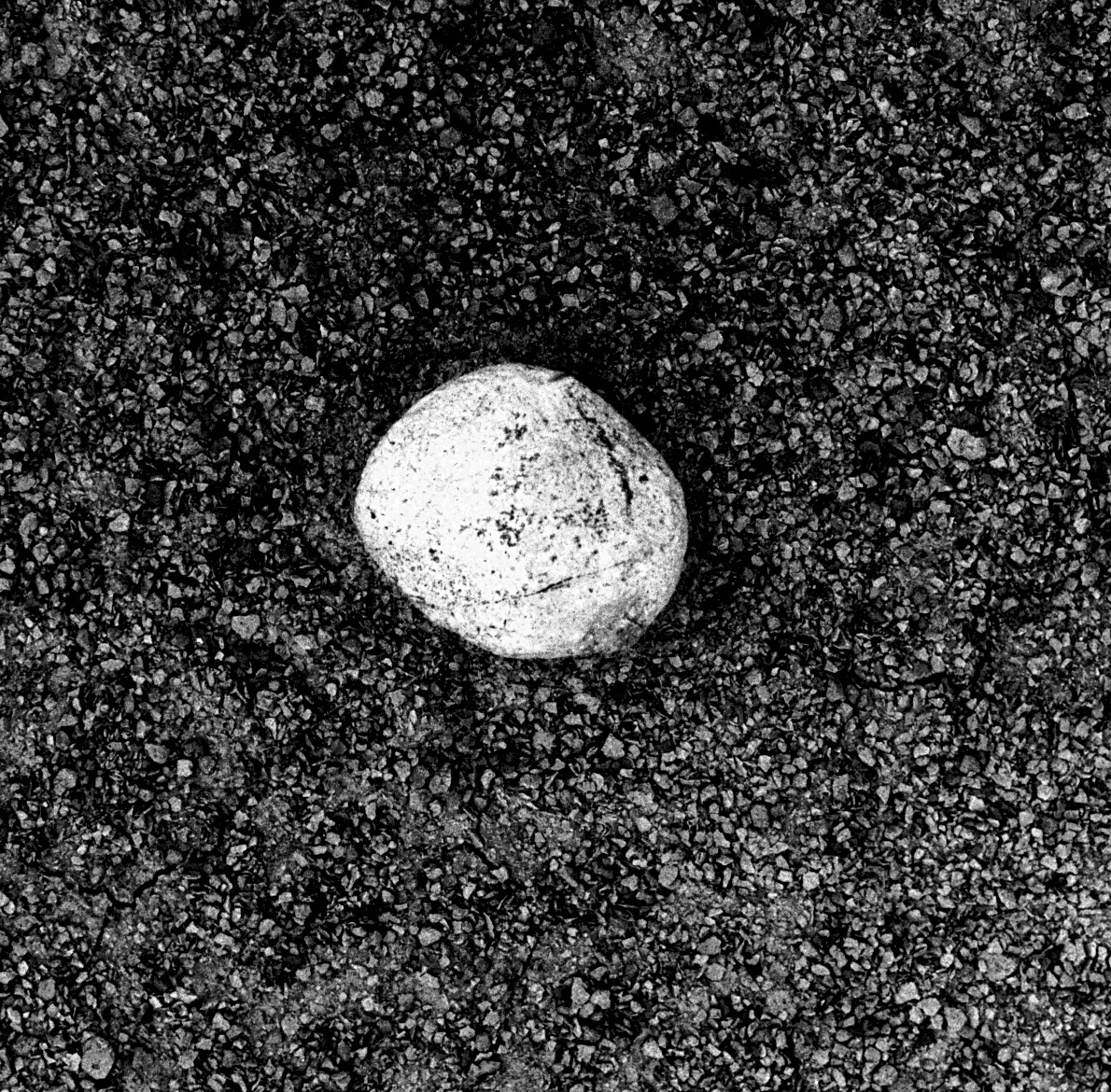
a rock on the ground in the Big Bend near the Rio Grande (photograph: roy hamric)
An earlier version of this review appeared in The Kyoto Journal.
The Blue Cliff Record: Zen Echoes by David Rothenberg; Codhill Press, 2001
the Zen koan
By Roy Hamric
But the poetry that thinks is in truth the topology of being.—Martin Heidegger
David Rothenberg’s book of poetry is based on his response to “The Blue Cliff Record,” the venerable koan collection, and has been launched with kudos from Sam Hamill, Frederick Franck and Mark Rudman, all esteemed poets.
Rothenberg is a poet and muscian, the author of “Sudden Music” and “Hand’s End,” and he is the founding editor of Terra Nova, a magazine devoted to deep ecology. A contributing editor at Parabola magazine, he also teaches philosophy.
Hamill, the poet and translator, notes in a foreward the long tradition of writers reinterpreting the work of other writers, giving renewed life to key ideas and images. Rothenberg labels his poems “echoes,” and he freely plays with the Blue Cliff Records’ koans and the “pointing” verses, spinning off his own interpretation and images based on his perspective and poetic sense. As students of Zen learn, koan “cases” are presented in a straight forward narrative by the writer, and they’re usually followed by commentary and short verses intended to highlight aspects of the case, a sort of coda that offers the student a breakthrough perception or idea.
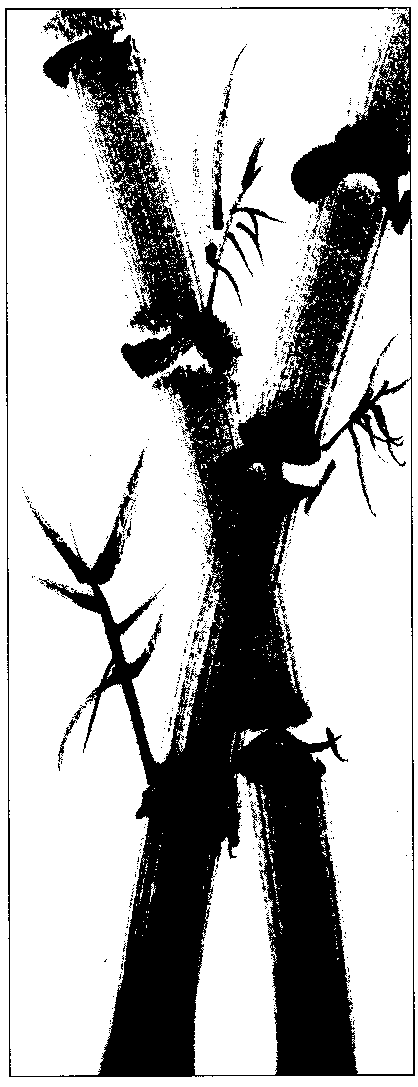
illustration by Jim Crump
Here is Rothenberg’s poem “The Cat Could Have Lived,” based on Case 63:
I took off my sandals, placed them on my head.
If you had been there, you could have saved the cat.
Of like hearts, like minds.
You two on the same road would know that.
You may murder the cat, it’s none of my business.
The sandals don’t purr, and torn they won’t scream.
If someone dies for them these puzzles matter.
You must try to care, if you wish to live.
Cumulatively, this type of Zen verse works something like a waterfall in Nature. We see the surface, and we are sometimes anesthetized by it, but we’re eventually led to wonder what’s behind this flow of words that sparkle inside our mind and endlessly circle around. These poems challenge, cajole, dare and nudge us deeper inside our mind and are worthy esthetic companions to the seemingly impenetrable koans.
Rothenberg knows his Zen esthetics. Slashing directness, grandiose overstatement and sharp minimalism are esthetic staples, and they are frequently used back to back in a line of Zen poetry. He understands the affect and mines this tension––”The great waves rise up a thousand feet”––but ”only a single shout is needed”––leading the reader one way only to be snapped back to simple reality.
Poems based on these fine points of Buddhist esthetics offer glimpses of mind working: mind rooted in a self viewing the world. Koan collections are primers on the affects of language on the mind, on the affects of language as the dancer-magician between our sense of external and internal.
Certainly, the best Zen poetry rests on compression. For that reason, koans and poetry have always had a kinship in the hands of people like Rothenberg, who have something to say beyond mere words.
An excerpt from “It Takes A Word,” based on Case 11:
One right word is all it takes
it can smash the chains and break down he gates
Who knows such words?
––Look around you and see,
What’s the use of today?
shock the country, stir up the crowd
swallow all in one gulp and dwell in the clouds
Look back at that monk who could walk across water
Don’t let him get away with it:
“You smug fellow, if I had known you could conjure up wonders,
I would have broken your legs!”
Then he who speaks disappears
(he has said the word).
Zen teaching has always divided its methods between the body and the mind. Break down the body in unrelenting, regular sitting––allow the body to come to silence like a horse to water. Break down the mind in linguistic disjunction––allow the mind to severe the bind of language to meaning; make language revelatory: allow it to reveal the truth of being. Such approaches, throughout Zen history, alternate between using non-sensical language constructions and sublime poetic beauty. Take your pick, either one might do the job.
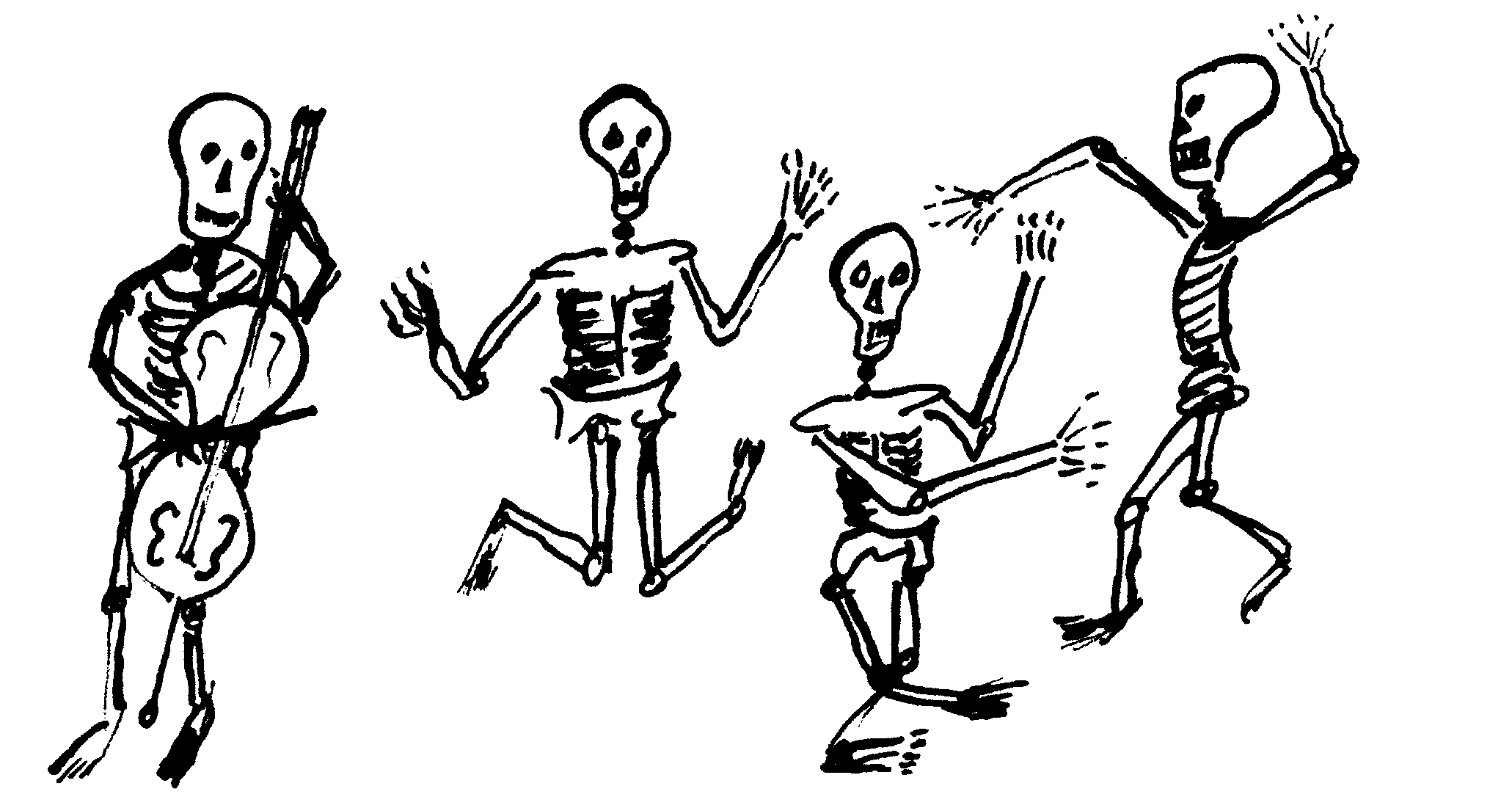
illustration by Jim Crump
Walter Benjamin, the astute critic of culture and mind, saw language itself as the primary subject of interest––and not just its role in creating a subject and object. He preferred to see language as a medium (in his case spiritual) where the absolute and the relative might be/are bridged. Rothenberg’s sense of poetry fits this view.
These poems have a sure, unforced lyrical touch. But they are not about lyricism. They are about our unending mentality, about the mind’s inate naming and circling from the expressible to the inexpressible. They take the reader on an exhilarating ride through knotty koans and Zen poetry.
Their goal is small, to give pleasure, and large, no less than to reach the other side of the river of words run by so many poets over the centuries.
the Golden Triangle
Posted: May 20, 2010 Filed under: articles, people, places Leave a commentThis is an expanded version of a story that originally appeared in The Bangkok Post.
The Heart of the Golden Triangle
By Roy Hamric
For decades, Sop Ruak, which means “golden triangle,” a sleepy riverbank town in Northern Thailand, was mostly just a name on the map with very few visitors. The occasional tourist who ventured there found few accommodations or attractions. However, just the name conjures up tales of drug runners and international intrigue behind the lush, green walls that form the nexus where the borders of Thailand, Myanmar and Laos merge. The actual vista is a spectacular swath of riparian jungle with the mighty Mekong River bending eastward in a great flowing mass before disappearing into Laos.
No one should be surprised that during the past decade Sop Ruak, with the sparkle of its name, has attracted a burst of five-star hotels, a hotel-gambling casino complex across the river in Myanmar, and the flowering of dozens of guest houses and outdoor shopping areas selling hill tribe handicrafts and goods from China, Laos and Myanmar. On any day of the week now, lumbering double-deck tour buses bring up to 1,000 or more tourists a day from Asia and the West, most of whom only stay a few hours and depart.
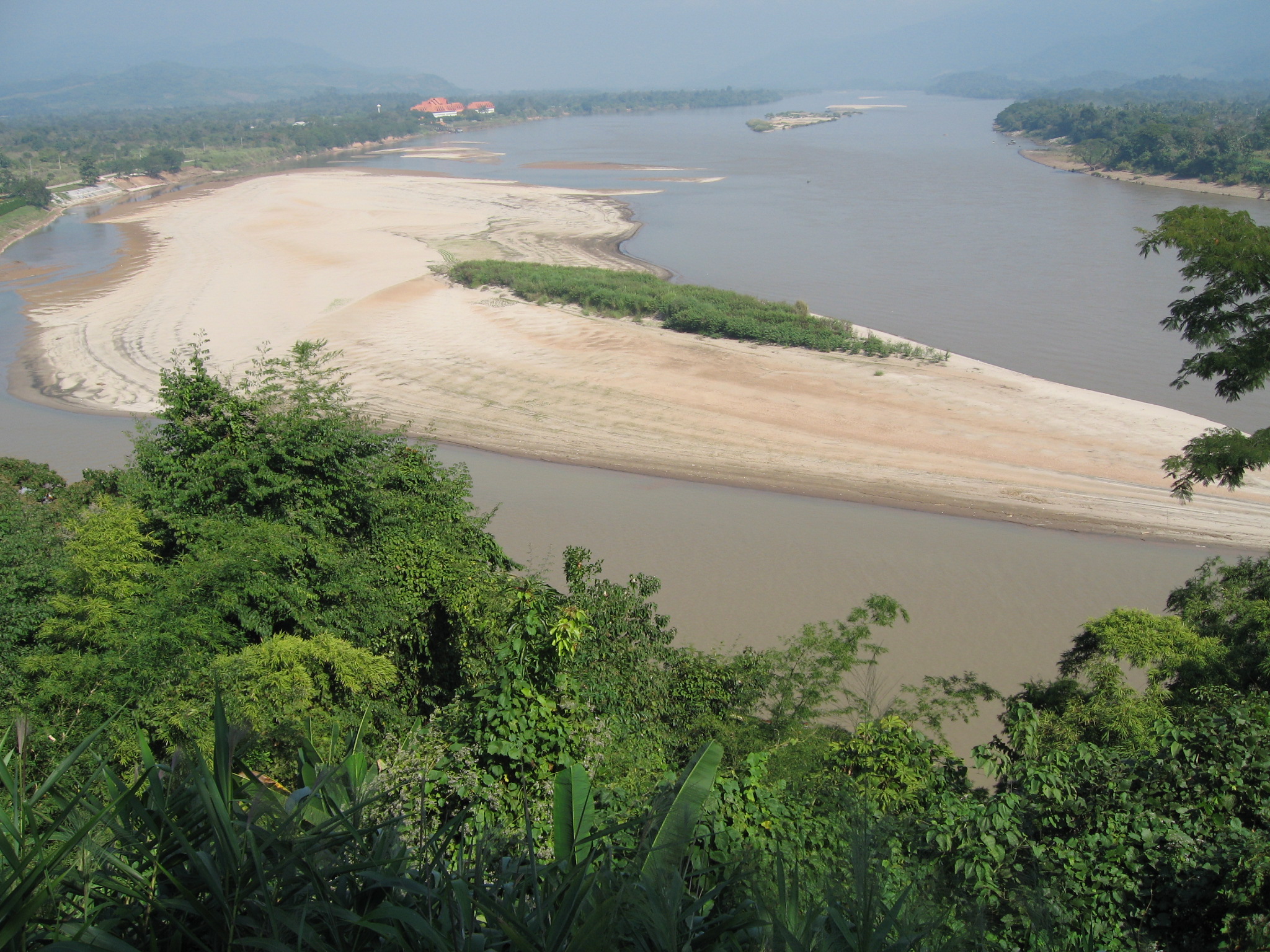
Makong River with Thailand in foreground, Myanmar, left, Laos, right.
By nightfall, the tiny riverside village is quiet again, with a few overnight visitors tucked away in the luxurious hotels outside of town or in the cheaper guesthouses hidden in the town’s backstreets. The village is one of the few tourist sites in Thailand where is no garish nightlife. The only action to be found is in the sound of a radio playing at an outdoor restaurant next to the river or in the lonely silhouette of a Chinese cargo ship plying its way upstream between the shifting sandbars of the Mekong River.
Despite the daily frenzied, packaged tour side of the little town, it’s worth a stopover because of its legitimate––or illegitimate––drug running history, the Akha, Yao and Hmong hill tribes, its unique Mekong River cruises, the casino across the river in Myanmar and as a backwater border point where you can cross over into the interior of Laos.
One of the first things you see in Sop Ruak is a huge golden Buddha rising 40-feet at the stern of an elaborately designed metal boat situated beside the Mekong River. From the deck, you have a sweeping view of the river, the glistening red-roofed casino in Myanmar.
Across the street is The House of Opium, easily one of the most interesting and extensive private collections of opium pipes (sometimes called “smoking guns”), opium measuring weights, scales, lamps, opium bowls and other items associated with “da yen,” Chinese for “the big smoke.”
The museum’s owner, Patcharee Srimatyakul, who was born in the area, started out years ago selling opium paraphernalia in a small shop. With smiling and calculating eyes, she started the museum when she saw that the opium items were becoming hard to find and once-sold, they disappeared forever. An elaborately made ivory or jade opium pipe can sell for $3,000 or more on the collector’s market.
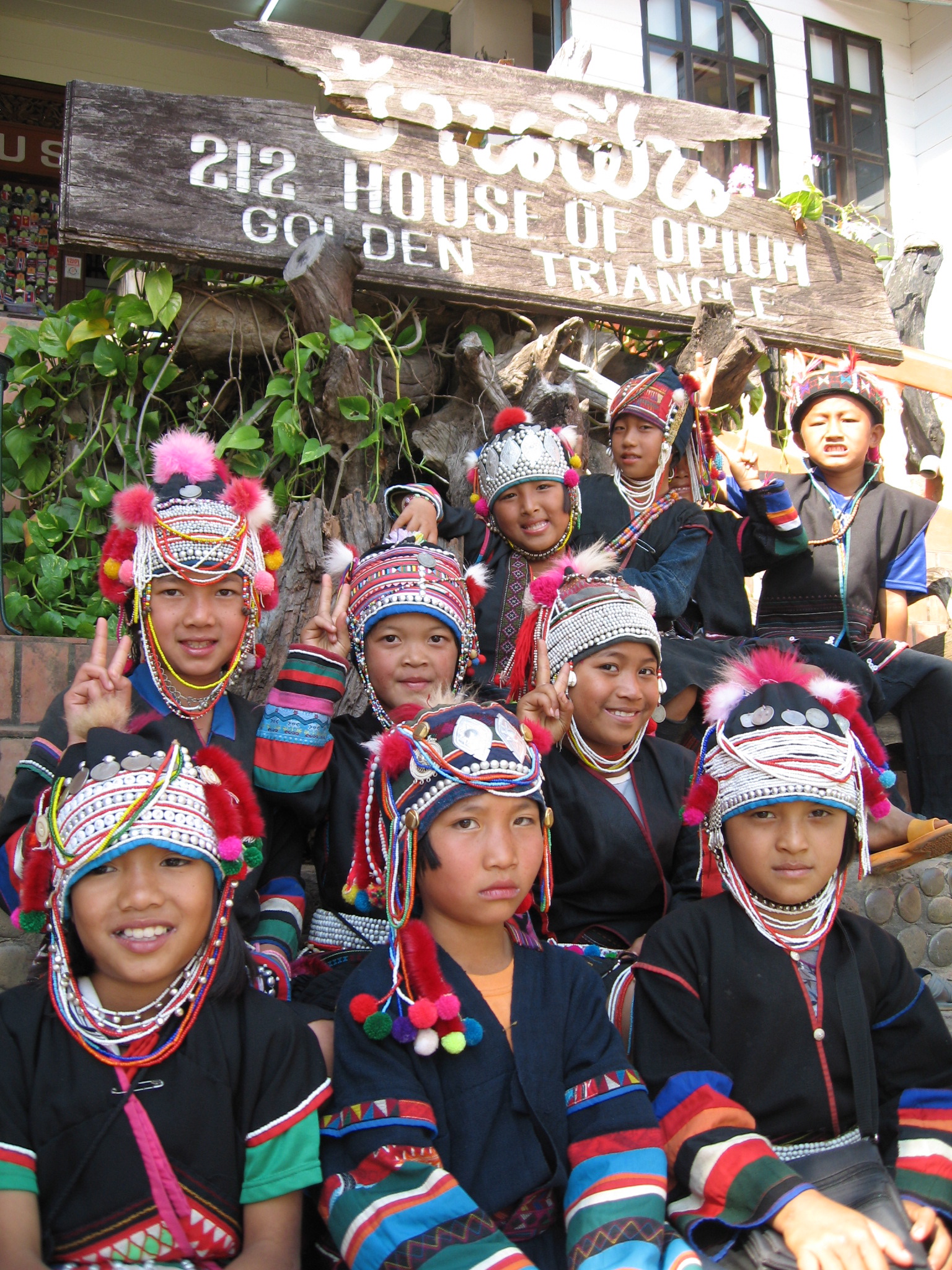
hilltribe girls outside the House of Opium
Mostly, she bought pipes from individuals in Myanmar, Laos and China. Now opium items are very hard to find anywhere. Locally, the main opium users were mountain people, who call opium “black medicine.” Drug lords with private armies were known for particular “brands,” such as Deer Brand, Lion Brand or KKK Brand. Nowadays, while opium is still smuggled through the area in caravans usually entering Laos, the trade is likely to be based on methamphetamine. Opium smuggling in the area is second only to Afghanistan. Thailand has been fairly successful in eliminating most opium growing for export, but opium use is still a regular part of the mountain tribes’ tradition, especially in Myanmar and Laos. To eliminate opium, experts say a product must be found to replace the hill tribes’ cultivation of opium, or Papaver Somniferum because opium cultivation offers poor farmers a significant income. Thailand, China, Myanmar and Laos have all made growing opium illegal, but law enforcement in Myanmar and Laos especially is nearly non-existent. It takes about one acre of cultivated fields to produce around 3,000 opium bulbs, which, after processing by a dealer, could make one kilo of opium. A hill tribe grower might receive around $1,000.
Short walk from the museum is the Imperial Resort, where the hotel’s outdoor restaurant balcony has one of the best views of the actual juncture of the three countries that form the Golden Triangle, especially just before nightfall when the evening light turns pink and gray with rose-colored reflections dancing across the water.
Foreigners must get a Thai permit to cross the river to the casino in Myanmar. The permit office is in nearby Chiang Saen, a lively river port where lines of Chinese cargo ships are docked, ready to be unloaded and re-loaded to return to China. Once back at the triangle, you pass through a Thai immigration checkpoint on the river and board a long-tail passenger boat that ferries visitors to Myanmar. After a quick check of papers by Myanmar authorities, a waiting bus carries visitors one-half mile to the Golden Triangle Paradise Resort, owned by a Thai businessman and his Japanese partners. The casino is one of 34 that encircle Thailand, which bans casinos. The resort offers rooms from $80 to $200. Most visitors stay only during daylight hours, returning to Thailand before the 6 p.m. ferry deadline. The casino and hotel are open 24-hours a day.
On weekends, an average of about 500 people lay down bets on roulette, blackjack, baccarat and draw poker. In a separate room, are rows of automatic gaming machines. Customers place bets ranging from US 0.25 cents to $250. Thai citizens make up the majority of gamblers. The atmosphere is like casinos everywhere except for the Buddhist amulets and lucky charms lined up in front of tense gamblers. An expansive restaurant dishes up Thai, Chinese and Western cuisine and duty-free shops sell jade and gems from China, Myanmar and Thailand, as well as designer items.
Travelers can also book rides on the “scorpion” boats that buzz up and down the Makong River nonstop. The pencil-like, long-tail boats, which carry two to four people, are powered by a car engine decked out with an extended drive shaft with a propeller attached at the end. Cost varies up to about $50, depending on the distance traveled and the number of stops. More adventurous travelers can book a birth on a passenger boat that plies up the Mekong River to Yunnan Province in China, a two-day trip.
Experienced tourists know that to see a place you must get off the main roads, and Sop Ruak is no exception. If you take a drive or walk along the streets leading away from the river, you’ll see small thriving neighborhoods and normal life in Sop Ruak with its schools, hairdressers, small neighborhood restaurants and a placid village lake where teenagers and young couples hang out.
You’ll have a chance to meet people like Anong Sangkawadee, a middle-aged, self-taught wood-carver with a wispy mustache and goatee and a tightly pulled-back pig-tail, who was carving a large wood sculpture in front of his studio.
Taking a break, he said he never cuts down a tree to get wood to work with, instead relying on roots of trees that have been blown down or died. He likes to work with teak or rubber wood.

wood carver in Sop Ruak
“There are a lot of artist in the area,” he said, “but so far we don’t have a local art gallery in Sop Ruak. He started carving wood after a very large, revered tree blew down in the village. “I felt sorry for the tree,” he said. “I told myself I would give the tree life again so people could see it. I want tourist to come and look at it and be happy seeing my work.” The tree, now covered with intricate floral carvings, stands nearly 30-feet tall in an outdoor display area near his workshop.
One of the best places to spend an evening is a five-minute drive downriver alongside the Makong to Chiang Saen, the administrative center of the area and the designated port of entry for international cargo from China or Laos. It’s a bustling market town with lines of vendors beside the riverbank, who sell local hill tribe handicrafts and imported items. Nearby are hill tribe villages that can be visited on private tours or by private car. An interesting relic of the past rests on a hill overlooking the town, the site where the Nationalist Chinese Soldiers Cemetery is located. It’s the final burial place for more than 200 Kuo Ming Tang soldiers (Nationalists Party of Republic of China). The graves are angled on the hill to face in the direction of China.
Chiang Saen has a small foreign expat population, largely citizens of Canada, Germany, Japan, Australia and the U.S. A local realtor, Sugit Tomara, credits the foreign community with the building a popular golf course. Land and home sales in the area have been climbing, but they’re are still low by Western standards. About one acre on the outskirts of the city can cost from $5,000 to $9,000 and could rise to $25,000 or more in town or along a major roadway. A modest Thai-style, two-bedroom home might start around $30,000 and increase in price depending on size and amenities. An acre of land on the Mekong River in or near Sop Ruak could cost as much as $200,000.

dock workers waiting to unload Chinese boats in Chiang Saen
Life in Chiang Saen is destined to get busier with the planned expansion of the Thai river port docking facility, to be located south of the present docking area. The director of the Thai Marine Office, Apisit Kumpiroj, said the expansion will eventually double the cargo volume to nearly 1 million tons annually. Currently, about 27 cargo ships a day are off-loaded at the port, but this will increase to nearly 50. On-loading and off-loading is done the old fashion way, largely by hand. The riverbanks are lined with stevedores who manhandle crates, boxes and other goods. The port takes in about 100 flat-bottom Chinese boats a week. More export goods go to China than are currently imported from China, but that will change soon. Locals see the creation of a regular river passenger service to China as inevitable. Passengers from China book crude accommodations on some cargo boats coming in to Thailand at a rate of about 200 or more each month, while a hundred or so people depart from Thailand. Only the most adventurous Westerners now make the trip on the Chinese cargo boats.
Chiang Saen also has a very worthwhile National Museum that displays pre-historic artifacts, ethnic textiles, hill tribe crafts and traditional musical instruments. Asian art lovers will pause to take in a collection of Taoist ceremonial scrolls called “The Dragon Bridge of the Great Tao,” a series of 17 scrolls arranged in a specific order that depict Taoist gods and spirits, probably painted in the late 19th century.
While Sop Ruak is evolving into a major stop on the tourist trail, and Chiang Saen will only get more crowded with visitors heading to China or Laos, once you step out of the package-tour zone these two Thai river towns, and the surrounding mountain area, offer real pleasures. At night in Chiang Saen when a string of Christmas tree-colored lights pop on at a riverside restaurant and a Chinese cargo ship silently slips by on the river with its solitary white running light scanning left to right in the darkness, you feel for a moment as if a great mystery awaits just around the bend in the river.
 the roy hamric journal