A Voice Like Sand and Glue, But Listen To It
Posted: February 13, 2015 Filed under: music, people | Tags: Dylan and Sinatra, Dylan sings Sinatra, Dylan: a voice like sand and glue Leave a comment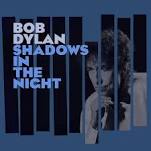
Click here to hear Full Moon and Empty Arms.
Dylan Sings American Classics
Posted: February 9, 2015 Filed under: articles, music, people, states of mind | Tags: Dylan and Sinatra, Dylan opens up the American song cannon, Dylan stands next to Sinatra, Shadows in the Night 1 CommentTypically, skepticism and misapprehension have greeted Dylan’s newest release, Shadows In The Night, based on one of Sinatra’s most enduring classic albums. The lead in the New York Times said, “It’s not a joke.” What disservice…Mark my words: This album will live. Dylan’s recording of under appreciated, early Americana folk music, his own blues songs, and especially this album, which puts him beside Sinatra, the other most enduring singer of the 20th century, will eventually rest beside the best of Dylan’s work. As Dylan said about the recording: it “uncovers” the songs. More generous was this review in The Telegraph: “Dylan sings Sinatra? It shouldn’t work but Shadows In The Night is quite gorgeous, the sound of an old man picking over memories, lost loves, regrets, triumphs and fading hopes amid an ambient tumble of haunting electric instrumentation. It is spooky, bittersweet, mesmerisingly moving and showcases the best singing from Dylan in 25 years. The very concept seems outrageous, which is perhaps why Dylan’s management have been at pains to insist it is not a Sinatra tribute. One was a vocal giant with perfect mix of tone, technique and emotional expression. The other has a voice that David Bowie described as “like sand and glue,” (and that was intended as a compliment). They are artists we listen to for very different reasons. Shadows In The Night is a perfect blend of those heartbreaking classics, digging beneath self-pity to reveal deeper relationship truths.”
Ralph Waldo Emerson: Give All To Love
Posted: January 28, 2015 Filed under: people, poetry, states of mind Leave a comment
The first stanza of Emerson’s Give All To Love:
Give all to love;
Obey thy heart;
Friends, kindred, days,
Estate, good-fame,
Plans, credit and the Muse —
Nothing refuse.
Atticus Lish’s Novel
Posted: January 19, 2015 Filed under: articles, interviews, people, writing Leave a comment By all accounts, Atticus Lish, the son of the editor Gordon Lish, has written a great American novel, in the fullest sense of American. Preparations For The Next Life… I haven’t read it yet, but I can’t resist helping to spread the word on this one. Here’s the New York Review of Books review, and several interviews with Lish on his background and how the book came together. Interview here, here and here.
Here’s the opening paragraph of the NYRB review by Cathleen Schine:
“Preparation for the Next Life, by Atticus Lish, is an astounding first novel about a world so large there is, sometimes, nowhere to go; a world so small the people in it, sometimes, get lost. The book has the boundless, epic exhilaration you expect to find only in a writer as mighty as, say, Walt Whitman. It is a love story, a war story, a tale of New York City in which familiar streets become exotic, mysterious, portentous, foul, magnificent. Some of it reads like poetry. All of it moves with a breathless momentum.”
A Manifesto For The Future
Posted: January 17, 2015 Filed under: articles, books, people | Tags: A manifesto for the technological future, leon wieseltier's humanism Leave a comment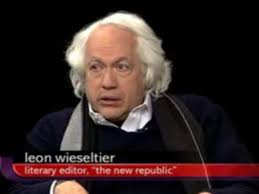 The former critic of the old New Republic, Leon Wieseltier, has written a beautify essay in the current New York Book Review. It’s a cogent assessment of the force of technology on culture and the human soul. More significantly, it’s a prescription for a response and a plea for understanding, patience and perseverance, and most importantly a continued allegiance to humanism, which offers the only hope to counteract the negative implications of a neutral technology that’s open to misuse (think calls to perpetuate physical violence). I was optimistic, looking at the long view, after I read this. Wieseltier, who I talked with briefly one day in Larry McMurtry’s bookstore in Archer City, Texas, (I told him how much I admired his New Republic work; reply: “Thanks…you’re too kind,”) wrote an enduring masterpiece, Kaddish, which sprang from the death of his father in the 60s. Among other things, it’s a plea for reading and continued study, a searching out for a way to lead a sustained, rich, meaningful life. He continues to offer a way through troubled times. Take your time reading this. It will steady troubled and despairing souls.
Here’s the essay.
Robert Stone Dies; Our Moral Existentialist
Posted: January 11, 2015 Filed under: books, fiction, people, writing | Tags: robert stone: our Graham Greene Leave a comment To: The Committee of Responsibility
The first sentences in Dog Soldiers:
“There was only one bench in the shade and Converse went for it, although it was already occupied. He inspected the surface for unpleasant substances, found none, and sat down. Beside him he placed the oversize briefcase he’d been carrying; it’s handle shone with the sweat of his palm. He sat facing Tu Do Street, resting one hand across the case and raising the other to check the progress of his fever. It was Converse’s nature to worry about his health.”
Robert Stone, the award-winning novelist known for “A Flag for Sunrise” and “Dog Soldiers,” has died. He was 77. Stone’s literary agent said Stone died Saturday at his home in Key West, Florida. The cause was chronic obstructive pulmonary disease.
More Bedside Books
Posted: December 31, 2014 Filed under: books, buddhism, fiction, people, poetry, reviews | Tags: Buddhism in medieval China, lawrence osborne's novel as autobiography, philip larkin's poetry and fiction, thomas mcguane's most American essay Leave a comment
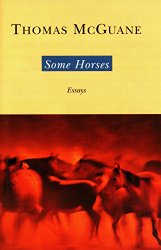 Thomas McGuane has never received anything less than the highest praise as a novelist, short story writer and essayist. I’ve read him since his first novel, picked up at a remainder bin. For me, his essays shine brightest. With an essay, you can’t leave the writer’s side. In a novel or story, you trail along with the characters with an ear cocked for the pyrotechnics of the writer’s voice. The essays spotlight McGuane’s unique voice, his sensibility, in a way fiction cannot allow. A Sporting Chance, his first collection, and his other nonfiction books The Longest Silence: A Life in Fishing and Some Horses are examples of the most personal art. My hand reaches out for them often.
An essay in Some Horses, titled On The Road Again, takes on one of the most anti-intuitive subjects imaginable for a first-class writer who has been called an heir to Hemingway. The topic? A long drive with his wife in a pickup truck, pulling a just-bought 38-foot horse trailer with special built-in, mini-living quarters, around a great circle of the West. In this quintessential American home-on-wheels, christened a “Horseabago,” he writes, “We simply pictured ourselves at one end, and Delta, Sassy, Zip and Lena, in the other, and wheels underneath.” After a few pages, you’re assured of his mastery to take on this tale, and carry it to sublime heights. His sensibility, or whatever it is that frees words to rise above themselves into something approximating quotidian reality, is on full display.
 A Girl In Winter is British poet Philip Larkin’s second novel. The book is the story of a 16-year-old European girl, her country is never named, who is prematurely mature and intellectual. She accepts an invitation to visit a young English boy and his family. She falls in love with the boy, but they lose touch. Six years later, she returns to Britain as a war refugee.
It’s a remarkable psychological portrait, in the vein of Larkin’s poetry, which is nihilistic, in almost stoic celebration of the ordinary, unexceptional, ultimately disappointing bits that give life its bitter taste.
What’s most interesting to me is Larkin’s very deep minutia describing the meeting of Katherine and Robin, in which he uses the sort of details that belie someone – meaning Larkin – who runs away from life, from the desire to understand others’ in hope to better understand themselves. Larkin’s austere poetry, even in its most gorgeous sensibility, keeps life at bay, at a safe distance that cannot disappoint, while this novel shows Katherine as a person who is probing and open to understanding, or trying to understand, the complexities of other souls. That she and Robin are ultimately unable to capture any of the romantic shavings that surround all lives, even if ungrasped, is all the more tragic. Larkin’s poems couldn’t display such depth of tragedy because he wrapped them in a polished shell of art, singular gems that, no matter their content, bespoke excellence even in the face of tragedy. The novel shows whereof the poems arose.
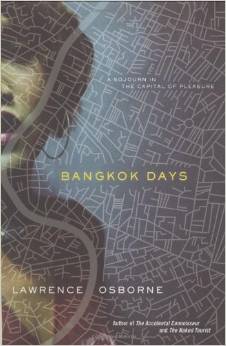 Bangkok Days by Lawrence Osborne is the best novel about Bangkok ever written. But, for clarification, it’s written and marketed as a nonfiction account of the author’s life in the city. The book reeks of novelization with the first-person author surrounded by a cast of fiction-like foils (and at least one real person) who capture the spirit and ambiance of the most sensuous, textured, layered city in the world.
Osborn, the author of the recent Ballad of a Small Player, which is set in the casinos of Macau, excels at romantic, slightly desperate characters and settings full of people who recognize each other for their individual élan in the face of life’s fragility. They are people who are unwilling to give up the fight for life and feeling. That such people in unusual numbers are drawn to Bangkok is no accident. Osborn’s tale of living in Bangkok displays a colorful subset of people of the city who refuse to forsake the quixotic in return for sleek, cosmetic urban wallpaper. The book serves equally well as a novel or one man’s guide to Bangkok, suggesting how to absorb and live within its refreshing disparities.
The Buddhist Conquest of China: The Spread and Early Adaptation of Buddhism in Early Medieval China by E. Zurcher.
This work of high scholarship looks at the social and cultural factors that led to the eventual adoption of Buddhist principles and practice in Chinese culture. It brilliantly captures the chaotic nature of how Buddhist principles were scattered piecemeal over two centuries by Buddhist monks and lay parties that included foreigners, the Chinese gentry, the court, and the intelligentsia. The beauty is the thousands of details it shares about monks and others from late 300AD through the fourth century. It was a perilous time of ferment, and it would be 200 years, in the Tang Dynasty, before Buddhism took on a more recognisable, coherent form eventually leading to the distinct Chinese Buddhist doctrine that we know today. It underscores the cultural fragmentation and difficulties a foreign doctrine of religion has in finding a place in a totally separate and distinct culture, with a different language and already established theories of religion, cosmology and metaphysics. Not surprisingly, the difficulty of transplanting a “foreign” religion, even one with obvious parallels in Chinese religious writings, is manifest throughout this work. It helps put in context the subsequent official elimination of Buddhist temples and practice in revolutionary China, when viewed from the rocky path that Buddhism walked in medieval times.
For a PDF copy of Zurcher’s book, go here.
Wittgenstein’s riddle of life
Posted: December 23, 2014 Filed under: articles, books, people, states of mind, writing | Tags: natural science, the Tao of Wittgenstein, wittgenstein as poet, wittgenstein's silence Leave a comment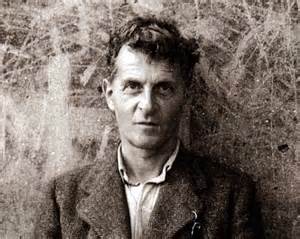
The magnificent ending of Ludwig Wittgenstein’s Tractatus Logico Philosophicus:
…The solution of the riddle of life in space
and time lies outside space and time.
(It is not problems of natural science which have to be
solved.)
6.432 How the world is, is completely indifferent for what is higher.
God does not reveal himself in the world.
6.4321 The facts all belong only to the task and not to its performance.
6.44 Not how the world is, is the mystical, but that it is.
6.45 The contemplation of the world sub specie aeterni is its contemplation
as a limited whole.
The feeling of the world as a limited whole is the mystical
feeling.
6.5 For an answer which cannot be expressed the question too cannot
be expressed.
The riddle does not exist.
If a question can be put at all, then it can also be answered.
6.51 Scepticism is not irrefutable, but palpably senseless, if it would
doubt where a question cannot be asked.
For doubt can only exist where there is a question; a question
only where there is an answer, and this only where something
can be said.
6.52 We feel that even if all possible scientific questions are answered,
the problems of life have still not been touched at all. Of course
there is then no question left, and just this is the answer.
6.521 The solution of the problem of life is seen in the vanishing of
this problem.
(Is not this the reason why men to whom after long doubting the sense
of life became clear, could not then say wherein this sense consisted?)
6.522 There is indeed the inexpressible. This shows itself; it is the
mystical.
6.53 The right method of philosophy would be this. To say nothing
except what can be said, i.e. the propositions of natural science,
i.e. something that has nothing to do with philosophy: and then
always, when someone else wished to say something metaphysical,
to demonstrate to him that he had given no meaning to
certain signs in his propositions. This method would be unsatisfying
to the other—he would not have the feeling that we
were teaching him philosophy—but it would be the only strictly
correct method.
6.54 My propositions are elucidatory in this way: he who understands
me finally recognizes them as senseless, when he has climbed out
through them, on them, over them. (He must so to speak throw
away the ladder, after he has climbed up on it.)
He must surmount these propositions; then he sees the world
rightly.
7 Whereof one cannot speak, thereof one must be silent.
Clive James on ‘Philip Larkin: Life, Art and Love’
Posted: November 24, 2014 Filed under: articles, books, people, photography, poetry | Tags: larkin biography, Larkin love life, larkin self-portrait, philip larkin poetry, Whitsun Weddings Leave a comment
Note the high humour here. This portrait was likely taken by Larkin himself using a timer on the camera.
Philip Larkin comes under the scalpel again, but this time the hand is friendly. The book, Philip Larkin – Life, Art and Love, takes a look what’s become a focal point of the great poet’s life and work: his seemingly banal Life as a librarian (I never shared that view – library work is richly rewarding for the literary inclined), his Art, which suffered tragic abuse when several critics and higher journalists blurred the picture by noting some seemingly racist and sexist language in his collected letters followed by a respected biography noting the same thing. And along with all that, his secretive Love life was exposed, which came as a shock and added spice to the staid picture he had painted of himself as a bored, suburban bachelor in a staid, middle class town.
Life, Art and Love are given a therapeutic scrubbing in this book, returning him to the shelf of normal, healthy souls who chose to live their life in semi-seclusion and not in the public eye. After all, Larkin’s true charm came from presenting himself as being un-Byron and un-Shelley, and, yet, he is, for our time, as great as the greatest British poets.
Larkin’s steadfast champion over the years, Clive James, gives the book high marks for setting the record straight and throwing water on whatever fainting spells caused the sniping in the first place.
Greil Marcus’ History of Rock and Roll
Posted: November 18, 2014 Filed under: books, interviews, music, people | Tags: greil marcus, history of Rock, musicology, writing about music Leave a comment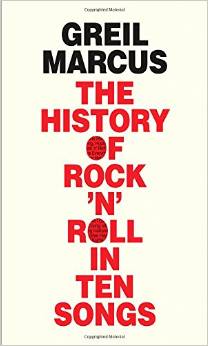
If you’re new to his writing, read Mystery Train before or after you read this mysterious “history.”
Here’s an essential new book by Greil Marcus, our best writer and social critic on Rock, Blues and early American music. The premise is 10 Rock songs as a way to approach the intertwined history of Rock music. He has an uncanny knack of taking a knife and opening up the heart of songs, putting you inside the music, making you wish for a compilation of the songs he illuminates. The choices are not what you’d expect – some are very obscure – leaving you wishing you had his ears and knowledge to “read” the music. Here’s an interview.
 the roy hamric journal