
William Empson on Chinese poetry
Posted: September 12, 2010 Filed under: articles, people, poetry 2 CommentsThe selection below is from William Empson’s Seven Types of Ambiguity. He’s writing about comparative adjectives which do not say what their noun is to be compared with, and he uses two lines of Chinese poetry in his explication which not only captures the precision of Empson’s writing and critical sense, but offers one of the best primers on how to approach the concision of Asian poetical use of ordinary language pushed to heighten meaning. Empson taught in Japan, Beijing and Kunming, before spending the rest of his teaching career in Britain.
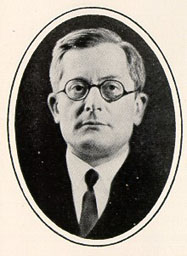
william empson
“Not unlike the use of a comparison which does not say in virtue of what the two things are to be compared is the use of a comparative adjective which does not say what its noun is to be compared with; since all adjectives are in a sense comparative, this source of ambiguity is a sufficiently general one. In particular, it is the chief source of euphuistic conceits and the paradoxes cultivated in the 1890s, which give a noun two contradictory adjectives and leave it to the reader to see how the adjectives are used. I shall give an example from one of Mr. Waley’s Chinese translations, to insist upon the profundity of feeling which such a device may enshrine.
‘Swiftly the years, beyond recall.
‘Solemn the stillness of this spring morning.’
“The human mind has two main scales on which to measure time. The large one takes the length of a human life as its unit, so that there is nothing to be done about life, it is of an animal dignity and simplicity, and must be regarded from a peaceable and fatalistic point of view. The small one takes as its unit the conscious moment, and it is from this that you consider the neighboring space, an activity of the will, delicacies of social tone, and your personality. The scales are so far apart as almost to give the effect of defining two dimensions ; they do not come into contact because what is too large to be conceived by the one is still too small to be conceived by the other. Thus, taking the units as a century and the quarter of a second, their ratio is ten to the tenth and their mean is the standard working day ; or taking the smaller one as five minutes, their mean is the whole of summer. The re pose and self-command given by the use of the first are contrasted with the speed at which it shows the years to be passing from you, and therefore with the fear of death; the fever and multiplicity of life, as known by the use of the second, are contrasted with the calm of the external space of which it gives consciousness, with the absolute or extra-temporal value attached to the brief moments of self-knowledge with which it is concerned, and with a sense of security in that it makes death so far off.
“Both these time-scales and their contrasts are included by these two lines in a single act of apprehension, because of the words swift and still. Being contradictory as they stand, they demand to be conceived in different ways ; we are enabled, therefore, to meet the open skies with an answering stability of self-knowledge ; to meet the brevity of human life with an ironical sense that it is morning and spring time, that there is a whole summer before winter, a whole day before night.
“I call swift and still here ambiguous, though each is meant to be referred to one particular time-scale, because between them they put two time-scales into the reader’s mind in a single act of apprehension. But these scales, being both present, are in some degree used for each adjective, so that the words are ambiguous in a more direct sense ; the years of a man’s life seem swift even on the small scale, like the mist from the mountains which gathers a moment, then scatters; the morning seems still even on the large scale, so that this moment is apocalyptic and a type of heaven.
“Lacking rhyme, meter, and any overt device such as comparison, these lines are what we should normally call poetry only by virtue of their compactness; two statements are made as if they were connected, and the reader is forced to consider their relations for himself. The reason why these facts should have been selected for a poem is left for him to invent; he will invent a variety of reasons and order them in his own mind. This, I think, is the essential fact about the poetical use of language.”
Bloom: the American religion
Posted: September 6, 2010 Filed under: articles, books, people, poetry Leave a comment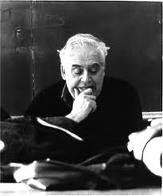
harold bloom
I’m again reading Agon by Harold Bloom. All I can say is Bloom’s early books are the deep roots of his present day flowering, his burst of books on religion and poetry. His contribution to the world of critical thought, so broad and connective, is original and hardly equaled, as far as I can tell. Agon, with its cold subtitle, Towards a Theory of Revisionism (which is too academic sounding), goes through and around Gnosticism, Kaballah, Freud, Emerson, Carlyle, Whitman, Stevens, Hart Crane, American pragmatism, etc. But what I most love is his capturing of “the American difference” in poetry and criticism. Frequently, in Bloom’s writing you can read “poetry” for “religion” and “religion” for “poetry.” Again, the pivotal heart of the book beats in the essay “Emerson: The American Religion.” I want to quote a passage that begins six sentences into the essay: It now reads like an anthem to me, and never fails to carry me away:
“The lengthened shadow of American culture is Emerson’s, and Emerson indeed saw everything is everything, and spoke with the tongue of a daemon. His truest achievement was to invent the American religion, and my reverie intends to a spiraling out from his center in order to track the circumference of that religion in a broad selection of those who emanated out from him, directly and evasively, celebratory of or in negation to his Gnosis. Starting from Emerson we came to where we are, and from that impasse, which he prophesied, we will go by a path that most likely he marked out also. The mind of Emerson is the mind of America, for worse and for glory, and the central concern of that mind was the American religion, which most memorably was named “self-reliance.”
For “self-reliance” read gnosis. After decades of reading Emerson and Bloom, I think I’m at last beginning to understand truly why America appears throughout its history to be verging toward crisis or collapse, while always moving forward.
For a list of Bloom’s books and selected articles, click here.
Red Pine: language, poetry, translation
Posted: August 14, 2010 Filed under: articles, buddhism, people, poetry, writing Leave a commentThis essay by Red Pine was first presented as part of the Simmons College International Chinese Poetry Conference, Oct. 8-10, 2004. For more on him, see the On the Record postings.
Dancing with the Dead: Language, Poetry and the Art of Translation
By Red Pine
Every time I translate a book of poems, I learn a new way of dancing. The people with whom I dance, though, are the dead, not the recently departed, but people who have been dead a long time. A thousand years or so seems about right. And the music has to be Chinese. It’s the only music I’ve learned to dance to.
I’m not sure what led me to this conclusion, that translation is like dancing. Buddhist meditation. Language theory. Cognitive psychology. Drugs. Sex. Rock and Roll. My ruminations on the subject go back more than twenty-five years to when I was first living in Taiwan. One day I was browsing through the pirated editions at Caves Bookstore in Taipei, and I picked up a copy of Alan Ginsberg’s Howl. It was like trying to make sense of hieroglyphics. I put it back down and looked for something else. Then a friend loaned me a video of Ginsberg reading Howl. What a difference. In Ginsberg’s voice, I heard the energy and rhythm, the sound and the silence, the vision, the poetry. The same thing happened when I read some of Gary Snyder’s poems then heard him read. The words on a page, I concluded, are not the poem. They are the recipe, not the meal, steps drawn on a dance floor, not the dance.
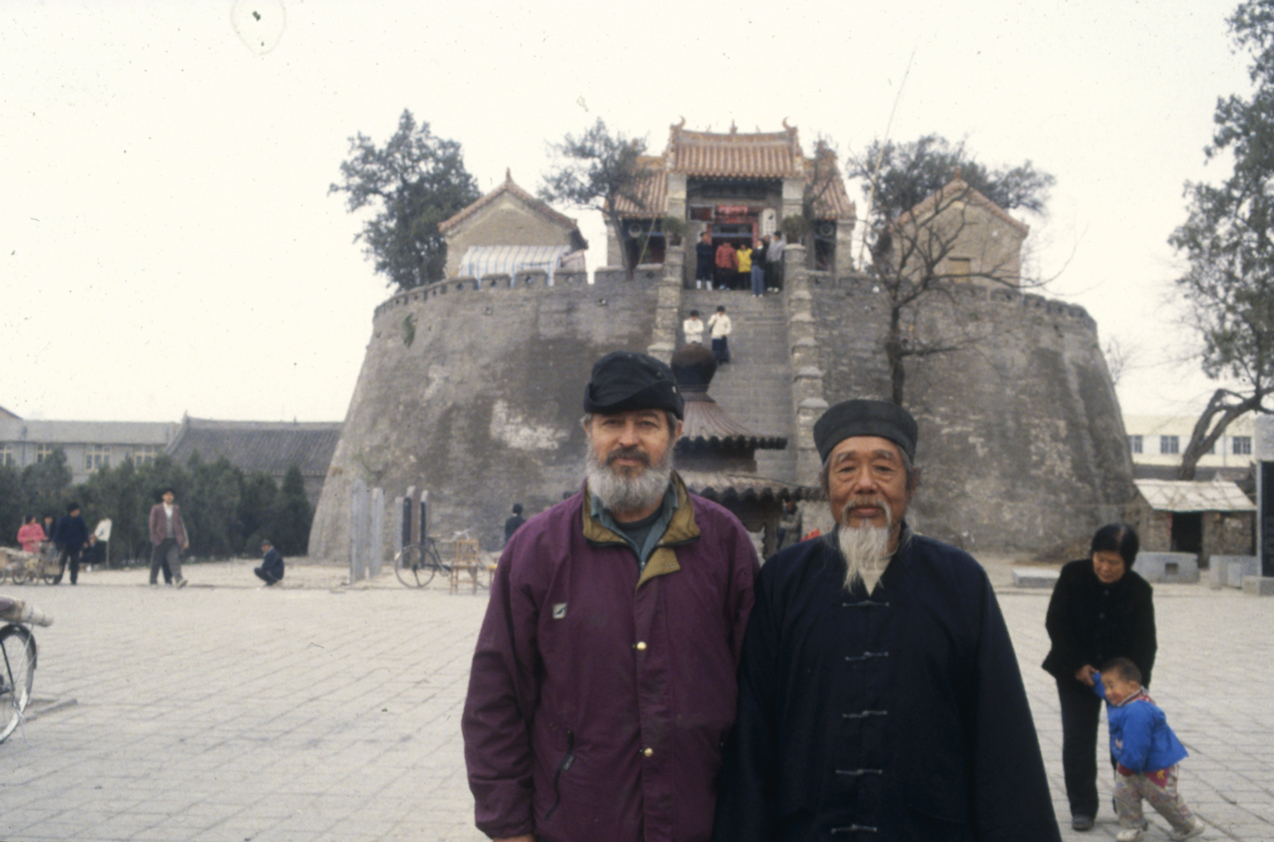
Red Pine with Taoist priest at Lao-tzu's observatory (photograph: Red Pine)
For the past hundred thousand years or so, we human beings have developed language as our primary means of communication—first spoken language and more recently written language. We have used language to convey information to each other, to communicate. But there are a set of questions just below the surface that we prefer not to address. How well does language do what we think it does? And what does it do? The reason we prefer not to address such questions is because language is so mercurial. We can never quite pin it down. It is forever in flux. And it is forever in flux, because we, its speakers and writers and translators, are forever in flux. We can’t step into the same thought twice. We might use or read or hear the same word twice, but how can it mean the same thing if the person who uses or reads or hears that word is not the same person? We speak of language, as if it was a fixed phenomenon, and we teach it and learn it, as if it was carved in stone. But it is more like water, because we are more like water. Language is at the surface of the much deeper flux that is our riverine minds. Thus, if we approach translation by focusing on language alone, we mistake the waves for the river, the tracks for the journey.
But this isn’t all. Many linguists and anthropologists are of the opinion that language was developed by early humans not simply for the purpose of communication but for deception. All beings communicate with each other, but at least on this planet only humans deceive each other. And for such deception, we rely primarily on language. It isn’t easy for us to hide our feelings and intentions in our facial or bodily expressions, but language offers ready and endless opportunities for altering and manipulating the truth. Thus, the question for a translator is not only the efficiency of language, but its truthfulness. That is, does it actually do what we think it does, and does what it does have any basis other than in fiction?
We live in worlds of linguistic fabrication. Pine trees do not grow with the word “pine” hanging from their branches. Nor does a pine tree “welcome” anyone to its shade. It is we who decide what words to use, and, like Alice, what they mean. And what they mean does not necessarily have anything to do with reality. They are sleights of the mind as well as the hand and the lips. And if we mistake words for reality, they are no longer simply sleights but lies. And yet, if we can see them for what they are, if we can see beyond their deception, they are like so many crows on the wing, disappearing with the setting sun into the trees beyond our home. This is what poetry does. It brings us closer to the truth. Not to the truth, for language wilts in such light, but close enough to feel the heat.
According to the Great Preface to the Book of Odes, the Chinese character for poetry means “words from the heart.” This would seem to be a characteristic of poetry in other cultures as well—that it comes from the heart, unlike prose, which comes from the head. Thus, prose retains the deceptive quality of language, while poetry is our ancient and ongoing attempt to transcend language, to overcome its deceptive nature by exploring and exposing the deeper levels of our consciousness and our emotions. Though poetry is still mediated by language, it involves a minimal use of words, and it also weakens the dominance of language through such elements as sound and silence, rhythm and harmony, elements more common to music than logic. In poetry, we come as close as we are likely to get to the meaning and to the heart of another.
This, too, isn’t all. Poetry is not simply “words from the heart.” A poet doesn’t make a poem so much as discover a poem, maybe in a garden or a ghetto, maybe in a garbage dump or a government corridor, or in a galaxy of stars. In poetry, we go beyond ourselves to the heart of the universe, where we might be moved by something as small as a grain of sand or as great as the Ganges.
So what does all this mean for the translator? For me it means that I cannot simply limit myself to the words I find on the page. I have to go deeper, to dive into the river. If language is our greatest collective lie, poetry is our attempt to undo that deception. When I translate a poem, I don’t think of the Chinese on the page as the poem, only evidence of the existence of a poem. Poetry shows itself in words, and words are how we know it. But words are only the surface. Even after poets give their discoveries expression in language, they continue to discover a poem’s deeper nuances, and they make changes: maybe a few words, maybe a few lines, maybe much more. The poem, as I see it, is a never-ending process of discovery. And it isn’t just language. It’s the unspoken vision that impels a poet and to which the poet tries to give expression. But the poet never gives complete expression to that vision, only a few fragments from a kaleidoscopic insight, a few steps on the dance floor impelled by music even the poet hears only imperfectly.
Then a translator comes along, and things change. It is only then that the poet no longer dances alone but with a partner. And together they manifest a deeper insight into the poem, into the music that motivates the dance. Thus, I have come to realize that translation is not just another literary art, it is the ultimate literary art, the ultimate challenge in understanding as well as performance. For me, this means a tango with Li Bai, a waltz with Wei Yingwu, a dance with the dead.
copyright@Bill Porter aka Red Pine
Bedside books II
Posted: August 7, 2010 Filed under: books, buddhism, poetry, writing Leave a commentBangkok Found: Reflections on the City by Alex Kerr. Thailand’s culture is not as highly defined as Japan, and a reliable guide is essential to take one down the roadmap into the origins and esthetics of the country’s food, architecture, design, dance, etiquette and other unique traits. You finish the book feeling you have seen a new Bangkok, a new Thailand, the same as before but deeper now and still mystifying.
 Inside the Whale and Other Essays by George Orwell. Orwell’s prose is always like a fresh drink of water, not overpowering but deeply affecting. He was an early champion of Henry Miller’s Tropic of Cancer, recognizing him as the embodiment of Whitman, a tramp-philosopher outside the circle of conventional society and literature. Orwell’s Politics Vs Literature and Politics and the English Language must be read by all young writers.
Jack Kerouac: Selected Letters 1957-1969. What’s amazing about this volume is that all–ALL–of his major novels were completed by 1957, before his fame. The letters among all the young writers who made up the Beat movement now constitute an American history of soul and intellect among a group of red-blooded poets who were an antidote to the beginning of America’s loss of heart. The tale of Kerouac’s final days has no silver lining. This volume should be followed by the long essay on Kerouac’s funeral by his old friend John Holmes, one of the finest things ever written about him.
 Saving Daylight by Jim Harrison. It’s hard to pick a favorite book of poems by Harrison, but this may be it for its blend of American and Asian flavors set in a homely scene of everyday urgency, of a unique voice on a moment-to-moment quest for more experiences, more abundance of life. This book should be read with his After Ikkyu.
Sexuality and the Psychology of Love by Sigmund Freud. That Freud is discounted in many circles today misses the point. Bloom rightly tells us that Freud is really writing a form of literature cast as a pseudo science (or theory at least), a literature of consciousness and its imagined affects and effects. For a novelist, he’s indispensable: just put his insights below the surface of your characters and you’re off to the races inside the human soul. For a reader, you may squirm at times, but you’re glued to the page because you recognize the unfolding of life, yours and others.
Ikkyu and The Crazy Cloud Anthology by Sonja Arntzen. Ikkyu was the Billy the Kid Zen poet of Medieval Japan who lived with the outlaws and flowers of the night in between trips to his solitary mountain hut and his occasional stint as abbot of some big Zen monastery. A deliciously split personality, he wasn’t willing to give up any element that reminded him that he was human, at-large in life which is not giving away anything free. He left us his life in poems.
Zen koans
Posted: May 26, 2010 Filed under: buddhism, people, poetry, reviews Leave a comment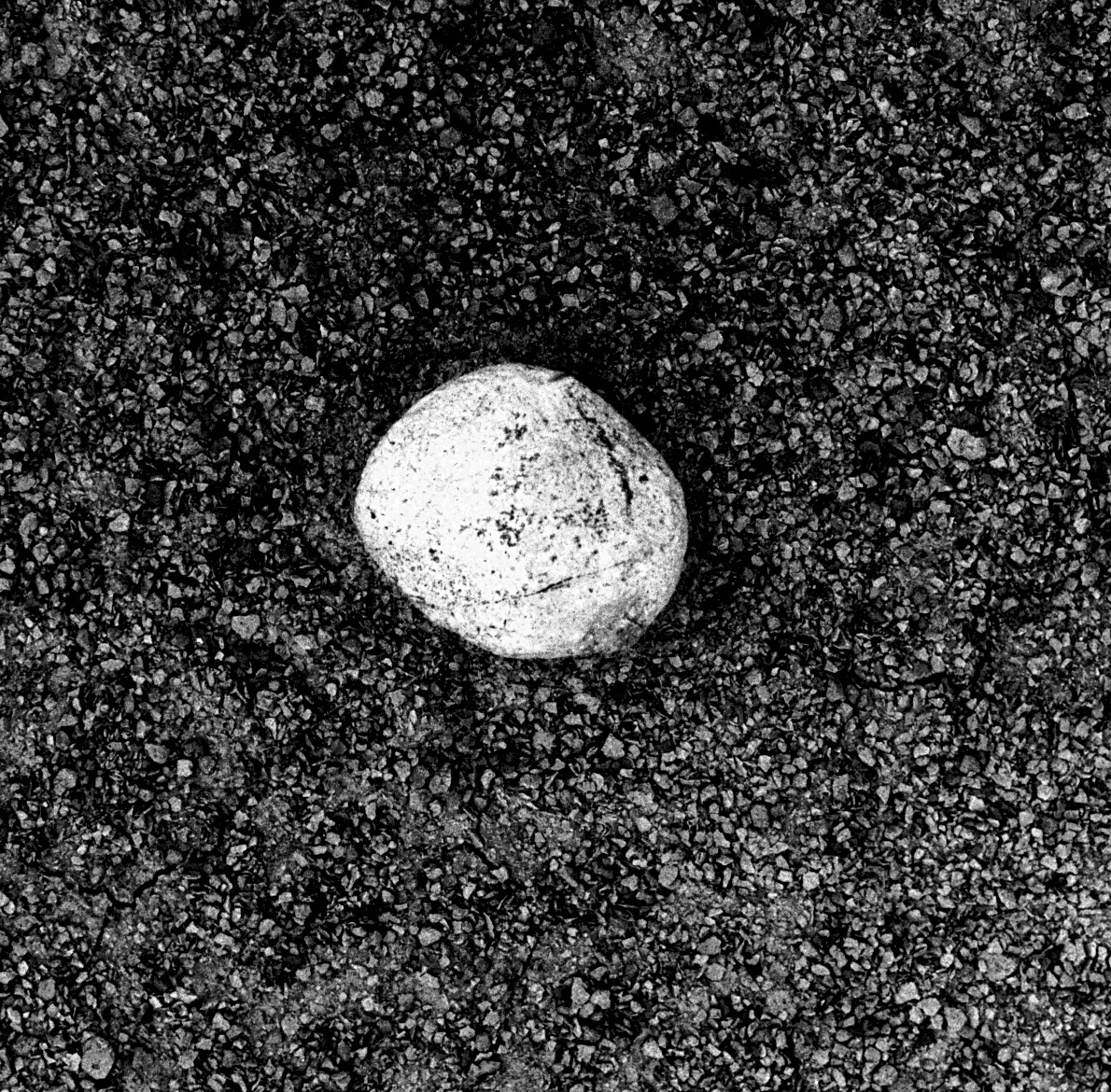
a rock on the ground in the Big Bend near the Rio Grande (photograph: roy hamric)
An earlier version of this review appeared in The Kyoto Journal.
The Blue Cliff Record: Zen Echoes by David Rothenberg; Codhill Press, 2001
the Zen koan
By Roy Hamric
But the poetry that thinks is in truth the topology of being.—Martin Heidegger
David Rothenberg’s book of poetry is based on his response to “The Blue Cliff Record,” the venerable koan collection, and has been launched with kudos from Sam Hamill, Frederick Franck and Mark Rudman, all esteemed poets.
Rothenberg is a poet and muscian, the author of “Sudden Music” and “Hand’s End,” and he is the founding editor of Terra Nova, a magazine devoted to deep ecology. A contributing editor at Parabola magazine, he also teaches philosophy.
Hamill, the poet and translator, notes in a foreward the long tradition of writers reinterpreting the work of other writers, giving renewed life to key ideas and images. Rothenberg labels his poems “echoes,” and he freely plays with the Blue Cliff Records’ koans and the “pointing” verses, spinning off his own interpretation and images based on his perspective and poetic sense. As students of Zen learn, koan “cases” are presented in a straight forward narrative by the writer, and they’re usually followed by commentary and short verses intended to highlight aspects of the case, a sort of coda that offers the student a breakthrough perception or idea.
illustration by Jim Crump
Here is Rothenberg’s poem “The Cat Could Have Lived,” based on Case 63:
I took off my sandals, placed them on my head.
If you had been there, you could have saved the cat.
Of like hearts, like minds.
You two on the same road would know that.
You may murder the cat, it’s none of my business.
The sandals don’t purr, and torn they won’t scream.
If someone dies for them these puzzles matter.
You must try to care, if you wish to live.
Cumulatively, this type of Zen verse works something like a waterfall in Nature. We see the surface, and we are sometimes anesthetized by it, but we’re eventually led to wonder what’s behind this flow of words that sparkle inside our mind and endlessly circle around. These poems challenge, cajole, dare and nudge us deeper inside our mind and are worthy esthetic companions to the seemingly impenetrable koans.
Rothenberg knows his Zen esthetics. Slashing directness, grandiose overstatement and sharp minimalism are esthetic staples, and they are frequently used back to back in a line of Zen poetry. He understands the affect and mines this tension––”The great waves rise up a thousand feet”––but ”only a single shout is needed”––leading the reader one way only to be snapped back to simple reality.
Poems based on these fine points of Buddhist esthetics offer glimpses of mind working: mind rooted in a self viewing the world. Koan collections are primers on the affects of language on the mind, on the affects of language as the dancer-magician between our sense of external and internal.
Certainly, the best Zen poetry rests on compression. For that reason, koans and poetry have always had a kinship in the hands of people like Rothenberg, who have something to say beyond mere words.
An excerpt from “It Takes A Word,” based on Case 11:
One right word is all it takes
it can smash the chains and break down he gates
Who knows such words?
––Look around you and see,
What’s the use of today?
shock the country, stir up the crowd
swallow all in one gulp and dwell in the clouds
Look back at that monk who could walk across water
Don’t let him get away with it:
“You smug fellow, if I had known you could conjure up wonders,
I would have broken your legs!”
Then he who speaks disappears
(he has said the word).
Zen teaching has always divided its methods between the body and the mind. Break down the body in unrelenting, regular sitting––allow the body to come to silence like a horse to water. Break down the mind in linguistic disjunction––allow the mind to severe the bind of language to meaning; make language revelatory: allow it to reveal the truth of being. Such approaches, throughout Zen history, alternate between using non-sensical language constructions and sublime poetic beauty. Take your pick, either one might do the job.
illustration by Jim Crump
Walter Benjamin, the astute critic of culture and mind, saw language itself as the primary subject of interest––and not just its role in creating a subject and object. He preferred to see language as a medium (in his case spiritual) where the absolute and the relative might be/are bridged. Rothenberg’s sense of poetry fits this view.
These poems have a sure, unforced lyrical touch. But they are not about lyricism. They are about our unending mentality, about the mind’s inate naming and circling from the expressible to the inexpressible. They take the reader on an exhilarating ride through knotty koans and Zen poetry.
Their goal is small, to give pleasure, and large, no less than to reach the other side of the river of words run by so many poets over the centuries.
Vietnamese writers
Posted: May 23, 2010 Filed under: places, poetry, reviews Leave a commentThis review originally appeared in The Kyoto Journal.
Manao Journal
TWO RIVERS:
New Vietnamese Writing
from America and Viet Nam
Summer 2002 (vol. 14, no. 1)
186 pages
Two Rivers: Vietnamese writers
By Roy Hamric
Even as more recent wars and conflicts push memories of the Vietnam War farther into the past, the effects, though lessening with time, go on within Vietnam and in the Vietnamese diaspora. “Two Rivers” is an apt title for an issue of Manao, the literary journal published by the University of Hawaii, whose mission is to publish literature from Asia and the Pacific region.
This issue, featuring the work of 23 writers – in poetry, fiction and critical essays – captures the ironies, passions and lifestyles among Vietnamese in the homeland and the United States. Contemporary Vietnamese literature is as varied and complex as the country’s winding history – ranging from classical romantic poems to gritty nonfiction tales of Vietnamese gangs in the industrial suburbs of California.
 The title “Two Rivers” carries multiple symbols: for the past and the present, for the Red River in the north and the Mekong River in the south, and for life today, as lived in Vietnam and in the United States. At its core, literature always carries a political-cultural subtext, and these stories and poems are no exception. Younger Vietnamese today in both countries are less attached to the nostalgia and loss experienced by their parents or grandparents but even so, their lives have been profoundly affected by the war.
Older Vietnamese-Americans were uprooted, fleeing the country in 1973, forcing many intellectuals and educated professionals into new lives, where they worked in menial jobs to survive in a new country. In the late 70s and early 80s, a second wave of “boat people” endured horrific experiences of brutality, rape, starvation, abandonment and long processing in refugee camps. In the late 80s, another wave immigrated, including political prisoners and offspring of American soldiers. Today, there are a little more than one million U.S. Vietnamese, compared to 80 million in Viet Nam, and another one million scattered around the world. The past’s shadow casts a stark dividing line across the work of many of these Vietnamese writers.
The poems of Nguyen Duy, one of Vietnam’s most respected writers, mourn the fading of traditional Vietnamese village culture, the source of so much wisdom and folklore.
 “Viet Nam is, in a way, the name of a poem, not a war,” he writes in an essay, adding that Vietnam, in its rush to forge a more secure future, has itself contributed to cultural erosion while at the same time improving the economy. Traditional family life breaks down , as well as in the new-found homelands in the West, leaving the “deepest imprint on each one of us.”
Lyrical power flows through the work of many of the writers in this collection. The stylistic contrasts are greatest, perhaps, in the poetry of the homeland and the United States. Much of the homeland poetry is imbued with the echoes, imagery, flavor and wisdom-tradition that goes back to the “One Sourced Triple Teaching,” a treatise which united Viet Nam’s Buddhist, Confucian, Taoist, Zen and home-grown wisdom traditions during the Ly Tran dynasties (11th to 15th centuries). Anti-romanticism and a more post-modern tone flavors the US-based poets.
The last stanza from the “Cricket Song” by poet Lam Thi My Da of Hue, who served in a youth brigade engineering unit, reflects elements of the traditional style:
Please just let me be a cricket
Lying down in the green cradle where I began
While the dying day releases a single dewdrop
That trickles into my soul as a kiss, a tear.
 Generally, the poetry and literature of the diaspora is more sardonic and clinically objective. The first stanza of the poem “In the Silicon Valley” by Phan Nhien Hao, who was educated in Saigon and Los Angeles, reflects a more detached, ironic view:
There are climates that can wear out shoes like acid
The view out the window is always cut by rain and sunlight,
And fuzzy calculations on a computer. I live in a valley where people will saw off their own leg to sell to buy a house.
The American poet and translator, Nguyen Ba Chung, in a critical essay surveying the past several decades, notes that overseas Vietnamese have recently acknowledged the blooming of a probing, more critical literature by Viet Nam writers, such as Nguyen Huy Thiep, Bao Ninh, Pham Thi Hoai, Nguyen Duy and Bui Ngoc Tan, dispelling the view held by some that the overseas community was the main hope for an esthetic and critical advance in Vietnamese literature. The younger U.S. generation of writers, such as Barbara Tran, Christian Longworthy, Le Thi Diem Thuy, Mong-Lan, Le Bi, Thuong Quan and Khe Iem, are more focused on writing about their dual-identity lives than the political issues of the past. Both approaches are serving to enrich Vietnamese literature.
Chung points out that the work of both groups, the two rivers, comes together in the overseas Vietnamese journals, such as Hop Luu (Confluence) Van Hoc (Literary Study), Van (Literature) and Tho (Poetry), which publish the work of both homeland and overseas writers plus translations into Vietnamese of essays on Western critical theory, an important source of new ideas for Viet Nam writers.
Manoa editor Frank Stewart and his guest editors, Kevin Bowen and Nguyen Ba Chung, have assembled a rich sample of creative and critical literature that captures the crosscurrents of Vietnamese and Vietnamese-American writers.
The journal itself plays a significant role in putting back together at least some of the pieces of a literary culture that was shattered by decades of war.
Information on Manoa can be found at www.hawaii.edu/mjournal
gary snyder: Danger on Peaks
Posted: May 13, 2010 Filed under: buddhism, people, poetry, reviews, writing Leave a commentThis review appeared in The Kyoto Journal:
Gary Snyder: Danger on Peaks
By Roy Hamric
“There is a point you can make that anything looked at with love and attention becomes very interesting,” – Gary Snyder. *
Gary Snyder’s Danger On Peaks, his 10th book of poetry, is further proof that since he first published Rip Rap in 1959 we’ve been in the midst of a rare weaving of life and art.
In a few more decades, it will probably be clear that Snyder has claimed the role of world icon of American poetry, bridging East and West, and his life will be a potent force as a model of committment to community and the natural world.
But what will become even clearer is that Snyder’s closest peers are not only Han Shan, Stonehouse, Bassho, Ikkyu and the other red-blooded, Zen poets whose voices Snyder has extended into modern times, but also Thoreau, William Carlos Williams, Wallace Stephens and his close fellow Beat poets.

gary snyder
Snyder’s cultural impact in America and beyond has been two-fold – practically useful and spiritually useful, in the sense of giving coming generations a model of creative responsibility and right thinking. Over time, my feeling is that his poetic and social influence will likely trump even Thoreau’s place as a writer and man of nature. It will, at the least, be seen as a twentieth century extension of Thoreau’s fierce independence of nature. Such is Snyder’s accomplishment since his famous reading at the Six Gallery in San Francisco 50 years ago.
Danger On Peaks is probably the most free and personal of his poetry books so far. It’s not Old Man Snyder’s wisdom finally revealed, but it is wise. In his poetry, he’s never preached. Each poem hoes the Zen line in each line – naming and pointing. Simple, and yet…
Snyder’s poetry, even for America, is rigorous and hardy, a West Coast counterpart to a venerable American-consciousness lineage, inaugurated by Emerson. And yet, Snyder is also a true man of Zen. How the two esthetics mix is up to each reader to decide. But by looking at his poetry and his writing about poetry, we do get a clearer understanding of his art.
For starters, go back to a criticism that Emerson made, measuring the poets of his day. He said poetry should be written so that meaning trumps meter, which is not to say that poetry should be without meter. Real meaning must carry the day. But what is real meaning? Beside Emerson’s esthetic, which he struggled to apply in his own poetry, largely unsuccessfully, let’s place a question Snyder asked in an essay in A Sense of Place: “Is art an imposition of order on chaotic nature, or is art [also read language] a matter of discovering the grain of things, of uncovering the measured chaos that structures the natural world?” Add to that his view that the world is itself an on-going “making poem,” and we’re off into new esthetic territory. Snyder has laid down markers on how and why his poetry works. Naturally, it is closely linked to his spiritual search, which eventually led him, in 1956, to Zen practice in Kyoto. Extended zazen practice makes one extra sensitive to the role of words and language and their effects on mind. From there, it’s a small step to see the practice of poetry as words that find their right place, which approach consciousness, rather than are made by consciousness.
Snyder would, of course, cringe at being called a Zen poet. He is a poet in the fullest sense, writing in an American-Asian poetry lineage of anti-romanticism and modernism –no matter how far back Zen poetry extends in historical time, it is esthetically modern because it doesn’t rely on symbolic, theological or mythological influences.
Before he had met Allen Ginsberg and Jack Kerouac and before he had arrived in Kyoto, Snyder, at age 24, had already seen his course: in a letter to his Buddhist pal PhilipWhalen in1954, fives years before Rip Rap was published, he wrote:
“I come to think more and more, poetry is a process and should be, in a Buddhist sort of way, didactic and sensual.” It all comes down to that: a poetry of attention, almost invisibly instructive, and usually without a pronounced message – a fundamental reliance on words and ordinary reality to carry the “message” rather than tropes or symbols. Let “just that” create the meaning, thank you. The world “making” itself through open mind. The wise and instinctive will see.
While this is an old chestnut in Zen, it was no small feat for an unpublished, young American poet to base his esthetics on – “just that,” freshly seen and vividly laid down.
Snyder has always been wisely reticent in talking about his Zen practice. If we are lucky, though, we someday will get an autobiographical account of his Zen journey, and the people in his life.
In his Paris Review interview in 1992, he speculated a little on the role of zazen in his poetry.
“This taught me something about the nature of thought, and it led me to the conclusion – in spite of some linguists and literary theorists of the French ilk – that language is not where we start thinking. We think before language, and thought images come into language at a certain point. We have fundamental thought processes that are prelinguistic. Some of my poetry reaches back to that.”
Again, in an essay, “Language Goes Two Ways,” in A Place in Space, he talked about, “The way to see with language, to be free with it and to find it a vehicle of self-transcending insight, is to know both mind and language extremely well and to play with their many possibilities without any special attachment. In doing this, a language yields up surprises and angles that amaze us and that can lead back to unmediated, direct experience.” He went on to say, “But, creativity is not a unique, singular, godlike act of ‘making something.’ It is born of being deeply immersed in what is – and then seeing the overlooked connections, tensions, resonances, shadows, reversals, retellings. What comes forth is new.”
The book is composed of six sections. Part one opens with a series of poems built around Snyder’s 1945 ascent of Mt. St. Helens (the year of Hiroshima) and its later eruption in 1980. The book ends in the period of 9/11 and the destruction of the carved Buddhas of Bamiyan Valley by the Taliban in Afghanistan. Between, we get a full range of auto-biographical moments, (truck stops, freeways, community workshops), glimpses of the natural world (mountains, rivers, fields, fauna), home life in the foothills of the San Juan Mountains, epiphanies, memories of earlier life, loves, the rhythm of friendship, his mother, assorted prose and haiku combinations and a final blessing gatha.
Here’s a sample of three short poems of the 97 poems that make up the book – many long, complex and demanding of multiple readings:
Steady, They Say
Clambering up the rocks of a dry wash gully,
Warped sandstone, by the San Juan River,
look north to stony mountains
shifting clouds and sun
– despair at how the human world goes down
Consult my old advisers
“steady,” they say
“today”
Work Day
They want –
Short lengths of 1” schedule 40 PVC
A 10’ chimney sweeping brush
Someone to grind the mower blades
A log chain,
My neighbors’ Spring Work
Chainsaw dust
Clay-clod stuck spade
Apple blossoms and bees
April Calls and Colors
Green steel waste bins
flapping black plastic lids
gobbling flattened cardboard,
far off, a backup beeper.
Like the coyote, the Native American symbol Snyder helped to put back into public consciousness in the early 60s, he has assumed many roles: mountain lookout, sailor, poet, translator, Buddhist, life-long meditator, counter-culture hero, essayist, agitator, government official and academic, while always casting a calm Bodhisattva aura as a worker for a better world.
This book is a hearty gift, another testament of art and faith from a rare talent. The poems show us again that the world of art and artful living is here now before our eyes and ears. Only the bravest poets have the confidence and mastery to rely on the ordinary to achieve the extraordinary. Traditionally, that has been the work of religious teachers.
Finally, here’s Snyder himself, as poet, on the mystery of mind and poetry:
How Poetry Comes to Me
It comes blundering over the
Boulders at night, it stays
Frightened outside the
Range of my campfire
I go to meet it at the
Edge of the light
*Paris Review Interview, 1992.
answering the koan
Posted: May 12, 2010 Filed under: buddhism, people, poetry, states of mind, Uncategorized Leave a commentDavid Rothenberg’s Blue Cliff Record: Zen Echoes tries to cut the koan knot in The Blue Cliff Record. My review appeared in The Kyoto Journal.
poem for red pine
Posted: May 7, 2010 Filed under: buddhism, poetry, writing Leave a comment
Bill Porter went West, took a new name––and came back from the East to spread the word.
A master of the shadow art, he trails behind, recasting Chinese ideograms into new lines for English minds.
He works from a second floor study in Port Townsend, deciphering black strokes from faraway days with sharp eyes, diamond mind––a time when hearts burned: writers of the Silent Word.
On the wall, a Tibetan tanka, and a small painting of bamboo with a poem by Wang Wei.
Through a window, the Cascade Mountains. Through another window, the ocean. Through another window, the branch of a plum tree.
Pine trees and bamboo sway in the morning wind.
Light brightens a new day as the pine tree’s shadow disappear, leaving no trace.
sumano’s poem
Posted: April 26, 2010 Filed under: buddhism, poetry, states of mind, writing Leave a commentSumano, an American Buddhist monk, has lived in a cave in the Khao Yai mountains east of Bangkok for nearly 20 years. Of his four or five books, the best known is Questions from the City, Answers from the Forest (which should be reprinted). He just published his translation of three dharma talks by Achan Tate, one of the great teachers from the Thudong (Wandering Monk) lineage of northeast Thailand. This is Sumano’s poem, used as a foreword in the Tate book. To see his website, click here.
The Way Things Are
If you realize that all things change, there is nothing you will try to hold on to.
If you aren’t afraid of dying, there is nothing you can’t achieve.
If you want to shrink something, you must first allow it to expand.
If you want to get rid of something, you must first allow it to flourish.
If you want to take something, you must first allow it to be given.
This is called the subtle perception of the way things are. The soft overcomes the hard. The slow overcomes the fast.
Let your workings remain a mystery; Just show people the results.
True words aren’t eloquent; Eloquent words aren’t true.
Wise men don’t need to prove their point; If you look to others for fulfillment, you will never truly be fulfilled.
If your happiness depends on money, you will never be happy with yourself.
Be content with what you have; Rejoice in the way things are.
When you realize there is nothing lacking, the whole world belongs to you.
 the roy hamric journal