
New Norton Anthology of World Religions
Posted: November 4, 2014 Filed under: articles, books | Tags: world religions 2 Comments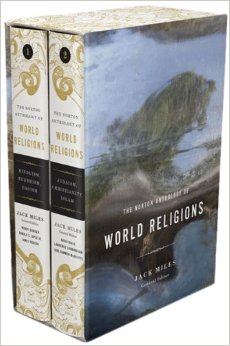
A classic, eclectic anthology on the major world religions is available now from Norton. The book includes some 4,200 pages of texts spanning roughly 3,500 years. Hinduism, Buddhism, Taoism, Judaism, Christianity and Islam are presented “in their own words,” followed by critical responses, dissents, appreciations, commentaries, poems, songs, broadsides, in short a wide range of material that offers a reader one of the broadest, most comprehensive views possible of humanity’s search for the meaning of life. The overall editor, Jack Miles, discusses the book here.
Anthony Quinn Does A Brando in ‘The Man From Del Rio’
Posted: November 3, 2014 Filed under: people | Tags: Anthony Quinn, Katy Jurado Leave a comment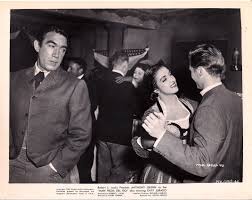 Anthony Quinn gives a powerful star turn in this 1956 Western Movie, The Man From Del Rio, using many of the tricks and mannerisms of Marlon Brando. The 1956 film was made after Quinn’s roles in Viva Zapata and La Strada. It’s a conventional Western genre movie, essentially a shoot-’em-up, borrowing from High Noon and other Western formulas, but it’s good to see Quinn inhabit the role. His performance is unwavering with his trademark sensitive-machisimo contrasted with the female lead, Katy Jurado, his perfect match, who always brought sensitivity and fire to her performances. Each cast member adds power to the story. Peter Whitney is the villain, Douglas Spencer is the spineless sheriff, and the town drunk is Whit Bissell. It was directed by Harry Horner with a screenplay by Richard Carr. An interesting note, Katy Jurado was born into a very wealthy Mexican family who once owned much of the land that is now Texas. She had a long affair with Brando after he made Viva Zapata.
Time and Space
Posted: October 23, 2014 Filed under: photography, time, space Leave a comment
Between yellow and blue, Oct. 23, 2014, 11:57 a.m., iPhone photograph.
Midnight at the 2300 Club
Posted: October 18, 2014 Filed under: poetry Leave a commentMidnight at the 2300 Club
The pole dancers inside don’t care about the lonely highway in the night.
They feel the eyes on their soft, fleshy gladiatorial bodies.
Is this West Texas or Rome? I see centurions, slaves, senators, coroners, cowboys,
and all the fallen angels too numerous to name. That look walking by said you didn’t
understand what I said. No matter. At 3 a.m., my eyes aglow, standing in the parking lot
I see an image in the clouds embracing a blood-red Moon
– creamy, soft, beckoning – veiling inestimable molecules up there and inside my head.
I call this moment passion.
Clive James Talks About His Illness & Plans For More Books
Posted: October 6, 2014 Filed under: books, interviews, people, poetry Leave a comment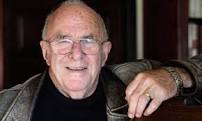 The Spectator has an article here about James, his serious health problems, and the books he hopes to finish: “This month there is a new book of writing on poetry, Poetry Notebook. He still hopes to live to see a new Collected Poems out next year, perhaps finish a final volume of memoirs and write a sequel to his immense 2007 work Cultural Amnesia.”
James Evans Sees His Masterpiece
Posted: October 1, 2014 Filed under: Uncategorized Leave a comment
A Javelina at Night Photograph copyright James Evans
James Evans has completed a series of photographs, called the Ranch Project, that are a testament to his beloved Big Bend area of desert and mountains in far West Texas. Working from his home in Marathon, a small crossroads town, Evans has risen to a new level of personal vision, revealing his inner eye and heart through his photographs of the land and the animals who live there. It is a vision of the natural world in dream-like images of the beauty and mystery that surrounds us and yet remains untouchable. To see a story about the project, go here. To see his website and hundreds of his photographs, go here.
Clive James’ Recent Poems
Posted: September 30, 2014 Filed under: Uncategorized Leave a comment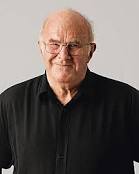 I’m always touched by Clive James’ essays, and his many books and poems. He’s a writer to read for a broad perspective on our world. Recently, his illness has forced him to concentrate more on his poetry. His latest work is a summing up, marked by thoughts of deep regret and death. The regret is the most tragic kind, involving affairs of the heart and the ending of close relationships. This is the last stanza of a recent, long poem, Rounded With A Sleep, which you can read here.
“All day tomorrow I have tests and scans/ And everything that happens will be real. / My blood might say I should make no more plans, / And when it does so, that will be the deal. / But until then I love to speak with you / Each day we meet. / Sometimes we even touch / Across the sad gulf that I brought us to. / Just for a time, so little means so much: / More than I’m worth, I know, as I know how / My death is something I must live with now.”
Leonard Cohen’s Songs Zero In
Posted: September 26, 2014 Filed under: interviews, music, people, poetry Leave a comment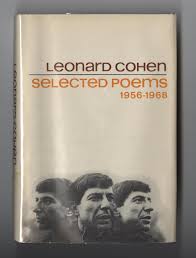
I’m slowing down the tune
I never liked it fast
You want to get there soon
I want to get there last
It’s not because I’m old
It’s not the life I led
I always liked it slow
That’s what my mama said
– Poem/lyrics from his new album, Popular Problems
Lonn Taylor’s Colbert Report Appearance
Posted: September 25, 2014 Filed under: articles, people, writing Leave a comment On Sept. 11, the great Lonn Taylor, my friend from Fort Davis, Texas, was on The Colbert Report talking about the 200th anniversary of The Star-Spangled Banner. He had a great time… Here’s his weekly newspaper column recounting his experience. He had never heard of Steve Colbert before he was contacted by the show’s producer.
September 25, 2014
The Rambling Boy Column
By LONN TAYLOR
Andy Warhol (or perhaps Marshall McLuhan; there is disagreement about who originated the phrase) said, “In the future, everyone will be famous for fifteen minutes.”
On September 11 I was famous for six and a half minutes, so I still have eight and a half-minutes coming to me. That night 1.2 million people watched me explain to Stephen Colbert why Francis Scott Key was on a sloop in the Patapsco River watching the British fleet bombard Fort McHenry 200 years ago and how he happened the next morning to jot down a poem that became our national anthem, “The Star-Spangled Banner.” I had written a book on the subject in 2000, and someone connected with the Colbert Report had found the book and invited me to appear on the show to help commemorate the bicentennial of our national anthem.
The call with the invitation came in late May. I have to confess that at the time I had never heard of Stephen Colbert or the Colbert Report. We do not have a television set and I really only watch television on election night and during the Miss America contest. Fortunately, my wife, Dedie, took the call and briefed me before I called back, so I did not sound like a total idiot to the producer I talked with.
Over the next three months I watched a lot of clips of the Colbert Report. The more I watched the more nervous I became. Colbert seemed irreverent, frenetic, and acerbic, someone who asked questions and didn’t listen to the answers but simply tried to score off his guests. I decided that it was going to be like being interviewed by Vance Knowles in his Jackie Pepper persona. By the time Dedie and I left for New York I was a nervous wreck. About a week before we departed Emily Lazar, the executive producer of the show, called me and spent half an hour rehearsing me on the phone, reading me a series of questions that she said were similar to those that Colbert would ask. She advised me to have three or four things in my head that I could talk about if the interview seemed to drag. I got on the plane running these little speeches through my head.
All of my fretting proved to be for naught. The show, which runs at 11:30 P.M. in New York, is taped before a live audience between 7:30 and 8:30 P.M. A limousine picked us up at our hotel at 6:30 and took us to the studio, where a young woman met us at the curb and showed us to a private green room with my name on the door. The room was furnished with sofas and plates of fruit and cheese were on a table. Henry Kissinger had occupied the room the previous evening and I signed the guest book just below his name.
Colbert came in just as we got settled and introduced himself. He explained that he was going to interview me in character, and that his character was that of a dumb right-wing idiot and that I should not take offense at anything he said. He was not intimidating at all; in fact was a most gracious host. After he left Emily Lazar came in and said they had now refined the script and she could run through the questions Colbert was likely to ask, although she also said that it was impossible to predict what he might do on camera. We went through another series of questions and she left the typed script with me. I was made up, a microphone was attached to my lapel, and I was led through a maze of cables and cameras to the set and seated at the interview table. The camera swung around, the lights came on, Colbert jumped up from his desk, introduced me, strode over to the table, shook hands, and we started talking. Six and a half minutes later it was over, and I realized that he had asked none of the questions that were in the script, had made no insulting remarks, and had not interrupted me once. I also realized that I had just had a wonderful time.
The television audience did not see the best part of the show. During the warm-up period, when Colbert was exchanging remarks with the studio audience, a young man wearing a Northwestern University t-shirt stood up and said that he was a student at Northwestern and that the Northwestern Dance Marathon, the annual student charity event, was coming up. He knew that Colbert was a Northwestern alumnus and he wondered if Colbert could work a mention of the dance marathon into tonight’s show?
Colbert thought a minute and said, “We’ll do something better than that. Come down front after the show.” When the taping was over Colbert called the young man down to the stage and explained that they were going to slow dance together, and that when they started the camera would be on the student’s face but as they turned it would reveal that he was dancing with Colbert. Colbert took the young man in his arms and they danced several steps and turned, and Colbert looked into the camera and said “Northwestern University . . . Dance Marathon,” providing Northwestern with an invaluable film clip to use in promoting the marathon.
With 1.2 million people watching I was sure that I would be stopped on the sidewalk the next day by people wanting autographs. It took 2 ½ days for it to happen, and it wasn’t an autograph. Dedie and I were waiting for a table for Sunday lunch at the Café Luxembourg on 70th Street when a young man leaving the restaurant stopped and said, “Aren’t you the historian I saw on the Colbert Report Thursday night?” I allowed that I was and he said, “Wow. You were really interesting. We’re studying Francis Scott Key in our Bible study class.” I’m still trying to figure that out.
I want to thank all of my friends who sent e-mails saying that they had enjoyed the show, and especially all of those folks who went to the Crowley Theater to watch it at the ungodly hour of 10:30 P.M. The fact that I knew that you were watching kept me from being completely tongue-tied.
Lonn Taylor is a historian and writer who lives in Fort Davis. He can be reached at taylorw@fortdavis.net. Email Taylor to be placed on the column’s mailing list.
Men With Style
Posted: September 22, 2014 Filed under: photography | Tags: recalling Leave a comment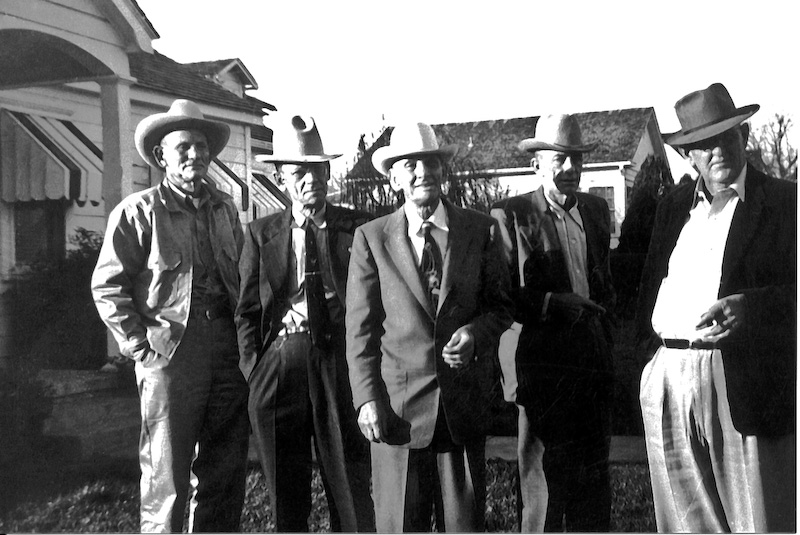
Big Daddy, on the far right, my grandfather.
 the roy hamric journal