
Rack ‘Em Up in Vientiane
Posted: June 1, 2014 Filed under: photography, places Leave a comment
A billiards hall in the Lane Xang Hotel in Vientiane, Laos. Photograph by Roy Hamric
Read Stonehouse In Troubled Times
Posted: May 30, 2014 Filed under: buddhism, people, poetry 1 Comment
IPhone photograph
Scorpion tails and wolf hearts overrun the world everyone has a trick to get ahead but how many smiles in a lifetime how many moments of peace in a day who knows a toppled cart means try another track when trouble strikes there is no time for shame this old monk isn’t just talking he’s trying to remove your obstacles and chains
– From The Zen Works of Stonehouse: Poems and Talks of a 14th Century Chinese Hermit, translated by Red Pine (Counterpoint 1999).
“Catch 22” in China
Posted: May 19, 2014 Filed under: articles, books, writing 2 Comments A Chinese website, Tea Leaf Nation, reported last week that the Western term “Catch 22” has taken hold in the culture. A recent search on Baidu, China’s largest search engine, found more than 4.9 million mentions of “Catch 22,” which in Chinese literally translates “military rule clause 22.’” The term was coined by Joseph Heller in his enduring World War II novel of the same name. Google reports 625 million citations worldwide.
Two examples: In 2010, in Kunming, the local government released a regulation that forbade employers from hiring migrants who did not hold a residency permit there. But to obtain the permit, a migrant was first required to hold a steady job. Responding to public outcries, newspapers published stories with headlines such as “Does Kunming have its own version of Catch-22?”
In March, Xinhua, the Communist Party’s official wire service, ridiculed public officials and labeled a government policy “a Catch-22-style ruse” in an editorial.
David Auerbach’s Blog, Waggish
Posted: May 18, 2014 Filed under: articles, books, people, writing Leave a comment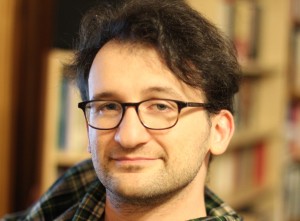 I somehow stumbled across an essential blog, Waggish, which is made up of pungent, cogent essays on ideas and people relevant to the ongoing cultural dialogue, as exercised in politics, the academy, the media and pop culture. Auerbach’s net is wide-ranging, and refreshingly more concerned with ideas and the way the world is always grappling with issues raised in classical Western philosophy. He’s both deep and accessible, and strikes me as unusually fair-minded and not ideologically driven; he splits hairs and crosses his Ts. I’m following his blog now and it’s added good things to my perspective on our times. He’s also a technology writer for Salon, on the side.
Give his idea blog, Waggish, a try. And if you follow the technology press, his Salon column, Bitwise.
Matthiessen On Writing, Zen
Posted: May 17, 2014 Filed under: articles, buddhism, people, writing Leave a comment
Peter Matthiessen is one of the rare greats, a man who took both spirituality and writing seriously. He never soft pedalled his Zen training and practice, and he wrote about it in his two perhaps most famous, or widely read, books: The Nine-Headed Dragon River, about a pilgrimage to Japan with his Zen teacher, and The Snow Leopard, about a trip to Nepal. This is from an NPR radio interview in 1989:
TERRY GROSS, HOST:
This is FRESH AIR. The publication of Peter Matthiessen’s final novel “In Paradise” is coinciding with his obituary. He died in April [2014] at the age of 86. We’re going to listen back to an excerpt of my interview with him. Matthiessen was a naturalist, as well as writer, and his fiction and nonfiction books were often inspired by his travels to remote regions, including mountains and rainforests. His books include “The Snow Leopard,” “Men’s Lives,” “At Play in the Field of the Lords” and “Far Tortuga.”
Along with George Plimpton he was a founder of the literary magazine The Paris Review, but it wasn’t until a few years ago that a documentary film revealed he was working for the CIA at the time and he used the Paris Review as his cover. I spoke with Matthiessen in 1989, before that revelation, and asked about a subject that was central to his life and his writing, Zen Buddhism.
He was initially reluctant to write about Zen. I asked him why.
PETER MATTHIESSEN: Well, I think it almost – in the nature of Zen, to speak about it is already kind of missing the point because Zen, the whole teaching depends on the immediacy and the spontaneity of this present moment. And the minute you talk about it, you’re introducing ideas and concepts that get in the way of seeing directly, which is the whole basis of the training.
And then to see behind it another way of looking at reality, which is what happens through meditation practice and really enhances one’s life. So there’s a built-in contradiction in writing about it. On the other hand, even the meditation is a tool, and the writing is a tool, and it helps people, prepares the ground for this sort of insight and training.
GROSS: Did you seek out Buddhism, or did you happen into it?
MATTHIESSEN: No, I didn’t seek it out, nor did I happen into it. I was – during the ’60s, very early on, my then wife, who since died, we were very interested in finding a teacher of some kind, and we couldn’t – there weren’t really any around in the early ’60s. And we got into experiments with LSD, and we did a lot of LSD during the ’60s not as a recreation but as a way of seeing something else, seeing things another way.
And that kind of wore out for her pretty early. I went on with it a bit longer. And she went over to Japanese tea ceremony and then from there, through friends, to a Zen teacher who was then working in New York City. And, I, a year or two later did the same thing and found that it was far more effective and far closer to what we originally had in mind than the drug use was.
GROSS: Had you ever asked any of your teachers what they thought about taking LSD?
MATTHIESSEN: I don’t think – I think they feel that any chemical is a screen that gets in the way, and I think that’s true. I think these drugs, if properly used, and if you knew what you were getting, which you don’t anymore – in the old days of LSD it was quite different because Sandoz Chemicals in Switzerland was making it, and you knew exactly what the dose was, and they knew exactly what the amount was.
But a Zen teacher, or any spiritual teacher, would be against it simply because you’re seeing things purely. There always is that, finally that chemical screen, even if you are having an extraordinary vision of existence.
GROSS: One of the founders of the school of Buddhism that you practice, Soto, had said that the way to be truly universal is to be particular, moment by moment, detail by detail. And I wonder if you see that as really applying to writing, as well, that to be universal you really have to focus on detail.
MATTHIESSEN: I think so. I think all really good writing is attention to detail. It’s that one detail, that one scrap of dialogue, one color or smell that brings the whole scene to life. You can’t throw in everything. You’d be just writing all day long over one small scene. So you have to find that one thing that the reader can build up from.
For example, William Faulkner, he was extraordinarily skillful. He would pick out one, or at most two, physical characteristics of somebody and then just repeat them over and over again, and the reader gradually builds up a whole character around that one physical detail because the detail is so well-chosen that it serves you in this way you can do it.
GROSS: I want to ask you something else about Zen, and this is from something that you said in your Zen journals book, “Nine-Headed Dragon River.” You were explaining that you were studying to be a Zen monk, studying in the States, and you had passed 13 of 14 checkpoints. You failed the last, which was about the vital expression of the inexpressible. And you said you were only able to come up with a weak intellectual answer.
I found that a fascinating thing to stumble on for a writer, and I was wondering if you’d tell us a little bit about what this means.
MATTHIESSEN: That’s in Koan training, which is part of formal training for the priesthood and so forth. In Soto Zen and also in Rinzai Zen, any kind of Zen, and that’s a very famous Koan, that, the sound of one hand, usually it’s called the sound of one hand clapping, but it’s actually the sound of one hand, what is the sound of one hand?
This is a Koan that stops you dead like an iron wall. I mean, where can you go with that logically? It just makes your whole logical apparatus collapse. And that’s the point of it, that you would see it all from a different way. And nonetheless, you could arrive at a kind of an answer, which would be adequate, a presentation which would be adequate, without quite understanding the subtleties and what’s behind it.
So there are 14 checkpoints of that Koan, and you have to pass all 14 of them, and they’re kind of increasing in difficulty and subtlety and so forth. So finally an intellectual answer is not nearly good enough. You have to manifest that Koan and present it, and this is part of the training.
GROSS: Well, let me ask you again how that connects with your writing. Has that training in not using the intellectual to explain or to understand helped you in your writing?
MATTHIESSEN: I wrote a novel called “Far Tortuga,” which is my own favorite of my books, and one reason it is is because I tried to replace, similarly in metaphor, an image with just these very simple descriptions of the thing itself, of, for example, the feelers of a cockroach coming out from underneath a galley cabin on a ship deck or the water vibrating in the rim of an oil drum on the deck because of the diesel motor, just these things, just to see over the line of birds migrating along the horizon, just if the reader could see those and see the immense mystery and hugeness of existence shimmering behind those very, very concrete details.
GROSS: Peter Matthiessen, recorded in 1989. He died Saturday at the age of 86.
(Transcript provided by NPR, Copyright NPR.)
Let There Be A Big Bend For All
Posted: May 5, 2014 Filed under: people, photography, places Leave a comment
A dance in the Big Bend. Photograph copyright Robert Hart
Why do I love the Big Bend in Texas? The people who live there, and the there. This photograph shows a dance held under the stars near Terlingua, on the Mexican border, the setting for most of the opening sequences of Wim Wender’s “Paris, Texas,” which I re-watched recently. Harry Dean Stanton, who was a soft, dark angel back then, and Dean Stockwell, who worked his ass off holding the film together. Wender’s? Who knows… But Sam Shepard wrote the script, which, I think, was really about his father, his lost-father, who dominates Shepard’s muse-land. For more Big Bend photographs, see Robert Hart’s website.
The Past is Always Right Here, James Newton
Posted: April 29, 2014 Filed under: people, photography, places, poetry 2 Comments
Marcy Newton, left, me, top, James, bottom, LeAnn, right.
James Newton is a giant in my life. He kept me alive in the 80s & 90s. I saw his Facebook page for the first time this week, and he had posted two pictures of me. What does it bring back? Hot late nights, cooking steaks on an outside makeshift grill, poems, songs, spinning vinyl records, constant calibration of young, raw, natural energy. A knowledge it could never be repeated. I think of you always and forever, James, my brother.
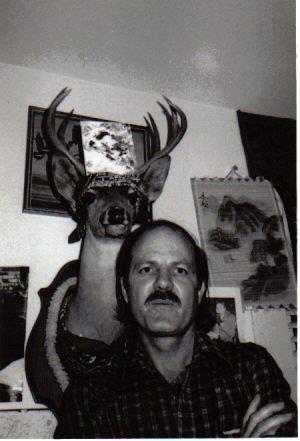
Maybe the mid-80s in my study in Arlington.
On James’ Birthday
(Mid-80s)
Unwrap this, it’s for you
to take along on your search
for the perfect back beat
and still sea.
On this still-light morning
breaths draw slowly.
Sleeping bodies throughout
the house, too much drink
last night. The still cat
sits in the window sill
staring outside.
Beyond is the Great Outdoors
but what is it?
In last night’s dream
there was a man with
three hooks piercing his
chest, bound and hanging
on a swaying rope.
Is he you and me?
Now comes the first morning sound.
A bird feeling the Sun
on its tongue on another
moment of birth.
Partying With the Shan Army
Posted: April 28, 2014 Filed under: people, photography, writing 1 Comment

photograph by Sam Jam
My friend Daniel Otis, a writer now living in Cambodia, spent almost a month in northeastern Myanmar in February, mostly reporting on the Shan Army. He’s written an insightful, revealing story that appeared in Vice, with various other versions for different publications. Sam Jam, a photographer, took great photographs of the trip. The days were marked with military drills and parades. At night, the rebel army’s rock and roll band took to the stage for raucous booze-fuelled concerts. To get a look at Dan’s writing, see his website Exhaust and Incense here. The Vice story is here.

Daniel Otis, in Cambodia.
‘Decoded’ By Mai Jia
Posted: April 25, 2014 Filed under: books, people, writing Leave a comment
I started reading the first pages of “Decoded” on Amazon’s “Look Inside,” and I couldn’t stop reading. The eighth novel by Chinese writer Mai Jia, and the first to be translated into English, it’s about the line between insanity and genius. It unfolds around the life of a young, genius mathematician who is recruited to work in a secret code breaking unit. Around its edges, it flirts with the spy genre but at its core it’s a character study: of a family and of a wide range of gifted people who live in the world of the mind in a way that’s foreign to ordinary people. I immediately ordered this book, and I’ll look forward to more translations by this writer. Here’s a short interview with him in the Wall Street Journal, and also a link to the book on Amazon. Give the first 20 pages a read. It may grip you like it did me…
Frank X. Tolbert 2: His Art
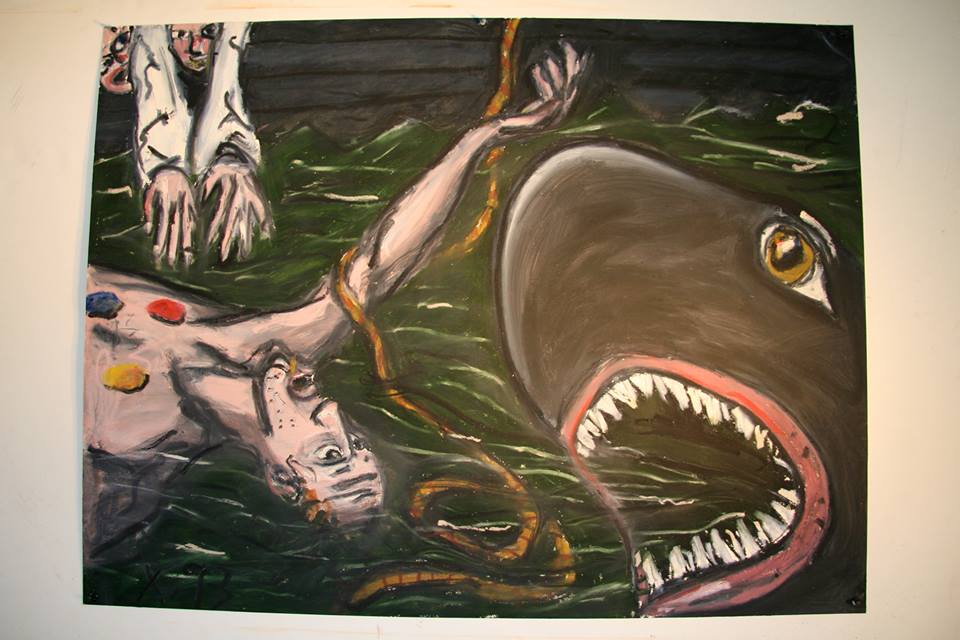
Posted: April 21, 2014 Filed under: people, poetry, sight seeing 1 CommentMy friend Frank X. Tolbert has always been one of my heroes, and I’ve missed him a lot in recent years. He lives in Houston. His father was a famous journalist with the Dallas Morning News. Frank is one of those people who nourishes your soul when you’re around him, and he doesn’t have any clue what he’s giving to you. Frank and I shared a friendship with a man who was a hero to both of us: Roxy Gordon, a writer, poet, and another one of those people who give you things without knowing it.
Here’s a few samples of Frank’s work. See his Facebook website here for a taste of X’s style. See more of his art here.
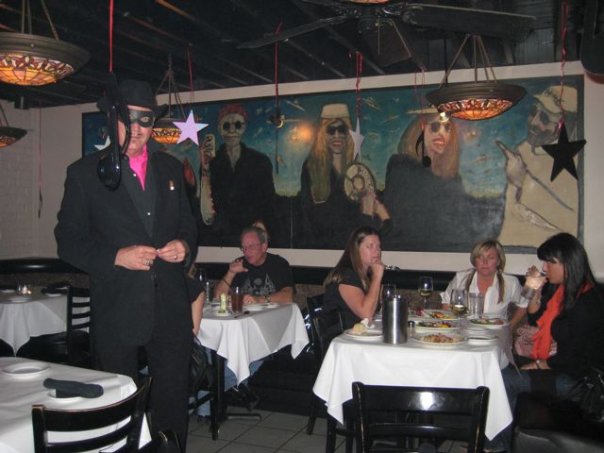
Frank X. Tolbert, standing on the left, with one of his large paintings in the background.

Frank, on the right, with an artist friend
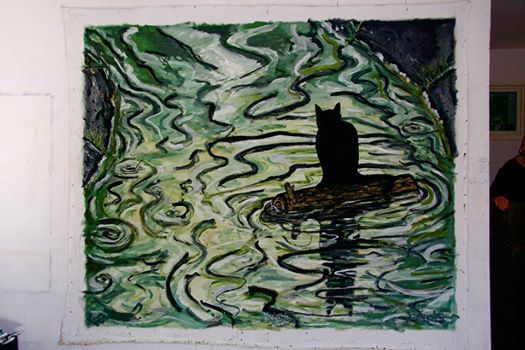


A painting of Roxy Gordon by Georgia Stafford.
Go here to see a sample of some of Roxy Gordon’s poems and writing and check him out on Amazon for some CDs of his poetry-songs. Note the death mask in the right corner.
 the roy hamric journal