
Asian moments
Posted: May 31, 2010 Filed under: buddhism, people, states of mind Leave a comment
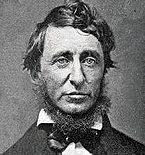
henry david thoreau
1854: The first edition of Thoreau’s Walden appears. On the frontispiece page is an engraving of a leaf from a Banyan tree, the tree under which the Buddha sat when he encountered enlightenment.
1958, November: Jack Kerouac, Allen Ginsberg and Peter Orlovsky call up D.T. Suzuki at his apartment in New York City, just arrived from Japan. His secretary says: “Can you come over right now?”
“You young men sit here quietly and write haikus while I go and make some powdered green tea,” Suzuki says. Sipping the tea, Allen says, “It taste like shrimp.” “It tastes like beef,” says Suzuki. “Don’t forget it’s tea.”
Kerouac’s haiku is:
Three little sparrows on a roof,
Talking quietly, sadly.
Kerouac tells Suzuki that he’s experienced several samadhis lasting “a whole half hour or three seconds.” After the visit, as Kerouac is walking away he realizes that Suzuki was his old father in China, and shouts: “I would like to spend the rest of my life with you.” Suzuki, waving goodbye, says, “Sometime.”
meditation retreats in Chiang Mai
Posted: May 28, 2010 Filed under: articles, buddhism, states of mind 2 Comments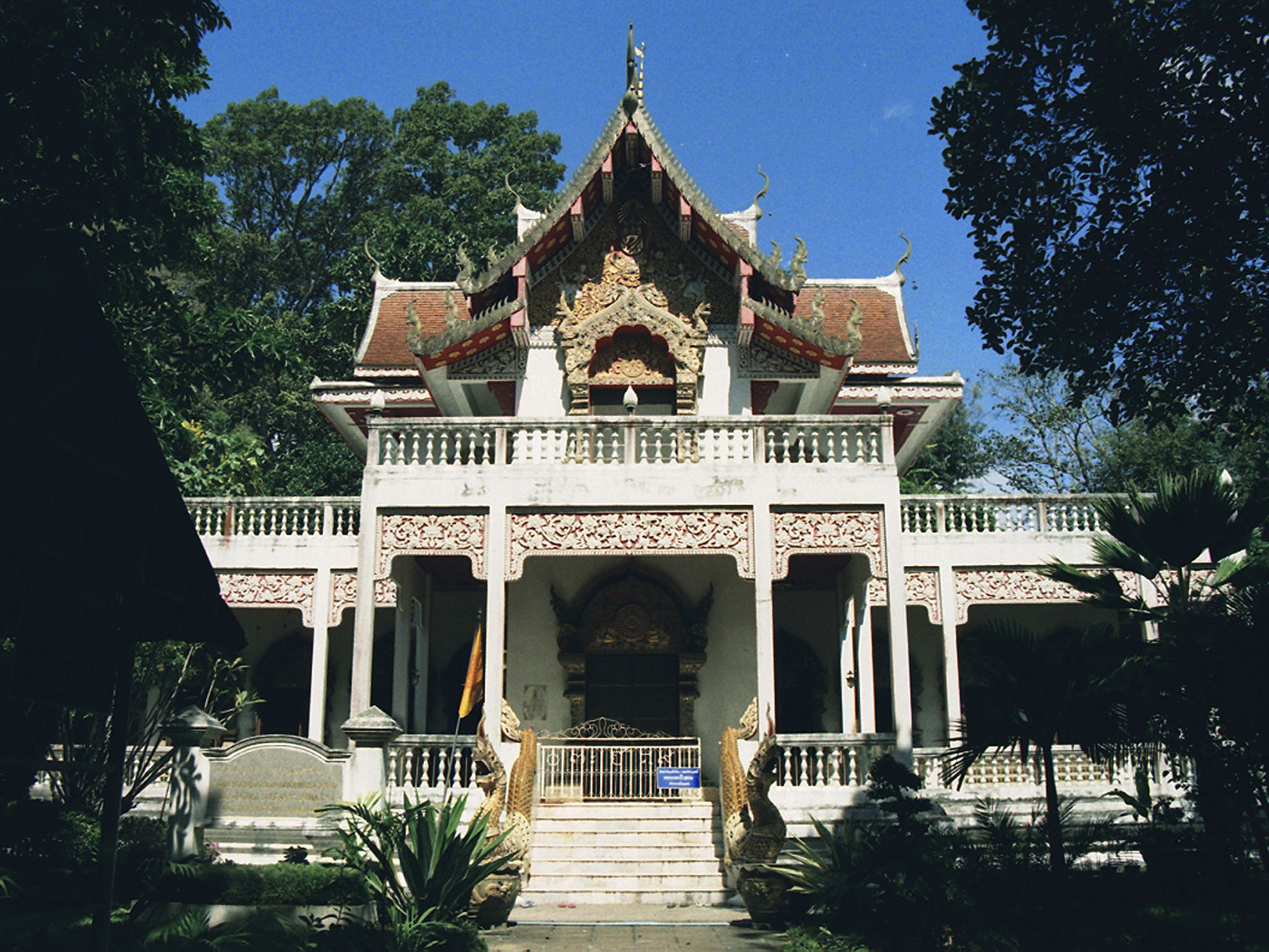
wat ram poeng in Chiang Mai
This article originally appeared in The Boston Globe.
By Roy Hamric
Foreigners first began visiting Chiang Mai in the late 19th century when the British opened a mountain station to extract teak and other timber. During the Vietnam War, Americans found it to be the most beautiful and sleepy of Thailand’s mountain cities. Today, it’s ranked among the top of Asia’s most livable cities list and an increasing number of Chiang Mai’s Buddhist wats, or temples, are drawing more and more Westerners seeking meditation retreats.
Many falangs (foreigners) are forsaking the more traditional spas and venues that offer massage, Thai cooking and yoga classes for Buddhist studies classes in English and Thai-style meditation retreats from one to 21-days or longer.
A popular temple among Westerners is Wat Umong, one of Chiang Mai’s 300 wats, located in the foothills of Mount Doi Suthep, which rises 5,478 feet above the 1,000-year-old city. “Wat” is a Thai word from the Pali-Sanskrit word meaning “dwelling for pupils and ascetics.” Wat Umong’s history goes back to the 14th century.
On the densely wooded temple grounds, moss-covered limestone sculptures of the Buddha are scattered over the grounds, some nearly completely covered by climbing vines. Small kutis–– self-sufficient huts that house one monk each––are bathed in yellow sunbeams filtering through the leafy canopy. The deep murmuring sound of monks’ chanting sutras filled the evening air. Blue signs with white lettering offered helpful aphorisms: “Today Is Better Than Two Tomorrows.” “I have not failed––I found ways that don’t work.”
One Sunday afternoon, I joined sixteen foreigners who sat quietly in a red-roofed Chinese Pavilion area near a two-acre pond. Green algae circled the pond’s edge extending out almost to its center, leaving a circle of water where large turtles poked their snouts into the air.
Nirodho Bikkhu, an Australian monk who lives in a nearby kuti, walked into the pavilion and sat down. He adjusted his brown robe and smiled.
“I would rather answer your questions and just talk. Does anyone have a question?” he asked. Moments of silence. Finally, a young girl with bronze skin from days on the road asked: “Is reality real?”
The monk smiled. Speaking slowly, he explained what the Buddha said about objective and subjective views. He talked about meditation as a way to experience the mind, the senses and the body. He talked about a concept in Vipassana Buddhism of small, discreet divisions of mental activity that can take years of meditation to fully distinguish. “They pass by unnoticed by most people,” he said.
More silence. Then an American lady asked: “What about bardos,” the different stages of the death-journey found in Tibetan Buddhism.
“I speak only about what the Buddha said,” Norodho Bikkhu answered. “bardos are concepts found only in the Tibetan Book of the Dead.”
A young American woman, Laura Robbins, listened quietly to the monk, and stayed the full two hours. After everyone left, she had a private conversation with Nirodho Bikkhu.
Later, walking beside the pond, she said she was starting a 21-day meditation retreat in two days at a nearby monastery.
“A little serendipity got me to this point,” she said. While on vacation, she had a conversation with the owner of a Thai restaurant who gave her the name of an American woman who teaches meditation at a wat outside Chiang Mai.
“I choose that temple,” she said, “because of what the woman teacher said, and I liked it that there were a lot of nuns there.”
In the past, it took a lot of effort for Westerners to find a wat where they could receive introductory lectures on Buddhism or go on short or long meditation retreats. Like many temples, Wat Umong is rapidly expanding its offerings to Westerners.
“We will be a friend to anyone who wants to know more about Buddhism,” said Songserm Bikkhu, the teaching monk who directs Wat Umong’s newly opened International Buddhist Education and Meditation Practice Center, which has 17 rooms for foreigners, who can choose from one to four-day retreats. The cost is a personal donation. Many Westerners give $4 to $6 a day.
“If people would like to take a retreat or to ordain as a monk and practice here, they can,” Songserm Bikkhu said. “If they would just like to come, learn and go and practice on their own, they can.”
Most Chiang Mai wats teach Vipasanna meditation, a system based on meditation and attention to the four foundations of mindfulness. Exercises are based on mindfulness of body and movement, mindfulness of feelings, mindfulness of mind and mindfulness of objects. In Pali, Vipasanna means “to see clearly.”
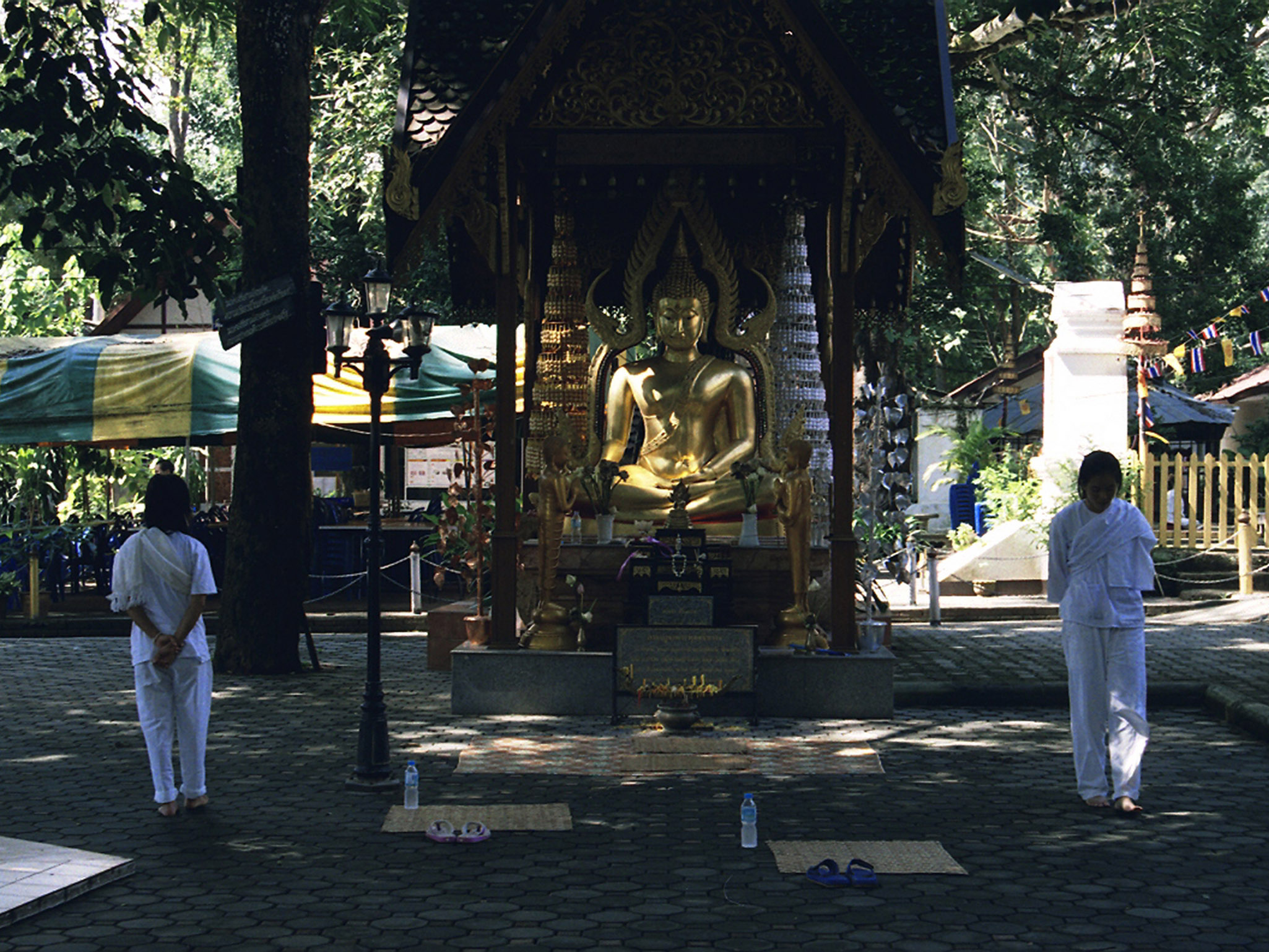
walking meditation at wat ram poeng
The retreat schedule is the same at most wats: rise at 4 a.m. followed by morning chanting and mediation, breakfast, dharma study, followed by lunch, afternoon walking and sitting meditation, a one-on-one talk with the supervising monk, rest time and evening chanting, concluded by more sitting and walking meditation. Students are encouraged to do sitting and walking meditation up to 12 hours a day, but few can or even try.
A short distance down the road from Wat Umong is Wat Ram Poeng, built in 1451, with touches of Burmese Buddhist architecture. A popular meditation center with Asians and foreigners alike, the wat is home to the Northern Insight Vipasanna Mediation Center.
Eric Stirnweis of Fort Collins, Colo., was in his second week of retreat, along with other Americans and people from Sweden, Canada and France. While waiting for his daily interview with the abbot, he said he had already increased his walking and sitting meditation to about 12 hours a day.
“Here you eat, sleep and meditate—that’s it,” Stirnweis said. “They push you.”
At the end of the retreat period, he said, each student goes through “termination” – a three-day period of very little sleep and constant sitting and walking meditation.
The daily interviews are helpful, he said, but the practice is tough with lots of ups and downs.
“It’s different – no telephone, no e-mail, six hours of sleep a day at most, but it’s a healthy focus,” he said. “The abbot is definitely perceptive. I didn’t even say anything one morning, and he said, ‘Ah, there’s much negativity here.’ He seems to know you without talking to you.”
Wat Ram Poeng is in the process of expanding facilities to house up to 30 foreigners.
Frequently, foreigners who want even longer retreats are sent to Wat Dthat Sri, a sister temple. It also is in the process of creating a foreigner-housing area complete with small cottages outside the wat grounds.
An American, Kathryn Chindaporn, who co-directs the meditation center for foreigners with her Thai husband, remembered her phone conversation with Laura Robbins.
“This is a good place for basic or long-term practice, tailored to individuals,” said Chindaporn, who is from Evervett, Wash. “We use the mental labeling technique. The technique is easy. You think, ‘I’m taking a step with my right foot, or I’m feeling content or sad.’ It’s easy to use, but the practice makes it very deep.”
Chindaporn said she was on her way to India in 1986, but found herself staying on in Chiang Mai to practice full-time at Wat Ram Poeng, where she took classes in Buddhist studies, learned Thai and has since translated early Thai meditation texts into English.
Meanwhile, Laura Robbins had started her retreat at the wat and had begun daily interviews with Thanat Chindaporn.
“It’s going fine,” she said, while in her second day of the retreat. Ten days later, she took a two-day break, but planned to return the next day for another 10-day stay.
“It was very difficult,” she said. “I wanted to leave at least three times. I was surprised how hard it was––the simplicity of it was frustrating.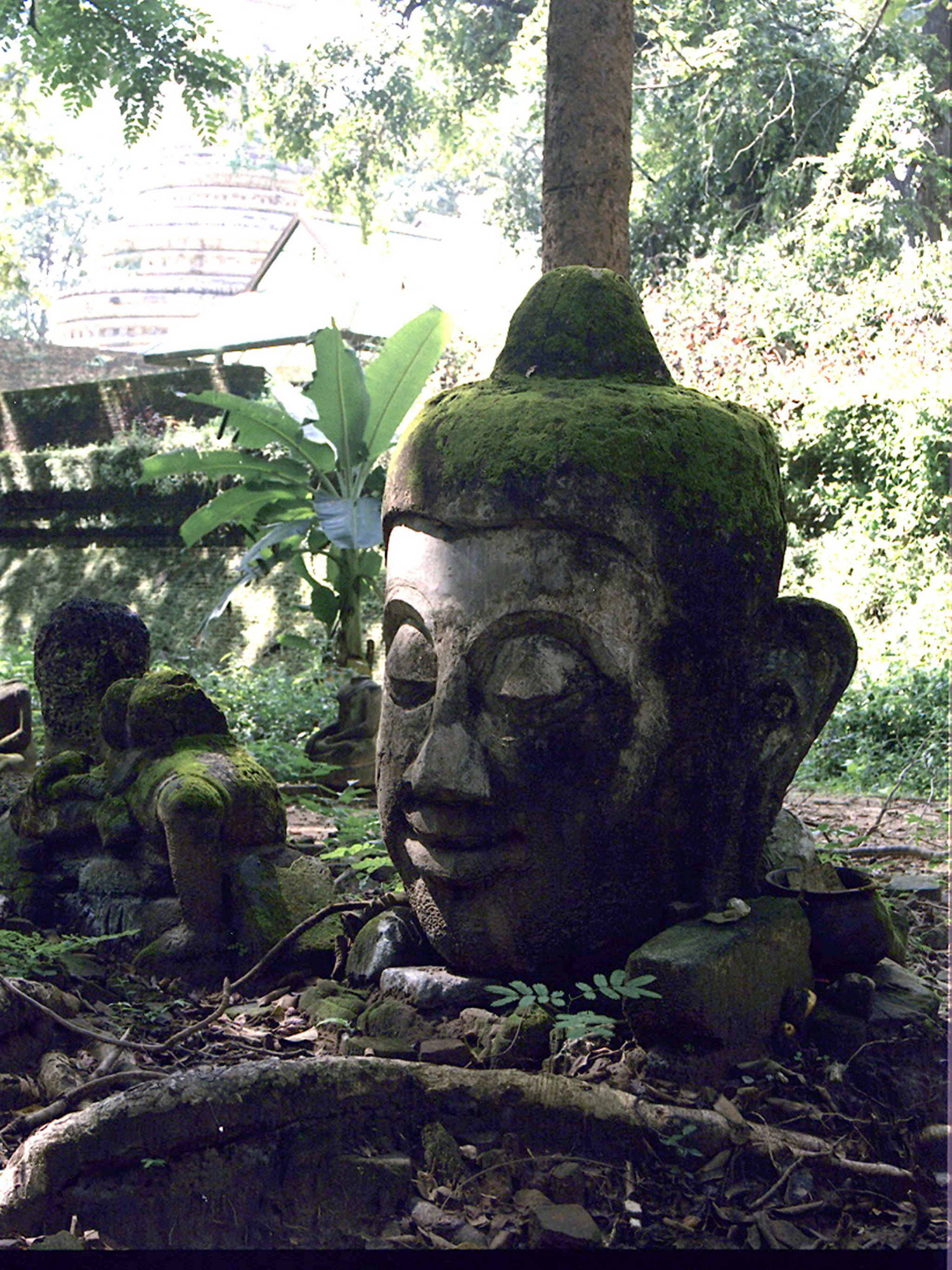
“My mind was running everywhere,” she said. “At the end we tried to practice for 72 hours straight. I had some very set ideas about who I am. I found that by pushing past that I’ve come out being much more gentle with myself.”
You can’t ask for much more than that in life.
______________
Contact Information
Wat Umong, 135 Moo 10, T. Suthep, Chiang Mai, 50200, Thailand; Open lectures in English on Mondays, Wednesdays and Fridays from 4 to 6 p.m. and on Saturdays from 2 to 5 p.m. Telephone: 011.66. 53. 810. 965; email: phrasongserm@watumong.org or www.watumong.org.
Wat Ram Poeng, Northern Insight Meditation Center; Tambol Suthep, Amphur Muang, Chiang Mai, 50200, Thailand. Telephone: 011.66.53. 278.620; email: watrampoeng@hotmail.com or www. watrampoenghi5.com
Wat Dhat Sri, Northern Insight Meditation Center, Tambon San Luang, Amphur Chomtong, Chiang Mai, 50160, Thailand. Telephone: 011.66.53.826.180. Email: kathrynchindaporn@yahoo.com
Zen koans
Posted: May 26, 2010 Filed under: buddhism, people, poetry, reviews Leave a comment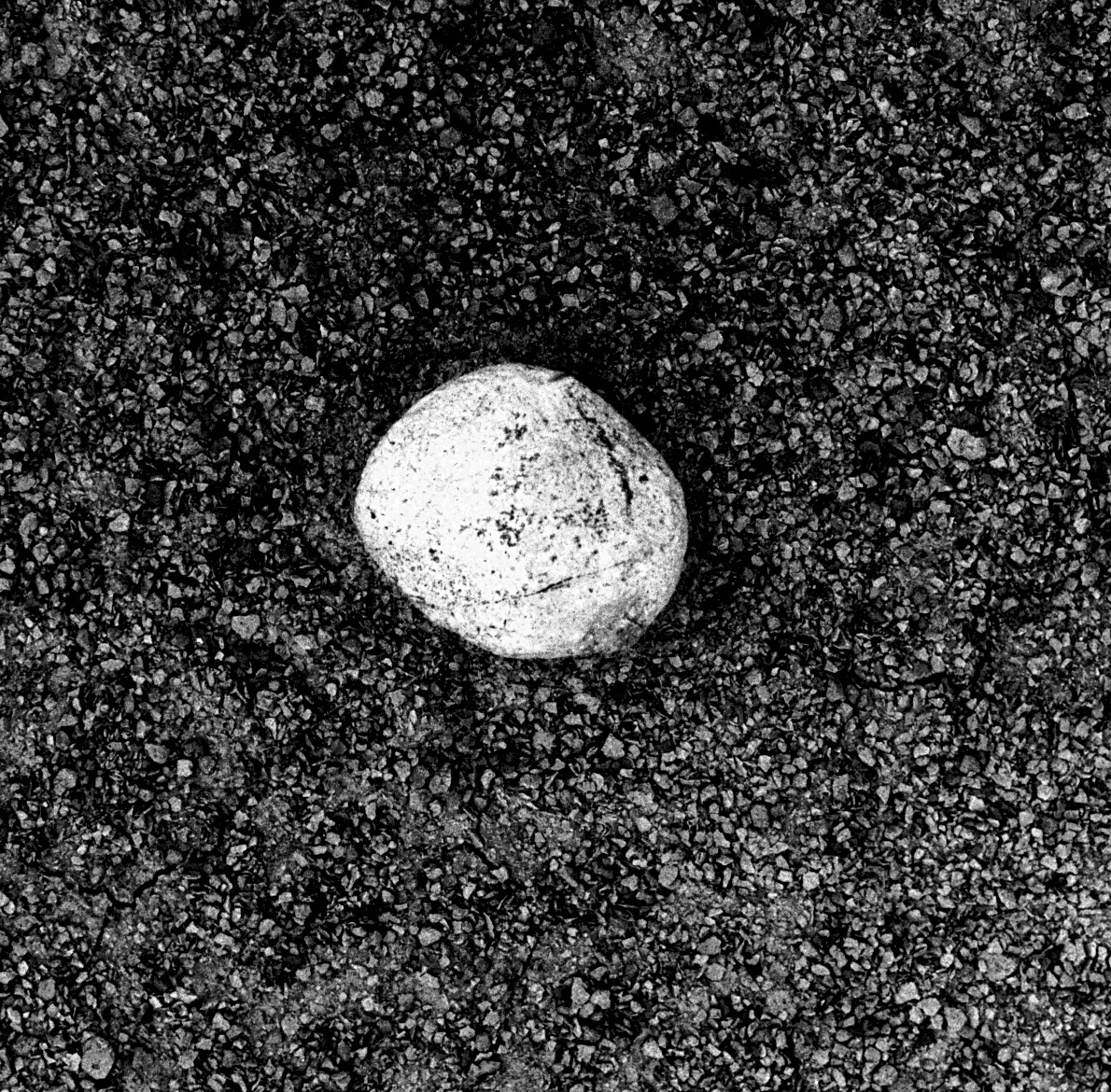
a rock on the ground in the Big Bend near the Rio Grande (photograph: roy hamric)
An earlier version of this review appeared in The Kyoto Journal.
The Blue Cliff Record: Zen Echoes by David Rothenberg; Codhill Press, 2001
the Zen koan
By Roy Hamric
But the poetry that thinks is in truth the topology of being.—Martin Heidegger
David Rothenberg’s book of poetry is based on his response to “The Blue Cliff Record,” the venerable koan collection, and has been launched with kudos from Sam Hamill, Frederick Franck and Mark Rudman, all esteemed poets.
Rothenberg is a poet and muscian, the author of “Sudden Music” and “Hand’s End,” and he is the founding editor of Terra Nova, a magazine devoted to deep ecology. A contributing editor at Parabola magazine, he also teaches philosophy.
Hamill, the poet and translator, notes in a foreward the long tradition of writers reinterpreting the work of other writers, giving renewed life to key ideas and images. Rothenberg labels his poems “echoes,” and he freely plays with the Blue Cliff Records’ koans and the “pointing” verses, spinning off his own interpretation and images based on his perspective and poetic sense. As students of Zen learn, koan “cases” are presented in a straight forward narrative by the writer, and they’re usually followed by commentary and short verses intended to highlight aspects of the case, a sort of coda that offers the student a breakthrough perception or idea.
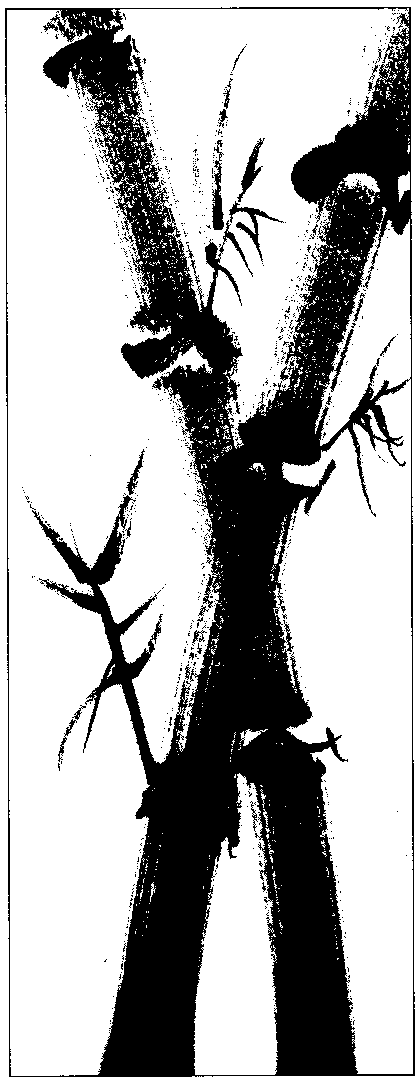
illustration by Jim Crump
Here is Rothenberg’s poem “The Cat Could Have Lived,” based on Case 63:
I took off my sandals, placed them on my head.
If you had been there, you could have saved the cat.
Of like hearts, like minds.
You two on the same road would know that.
You may murder the cat, it’s none of my business.
The sandals don’t purr, and torn they won’t scream.
If someone dies for them these puzzles matter.
You must try to care, if you wish to live.
Cumulatively, this type of Zen verse works something like a waterfall in Nature. We see the surface, and we are sometimes anesthetized by it, but we’re eventually led to wonder what’s behind this flow of words that sparkle inside our mind and endlessly circle around. These poems challenge, cajole, dare and nudge us deeper inside our mind and are worthy esthetic companions to the seemingly impenetrable koans.
Rothenberg knows his Zen esthetics. Slashing directness, grandiose overstatement and sharp minimalism are esthetic staples, and they are frequently used back to back in a line of Zen poetry. He understands the affect and mines this tension––”The great waves rise up a thousand feet”––but ”only a single shout is needed”––leading the reader one way only to be snapped back to simple reality.
Poems based on these fine points of Buddhist esthetics offer glimpses of mind working: mind rooted in a self viewing the world. Koan collections are primers on the affects of language on the mind, on the affects of language as the dancer-magician between our sense of external and internal.
Certainly, the best Zen poetry rests on compression. For that reason, koans and poetry have always had a kinship in the hands of people like Rothenberg, who have something to say beyond mere words.
An excerpt from “It Takes A Word,” based on Case 11:
One right word is all it takes
it can smash the chains and break down he gates
Who knows such words?
––Look around you and see,
What’s the use of today?
shock the country, stir up the crowd
swallow all in one gulp and dwell in the clouds
Look back at that monk who could walk across water
Don’t let him get away with it:
“You smug fellow, if I had known you could conjure up wonders,
I would have broken your legs!”
Then he who speaks disappears
(he has said the word).
Zen teaching has always divided its methods between the body and the mind. Break down the body in unrelenting, regular sitting––allow the body to come to silence like a horse to water. Break down the mind in linguistic disjunction––allow the mind to severe the bind of language to meaning; make language revelatory: allow it to reveal the truth of being. Such approaches, throughout Zen history, alternate between using non-sensical language constructions and sublime poetic beauty. Take your pick, either one might do the job.
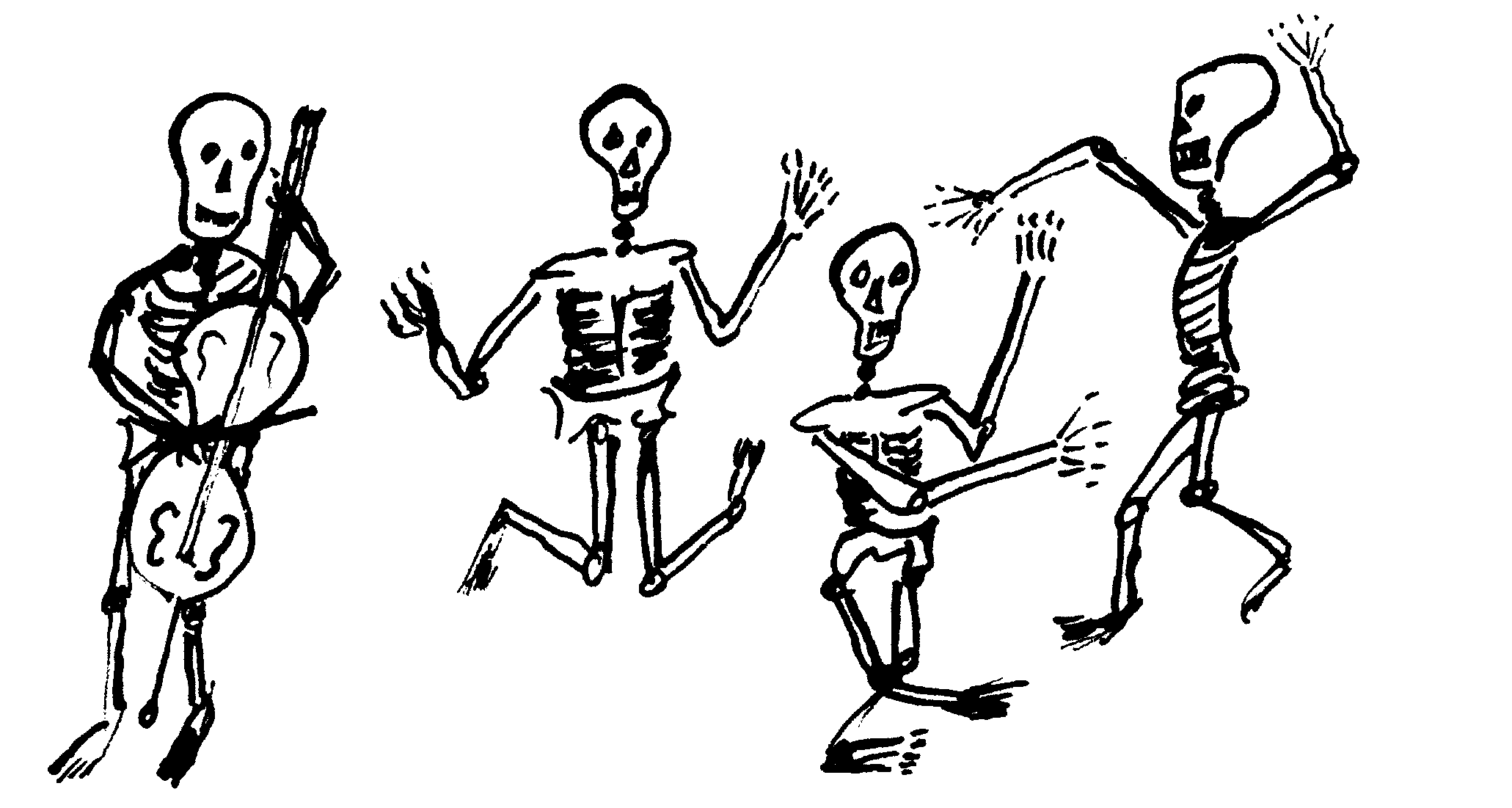
illustration by Jim Crump
Walter Benjamin, the astute critic of culture and mind, saw language itself as the primary subject of interest––and not just its role in creating a subject and object. He preferred to see language as a medium (in his case spiritual) where the absolute and the relative might be/are bridged. Rothenberg’s sense of poetry fits this view.
These poems have a sure, unforced lyrical touch. But they are not about lyricism. They are about our unending mentality, about the mind’s inate naming and circling from the expressible to the inexpressible. They take the reader on an exhilarating ride through knotty koans and Zen poetry.
Their goal is small, to give pleasure, and large, no less than to reach the other side of the river of words run by so many poets over the centuries.
the photography of thomas merton: seeing through the window
Posted: May 15, 2010 Filed under: articles, buddhism, people, photography 1 CommentThis is an expanded version of an essay that appeared in The Kyoto Journal, issue No. 47 in 2001.
The Photography of Thomas Merton: Seeing Through the Window
By Roy Hamric
Trappist Monk Thomas Merton, in his twenty-seventh year at Gethsemani Monastery, wrote to his friend novelist John Howard Griffin, in 1968, shortly after he received the gift of a camera: “It is fabulous. What a joy of a thing to work with.The camera is the most eager and helpful of all beings, all full of happy suggestions. Reminding me of things I have overlooked and cooperating in the creation of new worlds. So Simply. This is a Zen camera.”

merton with his Canon
And so, Merton’s life as an amateur photographer intensified. One of the most spiritual and literary men of our times, Merton had been taking photographs of his friends and the surroundings at Gethsemani, near Louisville, Kentucky, for several years. He enjoyed using the clear glass of the camera lens and the frame of the viewfinder as tools to help him see and to understand the world. The mirror-like view of the camera, recreating whatever it is pointed at, was perfect for Merton’s practical blend of spirituality.
His spiritual path had evolved over the years, as he began to explore the spiritual connections with Zen, largely through the writings of D.T. Suzuki. He longed to become more deeply involved in the “ordinary.”
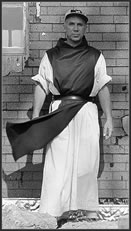
merton in a baseball cap
Many of Merton’s earliest photographs are similar in style to early Chinese painter-calligraphers who tried to capture the direct essence of form. Merton wrote to his friend, John C. H. Wu, the translator of one of the best English versions of the Tao Te Ching, that he was uncomfortable with “mystical writings.” He expressed his desire to go to Asia “to seek at the sources some of the things I see to be so vitally important–the Zen ground of all the dimensions of expression and mystery in the brushwork of Chinese calligraphy- painting, poetry and so forth.”
“On the contrary,” he wrote, “it seems to me that mysticism flourishes most purely right in the middle of the ordinary. And such mysticism, in order to flourish, must be quite prompt to renounce all apparent claim to be mystical at all.”
It is no surprise that a monk who lived a life sequestered from society should be attracted to the still, and silent, photographic image. Within that visual stillness and exchange between the seer and the seen lies a mystery–perhaps some of the spiritual mystery of why one would become a monk in the first place.
During the sixities, as Merton began to explore Asian philosophy, he also began to experiment with calligraphy, creating striking images. In 1958, he wrote in his journal that he had bought a copy of “The Family of Man,” Edward Steichen’s landmark photography book which established the power of photography to evoke universal truths. Merton saw the images as a form of “writing” in which “no explanations are necessary!” “How scandalized some would be if I said that this whole book is to me a picture of Christ, and yet that is the Truth..” This reaction to the visual came in the same entry in his journal in which he recorded what was later to be described as his “Louisville epiphany,” wherein he wrote that he had experienced an overwhelming sense of “oneness” with other people on a street corner.
John Howard Griffin, the author of the civil rights classic Black Like Me, was also an amateur photographer. In 1963, he wanted to build a photographic archive of Merton and his life at Gethsmeni. He wrote to Merton mentioning his desire, and he visited him a short while later. While there, he said, “Tom watched with interest and wanted an explanation of the cameras––a Leica and Alpha.” Merton told Griffin, “I don’t know anything about photography, but it fascinates me.”
Merton had begun his first serious exploration of photography when in January 1962, he visited a Shaker village near the monastery. He found “some marvelous subjects,” he wrote in his journal, and his description of what he saw and photographed signaled that his search for subjects was part of a highly developed visual acuity that unfolded in a charged contemplative state of mind : “Marvelous, silent, vast spaces around the old buildings.” he wrote in his journal. “Cold, pure light, and some grand trees…. How the blank side of a frame house can be so completely beautiful I cannot imagine. A completely miraculous achievement of forms.”
Merton and Griffin started a spiritual-literary friendship during a retreat Griffin made at Gethsemani. Griffin sensed that Merton’s mind innately took to the camera’s frame. He served as a constant source of encouragement to Merton, volunteered to process Merton’s film and became a casual critic of his contact sheets.
They exchanged regular letters touching on Merton’s photography from 1965 through 1968–the year of Merton’s accidental death in Bangkok, following his epiphanic tour of Asia. Merton’s Asian journal of his pilgrimage, and the inclusion of about 30 photographs that he took during the trip, were published as The Asian Journal of Thomas Merton–a work unlike Merton’s other books in its personal intensity. Upon finishing the book, you have a sense that Merton’s life was in a profound stage of evolution.
That revelation, for me, comes through most strongly in the journal entries chronicling the things he photographed during his journey. But his earlier photographs also offer tantalizing clues to Merton’s spiritual journey in his final years.
By 1964, Merton had regular access to a camera and his reading of Zen books became an integral part of his life, no doubt stimulating his interest in the visual experience itself through its emphasis on “attention” and “experiencing the moment.” On September 24, Merton linked Zen and photography in another journal entry: “After dinner I was distracted by the dream camera, and instead of seriously reading the Zen anthology I got from the Louisville Library, kept seeing curious things to shoot, especially a window in the tool room of the woodshed. The whole place is full of fantastic and strange subjects––a mine of Zen photography.”
In the following years, he moved on to better cameras, eventually gaining access to a Rollieflex owned by the monastery. When it malfunctioned in 1968, he immediately wrote to Griffin, who sent him a 35mm Canon FX with 50 mm and 100 mm lenses.
The new camera was the springboard to more sophisticated pictures, and Merton was soon comparing notes with Griffin on the ins-and-outs of photography. He never took any interest in developing his own film or printing his images, instead sending exposed rolls of film to Griffin, who with his son, Gregory, developed the film and sent back contact prints for Merton to select the images he wanted printed. Griffin recalls that he and his son were often frustrated that Merton seemingly skipped over “superlative” images and instead marked others that seemed ordinary to them.
“He went right on marking what he wanted rather than what we thought he should want,” recalled Griffin. “ Then, as he keep taking photographs, more and more often he would send a contact sheet with a frame marked and an excited notation: ‘At last––this is what I have been aiming for.”
Griffin soon began to appreciate Merton’s personal visual quest: “He focused on the images in his contemplation, as they were and not as he wanted them to be. He took his camera on his walks and, with his special way of seeing, photographed what moved or excited him––whatsoever responded to that inner orientation.”
Merton’s interest in painting and photography had taken a decisive turn in early 1965, after he read “The Tao of Painting” by Mai-Mai Sze, a work he called “deep and contemplative.” He began practicing Chinese brushstrokes in a freehand style, one of which he published on the cover of Raids on the Unspeakable. In August of that year, he moved to a cottage hermitage surrounded by woods on the grounds of Gethsemani where he found more solitude and where nature increased his awareness of flora and fauna. Writing in his journal of his early days at the hermitage, he said the hermitage lifestyle challenged him “to see the great seriousness of what I am about to do.”
“Contrary to all that is said about it,” he wrote, “I do not see how the really solitary life can tolerate illusion or self-deception. It seems to me that solitude rips off all the masks and all the disguises. It tolerates no lies. Everything but straight and direct affirmation, or silence, is mocked and judged by the silence of the forest.”
Merton’s natural visual acuteness was intensified during his walks through the fields and woods at his monastery. As a band of deer appeared from out of the woods one day, he watched silently:
“I watched their beautiful running, their grazing,” he wrote in his journal. “Every movement was completely lovely, but there is a kind of gaucheness about them sometimes that makes them even lovelier, like girls. The thing that struck me most–when you look at them directly and in movement–you see what the primitive cave painters saw. Something you never see in a photograph. It is most awe-inspiring. The ‘spirit’ is shown in the running of the deer. The deerness that sums up everything and is sacred and marvelous.”
Merton described such deep perceptions as “contemplative intuition, yet this is perfectly ordinary, everyday seeing–what everybody ought to see all the time.”
“The deer reveals to me something essential, not only in itself, but also in myself,” he wrote. “Something beyond the trivialities of my everyday being, my individual existence. Something profound. The face of that which is both in the deer and in myself.”
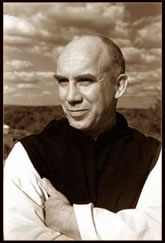
thomas merton
Whenever Griffin visited Merton, the two men often took long walks in the woods and surrounding countryside looking for objects and scenes to photograph. A letter dated Dec. 12, 1966, refers to pictures Merton took of tree roots. “I signed them as you requested, and have sent back the ones you want,” he wrote to Griffin. “They are really splendid. I find myself wondering if I took such pictures.”
His life at Gethsemani was isolated, yet he became friends with another most unusual photographer, Ralph Eugene Meatyard, who had photographed Merton and who lived in Louisville. Meatyard had already achieved great recognition as an exceptionally original and brilliant photographer. He was also interested in Zen, and he took many mysterious, haunting photographs of Merton. They exchanged 16 letters. Meatyard was not, unlike most people, awed by Merton’s reputation, and he seemed to see the man whole: “[I was] photographing a Kierkegaard who was a fan of Mad [magazine]; a Zen adept and hermit who droooled over hospital nurses with a cute behind…a man of accomplished self-descipline who sometimes acted like a 10 year old with an unlimited charge account at a candy store.”
 One of Merton’s most personal photographs from that period is called “The Sky Hook.” He wrote that the picture “is the only known photograph of God.” The picture’s composition is balanced between material and non-material space, cut through the center from the top by a steel hook, curled toward the sky–empty–holding nothing.
In January, 1968, Merton wrote to Griffin, “Unfortunately, the old Rolleiflex is just falling apart…. I guess the old box is shot.I ought to seriously consider your offer. It is justifiable for me to have a camera, since I do occasionally sell a picture and it is not just diddling.” When the new camera arrived, he wrote: “What a thing to have around. I will take reverent care of it.” In the same letter, he made a prophetic statement: “I will take good care to see that it goes straight back to you if anything happens to me.” Nine months later, Merton would die of electrocution in a freak accident in Bangkok.
Merton’s Asian pilgrimage had been an evolving dream, perhaps beginning with his earliest letteers to D. T. Suzuki,whom he corresponded with in the late 1950s. In one of his first letters to Suzuki, he included a picture of himself. “There is no law against my visiting Japan in the form of a picture,” he wrote. A few days before Merton left for Asia in 1968, he had put the final touches on his manuscript for Zen and the Birds of Appetite, which is still an elegant introduciton to Zen and to the similarities and differences between Christianity and Zen, and how the two paths may merge. In the book, Merton quoted Shen Hui: “The true seeing is when there is no seeing.”
Prior to leaving Gethsemani, he wrote in his journal: “I am going home, to the home where I have never been in this body….” He had a stopover in Bangkok for three days before flying to Calcutta and then New Delhi. On Nov. 1, he was in Dharamsala where he met with the Dalai Lama three times. Later, near Darjeeling, he met Chatral Rimpoche, a lama who had meditated extensively for more than 30 years, and who, for Merton, “was the greatest rimpoche I have met so far.”They talked for more than two hours, always coming back to dzogchen (Zen). Upon leaving, they had “a kind of compact that we would both do our best to make it [“complete Buddhahood”] in this life.”
His diary entries during the next days are full of descriptions of the act of seeing new cities, new landscapes and new people. After viewing nearby Mount Kanchenjunga, which seemed to both repel and attract him at the same time, Merton made notes about its powerful force of nature. Kanchenjunga had been constantly surrounded by clouds, revealing itself to him only grudgingly. One night Merton dreamed about the mountain, pure white, and a voice said, “There is another side to the mountain.” He then realized, in the dream, that he was seeing the mountain from the other side and that, : “That is only side worth seeing.”––an image that parallels the concept that the true nature of reality cannot be experienced dualistically, but only through a unitive state of emptiness and limitlessness.
His diary entries during the next days are full of descriptions of the act of seeing new cities, new landscapes and new people. After viewing nearby Mount Kanchenjunga, which seemed to both repel and attract him at the same time, Merton made notes about its powerful force of nature. Kanchenjunga had been constantly surrounded by clouds, revealing itself to him only grudgingly. One night Merton dreamed about the mountain, pure white, and a voice said, “There is another side to the mountain.” He then realized, in the dream, that he was seeing the mountain from the other side and that, : “That is only side worth seeing.”––an image that parallels the concept that the true nature of reality cannot be experienced dualistically, but only through a unitive state of emptiness and limitlessness.
Over the next few days his diary entries are discerning analyses of the processes of discrimination and the subject-object dance of mind. Describing his feelings about his frustrating attempts to photograph the mountain while it was shrouded in clouds, he wrote:
“I took three more photos of the mountain. An act of reconciliation? No. A camera cannot reconcile one with anything. Nor can it see a real mountain. The camera does not know what it takes: It captures the materials with which you reconstruct––not so much what you saw as what you thought you saw.
“Hence, the best photography is aware – mindful, of illusion and the uses of illusion–permitting and encouraging it – especially unconscious (and powerful) illusions that are not normally admitted on the scene.” The last reflection is an affirmation that the photographic process of seeing has the potential–at least for some people –to be a powerful stimulant to the unconscious.
Finally, the clouds lifted from around Kanchenjunga. Merton wrote: “The full beauty of the mountain is not seen until you too consent to the impossible paradox: it is and is not. When nothing more needs to be said, the smoke of ideas clears, the mountain is seen.” *Footnote 1
After completing his visit to Mount Kanchenjunga, Merton returned briefly to Calcutta where a package of his contact prints from Griffin awaited him. “The one of the Dalai Lama is especially good,” Merton wrote. He arrived in Kandy, Ceylon (Sri Lanka), on Dec. 2 and a car took him to Polonnaruwa, the site of an assemblage of large stone Buddhas carved out of a hillside, and “the most impressive things I have seen in Asia.”
Two days later, he wrote in his diary, “Polonnaruwa was such an experience that I could not write hastily of it and cannot write now, or not at all adequately.” During the visit, Merton’s spirit seemed to have opened to the point of bursting forth upon seeing the languid, relaxed forms of the Buddhas in peaceful repose.
“I was knocked over with a rush of relief and thankfulness at the obvious clarity of the figures, out of the habitual, half-tied vision of things, and an inner clearness, clarity, as if exploding from the rocks themselves, became evident and obvious. I don’t know when in my life I have ever had such a sense of beauty and spiritual validity running together in one aesthetic illumination. I mean I know and have seen what I was obscurely looking for. I don’t know what else remains, but I have now seen and have pierced through the surface and have got beyond the shadow and the disguise.”

buddha sculpture in Polonnaruwa
Merton’s widely discussed Polonnaruwa diary entry describes an overwhelming moment loaded with the nuances of Zen experince. In Zen, such moments are sometimes of such depth that they are called kensho experiences, a moment in which one experiences–in Zen terms– the ground of being. Earlier, Merton, in trying to find an equivalent phrase for kensho in Christian terms, in his conclusion to Zen and the Birds of Appetite, suggested “divine grace,” or “perfect clarity.” Zen history is full of stories recording moments when a particular sight of an object strikes a cord in the seer, snapping the ordinary relationship between seer and seen. The physical presence of the large reclining Buddhas seemed to have touched Merton at this deepest level. He wrote in his journal:
“Looking at these figures I was suddenly, almost forcibly, jerked clean out of the habitual, half-tied vision of things, and an inner clearness, clarity, as if exploding from the rocks themselves, became evident and obvious….The things about all this is that there is no puzzle, no problem, and really no “mystery.” All problems are resolved and everything is clear, simply because what matteris is clear. The rock, all matter, all life, is charged with dharmakaya…everything is emptiness and everything is compassion. I don’t know when in my life I have every had such a sense of beauty and spiritual validity running together in one aesthetic illumination.”
This illumination came a week before his death. On Dec., 7, he arrived in Bangkok, where he was scheduled to deliver a paper titled “Marxism and Monastic Perspectives” at a religious conference at the Red Cross Center on the outskirts of town. He stayed at the renowned Oriental Hotel, known for its association with writers traveling through Asia. From his hotel room window, Merton took his last photograph, which looked out through the room’s window onto Thailand’s sacred Chao Prayo River and a section Bangkok lining the other side of the river. Later, he took nine rolls of exposed film to the nearby Borneo Studio on Silom Road. After his death, Griffin wrote to the photographic studio, obtained the rolls of film, and found the window photograph, the last picture on the last role of file exposed. It is a simple, ordinary, yet–for me–haunting image. I can only attempt to touch on the power that resonates around the photophraph by referring to a dream recorded by Merton in Conjectures of a Guilty Bystander, and then to an early essay by one of his early Buddhist mentors, D.T. Suzuki.
Merton described his dream: “I dreamt I was lost in a great city and was walking toward the center without quite knowing where I was going. Suddenly, I came to a dead end, but on a height, looking at a great bay, an arm of the harbor. I saw a whole section of the city spread out before me on the hills covered with a light snow, and realized that, though I had far to go, I knew where I was: because in this city there are two arms of the harbor and they help you to find your way, as you are always encountering them.”
Suzuki also used a window image in a short essay he read on the “Supreme Spiritual Ideal” before the World Congress of Faiths, an assembly of religious leaders, in London in 1936. Suzuki began the essay with a description of his home in Japan and his windows looking out into his garden. He made the point that in Japan when windows are opened, very often “one side of the house is entirely taken away….There is no division between the house and the garden. The garden is a house and the house is a garden; but here [in England] a house is quite separate. A house stands by itself, and so does its occupant. There is nature, here I am; you are you, I am I; so there does not seem to be any connection between those two–– nature, natural surroundings and the occupants of the house.”

thomas merton
Suzuki ended his essay by referring to Chao Chou’s stone bridge [Case No.42 in The Blue Cliff Record] and the awareness of being thankful that all things and beings are passing over the bridge at every moment “from the beginningless past to the endless future.”
On the day Merton died, Dec.10, 1968, he read his conference paper at the Red Cross center and afterwards retired to rest in a cottage on the grounds. His body was found about two hours later. Apparently, after taking a shower he had reached for a large standing fan and was electrocuted. The fan was found lying across his body.
Merton would have relished the poetic irony that can be read into his final photograph, a view of the Chao Phaya River. The photograph closely mirrored his earlier dream image––the “snow” being replaced by a tropical day, a “bay” by a river and the “two arms of the harbor [the relative and the absolute]” by the two banks of the sacred river. It is easy to make too much––or perhaps not enough––from the above description and speculation.
This is only my personal reading of Merton’s spiritual journey during his Asian pilgrimage, and the role of vision in his meditative life. No one will ever know for sure the dimension of his spiritual experience and awakening in Asia, except through his words and photographs. But it is clear that Merton, one of the 20th century’s greatest spiritual souls, had ultimate respect for the beauty and mystery of seeing and experiencing the world as it is, and for the mysterious space that unites the seer and the seen.
But that is not the end of the story. There’s one more photograph, a photograph of Thomas Merton. While Merton was in Darjeeling and experiencing his on-and-off-again affair with Mount Kanghenjunga, he was staying as a guest in a house on a tea plantation. The owner had allowed Thugsey Rinpoche to build a hermitage monastery in the forest near the plantation. The story goes that after Merton’s death, his friend, Harold Talbott, saw the rinpoche, who asked him for a photograph of Merton. Asked why, the rinpoche said Merton had liked the hermitage, and he wanted to put a photograph of Merton on a shrine and say prayers to encourage him to take rebirth as a monk at the hermitage. Time passed. Later, Talbott asked the rinpoche about Merton. “He is here, but I can’t say anything more,” said Thugsey Rinpoche.
Footnote 1: That Merton’s visual intellect was brilliant can be seen in an earlier passage from his Conjectures of a Guilty Bystander: “Nothing resembles substance less than its shadow. To convey the meaning of something substantial you have to use not a shadow but a sign, not the imitation but the image. The image is a new and different reality, and of course it does not convey an impression of some object, but the mind of the subject: and that is something else again.”
gary snyder: Danger on Peaks
Posted: May 13, 2010 Filed under: buddhism, people, poetry, reviews, writing Leave a commentThis review appeared in The Kyoto Journal:
Gary Snyder: Danger on Peaks
By Roy Hamric
“There is a point you can make that anything looked at with love and attention becomes very interesting,” – Gary Snyder. *
Gary Snyder’s Danger On Peaks, his 10th book of poetry, is further proof that since he first published Rip Rap in 1959 we’ve been in the midst of a rare weaving of life and art.
In a few more decades, it will probably be clear that Snyder has claimed the role of world icon of American poetry, bridging East and West, and his life will be a potent force as a model of committment to community and the natural world.
But what will become even clearer is that Snyder’s closest peers are not only Han Shan, Stonehouse, Bassho, Ikkyu and the other red-blooded, Zen poets whose voices Snyder has extended into modern times, but also Thoreau, William Carlos Williams, Wallace Stephens and his close fellow Beat poets.

gary snyder
Snyder’s cultural impact in America and beyond has been two-fold – practically useful and spiritually useful, in the sense of giving coming generations a model of creative responsibility and right thinking. Over time, my feeling is that his poetic and social influence will likely trump even Thoreau’s place as a writer and man of nature. It will, at the least, be seen as a twentieth century extension of Thoreau’s fierce independence of nature. Such is Snyder’s accomplishment since his famous reading at the Six Gallery in San Francisco 50 years ago.
Danger On Peaks is probably the most free and personal of his poetry books so far. It’s not Old Man Snyder’s wisdom finally revealed, but it is wise. In his poetry, he’s never preached. Each poem hoes the Zen line in each line – naming and pointing. Simple, and yet…
Snyder’s poetry, even for America, is rigorous and hardy, a West Coast counterpart to a venerable American-consciousness lineage, inaugurated by Emerson. And yet, Snyder is also a true man of Zen. How the two esthetics mix is up to each reader to decide. But by looking at his poetry and his writing about poetry, we do get a clearer understanding of his art.
For starters, go back to a criticism that Emerson made, measuring the poets of his day. He said poetry should be written so that meaning trumps meter, which is not to say that poetry should be without meter. Real meaning must carry the day. But what is real meaning? Beside Emerson’s esthetic, which he struggled to apply in his own poetry, largely unsuccessfully, let’s place a question Snyder asked in an essay in A Sense of Place: “Is art an imposition of order on chaotic nature, or is art [also read language] a matter of discovering the grain of things, of uncovering the measured chaos that structures the natural world?” Add to that his view that the world is itself an on-going “making poem,” and we’re off into new esthetic territory. Snyder has laid down markers on how and why his poetry works. Naturally, it is closely linked to his spiritual search, which eventually led him, in 1956, to Zen practice in Kyoto. Extended zazen practice makes one extra sensitive to the role of words and language and their effects on mind. From there, it’s a small step to see the practice of poetry as words that find their right place, which approach consciousness, rather than are made by consciousness.
Snyder would, of course, cringe at being called a Zen poet. He is a poet in the fullest sense, writing in an American-Asian poetry lineage of anti-romanticism and modernism –no matter how far back Zen poetry extends in historical time, it is esthetically modern because it doesn’t rely on symbolic, theological or mythological influences.
Before he had met Allen Ginsberg and Jack Kerouac and before he had arrived in Kyoto, Snyder, at age 24, had already seen his course: in a letter to his Buddhist pal PhilipWhalen in1954, fives years before Rip Rap was published, he wrote:
“I come to think more and more, poetry is a process and should be, in a Buddhist sort of way, didactic and sensual.” It all comes down to that: a poetry of attention, almost invisibly instructive, and usually without a pronounced message – a fundamental reliance on words and ordinary reality to carry the “message” rather than tropes or symbols. Let “just that” create the meaning, thank you. The world “making” itself through open mind. The wise and instinctive will see.
While this is an old chestnut in Zen, it was no small feat for an unpublished, young American poet to base his esthetics on – “just that,” freshly seen and vividly laid down.
Snyder has always been wisely reticent in talking about his Zen practice. If we are lucky, though, we someday will get an autobiographical account of his Zen journey, and the people in his life.
In his Paris Review interview in 1992, he speculated a little on the role of zazen in his poetry.
“This taught me something about the nature of thought, and it led me to the conclusion – in spite of some linguists and literary theorists of the French ilk – that language is not where we start thinking. We think before language, and thought images come into language at a certain point. We have fundamental thought processes that are prelinguistic. Some of my poetry reaches back to that.”
Again, in an essay, “Language Goes Two Ways,” in A Place in Space, he talked about, “The way to see with language, to be free with it and to find it a vehicle of self-transcending insight, is to know both mind and language extremely well and to play with their many possibilities without any special attachment. In doing this, a language yields up surprises and angles that amaze us and that can lead back to unmediated, direct experience.” He went on to say, “But, creativity is not a unique, singular, godlike act of ‘making something.’ It is born of being deeply immersed in what is – and then seeing the overlooked connections, tensions, resonances, shadows, reversals, retellings. What comes forth is new.”
The book is composed of six sections. Part one opens with a series of poems built around Snyder’s 1945 ascent of Mt. St. Helens (the year of Hiroshima) and its later eruption in 1980. The book ends in the period of 9/11 and the destruction of the carved Buddhas of Bamiyan Valley by the Taliban in Afghanistan. Between, we get a full range of auto-biographical moments, (truck stops, freeways, community workshops), glimpses of the natural world (mountains, rivers, fields, fauna), home life in the foothills of the San Juan Mountains, epiphanies, memories of earlier life, loves, the rhythm of friendship, his mother, assorted prose and haiku combinations and a final blessing gatha.
Here’s a sample of three short poems of the 97 poems that make up the book – many long, complex and demanding of multiple readings:
Steady, They Say
Clambering up the rocks of a dry wash gully,
Warped sandstone, by the San Juan River,
look north to stony mountains
shifting clouds and sun
– despair at how the human world goes down
Consult my old advisers
“steady,” they say
“today”
Work Day
They want –
Short lengths of 1” schedule 40 PVC
A 10’ chimney sweeping brush
Someone to grind the mower blades
A log chain,
My neighbors’ Spring Work
Chainsaw dust
Clay-clod stuck spade
Apple blossoms and bees
April Calls and Colors
Green steel waste bins
flapping black plastic lids
gobbling flattened cardboard,
far off, a backup beeper.
Like the coyote, the Native American symbol Snyder helped to put back into public consciousness in the early 60s, he has assumed many roles: mountain lookout, sailor, poet, translator, Buddhist, life-long meditator, counter-culture hero, essayist, agitator, government official and academic, while always casting a calm Bodhisattva aura as a worker for a better world.
This book is a hearty gift, another testament of art and faith from a rare talent. The poems show us again that the world of art and artful living is here now before our eyes and ears. Only the bravest poets have the confidence and mastery to rely on the ordinary to achieve the extraordinary. Traditionally, that has been the work of religious teachers.
Finally, here’s Snyder himself, as poet, on the mystery of mind and poetry:
How Poetry Comes to Me
It comes blundering over the
Boulders at night, it stays
Frightened outside the
Range of my campfire
I go to meet it at the
Edge of the light
*Paris Review Interview, 1992.
answering the koan
Posted: May 12, 2010 Filed under: buddhism, people, poetry, states of mind, Uncategorized Leave a commentDavid Rothenberg’s Blue Cliff Record: Zen Echoes tries to cut the koan knot in The Blue Cliff Record. My review appeared in The Kyoto Journal.
bagan, myanmar
Posted: May 9, 2010 Filed under: buddhism, photography, places Leave a comment
Bagan temples are spread out across a vast valley, now largely unpopulated.
I ‘m posting this picture of temples in Bagan, Myanmar, in order to create a blog link to a pdf which will give me a wordpress link and then I can post it under my On the Record stories using the wordpress link. Learning the ins and outs of blogging looked fairly easy, and it’s turning out to be so. Anyway, you can click on the Bagan listing in On the Record to read a story about one of Asia’s most spectacular sites of Buddhist temples, comparable to Angkor Wat. Bagan, unlike Angkor, is in jeopardy.
poem for red pine
Posted: May 7, 2010 Filed under: buddhism, poetry, writing Leave a comment
Bill Porter went West, took a new name––and came back from the East to spread the word.
A master of the shadow art, he trails behind, recasting Chinese ideograms into new lines for English minds.
He works from a second floor study in Port Townsend, deciphering black strokes from faraway days with sharp eyes, diamond mind––a time when hearts burned: writers of the Silent Word.
On the wall, a Tibetan tanka, and a small painting of bamboo with a poem by Wang Wei.
Through a window, the Cascade Mountains. Through another window, the ocean. Through another window, the branch of a plum tree.
Pine trees and bamboo sway in the morning wind.
Light brightens a new day as the pine tree’s shadow disappear, leaving no trace.
sumano’s poem
Posted: April 26, 2010 Filed under: buddhism, poetry, states of mind, writing Leave a commentSumano, an American Buddhist monk, has lived in a cave in the Khao Yai mountains east of Bangkok for nearly 20 years. Of his four or five books, the best known is Questions from the City, Answers from the Forest (which should be reprinted). He just published his translation of three dharma talks by Achan Tate, one of the great teachers from the Thudong (Wandering Monk) lineage of northeast Thailand. This is Sumano’s poem, used as a foreword in the Tate book. To see his website, click here.
The Way Things Are
If you realize that all things change, there is nothing you will try to hold on to.
If you aren’t afraid of dying, there is nothing you can’t achieve.
If you want to shrink something, you must first allow it to expand.
If you want to get rid of something, you must first allow it to flourish.
If you want to take something, you must first allow it to be given.
This is called the subtle perception of the way things are. The soft overcomes the hard. The slow overcomes the fast.
Let your workings remain a mystery; Just show people the results.
True words aren’t eloquent; Eloquent words aren’t true.
Wise men don’t need to prove their point; If you look to others for fulfillment, you will never truly be fulfilled.
If your happiness depends on money, you will never be happy with yourself.
Be content with what you have; Rejoice in the way things are.
When you realize there is nothing lacking, the whole world belongs to you.
the junkman
Posted: April 16, 2010 Filed under: articles, buddhism, people, places Leave a commentThe Songkran water festival is over, and street life returns to normal. The neighborhood’s singing junkman peddles by on his tricycle with the first of the morning’s cast-offs culled from his rounds, a Thai flag fluttering in the breeze behind the cart that overflows with oddities, a single plastic leg, a motorcycle wheel, bright scraps of cloth, a few water gun rifles and pistols, some clay pots. He has a handsome movie star Western face, confident, secure. It says, “I’m a loner. I love my life.” He uses his time efficiently, always busy, resourceful. By evening, he’s parked beside Heaven’s Beach, the local Rasta bar, and the cart is a rolling found-art exhibit, its sides covered with his neat, handwritten Thai script quoting Buddhist aphorisms: Silence Speaks Loudly, Think Like a Flower, A Strong Tree has Deep Roots.
 the roy hamric journal
