
Lonn Taylor’s Colbert Report Appearance
Posted: September 25, 2014 Filed under: articles, people, writing Leave a comment On Sept. 11, the great Lonn Taylor, my friend from Fort Davis, Texas, was on The Colbert Report talking about the 200th anniversary of The Star-Spangled Banner. He had a great time… Here’s his weekly newspaper column recounting his experience. He had never heard of Steve Colbert before he was contacted by the show’s producer.
September 25, 2014
The Rambling Boy Column
By LONN TAYLOR
Andy Warhol (or perhaps Marshall McLuhan; there is disagreement about who originated the phrase) said, “In the future, everyone will be famous for fifteen minutes.”
On September 11 I was famous for six and a half minutes, so I still have eight and a half-minutes coming to me. That night 1.2 million people watched me explain to Stephen Colbert why Francis Scott Key was on a sloop in the Patapsco River watching the British fleet bombard Fort McHenry 200 years ago and how he happened the next morning to jot down a poem that became our national anthem, “The Star-Spangled Banner.” I had written a book on the subject in 2000, and someone connected with the Colbert Report had found the book and invited me to appear on the show to help commemorate the bicentennial of our national anthem.
The call with the invitation came in late May. I have to confess that at the time I had never heard of Stephen Colbert or the Colbert Report. We do not have a television set and I really only watch television on election night and during the Miss America contest. Fortunately, my wife, Dedie, took the call and briefed me before I called back, so I did not sound like a total idiot to the producer I talked with.
Over the next three months I watched a lot of clips of the Colbert Report. The more I watched the more nervous I became. Colbert seemed irreverent, frenetic, and acerbic, someone who asked questions and didn’t listen to the answers but simply tried to score off his guests. I decided that it was going to be like being interviewed by Vance Knowles in his Jackie Pepper persona. By the time Dedie and I left for New York I was a nervous wreck. About a week before we departed Emily Lazar, the executive producer of the show, called me and spent half an hour rehearsing me on the phone, reading me a series of questions that she said were similar to those that Colbert would ask. She advised me to have three or four things in my head that I could talk about if the interview seemed to drag. I got on the plane running these little speeches through my head.
All of my fretting proved to be for naught. The show, which runs at 11:30 P.M. in New York, is taped before a live audience between 7:30 and 8:30 P.M. A limousine picked us up at our hotel at 6:30 and took us to the studio, where a young woman met us at the curb and showed us to a private green room with my name on the door. The room was furnished with sofas and plates of fruit and cheese were on a table. Henry Kissinger had occupied the room the previous evening and I signed the guest book just below his name.
Colbert came in just as we got settled and introduced himself. He explained that he was going to interview me in character, and that his character was that of a dumb right-wing idiot and that I should not take offense at anything he said. He was not intimidating at all; in fact was a most gracious host. After he left Emily Lazar came in and said they had now refined the script and she could run through the questions Colbert was likely to ask, although she also said that it was impossible to predict what he might do on camera. We went through another series of questions and she left the typed script with me. I was made up, a microphone was attached to my lapel, and I was led through a maze of cables and cameras to the set and seated at the interview table. The camera swung around, the lights came on, Colbert jumped up from his desk, introduced me, strode over to the table, shook hands, and we started talking. Six and a half minutes later it was over, and I realized that he had asked none of the questions that were in the script, had made no insulting remarks, and had not interrupted me once. I also realized that I had just had a wonderful time.
The television audience did not see the best part of the show. During the warm-up period, when Colbert was exchanging remarks with the studio audience, a young man wearing a Northwestern University t-shirt stood up and said that he was a student at Northwestern and that the Northwestern Dance Marathon, the annual student charity event, was coming up. He knew that Colbert was a Northwestern alumnus and he wondered if Colbert could work a mention of the dance marathon into tonight’s show?
Colbert thought a minute and said, “We’ll do something better than that. Come down front after the show.” When the taping was over Colbert called the young man down to the stage and explained that they were going to slow dance together, and that when they started the camera would be on the student’s face but as they turned it would reveal that he was dancing with Colbert. Colbert took the young man in his arms and they danced several steps and turned, and Colbert looked into the camera and said “Northwestern University . . . Dance Marathon,” providing Northwestern with an invaluable film clip to use in promoting the marathon.
With 1.2 million people watching I was sure that I would be stopped on the sidewalk the next day by people wanting autographs. It took 2 ½ days for it to happen, and it wasn’t an autograph. Dedie and I were waiting for a table for Sunday lunch at the Café Luxembourg on 70th Street when a young man leaving the restaurant stopped and said, “Aren’t you the historian I saw on the Colbert Report Thursday night?” I allowed that I was and he said, “Wow. You were really interesting. We’re studying Francis Scott Key in our Bible study class.” I’m still trying to figure that out.
I want to thank all of my friends who sent e-mails saying that they had enjoyed the show, and especially all of those folks who went to the Crowley Theater to watch it at the ungodly hour of 10:30 P.M. The fact that I knew that you were watching kept me from being completely tongue-tied.
Lonn Taylor is a historian and writer who lives in Fort Davis. He can be reached at taylorw@fortdavis.net. Email Taylor to be placed on the column’s mailing list.
For Ikkyu
Posted: September 7, 2014 Filed under: buddhism, people, poetry, states of mind, writing Leave a comment
Spoon strikes cup,
Sound made flesh
Each time the door opens
Something is given and given up
Upon waking: The corpse dances
In the empty casket
Rock on the ground
Moon in the cosmos –
Breathe this.
Ernest Hemingway: Revealing, New Edition of The Sun Also Rises
Posted: August 31, 2014 Filed under: people, writing Leave a comment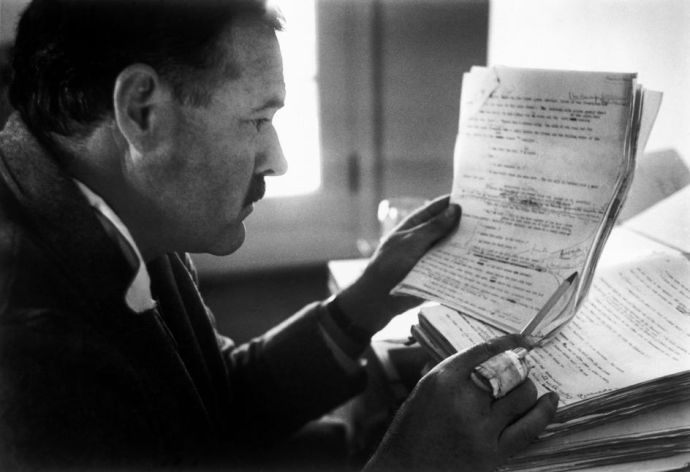
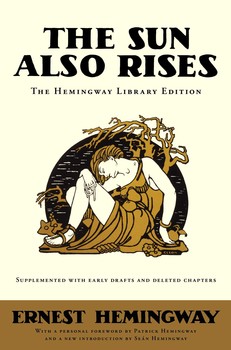
Simon & Schuster has published a new edition of Hemingway’s first novel, which includes generous portions of early drafts, deleted passages, and self-musings about the role of the author’s voice in a novel. Here’s an article from The New Yorker looking at how the editing process, with crucial suggestions from Scott Fitzgerald, saved the book’s structure and offered warnings about inserting Hemingway’s authorial presence directly into the story.
Confucius: Rectify The Language
Posted: July 20, 2014 Filed under: articles, books, people, writing Leave a comment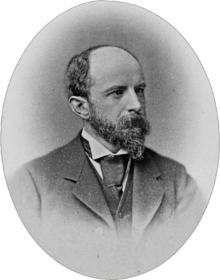
Henry Brooks Adams (February 16, 1838 – March 27, 1918) was an American historian and member of the Adams political family, being descended from two U.S. Presidents.
I’ve still not let go of reading and rereading new and old essays of Vidal. He’s fearsomely prescient and usually right in interpreting US history and forecasting where the world is heading, in some cases fully 40-50 years before recent events and popular opinion confirmed and caught up with him. Here he is in the essay “The Day the Amercan Empire Ran Out of Gas (1986)” from Imperial America: Reflections on the United States of Amnesia (2004).
“When Confucius was asked what would be the first thing he would do if he were asked to lead the state – a never-to-be-fulfilled dream – he said, ‘Rectify the language.’ This is wise. This is subtle. As societies grow decadent, the language grows decadent too. Words are used to disguise, not to illuminate, action: You liberate a city by destroying it. Words are used to confuse so that at election time people will solemnly vote against their interests. Finally, words must be so twisted as to justify an empire that has now ceased to exist, much less make sense. Is rectification of our system possible for us? Henry Adams thought not. In 1910, he wrote: ‘The whole fabric of society will go to wrack if we really lay hands of reform on our rotten institutions.’ Then he added: ‘The whole system is a fraud, all of us know it, labourers and capitalists alike, and all of us are consenting parties to it.'”
Is it really too late to right the system more towards the people rather than the oligarchical class? I hope not, but certainly effort is all and it could make a difference as it has throughout America’s history. US history is nothing if not a sustained attempt by hardy souls to come closer to a more egalitarian, just society not controlled by an elite, wealthy oligarchical class. A wise Jewish saying from The Sayings of the Fathers, a compilation of the ethical teachings and maxims of the Rabbis of the Mishnaic period, offers sage advice:
“It is not your responsibility to finish the work of perfecting the world, but you are not free to desist from it either.” – Rabbi Tarfon, Pirke Avot 2:21.
Wislawa Szymborska: Where Were You When I Needed You?
Posted: July 11, 2014 Filed under: people, poetry, states of mind, writing 3 Comments
A Poem
By Wisława Szymborska
Nothingness unseamed itself for me too.
It turned itself wrong side out.
How on earth did I end up here—
head to toe among the planets,
without a clue how I used not to be.
O you, encountered here and loved here,
I can only guess, my arm on yours,
how much vacancy on that side went to make us,
how much silence there for one lone cricket here,
how much nonmeadow for a single sprig of sorrel,
and sun after darknesses in a drop of dew
as repayment—for what boundless droughts?
Starry willy-nilly! Local in reverse!
Stretched out in curvatures, weights, roughnesses, and motions!
Time out from infinity for endless sky!
Relief from nonspace in a shivering birch tree’s shape!
Now or never wind will stir a cloud,
since wind is exactly what won’t blow there.
And a beetle hits the trail in a witness’s dark suit,
testifying to the long wait for a short life.
And it so happened that I’m here with you.
And I really see nothing
usual in that.
—Translated from the Polish by Clare Cavanagh
“The world — whatever we might think when terrified by its vastness and our own impotence, or embittered by its indifference to individual suffering, of people, animals, and perhaps even plants, for why are we so sure that plants feel no pain; whatever we might think of its expanses pierced by the rays of stars surrounded by planets we’ve just begun to discover, planets already dead? still dead? we just don’t know; whatever we might think of this measureless theater to which we’ve got reserved tickets, but tickets whose lifespan is laughably short, bounded as it is by two arbitrary dates; whatever else we might think of this world — it is astonishing.” – Wisława Szymborska (died February 11, 2012).

Notes for a Jim Harrison Interview
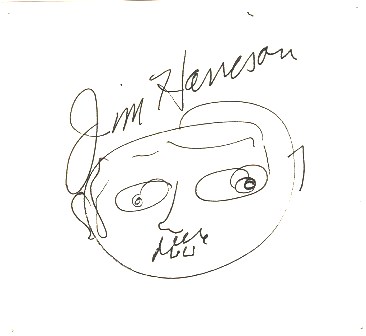
Posted: July 4, 2014 Filed under: books, interviews, people, writing Leave a commentNotes for a prelude to an earlier Q&A interview with poet and novelist Jim Harrison:
“Jim –
“Like a diving board, these questions are meant as jumping-off points. They await your exotic, mid-air maneuvering; no-splash 10-pointers; or massive cannonballs of spray washing the sun-block off the babes at the edge of the pool…
“…Harrison’s warm-blooded media personae sprang from his natural swagger and wit… his love of art, stories, food, drink and a Dionysian-courting of the Word. Like Falstaff, he chose Life as the answer to the question. Wisdom sprang from the tested, hard-earned lessons of walking back-and-forth on Blake’s Road of Excess. Throughout, he followed – most closely –his self-anointed gods on earth, the whispering spirits, the woods and fields, the animals, the birds, the rivers and mountains. True writers and poets read his work as transfusions of the Blood of Art. But again, dim-witted people misread his novels, believing his outlying, brutish, alpha male characters are stand-ins for Harrison rather than witty, ironic metaphors for escaping a life of entrapment – a life in which true consciousness is foreign and forever unapproachable instead of native.”
The Third Culture: Writers Respond to Steven Pinker’s Ideas
Posted: July 3, 2014 Filed under: articles, books, people, writing Leave a comment Steven Pinker’s book on writing, The Sense of Style, to be released in September, (see his article below on my blog) will be like beating a hornet’s nest with a big stick. He’s eager to carve out a space for the sciences in serious literary writing, now largely found in the humanities. In fact, a crop of scientists has been turning out books of high literary merit based on conveying key scientific discoveries and truths. Crudely put, he also feels that the humanities approach should be broader and deeper, precisely because it has failed to incorporate the vast knowledge about people and Nature that’s available through science.
A recent column in The Guardian by Oliver Burkeman got on the Pinker bandwagon, quoting just a few of his suggestions on what makes good writing today. Ouch! Readers’ responses were fast and combative all round. This is just the beginning… It shows how much people are vested in the art of writing, creativity, the values of science – and how to make recent theories and knowledge more available to readers in both the humanist and scientific camps (and perhaps more importantly the general reader). The real effort is to bridge the two camps with each camp freely using the best techniques and knowledge accrued over time.
C.P. Snow, of course, broke this ground in 1959 in his The Two Cultures lecture, setting off the debate that’s still ongoing, leading to the “Third Culture” concept which combines the best of both camps and is perhaps best exemplified by The Edge website, an ongoing dialogue between the two camps.
 Any discussion that sheds more light on what makes good writing is a good thing. Of course, it can’t be distilled into “rules,” but that shortsighted approach will disappear in the doing, especially for the truly creative novelist or poet who starts with a single thread and, miraculously, stitches together a coat of many colors which reflects a slice of real life. Science, at its best, probes for the truths of Life using scientific techniques and tools. Creative writers and artists seek to touch the same ground through the exploration of individual spirit and esthetic techniques.
For a much deeper look at these two approaches and the fascinating merging that’s underway, see this exceptional article by Hong-Sho Teng, an English professor at National Taitung University in Taiwan. It was originally published in Chinese in The China Times Book Review.
To paraphrase his thesis: “”We are going to die, and that makes us the lucky ones. Most people are never going to die because they are never going to be born.’” This passage is not from [James] Joyce, but from [scientist Richard] Dawkins’s Unweaving the Rainbow. A modern protégé of Darwin, Dawkin’s borrows Keats’s idea, from the poem Lamia, which accused science of ruining nature’s beauty in order to reveal in turn the beauty in science and the aesthetics of scientific endeavors. Dawkin’s of course holds that science can increase an artist’s appreciation of Beauty. In contrast to the eloquent science writers (think Edwin O. Wilson, and earlier Loren Eisley), traditional humanities scholars and authors are in danger of being marginalized. In May, English writer Will Self gave a talk in Oxford entitled “The novel is dead (this time it’s for real),” clearly echoing the predicament of contemporary novelists. Following the 20th Century legacy of public intellectuals like Edward Said, Hong-Sho says literary writers must take the next step forward to encourage a new generation … in order to lead the humanities [read writers of all types] into participation in cross-boundary dialogues in the third culture. While science speaks to a “rainbow of knowledge,” he says, there must be clouds on both sides of the rainbow’s”bridge” that, however evanescent, will form a third culture.
Below is a letter from astronomer Carl Sagan and his collaborator, Ann Druyan. They knew how to write and tell a good story. Their books about the Universe revealed how science and the human spirit of discovery go hand in hand.

See the comments below in response to The Guardian column on Pinker’s upcoming book. They underscore how people are vested in ideas about writing well:
“24 comments:
“It ain’t whatcha write, it’s the way atcha write it.” —Jack Kerouac
LilywhiteGirl 28 June 2014 11:34am
Just write however the hell you want to write. Being passionate about it is what’s important; if you lose that passion there’s no point bothering because you’re just going through the motions. Oh, and never write with thoughts of the money you’ll earn; the notion of future wealth is an incredibly bad reason to be creative in any way. Plus, you’ll likely be disappointed because relatively few writers have ever been able to make a tidy living out of it. The same goes for the fame aspect of the craft. I write because I love writing – end of.
capelover LilywhiteGirl28 June 2014 12:42pm Recommend 23
I’m not sure that “end of” is a good way to end a comment on how to write well.
LilywhiteGirl capelover3
Touché. I shall now go and stand in the corner with my hands on my head until I’ve learned my lesson. *slinks off, tail between legs, hanging head in shame*
pol098LilywhiteGirl28 June 2014 1:36pm Recommend 6
”never write with thoughts of the money you’ll earn…” Well said! That’ll show that hack William Shaksper, who had a living to earn.
pol09828 June 2014 3:22pm Recommend 2
“why I’m trying to explain this to someone who can’t even spell Shakespeare is beyond me. Maybe you should have explained it to Shakeſpere himself when he signed the conveyance on his house?
LilywhiteGirl pol09828 June 2014 4:16pm Recommend 8
Yeah yeah, we all know Shakespeare spelled his name several different ways but the accepted spelling has remained the same now for centuries. It doesn’t mean I have to take your original crappy comment that completely missed the point seriously though.
tenduvets 28 June 2014 10:10pm Recommend 3
It’s the writer and reader, side by side, scanning the landscape. The reader wants to see; your job is to do the pointing. Only sometimes. And in answer to this: should you write for yourself or for an audience? The answer is “for an audience”. One word: Pepys
ID77405328 June 2014 11:56pm Recommend 7
I hope various Guardian columnists and book reviewers take this to heart since many of them are insufferable egotists more concerned with intellectual masturbation than seriously engaging with the people who buy the newspaper. Or read it for free online, in my case.
SLHenry ID77405329 June 2014 7:07am Recommend 1
Your audience just LOLed – you’re a natural writer 🙂 x
Papistpal 29 June 2014 1:52am Recommend 3
”It’s also an answer to an old question: should you write for yourself or for an audience? The answer is “for an audience”. But not to impress them. “ I write. Anyone who thinks you can decide, as if by fiat, to write to an audience, but “not to impress them,” knows nothing.
wordswort 29 June 2014 12:41pm Recommend 1
I think that Elmore Leonard’s typewriter might have been firmly between his cheeks when he wrote that ‘show, don’t tell’ advice to writers. He was probably preaching against the style of ‘girly-writing’ (not always just women) whose style evokes, in a different context, Martin Amis’s plaintive “Why are you telling me all this”? Where an effort to elevate quotidiana is simply boring, and redundant. When a character in one of those prolix, tell it all novels makes coffee, for instance, the reader ends up learning far more – to paraphrase Thurber – about coffee-making than he wants to know. A sentence, two at the most, is all that’s required; but all too often we get the painstaking and painful description of measuring the sugar, choosing a cup, stirring, sipping – all that. Leonard’s plea to cut to the chase is worth thinking about.
Comments for this discussion are now closed.”
Joseph Rakowski’s Jim Harrison Interview; Best Lately
Posted: July 1, 2014 Filed under: books, people, writing Leave a comment
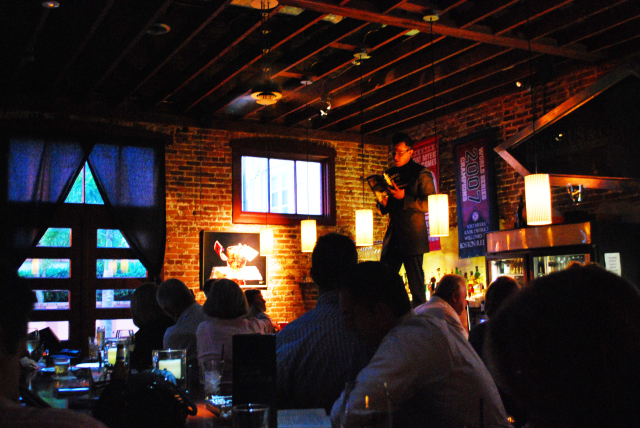
Jim Harrison’s amazing body of poems and fiction and, equally important, his way of life and mind, have a new fan, who has written one of the most interesting takes on Harrison I’ve read lately. Rakowski is a young writer whose first novel, The Delivery Cut, is in the early spirit of Thompson’s The Rum Diary, and he’s done a series of interesting reviews and interviews on the Three Guys One Book website. Here’s the first few hundred words of Rakowski’s long, perceptive review. The full story can be read here. What I like about Rakowski, besides his protective, tender response to Harrison, is this picture of Rakowski (below) reading from his novel while standing on top of a bar. Way to go…here’s Rakowski’s website
From Rakowski: “In the land of the blind, the one-eyed man is king. If you have read Jim Harrison, more than likely, you were blinded by his poetry and prose.
“I’ve heard of Jim Harrison since I was a young boy, but it wasn’t until I received a catalogue from Grove Atlantic that I sat down, away from my own selfish paperback endeavors, and decided to read nearly everything by one of the greatest American fiction writers of all time. What kind of egotistical, navel-gazing writer out there doesn’t take this opportunity? What more impetus does an aspirant literate need?
“After requesting everything Grove had to offer, I sent Copper Canyon a message requesting his poetry and hit the local library and bookstore for his earlier stuff. Within a week, I had received from Grove Atlantic Harrison’s memoir Off to the Side, his adventures as a roving gourmand The Raw and The Cooked, and his fictional novellas and novels Julip, The Summer He Didn’t Die, Returning to Earth, The English Major, The Great Leader, The River Swimmer, and Brown Dog. Copper Canyon sent me The Shape of the Journey and Songs of Unreason, nearly 600 pages of poetry. From the store, I purchased The Woman Lit by Fireflies, Dalva, Wolf and Legends of The Fall.
“Overall, the fifteen books weighed around twenty-five pounds in mental edibleness. I know because I put them on the scale at a grocery market impressed by the idea of the weight of one man’s knowledge.
“I started my journey on a plane to Boston reading his memoir and poetry. Harrison, which I will refer to intermittingly as Jim because I feel a part of his soul wove its way into mine, considers himself a poet first. It seemed like the auspicious place to start, though I am in the wolf stage of my life and Harrison is in the bear and raven.
“When I think of individual poems, I think of a completed, one or so page, story. As I finished The Shape of the Journey and Songs of Unreason, the first and last of Jim’s poetry, I realized I had not read one completed story at the ending of each poem. Instead, I’d watched as each poem escorted itself to the next, producing a book of a man’s life written doggedly over the course of his existence. Through poetry and in the beauty of morality, it was the most complete story I have ever read about a man’s life. It was chronological to the point of despair, complete to the point of tears, and maddening to the point of self-reflection.” …Continued…
Morning Practice
Posted: June 28, 2014 Filed under: buddhism, poetry, writing Leave a commentMorning Practice
When my eyes open at dawn’s light
the question naturally arises,
whose arms are these – flaccid pink
skin draping off brittle bones?
On the pillow there’s some long hairs – mine
or the two dogs, Roxy and Daisy, sleeping on
the bed? Before, the long hairs were always
a woman’s, her body pressed close
in the morning chill.
Now part of my lung is gone, infiltrated
by swarming molecules hungry to
devour my breath. It’s rationed now.
My heart beats harder to help
its neighbor. My heart’s comforting
sound fills my chest, but my morning
cough sounds like a sick man.
One beat, one breath….
Good practice for a lazy man.
As Su Tung p’o said,
“I’m a tired horse unharnessed at last.”
Minding My Time
Posted: June 27, 2014 Filed under: buddhism, poetry, states of mind, writing Leave a commentMinding My Time
Awash in mind time. Mind’s always mattering,
mothering: words, sensations, feelings always
forming stuff. Words always mattering
in Universe of Matter. That’s all (not really for
Roy & Laddawan and the Thai band playing Eric Clapton).
Mind called self is just the go-between
for no-body. Big Self mothers every thing
– knows like a bone every thing’s just co-
existing meaning-matter like mothering sky.
Right now in Chiang Mai at 1:18 a.m.
as a tiny candle lantern rises golden
in the night like a star.
 the roy hamric journal